Restoring the Ruins of Afrocentric Thought: A Rebuttal to Anthony Browder’s 5 Patterns of Historical Erasure

In a rush? Check out this 6-minute summary.

Anthony Browder recently posted to his blog a piece titled 5 Patterns of Historical Erasure That Have Hidden Africa’s Greatest Civilization in Plain Sight promoting his final two tours to Luxor, Egypt (which he calls by its ancient name Waset). Although I’m sure Mr. Browder is well-intentioned (for Black people) in writing this post, his five patterns of historical erasure are weak, ill-informed, and antiquated. Not only are some of his assertions simply not true but they speak to the lack of sophistication and intellectual integrity that plagues Black Conscious circles that keep open-minded and educated individuals from ascribing to their theories. In the post, he wishes to highlight five recurring ways an unnamed villain uses to hide African history:

  1. The Name Change Pattern
  2. The Impossible Achievement Pattern
  3. The Religious Theft Pattern
  4. The Systematic Burial Pattern
  5. The Compartmentalization Pattern

Beyond the fact that the article reads like an AI generated blog post, I will take issue with points 1, 3, 4, and 5, and the anti-intellectual dichotomy between seeing primary evidence and textbooks.

Rebuttal of #1 The Name Change Pattern

Mr. Browder contends that the name of the city of Waset was changed by “conquerors” for sinister reasons. He does not mention what those reasons were, but the reader is left to assume that the Greeks, Arabs, and (Western) Europeans wanted to make their mark on the great civilization they conquered.

His claim that the name Luxur, the European pronunciation of the Arabic name al-’Uqṣur meaning castles is the origin of the word “luxury” is false. The English word actually has two Latin roots: luxus (excess) and luxuria (offensiveness). The two meanings were merged when it reached old English. As such, the word not only meant lasciviousness, but also debauchery and adultery. Spreading the idea that the word luxury has an African origin is not only wrong, but demonstrates a lack of academic negligence on his part. Furthermore, it might lead to some cognitive dissonance for his Afrocentric constituents who may consider Arabic, the language from which the name Luxor is derived, as non-African.

What is the issue with changing the name of a place if its history is preserved anyway? Many places around the world have undergone name changes, from ancient names to modern ones and vice versa. The people that live there have a right to change the name based on their current sentiments. Oftentimes, cities built around ancient sites have boarders and residences beyond the ancient city limits. So they are not the same exact cities from ancient times. Why can’t Afrocentrists acknowledge that over time people change, languages change, cultures change, and even religions change?

Rebuttal of #3 The Religious Theft Pattern

Mr. Browder claims that religious concepts such as the Annunciation, Immaculate Conception, Virgin Birth, and the Trinity of Ausar, Auset, and Heru were carved into the ancient monuments of Luxor. However, these concepts were appropriated and then plastered over and replaced with images of Jesus Christ and the 12 disciples by something he calls the “Coptic occupation” of 450 ACE. While it is true that certain religious concepts pass from one tradition to another and that there are Christians known as Copts in Egypt, Mr. Browder’s characterization of them is completely wrong.

First, the religious and linguistic traditions from ancient Egypt have been lost for at least two millennia (the coming of the Age of Pisces according to Bernal’s explanation of Egypt’s embrace of Christianity (Bernal and Gaballa, 1987, p. 125)). The Copts are the indigenous Egyptians. In fact, the name Egypt is a modern adaption of the word Copt, which the name of an Egyptian city Qifṭ. According to Medieval sources written by Egyptians themselves, Qifṭ was an ancestor of theirs. In some sources he is considered the son of Hermes (Ibn Nadīm, 1970) and in other sources he is one of the grandchildren of Ham (Suyuti and Ibrahim, 1968, page 35-36 vol. 1).

The Copts freely embraced Christianity shortly after what they consider the ascension of Christ by St. Mark, making them one of the oldest Christian traditions in the world. The fact that Copts are indigenous to Egypt and that their church dates back to the time of Christ makes me wonder what Mr. Browder is referring to when he says “Coptic occupation” at the date of 450.
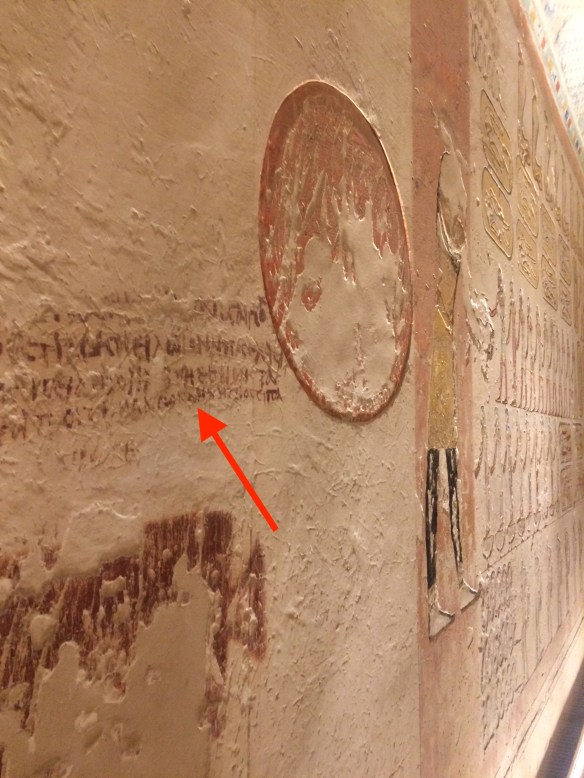
Coptic Writing from the Tombs of Dayr al-Baḥrī

Perhaps a source of confusion for him is the Roman occupation of Egypt that extended from about 30 BCE until the Arab Muslim conquest of 641 CE. During that period the Copts were oppressed by the Romans, first due to the fact that they were Christians. Then, once the Romans officially embraced Christianity, they oppressed the Coptic Christians again because they did not accept the doctrine set at the Council of Chalcedon of 451 CE. The Copts, who see their version of Christianity and language as a continuation of their ancient religion and language, fled Roman persecution in the north of Egypt and naturally took refuge in the tombs and temples of southern Egypt. They repurposed those temples as monasteries and libraries for their monks and scholars. They added writing and imagery that reflected their current beliefs to some of the temples but did not deface all of them. Or else, we would not know about the ancient writing and imagery today.

It was the Muslims who ended Roman persecution of the Copts with their conquest. There was only a small faction of Arab Muslims who conquered Egypt in the 7th century, so the Muslim majority that you find in Egypt nowadays is largely pulled from Coptic converts as well as a myriad of non-Arab, non-Coptic ethnic groups who settled in the region. While Muslim – Coptic relations were turbulent at times in their history, Coptic Christians still make up about 10% of the population. In the same vein, while neither Muslims or Christians worship at the ancient Egyptian temples, they did not set out to systematically destroy or cover them up, which I will address in the next section.

Mr. Browder’s mischaracterizations of the Copts and their religion speaks to his dearth of knowledge about the full range of Egyptian language and history. Mr. Browder and other Egyptophiles only immerse themselves in a selective part of Egyptian history, to the neglect of other parts. This would not be so bad if only they would remain silent on aspects of history they have no knowledge of. Yet, they continually adopt/concoct spurious versions of subsequent Egyptian history that has no basis in reality.

Rebuttal of #4 The Systematic Burial Pattern

With regards to Mr. Browder’s points about “systematic burial,” this is yet another mischaracterization based on an ignorance of Egyptian history, environment, religion, and sociology. One need only to look at some of the early paintings and photos of ancient Egyptian monuments to find that many of the monuments we know and love today were actually covered in sand after being unused for several hundred years. This is why they required excavations to uncover. I lived in Egypt for several years and I can attest to the fact that if you leave your home for a few days without a thorough dusting, your home can easily succumb to the same fate.

Jokes aside. Obviously, this is not what Mr. Browder means by a “systematic burial.” Rather, he speaks of the Mosque of Abū al-Ḥaggāg (which he misspells as Abu el-Haggar). When I visited Karnak, I too was surprised to find a mosque decorated with hieroglyphs on its walls sitting on top of the temples. I entered and took a tour of the mosque. Unlike Mr. Browder in his 38 years of touring Egypt, I wanted to know the history of the mosque rather than just make my own assumptions.

Prior to becoming a mosque, it was a Coptic basilica and once occupied by a Coptic woman, Therese bint al-Qums. Yūsuf ibn ʿAbd al-Raḥīm ibn ʿĪsā al-Zāhid, known as Abū al-Ḥajjāj, was a Sufi teacher from Baghdad. He moved to the area teaching Sufism and ultimately attracting most of the inhabitants to Islam (who were predominantly Coptic Christians by then). He acquired a piece of property from Therese, and his son made the basilica into a mosque after the death of his father in 1286 CE.

The mosque speaks to the continuity of socio-religious culture in Luxor rather than “systematic burial.” In fact, nothing is covered up or systematically destroyed. The structure and material is actually preserved by its repurposing. This is nothing new. All over Coptic, Fatimad, Mamluk, and Ayyubid Cairo, one will find mosques, schools, and other structures used from the same materials of structures that once lay in ruins. In contrast to our present sentiments, preservation of unused structures was not always a priority for the people of Egypt. Our current-day obsession with artifacts is partially the result of the European materialist mindset that has been programmed in us, which ties civilization with advancements in technology and buildings. However, for most societies it appears that preservation of culture and traditions takes a higher priority, even after their material wealth and imperial power diminishes and their religion and language change. Although, celebrations like the Mawlid of Abū al-Ḥajjāj (El-Daly, 2005, p. 92) and the planting fenugreek seeds in remembrance of Osiris (El-Daly, 2005, p. 82) retain some pre-Islamic elements, they are largely considered Egyptian cultural holidays.

Misunderstanding these facts and immediately casting suspicions of a cover up of African civilizations makes me question the veracity of Mr. Browder’s conclusions and ability to give a tour based on sound information, not just his personal beliefs. Such a methodology defeats the purpose of in-depth study and traveling in the pursuit of knowledge. As someone who was immersed in Afrocentric thought as a youth, I dared to put my beliefs about ancient Egypt to the test while living and studying there. I believe Mr. Browder can do the same.

Rebuttal to #5 The Compartmentalization Pattern

Mr. Browder’s fifth point is embarrassingly oblivious to how knowledge works and it makes me cringe to have to explain this. Mr. Browder claims that “compartmentalized knowledge” keeps people from seeing the “bigger picture” of how spirituality was embedded into ancient Egyptian structures. First, we call them temples because we imagine they were used for a spiritual purpose. That is obvious to anyone reading about them or seeing images of them. It has only been in recent years that people have begun to theorize that ancient Egyptian structures were built for non-religious reasons like celestial observatories, to mark a king’s legacy, or simply to awe visitors.

Secondly, he may not realize it, but every building and piece of technology we use today is a result of “integrated knowledge systems,” or as academics call it “interdisciplinary knowledge.” Art, philosophy, architecture, and even religion are employed to create the many gadgets, buildings, and objects we use everyday. I will give the example of an apartment building found in an urban or suburban area of the U.S. Every apartment building is a complex integration of architectural design, carpentry, electrical work, plumbing, thermodynamics, and legal codes among other things. Each building has a philosophy – no matter how dumb – about how people should live or want to live. To only look at an apartment as a unified system i.e., as just an apartment building, is to not appreciate its complexity. Therefore, we must argue the opposite of what Mr. Browder is trying to say. The only way to proper appreciate the ancient Egyptian temples  is through the various disciplines it took to create them.

Thirdly, I would take issue with his uncritical use of R.A. Schwaller de Lubicz as a source of information on this topic. For one, this is a selective use of European authors. If Mr. Browder, as an Afrocentrist, is going to cite an Egyptologist, he should at least cite someone who is respected in the field. Schwaller was not just a “mathematician” as Mr. Browder would have you believe, he was an occultist and Theosophist, who read his beliefs and theories into what he found in ancient Egypt. While interesting, his work, which was never accepted by other archaeologists, cannot serve as a definitive view on the temples of Luxor.
Rebuttal to “Why Primary Evidence Matters More Than Textbooks”

Finally, this faux pas in logic and scholarship have led him to make the statement:

“You cannot truly understand these patterns until you see the evidence with your own eyes.”

This is actually wrong. Many people think they can travel to Cairo and see all the sites they were shown on videos and in books, not realizing that only the pyramids and the Sphinx are located there. They will need to take another plane ride to Aswan or Luxor in the south of Egypt, and maybe take a ground trip to Abu Simbel and a boat ride down north (since the Nile flows north). This should let us know that a little bit of preliminary research can go a long way.

Mr. Browder’s above-mentioned quote also contradicts the point he was trying to make about “integrated knowledge systems.” It is possible to witness a thing and not understand it. Many of us use smart phones, but have no understanding of haptics or nanotechnology. Unless we have particular knowledge of a discipline it is difficult to appreciate a thing from that perspective.

Conclusion

It will behoove the potential traveler to learn all they can about Egypt (ancient, medieval, and modern) before traveling there. They should travel there with a well-researched an open-mind, rather than stirred by the emotionalism and anti-intellectualism Mr. Browder seeks to lure you with. Americans traveling to Egypt looking for remnants of ancient Egypt is like Egyptians traveling to the U.S. looking for remnants of the Native Americans. You can find what you are looking for if you researched it properly, but it might not be obvious in contemporary society. A lot has happened in America in the last 500 years. This is even more true of Egypt over the last 4000 years.

References

Bernal, Martin, and G. A. Gaballa. Black Athena: The Afroasiatic Roots of Classical Civilization. Rutgers University Press, 1987.
El-Daly, Okasha. Egyptology: The Missing Millennium, Ancient Egypt in Medieval Arabic Writings. UCL Press, 2005.

Ibn al-Nadīm, Abū al-Faraj Muḥammad ibn Isḥaq. The Fihrist of Al-Nadim: A Tenth Century Survey of Muslim Culture. Translated by Bayard Dodge, vol. 2, Columbia University Press, 1970.
Redford, Donald, et al. “East Karnak Excavations, 1987-1989.” Journal of the American Research Center in Egypt, vol. 28, 1991, pp. 75–106. JSTOR, https://doi.org/10.2307/40000573.

al-Suyuti, Jalal al-Din, and Muhammad Abu’l Faḍl Ibrahim. Ḥusn Al-Muḥāḍara Fī Tārīkh Miṣr Wa’l Qāhira. Dār Iḥyā’ al-Kutub al-’Arabīyya, 1968.

America is Not Egypt

It should go without saying that Egypt is not America. After all, they are two different places on two different continents. However, in the world of Wikipedia research, YouTube scholarship, and gullible social media disciples, this is one of the many theories that has been circulating that has no merit. While much of the current media hoopla about Ye and Kyrie Irving is indirectly a critique of the Hebrew Israelite claim that Africans in the Americas are the true Jews (yet another colonialist construct), they and their Moorish counterparts also promote a more extremely bogus theory: that ancient Egypt was in America.

Uriah Brandon*, in his YouTube series, America is Egypt, argues that there is a massive conspiracy to conceal the fact that the civilization, knowledge, and artifacts – attributed to the ancient African civilization Egypt – actually belonged to ancient Native Americans. What is more is that these ancient Native Americans were in actuality the so-called African Americans. The series raises a number of questions, to which Mr. Brandon attempts to answer with his America is Egypt theory. In Episode 4, he queries:

Shouldn’t the Egyptians aka Arabs have known about Egyptian history before the Europeans? So all of these ancient grandiose monuments sit abandoned in the desert in the middle of a trade highway between three continents and they were never studied or surveyed by the Arab population who had been living in the region for at least a thousand years?! How is it possible that supposed native Egyptians knew nothing about Egyptian culture or language until the invasion of the French? The Rosetta Stone and the pyramids had been there for thousands of years, yet the same people accredited with the some of the world’s most advanced knowledge hadn’t even cared to take a peak at a pyramid wall?

America Is Egypt Episode 4. America Is Egypt. UB TV, https://youtu.be/_0fIwWiGoiI. (5:04-6:05)

One of the foundational premises of his theory rests on the claim that Egyptians had no conceptualization, recollection or academic interest in their ancient past. This feeds into his conclusion that the Egyptian monuments and artifacts and even its historicity was concocted by European Jesuits and Freemasons. Mr. Brandon expounds upon this premise in Part 4 of his series, which I will demonstrate in this post is spurious.

Medieval Egyptology

Mr. Brandon did a good job of recounting the problematic origins of the Egyptology field and is right to question colonial scholarship on the ancient world, which is wrapped up in racialized and racist views of people and clear white supremacist motives. His deconstructions of race and language are also meritorious. However, he, like many Hebrew Israelites, Afrocentrists, Moors, and New Agers, suffer from the ailment of not reading widely enough, a lack of scholarly rigor, and debilitating confirmation bias.

Mr. Brandon exposes his ignorance of Egypt in his statement about Egyptians not bothering to look at the pyramids. Anyone who has been to the Pyramids of Giza knows that there are no hieroglyphic inscriptions on them or the Sphinx that sits in their vicinity. One will have to venture (by plane) to the southern part of Egypt to the city of Luxor to find hieroglyphic inscriptions on the walls of their temples and burial sites. On top of that, even the most ignorant Egyptian tour guide will point out that Coptic Christians used these temples and tombs as monasteries and hiding places from the Byzantines (i.e. Romans) who sought to impose their theology on the Egyptian Coptics.

Mr. Brandon might be surprised to learn that not only was there  continuity between ancient Egypt and medieval Egypt, but aspects of ancient Egyptian culture, language, and religious beliefs were retained and studied over the medieval period… in Arabic. Although the study of Egypt since the Islamic expansion to the region is an under-researched topic in English, there was a genre of writings in the Arabic language on ancient Egypt from the likes of Abu Al-ʿAbbās al-Maqrīzī, Jamāl al-Dīn al-Suyūṭī, Ibn Khaldūn, and more. Many of these sources are cited in the book  Egyptology: The Missing Millennium, Ancient Egypt in Medieval Arabic Writings by Ukasha El-Daly. I recently met the author at a talk he gave at the American Research Center in Egypt on Oct. 12, 2022. Although his research aims at correcting the Western academic narrative on the topic, he also answers the very questions Mr. Brandon poses concerning the Egyptians’ own knowledge of their ancient heritage.

Mr. Brandon embraces the same conclusions as the European Orientalists who believe that only they took an interest in unlocking the secrets of ancient Egypt. They carry the attitude that a people’s adoption of Christianity or Islam  automatically makes them religious bigots incapable of not only studying but remembering their ancient past. Yet El-Daly shows both empirically and anecdotally that this was not the case. Rather it was European and American Egyptologists who ignored all indigenous writings on ancient Egypt between the 7th and 16th centuries even though they were aware of them. El-Daly asserts that:

“The main reason was the desire of early Western Egyptologists and others to keep Egyptians out of Egyptology by discouraging them from participation and study, thus leading to their marginalisation and to inevitable Western dominance of the subject” (El-Daly, 2005, p. 4).

We know that early European Egyptologists were not oblivious to the works of the Arabs, Muslims, and Copts with regards to ancient Egypt. El-Daly points out that the British Orientalist, Joseph von Hammer, published an English translation of the 10th century scholar Ibn Waḥshīya’s** deciphering of ancient scripts along with its original Arabic. Others like Athanasius Kircher (17th century) and Wallis Budge (19th/20th century) were indebted to medieval Muslim and Coptic scholarship on the Demotic, Hieratic and Hieroglyphic.*** (El-Daly, 2005, pp. 57-58)

Chapter 5 of El-Daly’s book is titled, “Medieval Arab attempts to decipher ancient Egyptian scripts.” In this chapter, he documents Arab and Muslim attempts at deciphering the hieroglyphics. He says the first of them to take an interest in deciphering the scripts of the ancient Egyptians was the mid-7th century scholar Jābir ibn Ḥayān. Other Arab and Muslim scholars who wrote on the topic include Ayūb Ibn Maslama (9th century), Dhū al-Nūn al-Miṣrī (9th century), Ibn Waḥshīya (9th/10th centuries), and Abū al-Qāsim (El-Daly, 2005, p. 67).

El-Daly’s work introduces the English reader to a myriad of medieval writings in Arabic not the least of which is Anwār ʻUlwīyy al-Ajrām fī al-Kashf ʻan Asrār al-Ahrām by the 13th century scholar of Moroccan descent, Muhammad al-Idrīsī. It provides insights into the nature of medieval Arabic Egyptology. For instance, throughout the book it only mentions the presence of two pyramids. This is not because the others were built later, but because they were covered in sand and only the two largest ones were visible.

During al-Idrīsī’s time, there were a number of theories in circulation about who built the pyramids and for what purpose. One theory was that it was built by thirty consecutive kings of Egypt starting with Bayṣar, the son of Ḥām, and was used as a food repository during the time of Prophet Yūsuf. Some believed that Aristotle had the two pyramids built for himself and Alexander of Macedonia. (Idrīsī and Haarmann, 1991, p. 89). Some thought they were built by the people of ʿĀd, a race of giants from  Arabia (Idrīsī and Haarmann, 1991, p. 99). Others believed that the pyramids and the other monuments, statues, and structures (known as barbā) were built by Enoch (Prophet Idrīs) to preserve the world’s knowledge in preparation of the great cataclysm that was foreseen in the stars. They were not sure if the cataclysm would be in the form of a flood, fire, or invasion. Therefore, they build the structures out of stone and clay so that if the cataclysm was a flood, the stone would remain. If it was by fire then the clay would remain. And if it was by the sword, then everything would remain (Idrīsī and Haarmann, 1991, p. 94). Al-Idrīsī concluded that this latter theory was the most plausible and that the people of the Nile Valley collectively agreed to build these structures for the sake of mankind, showing that they did not believe that the pyramids were built with Israelite slave labor far before Western scholars came to this realization.

The linguistic terrain in Egypt was also complicated by the presence of a plethora of groups and languages in the region in late antiquity prior to Islamic hegemony. This linguistic diversity is best represented in the Genizah documents that were found in Old Cairo’s Ben Ezra Synagogue. In this collection of legal, religious, and mundane papyri documents, One can find Hebrew written in Arabic and Coptic scripts, Arabic written in Hebrew and Coptic scripts, Coptic written in Arabic and Hebrew scripts, as well as Persian and Ethiopic languages. This shows that Egypt was a linguistically plural society since the 6th century. So there is no wonder how lesser used, esoteric ancient languages can die out in such an environment.

In terms of continuity, Coptic is not just a sect of Christianity, but the cultural, ethnic, linguistic, and some would argue, the religious continuation of ancient Egypt. First, the word Egypt is derived from the word Copt, which is pronounced gipṭ. This is perhaps an adaptation of Qifṭ, the son of Miṣr, who was a grandson of Prophet Noah according to al-Masʿūdī (El-Daly, 2005, p. 21). Muslim historians from other lands often sat at the feet of Coptic monks to learn about ancient Egypt. Al-Idrīsī relates the anecdote of a non-Arab expert on Egyptology who used to collect ancient Egyptian texts. He found a mummy and a scroll in the monastery of Abū Hermes, but did not recognize the script. Believing it to be an ancient form of Coptic, he sought out a monk at the monastery of al-Qalamūn in Fayyum who could read it (Idrīsī and Haarmann, 1991, p. 100). This shows that the religious scholars among the Copts continued to retain knowledge of their ancient past at the time of Islamic expansion and Muslim scholars came to learn from them. This further demonstrates that neither the advent of Christianity or Islam eroded this knowledge and clearly they had a concept of ancient Egypt.

The Cairo Postcard Trust. Pyramid and Sphinx. Still Image, c. late 19th/early 20th century. Rare Books and Special Collections Library; American University in Cairo.

Egypt is Arabia

Mr. Brandon and those who believe that America is Egypt need not jump to far-fetched conclusions to explain anomalies in history, such as the lack of archaeological evidence for an Israelite presence in Egypt and the Levant. Indeed, there is a burgeoning school of thought that challenges classical Biblical scholarship on this matter. In 1985, Kamal Salibi, a Lebanese scholar of Christian background, published his controversial book, The Bible Came From Arabia. In light of the lack of physical evidence in the Levant and Egypt for an Israelite presence, he hypothesized that the events occurred further south. He laid a map of the Biblical place names over a map of current-day places in Arabia and was able to observe a correspondence.

Later, Salibi’s research was developed by the likes of Bernard Leeman in his Queen of Sheba and Biblical Scholarship, Dana Reynolds-Marniche’s The African and Arabian Origins of the Hebrew Bible: An Ethnohistorical Study, and the works of Fāḍil al-Rabīʿī. While I will admit that their work is inconclusive because the necessary archaeological excavations cannot be done at present due to conflict in the region, their hypothesis has some basis in logic and pre-modern texts such as al-Shahrastānī who believed that Jews, Christians, and Pagans in pre-Islamic Arabia were not ethnically distinct peoples, but rather their differences were theological (Shahrastānī and Muhammad, 1992, p. 227-228). Mandaean scriptures also corroborate a common Semitic genealogy among Jews, Christians, Mandaeans, and Egyptians and highlight the theological dichotomy between Sabians (represented by Mandaeans, Egyptians, Harranians, and the like) and Hanifs (Jews, Christians, and other followers of Abraham) (Samak, 1995, p. 38-39).

One might notice that Leeman is of European descent but was raised in Kilimanjaro, Tanzania, Reynolds-Marniche is an African American raised as a Theosophist and contributed a chapter to Ivan van Sertima’s Golden Age of the Moor, and al-Rabīʿī is an Iraqi leftist thinker and historian. Each author is from a different region and a different linguistic and educational background, which allows them to bring different expertise and perspectives to the topic. As such, scholarship is not a conspiracy, they are submitting their works to the scholarly community for review and criticism in order to arrive at a consensus.

Conclusion

It is possible for knowledge to be forgotten if the ones that possess it do not transmit it orally or in the written word. What most modern Sabian groups do not understand is that the nature of teaching in the ancient world was such that one had to have contact with a teacher or at least be taught how to read certain texts in order to acquire knowledge. This student-to-teacher transmission kept the links of knowledge alive. In times of war, disease, famine, and social upheaval the concerns of people turn away from knowledge acquisition to the issues of the time. So the number of people who devote their time to study and teaching diminishes and sometimes they die without transmitting certain knowledge. Thus, not ever omission of knowledge is a conspiracy or cover up. But perhaps the die-hard skeptical conspiracy theorist will dismiss the facts and references I posited here as well, wrapping me and the authors I cited into another layer of their elaborate conspiracy theory. But before they do, I will present this question to them: What is the difference between an age-old global conspiracy and your overall ignorance about a topic?

Notes:

*Mr. Brandon is a filmmaker out of North Carolina and graduate of North Carolina A&T in Greensboro. Like myself, he was influenced by the Afrocentric researcher, Steve Cokeley, who is responsible for giving countless lectures exposing the Black fraternal order of the Boulè Both Mr. Brandon and I grew up in the same state, had similar majors in college, similar interests, and influences. However, he is a much better filmmaker than I ever was but I am surely a better researcher. We further diverge on the level of philosophy. He seems to have embraced a strand of the Hebrew Israelite doctrine, while I am clearly a Muslim.

**Ibn Waḥshīya, though he wrote in Arabic, was not an Arab. He was of Aramaic Nabataean origin of southern Iraq.

***It must be noted that Hieroglyphics were not the everyday script of the ancient Egyptians. Demotic was found in more common use, while Hieratic was used by the scribes. Hieroglyphics was used as an esoteric script, reserved for only the high priests and kings (El-Daly, 2005, p. 60).

References:

El-Daly, Okasha. Egyptology: The Missing Millennium, Ancient Egypt in Medieval Arabic Writings. UCL Press, 2005.

Idrīsī, Muḥammad ibn ʻAbd al-ʻAzīz, and Ulrich Haarmann. Anwār ʻUlwīyy Al-Ajrām Fī al-Kashf ʻan Asrār al-Ahrām. Frānts Shtāyrir, 1991.

Samak, ʿAbdullah ʿAlī. Al-Ṣābiʼūn. 1st ed., Maktabat al-Ādāb, 1995.

Shahrastānī, Muhammad ibn ʿAbd al-Karīm al-, and Ahmad Fahmi Muhammad. Al-Milal Wa al-Niḥal. 2nd ed., Dār al-Kutub al-ʿIlmīyyah, 1992.

The Cairo Postcard Trust. Pyramid and Sphinx. Still Image, c. late 19th/early 20th century, https://digitalcollections.aucegypt.edu/digital/collection/p15795coll21/id/1609/rec/93. Rare Books and Special Collections Library; American University in Cairo.

The Free National Name of the Copts

The declaration of a free national name and religion is a concept that was popularized by Noble Drew Ali, founder of the Moorish Science Temple. He rejected a color-based identity in favor of one based on heritage. While I am not an expert on Moorish Science, I found a fitting parallel to this concept in the history of Copts in Egypt, one of the oldest Christian sect in the world.

Some years ago, I came across a documentary series about various Arab religious communities on Al Jazeera. In the episode about the Copts, there was an interesting remark made by Pope Shenouda III, the Patriarch of the Coptic Orthodox Church in Alexandria, Egypt. Starting around the 5:20 until the 5:40 mark he states what can be translated as:

“The origins of the Copts are Pharaonic and not Arabic. However, they now possess Arab citizenship and the Arabic language, but their origins are not Arab.”

Arabization in Egypt

The Coptic Christian community of Egypt are not ethnically Arabs, despite being native Arabic speakers and being physically indistinguishable from other Egyptians. Technically, their ethnicity should represent the majority in Egypt and their presence predates Arab Muslim hegemony in the region. The same can be said of Berbers in Northwest Africa. How is it, then, did they assume an Arab identity?

It suffices us to know that Arabization in Egypt, like much of North Africa, was a slow and complicated process. The early Muslims played a major role in ending Byzantine oppression of indigenous Christian sects in Egypt and the rest of North Africa in 7th century CE. Their initial social contract was that of a dhimmi status, which guaranteed them protection as long as they paid the jizyah tax.

The Cairo Geniza papers reveal the rich linguistic environment of the Nile between the 3rd century BCE and the 7th century CE. These papers consist of papyri written in languages such as Hebrew, Syrian, Ethiopian, Middle Persian, and hieroglyphics to name a few. However, the majority of these documents are in Arabic, Coptic, and Greek. They suggest that by the 7th century Arabic was used side-by-side with Coptic and Greek until 705 when a decree made Arabic the official administrative language.

We know that by the 12th century Pope Gabriel II (Ibn Turayk) had officially made Arabic the language of Coptic liturgy. His reasoning for this was that Copts had already been Arabized and that they should worship in a language they understand.[1] Of course, the true extent of Arabization at this point in time is debatable. Perhaps only urbanized Copts had become comfortable with conversing in Arabic, while rural Copts were not.

Furthermore, scholarship on the topic shows that there were a number of factors that led to the ultimate Arabization of Egypt.These factors were an interplay of “Arab” migration, their intermarriage with Coptic women, willing and coerced conversion to Islam, popular Muslim distrust of and violence against Copts, and official policies of the state. (To learn more read: Coptic Conversion and the Islamization of Egypt and Coptic Language and Identity in Ayyūbid Egypt).

Coptic monks in the Church of the Holy Sepulchre. Accessed from: https://commons.wikimedia.org/wiki/File:Church_of_the_Holy_Sepulchre_-_Coptic_monks_(2).jpg

Lessons for America

Even after a difficult history under Muslim rule, the Coptic population has survived as Egypt’s largest national minority. While their Arabness is a topic of continued debate in their communities and within Egypt, I will suggest a few lessons that the so-called African American can learn from this history.

  • As we note from Pope Shenouda II’s statement, the Coptic community is an indigenous community with a distinct heritage. While their heritage is initially Pharaonic, it is their Christian heritage that allows them to maintain a social contract under Muslim rule. It is an Islamic belief that Islam abrogated Christianity, just as Christianity abrogated Judaism and so forth, which might have served as the basis for Muslims’ harsh treatment of the Copts throughout history, especially after the Crusades.
  • However, it was only after they proclaimed their free national and religious identity that they were able to attain Arab citizenship. While much was lost in this transaction, they were also able to maintain their legal sovereignty in a nation ruled by Islamic law. In fact, Islamic law, like American law, guaranteed them the right to govern themselves.
  • Additionally, by Arabizing their heritage they were able to preserve what they could of their history in a living language. This is an important point for so-called African Americans, as the language of our history and scholarship provides access to different audiences and influences the types of discussions we have around topics of concern to us.
  • Finally, their citizenship is not simply tied to a nation (Egyptian), but to a heritage (Arab). As Arab citizens, the Copts were not only able to secure a place within Egyptian society, but in the greater Arab world. As Arab citizens, they have the right to produce culture, scholarship, and engage in the current events of the Arab world.

[1] This argument is reminiscent of the contemporary argument for the use of colloquial Arabic in the Arab world. See Is Fusha Elitist?