The New African Gold Rush: Thoughts on Sudan (Part 2)

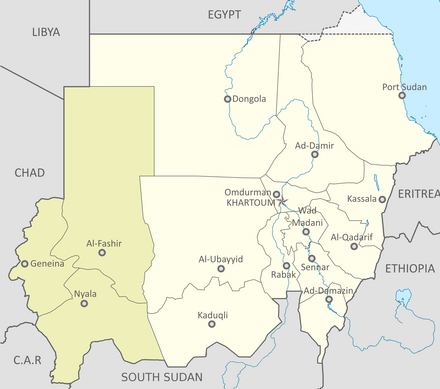
The images of horrific killings and explosive clashes currently shattering El Fashir and Kordofan are not simply the sights of a localized power struggle between two warring Sudanese military factions, they are the visual symptoms of a new global African Gold Rush. There are ideological or ethnic divides, but the big picture shows the usual suspects of multinational corporations and imperialist interests meddling behind the scenes. Sudan is but one site in the a multi-billion-dollar, transnational exploitation collage where natural resources are being siphoned off to power Big Tech and provide an insurance policy against the looming instability of Western currencies. In this post, I will discuss some of the actors driving the war in Sudan and their interests and how we in the US are complicit in it.
Actors and Interests

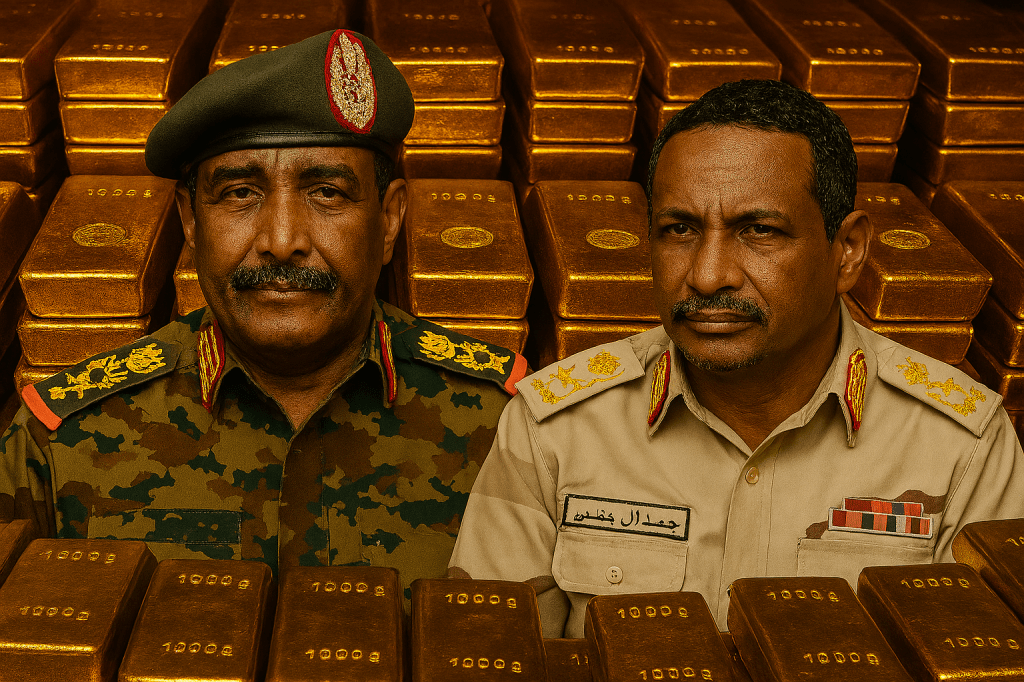
Two men stand at the center of the Sudanese conflict: General Abdul Fattāḥ al-Burhān of the Sudanese Armed Forces (SAF) and Muḥammad Ḥamdān “Hemedti” Dagalo of the Rapid Support Forces (RSF). Once friends, and fellow war criminals, the two men previously served as henchmen for former president ʿUmar al-Bashīr. Hemedti was a leader within the mercenary forces known as the Janjaweed, who in addition to  massacring hundreds of thousands of Darfurians, also fought against the people of Yemen and Libya.(Booty et al., 2025) Hemedti also became rich by controlling several gold mines in Darfur. While the two men were able to share in the overthrow of Bashīr, they were not able to share in their mutual avarice for power. Despite the people’s ardent rejection of military rule, the two men decided that their personal interests were more important than the will of the people. So they dragged the countrymen into a prolonged war to decide who will be the next leader of the Republic of Sudan.

In the words of Donald Trump, Sudan is just another sh•thole African country. So why would these two men fight over power in a country that has nothing? Again, the gullible American people have been lied to. Not only are states like Sudan, Niger, and Congo rich in minerals, they serve as the backbone of many American and European economies. Without them, the West would be full of… well… sh*thole countries.

This is the dark side of globalization that we used to hear about some 30 odd years ago. Every year, as much as $35 billion worth of gold produced by artisanal and small-scale mining (ASM) in Africa goes undeclared and is smuggled out. Between 80% and 85% of this illicit gold finds its way to the United Arab Emirates (UAE), which acts as a “golden gateway” of ill-gotten gold to the so-called legitimate world. (Soguel and Turuban, 2024) Apparently, owning gold mines is the secret to funding a paramilitary group which can operate beyond the reach of the local state, while avoiding being kidnapped in the darkness of night or bombed to smithereens by some of the world’s largest militaries. The money from this illicit trade could go to the Sudanese people to fund essential services like roads, health, and education. Instead, it is being used to beef up a murderous regime that seeks to establish their own state in Western Sudan at the very least.
The Rush for Sudan

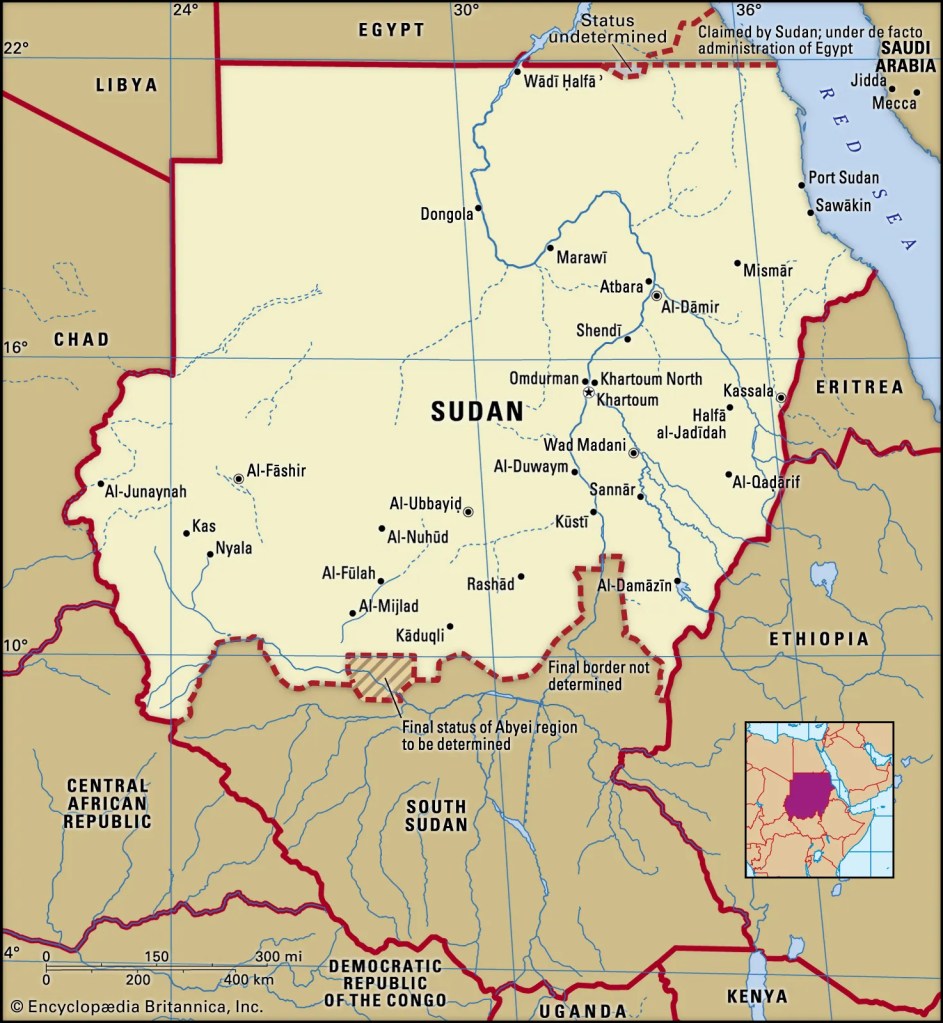
The Republic of Sudan sits on several reserves of natural resources in addition to gold and oil like chromium ore, iron ore, uranium, and manganese.(naturalresourceinfo, 2025) Sudan is also home to much arable land around the Nile, at least 180,000 hectares of it is already used to feed oil-rich Gulf nations.(Guo, 2025) Anyone who rules over such a resource rich terrain will be rolling in the dough no doubt. However, the two contenders must first overcome a comparable antagonistic military from within Sudan. Secondly, they must deal with the interests of the international community, not the least of which are the US and Russia with two polar opposite interests, as well as the UAE, Egypt, Ethiopia, Iran, among others. Thirdly, they must deal with an impoverished, traumatized, dispersed, and revolution-thirsty citizenry who have mentally checked out of capitalist military dictator rule. Finally, they must come to terms with a new global reality and decide which side they will fall on. They can either join the ranks of the Sahelian Alliance and BRICS who will manage their resources on their own terms or remain in the old neo-colonial order.

The demand for African resources is driven by Western greed for industrial gold, a critical component in the medical, electronics, automotive, and aerospace industries. Our smartphones, EV cars, and server farms (the backbone of Big Tech) come from unregulated streams of African resources. A destabilized Sudan comes just in a nick of time as the Sahelian Alliance nationalize their resources and wrangle themselves free from French and American neo-colonialism and as more countries see BRICS as a way out. Seeing that some nations are waking up, the West (primarily the US and Israel) is scrambling to weaken and divide unwitting nations to doubly exploit. Among them are the Sudan and Congo, but are soon to include the recently invaded Venezuela and other countries on their hit list.  

Beyond manufacturing, gold serves as the ultimate insurance policy against the inevitable collapse of the US dollar. This collapse results from over a century and running of senseless wars, corporate bailouts, and overall mismanagement of the US economy by the American status quo. Matthew Miller, vice president of the CFRA financial research firm, stated:

…this debasement of the U.S. dollar is the biggest reason why central banks continue to demand gold at a high level, despite really gold prices continuing to go up. Central banks are big buyers.(“How Illegally Smuggled Gold Is Fueling The U.S. Gold Boom”, 2025)

Sudan’s crisis is a Westerner’s convenience. By allowing this gold to enter the global market as refined, “legal” bars in Dubai, which then exports gold to Switzerland (the world’s top gold exporter), the UK, US, and Hong Kong, we choose to ignore that it was mined amidst genocide and ethnic cleansing. As long as the global high-tech and financial sectors require these materials to safeguard their own futures, the incentive to prolong the conflict in Sudan will continue.

Conclusion

In the 16th century, the Portuguese sought African gold and slaves to solve their domestic “bullion famine” and finance their presence in the world market.(Solow, 1993) Today, foreign interests deepen the Sudanese crisis by supplying weapons to ensure their continued access to these resources. This cycle of violence and extraction sacrifices the lives, sovereignty, and well-being of African for the prosperity of the global capitalist class.

The modern scramble for empire is like a screen time addicted child desperately looking for a charger. If we are not aware of global supply chains and if we do not hold guilty parties accountable for their smuggling and convenient oversights, luxuries will continue to come at the expense of African lives as we watch their massacres on devices made from the materials they dug up. The tragedy of the war in Sudan is not that the world has forgotten it, but that the world is actively, and profitably, ignorant of it. For the Sudanese, the price is of genocidal proportions; more than 150,000 people have died and 12 million have been displaced. While diplomats and corporations remain silent and social and traditional media misinform, the mines remain open and the minds remain closed. In the meanwhile, criminals continue to carry their heavy, golden cargo to Dubai, Switzerland and beyond.

References

Booty, Natasha, Farouk Chothia, and Wedaeli Chibelushi. “Sudan War: A Simple Guide to What Is Happening.” Africa. BBC News, November 13, 2025. https://www.bbc.com/news/articles/cjel2nn22z9o.

Guo, Zihao. “UAE Land Grabs in Sudan and Famine Mitigation by Local Resistance Committees.” The Global Horizon, March 6, 2025. https://www.theglobalhorizon.press/studentfeature/view/uae-land-grabs-in-sudan-and-famine-mitigation-by-local-resistance-committees.

Pettitt, Jeniece, dir. How Illegally Smuggled Gold Is Fueling The U.S. Gold Boom. Produced by Comfort Woode. With Zinhle Essamuah. CNBC, January 16, 2025. 10:57. https://www.youtube.com/watch?v=3YWEy0ijeuo.

Soguel, Dominique, and Pauline Turuban. “Hidden Wealth: Swiss NGO Maps Africa’s Undeclared Gold Flows.” SWI Swissinfo.Ch, May 29, 2024. https://www.swissinfo.ch/eng/multinational-companies/hidden-wealth-swiss-ngo-maps-africas-undeclared-gold-flows/79009684.

Solow, Barbara L. Slavery and the Rise of the Atlantic System. 1st ed. Cambridge University Press, 1993.

“Sudan’s Natural Resources: Locations, Discoveries, Viability, Export Potential, And Economic Impact.” Natural Resouce Info, April 29, 2025. https://naturalresourceinfo.com/sudans-natural-resources/.

Thoughts On Sudan (Part 1): The Pro-Black Deception

While most of the world focused on the atrocities happening in Gaza, despite the Sudan conflict predating it, I watched young Sudanese social media influencers struggle to gain their footing over the years. Most Americans had never even heard of Sudan unlike Palestine, which is understood to hold religious significance to even the most ignorant Americans. Israel is clearly the villain in Gaza and their crippling grip on U.S. politicians, media, business people, and intelligence agencies has been exposed. Unfortunately, the villains in the Sudan crisis were largely nameless and faceless until recently and it suffered the stigma of being “just another African conflict” that average Americans are helpless to solve.

Occasionally, misguided African American social media influencers would mention the Sudan (often in the same breath as the Congo) in a lame attempt to appear pro-black. While they rightly highlighted the racial dynamics with regards to international solidarity, they also effectively discouraged people from taking action on either of these causes, which I suspect is their mission.

I am a rare breed of African American Muslims who has lived in the Sudan for an extended period of time. Therefore, the Sudan crisis has been personal for me. I lived, learned, loved, and lamented in the Sudan for three years. Since, I published my memoirs from my sojourn, Thoughts From Sudan: An American Muslim Experience in 2022, I found it difficult to return to the words in my book. The years I spent in the Sudan from 2008 to 2011 seems so far removed from the current news I’ve been hearing about the Sudan, it might as well be Mars. But it’s not. And a friend of mine who has been trapped in Khartoum throughout the conflict has constantly reminded me that it’s the same Sudan. The problems I observed and wrote about in my memoirs are exactly the same problems we are seeing manifest on our social media feeds but the conflict is not as simple as we might think.

As someone raised in the ways of Black political consciousness, Afrocentrism, and African American Islam, I was able to make some pertinent observations in my book. And as someone who had acquired a level of proficiency in Arabic, I was able to interpret and articulate aspects of Sudanese culture and society in a way that is digestible to Black American audiences. I say this not to make some grandiose claim to authority, but to distinguish myself from the myriad of chatter from misinformed African Americans who have spoken publicly about the crisis in the Sudan. In this post and its follow-up, I will address some of the misinformation regarding Sudan emanating from the Black American community.

The Pro-Black Deception

When the Umar Johnson types make benign statements like “why doesn’t anyone talk about Sudan?” rarely is it followed up with a proper background and analysis of the situation. They are content to mic drop and high five each other for championing some sort of redneck-in-black-face sentiment, while leaving their ignorant followers in the dark about what is actually happening in the Sudan and Congo. Such disingenuous mumbo jumbo should not be taken seriously. They offer no information and no solutions; not even the innocuous “thoughts and prayers.” Additionally, some ill-informed Afrocentric historians, whose latest update on Sudan pertains to events that happened a thousand years ago, have popped up on the web to appear relevant and promote their inaccurate views of history. It is better for such people to remain silent, because their reactionary diatribes are counterproductive.

Until now, I have deferred to the international Sudanese diaspora to educate the public and advocate for their own solutions in public. The most notable analysis on the Sudan has come from journalist Ahmad Kaballo of the pan-African media organization Africa Stream, now “de-platformed.” I would also recommend the work of UK-based journalist Nesrine Malik. The strategy of most Sudanese youth in the West has been to target the government of the United Arab Emirates (UAE) for their support of the Rapid Support Forces (RSF) who have been responsible for the genocidal killings in Darfur and Kordofan that we have been witnessing lately.

The RSF, who were better known as the Janjaweed (Horseback Jinns) in the early 2000s, were also the so-called Arab militia the deposed president Omar Bashir used to subdue dissent in the Dar Fur region. The Arab identity of some RSF members has caused some race-conscious African Americans to conclude that the conflict is a concerted Arab genocide against Africans in the Sudan. They often conflate the Dar Fur conflict with the north’s dissension with South Sudan but interestingly they had nothing to say when South Sudan was suffering from its own civil war following their succession. In both situations, the main issue was not Arab vs. African or Muslim vs. non-Muslim and seeing it this way only obscures the real problems. In fact, the RSF brands themselves as being anti-Islamist, accusing the Sudan Armed Forces (SAF) as being led by the Muslim Brotherhood. I caution African Americans from approaching issues in Sudan and elsewhere through an Americanized lens that sees race as the only motivating factor in conflict between people, especially when they do not know what they are talking about.

Race & Ethnicity in Sudan

Sudan is an African country populated by African people. However, like many places in Africa, it is made up of a diverse conglomerate of people who, prior to European colonialism, never saw themselves as one people. They spoke different languages and had different ancestral lineages. They did not always get along with each other but there was some coexistence in the absence of firearms. There were many kingdoms and civilizations that persisted for hundreds of years, even beyond the well-known ancient civilizations of Kush and Nubia.

African Americans are sensitive to words that signify racial division: African, Arab, slavery, invasion, etc. However, understanding them only according to American and European sensibilities will not yield an accurate understanding of Sudanese ethnic conflicts. It was Africans’ contact with Europeans that made them one nation-state and one continent. In order for us to truly understand Africa, the African people, and their current events, we must understand them as they are and not as we imagine them to be.

Many associate north Sudan with Arabs, but the country covers a wide swathe of land consisting of many different ethnic groups. Sudan consists of the Red Sea Hills in the east, the Nile Valley, and the highlands in the west, which include the Nuba mountains and Dar Fur. The east consists of non-Arab Hamitic people like the Beja. The Nile Valley consists of the various Nubian tribes some of whom are the main propagators of Arabization in Sudan. In the west are Fur people and the other Nuba (who are considered African and distantly related to the Nubians of the Nile Valley). The Fur people are more closely related to the people of Chad and West Africa, but some consider themselves Arab. There are also states like Maiurno and Sennār that have significant Hausa and Fulbe speaking populations and Gaḍārif, and Kasala with large Tigray and Tigrinya speaking populations. Almost all of them are Muslims.

All Sudanese are Africans, but some of them also identify as Arabs. Arab identity is contested and debated among the Sudanese themselves. Arabness is defined as speaking Arabic as one’s first language and the absence of a raṭānah (an epithet for local African languages). There are real and imagined Arab identities in the Sudan. Some like the Rashāyidah only migrated within the borders of Sudan in the 19th century, while others like the Juhaynah and the Rufāʿah started to migrate there as early as the 15th century. While these groups are by necessity minorities in the Sudan, we can say that the primary ethnic group in North Sudan is Nubian. Among them there are families and sub-clans who intermarried with Arabs. Most Arabized Nubians trace their Arab ancestry to Ibrāhīm Jaʿal, who is said to be a descendant of the Prophet Muhammad’s uncle al-ʿAbbās. (Holt, 2011, p. 4) Hence, the name of one of the most powerful ethnic groups in the Sudan, the Jaʿalīyyah, to which former president Omar Bashir belongs.

While slavery had been practiced by the indigenous African populations in the Sudan, which included the Nubians the descendants of Kush, the Ottoman Turks (Central Asians/East Europeans) sought to acquire enslaved people for their armies under Muhammad ʿAli Pasha as his previous Albanian (Eastern European) servicemen were insubordinate. Since the Turks ruled Egypt, and the British eventually ruled the Turks, they sought incursions into current-day Sudan for economic and political reasons. The Sudanese saw all European-looking people as Turks (Khawājah), whether they were British or Albanian.(Holt, 2011, pp. 35-37)

Under the British-run Anglo-Egyptian Condominium (1899–1955), the English sought to exacerbate the tensions between the north and south by allowing missionaries to spread Christianity in the south in a way that fomented hatred against Muslims and Arabs.(Mahdi, 1965, p. 150) In the meanwhile, the north formed its own prejudices against the South. In post-independent Sudan, doctrines of Islamism, Arabism, and anti-African sentiment began to spread in the north culminating with Omar Bashir and the Muslim Brotherhood taking power in a 1989 coup. Contrary to popular belief, Jaʿfar Nimeiri, an initially socialist and Pan-Arab leaning president, imposed so-called “sharīʿah law” on all Sudanese in 1983, north and south, six years before Bashir took power.(Holt, 2011, p. 134)

Conclusion

In summary, the current conflict in Sudan is not Arab vs. African or Muslim vs. non-Muslim. Furthermore, we should not reduce Sudanese ethnicity to a simple Arab vs. African dichotomy. This erases the Sudanese people’s agency in defining themselves, which will not match pervading American concepts of race, which most Americans find difficult to let go. We as conscious Black Americans should avoid projecting our racial constructs onto other societies. The situation in Sudan is bad enough without mucking it up with lies and personal agendas.

I do not deny that the fighting and killing happening in the Sudan is a political conflict with ethnic components. Yet, if we only look at the ethnic components, we will not see the problem in its entirety. And if we only look at the political aspects, we will not fully see the real problems. We must look at the full picture of what is happening in Africa and the world to reach viable solutions. In my next post, I will discuss Sudanese politics, the African gold rush, and the complex web of actors fueling this conflict.

References

Holt, P. M. (2011). A History of the Sudan: From the Coming of Islam to the Present Day (6th ed.). Routledge Taylor & Francis Group.

Mahdi, M. E. (1965). A short history of the Sudan. Oxford University Press.

“Thoughts From Sudan,” No Longer Are They Just In My Head

What do Dave Chappelle, Malaria, and the FBI have in common? They all make appearances in the latest publication from the Maurchives, Thoughts from Sudan. Once I graduated with my master’s from the Khartoum International Institute for Arabic Language in 2011, I thought I had closed that chapter of my life, but the thoughts from Sudan kept on coming back to mind. The emails and stories I shared with my family and friends throughout my travels and studies gave us all a good laugh. Some have encouraged me to publish them. So as of August 21, 2022, Thoughts from Sudan, the monograph, is available for the world to chuckle at.

Order it here.

Cover of Thoughts from Sudan

Thoughts is one of the works I will be publishing in the Islamic Literacy Series, in which I will address the elusive topic of how to embark on a path of studying the sacred sciences of Islam. My goal is to increase the Islamic literacy of the American Muslim community, young and old, by sharing my experiences, providing sound advice on study plans and strategies, and using my connections to facilitate travel to the Muslim world for advanced studies, if they choose to do so. Thoughts will be followed by the title, Towards Islamic Literacy, which will provide a definition to the much abused term “Islamic Literacy” and a practical model one can follow to achieve it.

Before I conclude this post, I want to share with you a brief passage from Thoughts. It’s about my landing in the Khartoum airport after being stranded in Detroit due to an interrogation with the FBI and Immigration, which made me miss my initial flight. This passage describes a nightmare scenario in which I landed in a foreign country with nothing three days after I was scheduled to be there. Check out my initial reaction to life in Sudan. The rest of the book is full of these types of scenarios.

From the chapter “My journey:”

As I flew into Khartoum, all I noticed was low level square hut-like dwellings. From my vantage point, it did not look a lot different from the Detroit terrain I just left. When it was time to finally exit the plane, I felt a gush of hot air overcome me; one that would not leave me until I left ten months later. I stood in a long line of people passing through customs, eventually entering the airport about an hour later. I waited quite a while for my luggage at baggage claim. Most people from my cohort grabbed their bags and left, followed by another cohort. However, I and a handful of other people were still waiting for our bags. It became evident that something went wrong, and a significant amount of people’s luggage did not arrive with the flight. So those of us still waiting, surrounded a 20-something airport employee and described to him our bags and their contents. He seemed like a nice guy, but he was unbearably slow.

Employee: “What was uh… in your bag?”

European Traveler: “I had some clothes…”

Employee: “Ok, clozes…” Writes something down for about fifteen seconds. “What kind of clozes?”

European Traveler: “Let’s see, I had some socks…”

Employee: “Yes. Sooks.” Writes something down for about twenty seconds. “How many sooks?”

European: “Oh, I don’t know. Maybe ten.”

Employee: “Yes. Ten.” Writes something down for about thirty seconds. “What color sooks?”

After what had to be several hours of chasing these rabbit holes, finally it was my turn, and I was the last one. Once I finished, I had something else to think about. How was I going to get to my destination? Dr. Lo’s Senegalese friend studying in the Sudan, Muhammad (Mamadou) Diouf, was assigned to meet me at the airport, but I could not imagine him waiting so long. First, I was three days late. Secondly, I exited the airport several hours after my flight was scheduled to arrive and it was already dark.

Upon stepping out of the airport, I was quickly approached by a taxi driver, whose question in Arabic I understood as, “Do you need a taxi?” To which I said (no). He looked at me in surprise and said in Arabic, “You speak Arabic very well!” This is something I and many other Westerners traveling in the Arab world experience. You say one word of Arabic to a native speaker, and they quickly compliment your Arabic proficiency, even if you know nothing more than that single word. Nevertheless, I welcomed the official transition from English to Arabic.

Shortly afterwards, someone who appeared to be Senegalese caught my eye. He was a lean, dark-skinned man with piercing eyes. We both approached each other asking the other by name. Alhamdulillah! It was a big relief that he waited. He ended up negotiating with that taxi driver to take us to the dormitory. First, we had to stop and exchange some of my dollars for Sudanese guinea, then we were on our way. Muhammad wondered where all my luggage was, to which I told him it was lost, and I had to go back to get it later. He said that the next day was a holiday in the Sudan, but we would make plans to go after that.

An image from Sudan I will never forget.

We arrived at his dark and dusty dorm room where he promptly began chopping up onions and putting rice in a pot on an electric heater. He gave me a pair of his shorts, a pair of sandals, and a bar of soap and directed me to the bathroom. Only in Moroccan rest stops had I seen bathrooms so filthy. Brown streaks ran up and down the ancient tile walls and pieces of hair were tucked between crevices. Was this the place I was to live for the indefinite future?