Assata’s Victory is Our Victory

On the afternoon of November 5, 1979, Bronx activist Muntu Matsimela took to the stage in front of U.N. headquarters in New York for Black Solidarity Day. He announced that “comrade-Sister Assata Shakur was freed from racist captivity” just three days prior by members of the Black Liberation Army (BLA). (Holley, 2023, pp. 159-160) This news was celebrated in Black media at the time and remained a legendary moment in the minds of many conscious African Americans ever since. Her passing on September 25, 2025 marks another major victory for the Black Liberation struggle in the U.S. The fact that she was able to die a free woman under political asylum in Cuba is a defeat to the FBI, the Fraternal Order of the Police, the state of New Jersey, and several American presidents who were unable to extradite her and return her to an American prison. Her life and death should be a reminder to the world that resistance to oppression can and will lead to victory.

Poster for Black Solidarity Day 1979 (Golden Age Posters)

First, one might ask: in what way is Assata’s death in exile a victory? To answer this, we must consider Assata in her historical context. She follows in a long history of Maroons and resistance fighters who refused to accept life under oppressive conditions in the Americas. In his book, the Counterrevolution of 1776, Gerald Horne cites the Maroon communities of Jamaica as a prime example of African resistance to imperial powers. According to Horne, these Maroon fighters were able to attain a type of autonomy, fear, and respect in the Western Hemisphere because they resisted imperial oppression. For instance, under the leadership of Cudjoe, the Maroons of Jamaica (known as the “Madagascars”) staged a series of attacks on the British just as they had on the Spanish before them. This campaign led to a 1738 treaty with the Brits, thus recognizing their sovereignty. Such a treaty was deemed a humiliation for London and a victory for the Africans of Jamaica.(Horne, 2014, pp. 100-101) Resistance to slavery was a continuous campaign that lasted lifetimes but it was overcome. Assata’s revolutionary acts were only a moment, but her movement against racist imperialism will overcome.

Secondly, it is important to know that Assata, like Harriet Tubman and Ida B. Wells before her, belonged to a later iteration of those earlier movements. The New York Black Panther Party, Young Lords, and the BLA of the 1970’s forced the US government entities to respond to their actions. For instance, their activism at Lincoln Hospital in the Bronx led to the Patient’s Bill of Rights.(Holley, 2023, p. 99) Afeni Shakur’s work with the Black Panthers and Bronx Legal Services led to reforms to tenant’s rights and eviction laws.(Holley, 2023, pp. 83-84) Similarly, the targeted retribution of police guilty of extrajudicial corporal and capital punishments made police forces think twice about molesting the Black community. Additionally, they began to hire Black police officers to improve their image. In all of these examples and more, the movement to which Assata belonged forced the state to respond. The lesson in this is that the many protections we enjoy in the U.S. in health, housing, education, employment, roadways, and other areas comes from the activism of regular people and not the kind hearts of the capitalist and ruling class.

It must also be mentioned that Assata Shakur was a Black Nationalist in the true meaning of the term. That is to say, she was part of a movement towards nationhood outside of the constructs of the United States. She answered the call of Martin Delany, who wrote in 1852, that African populations within the US are “a nation within a nation.” This was exemplified by Maroon societies of Jamaica, the Seminoles of Florida, and various attempts in the piedmont and swamps of Virginia before him. And subsequently, the call for statehood was the position of every radical black political movement of the 19th and 20th centuries. They had different iterations, from Edward McCabe’s call for Black people to move en mass to the Oklahoma Territory to the Chicago-based National Movement for the Establishment of the 49th State, which aimed to establish an autonomous Black state in the South. African American Communists of the 1920’s and 30’s would imagine the “Black Belt Republic.” Likewise, the Nation of Islam would also advocate for a similar state to be established in the South. The movement that Assata Shakur was most closely associated with was the Republic of New Afrika whose modus operandi was to operate as a sovereign government until they achieved their goal of acquiring land. Assata and her comrades in the BLA were part of its armed wing.(Holley, 2023, pp. 91-94)

“Assata Shakur is Welcome Here” Poster (Red Bubble)

Concluding Thoughts

Every time I learn that another luminary of the revolution has passed away, my resolve strengthens for the renewed education about these individuals and the accurate preservation of their legacies. While we can never hope for fair treatment by corporate media outlets, I have watched more informed independent media like Marc Lamont Hill, Democracy Now!, and Willie D make Assata’s importance about her innocence. We should be clear that she was not simply a “leader by victimhood,” as her comrade Dhoruba Bin-Wahad would say. She was not like the many people who are convicted of a crime that she did not commit and was subsequently rescued and desperately fled to Cuba. Rather, she was an active member in a group that was dedicated to relieving Black communities of some of the pressure of police brutality in the 1970’s. Her service in the BLA as not only a soldier, but a theorist and a strategist, cannot go overlooked by history. Therefore, the central issues in Assata’s case was about the human right of the Black community to organize to defend itself and its human right of self-determination.

This does not mean that the actions of the BLA should not be analyzed and scrutinized or repeated. Indeed, Assata and surviving BLA members were able to reflect on their actions as they matured. But the world could use their bravery, audacity, and fortitude to combat the forces of genocide and imperialism today, just as we see in the Global Sumud Flotillas to Gaza. The BLA were aware of the consequences, repercussions, and sacrifices of their actions. Many did not survive, many remain in prison, and many remained in prison several decades before being released. Assata was unique because she was able to break free and remain free. In this people can find strength, inspiration, and hope, whether in Gaza or Chicago. In the infamous words of Assata:

And, if i know anything at all,

it’s that a wall is just a wall

and nothing more at all.

It can be broken down.(Shakur, 1987, p. 2)

In some instances, a wall can be climbed and burrowed underneath. Occasionally it can be restored or rebuilt. But to anyone paying attention it is obvious that the wall is crumbling.

References

Holley, Santi Elijah. 2023. An Amerikan Family: The Shakurs and the Nation They Created. First edition. Mariner Books.

Horne, Gerald. 2014. The Counter-Revolution of 1776: Slave Resistance and The Origins of the United States of America. New York University Press.
Shakur, Assata. 1987. Assata: An Autobiography. With Angela Davis. Zed Books / Lawrence Hill and Company.
X Marks the Spot: Malcolm X, the Bridge Between Sabians and Hanifs

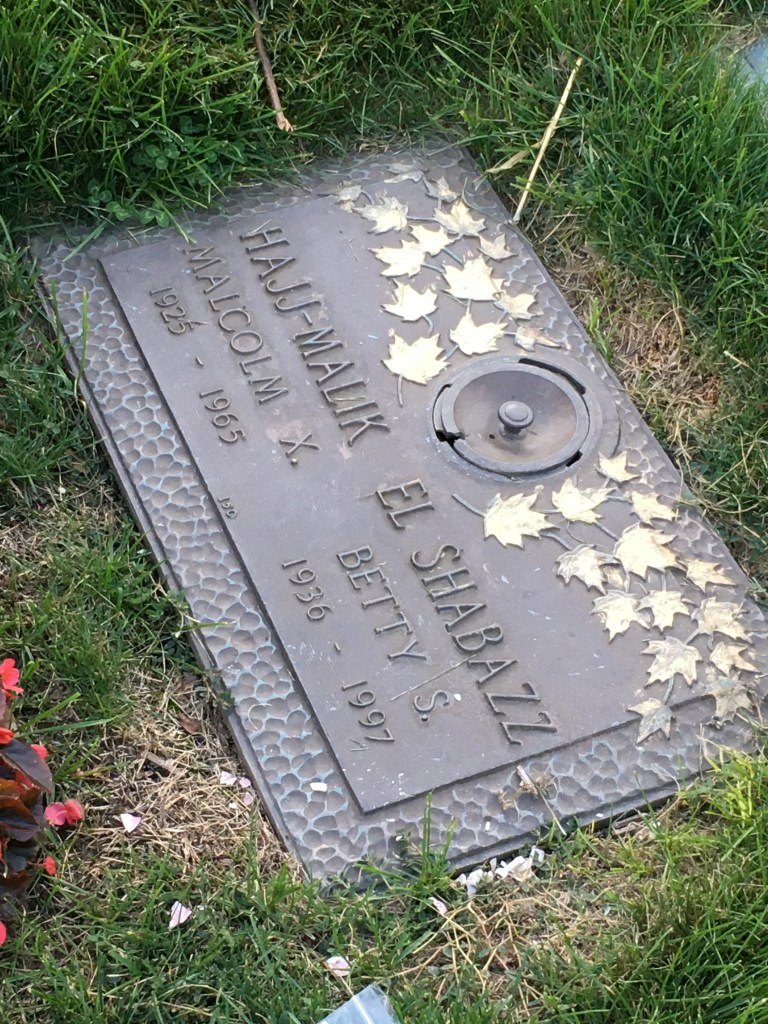
Sunday May 19, 2024 marked the 59th Ziyara (commemorative visitation) to the grave site of El Hajj Malik Shabazz (Malcolm X) and Dr. Betty Shabazz at Ferncliff Cemetary in Hartsdale, NY. As many know, the African American community cannot agree on many things but Malcolm is a rallying point for the forward-thinking trajectories within the community. This was evidenced by the peaceful coexistence of Sabian and Hanif traditions practiced by the intellectual, political, and spiritual offspring of Malik Shabazz at the annual Ziyara.

It was not always this way. In the aftermath of Malcolm’s murder it was a struggle to to keep his name alive let alone his ideas and his work. Only a few brave souls had the guts to open their doors and speak at his funeral. Joseph E. Hall and the Unity Funeral Home allowed the viewing of his body, the Faith Temple Church of God in Christ, allowed his wake, Shaykh Hesham Jaaber, who along with Shaykh Ahmad Hassoun washed and wrapped his body according to the Islamic tradition, Ahmad Osman, Ossie Davis who spoke, and the list of attendees like the late John Lewis, James Farmer, Andrew Young and many others… Their names will be forever etched in history. Similarly, Malcolm’s older sister and confidant Ella Collins sought to keep an accurate depiction of his character, philosophy, and direction by holding the annual Ziyara.

I will point out that these brave people were Hanifs. Despite the association of Hanif religions with conformity and reactionary politics the Black resistance to oppression required the strength and courage only inspired by true faith. That was the place of Malcolm, Betty Shabazz, Ella Collins, Martin Luther King, James Farmer, Mutulu Shakur, Sekou Odinga and countless other freedom fighters. Many of whom were practicing Muslims and Christians.

The Sabian dimension, like their ancient counterparts, has always contributed to the philosophical development of our people. A philosophy that pushes the boundaries of intellectual inquiry and imagination of how Africans can be in this world spiritually, mentally, and physically. Their contributions on the Black intellectual tradition should not be disregarded, as it was the likes of John Henrik Clarke and Dr. Ben Jochanan (both intellectual offspring of Malcolm), who forged a path for Black Studies in the universities to the chagrin of white intellectuals who controlled the narrative on African history. They were able to pry open the  grip that white Africanists had on the field prior to the 1960’s. Their contributions continue to reverberate with regards to the study of ancient Egypt (Kemet), which Africans on the continent and in the Diaspora rightfully claim a connection to despite the protests of some modern Egyptians.

This is not to say that they did not have lapses in knowledge, especially regarding the history of Islam. Their lack of contact with learned continental African Muslims and lack of acquaintance with the Islamic intellectual tradition in Africa and around the world has led to their over reliance on the sources of white Africanist and Orientalist scholars. Similarly, their logical fallacies that equate the Islamic experience with the Christian experience and inability to view things outside of the American paradigm has crippled their understanding of Hanif religions and led to an uncritical embrace of Sabian religion and spiritual thought. Their rejection of religion, while claiming a form of “spirituality,” has warranted them the label Sabian, whose etymological meaning refers to “one who has left religion.”

Beyond the ceremonious nature of the gathering, there was undoubtedly a political message. One that stood on the legacy of the Black Radical Tradition. This was orchestrated by Prof. James Small, a living progenitor of Malcolm. Not only was he the body guard of Malcolm’s older sister Ella Collins, but he was also imam of Muslim Mosque, Inc. and a leader within the Organization for Afro-American Unity (OAAU), the two organizations started by Malcolm before his death. Not only that, but he later acquired authorizations in the priesthoods of several African systems of spirituality and served as a point person for many Black revolutionary activists and freedom fighters since the 60’s. He is therefore an authority in African American Sabian, Hanif, and radical political traditions. As he emceed the event, he stressed the universality of these traditions and some of the speakers’ connection to Islam. He introduced the all-star round up of speakers consisting of scholars, revolutionaries, and leaders of the past and the future, like Dr. Leonard and Rosalind Jeffries, Sundiata Acoli, Pam Africa, Mfundishi Jhutyms, Jihad Abdul Mumit, Baba Zayid, Brother Reggie, Adéyínká “Muhammad” Mendes, and others. They shared prayers and spoke in brief about the legacy of Malcolm. Imam Talib Abdurrashid was noticeably absent from this gathering due to health issues, but members of the Mosque of Islamic Brotherhood (MIB) in Harlem as well as the Jamaat of Shehu Uthman Dan Fodio were delegated to represent him in his absence.

A final point was made about the link between the Pan African struggle and that of Palestine. Contrary to the sentiments of Pan African social media influencers and personalities, who claim that Palestine is not a “black issue,” the veterans and students of Malcolm say it is, because the Black radical tradition stands for justice everywhere. Additionally, we should not allow morally degenerate politicians and media executives to frame our issues for us. The issues of Palestine are not race, religion, terrorism, anti-Semitism, or even freedom of speech. Rather they are colonialism, the right to self-determination, and the right to self-defense. Likewise, these were the issues of the Black Power struggle in the U.S.; a struggle I would deem as successful in many ways. Although police brutality remains a salient issue for many Black communities, there are undoubtedly marked changes from the Jim Crow era to now that almost no elder will deny. But those improvements were not made from the kindness of the hearts of politicians and law enforcement, they were made from decades of political pressure applied by the likes of Martin Luther King and Malcolm X and those who upheld their intellectual, political and spiritual legacies.

Hamitic Arabs: A Revolutionary Approach to Race and Resistance

As we close out Black History Month 2024 with the trials facing Gaza, the West Bank, and throughout the Muslim world, Arab world, and Africa, I would like to highlight a movement that is often not acknowledged, but serves as one of the bridges between Pan-Arabism, African American Muslims, and social justice. Addeynu Allahe Universal Arabic Association is an American orthodox Muslim movement that has operated below the radar for almost a century and has an interesting take on identity that might raise eyebrows in Black and Arab communities alike. However, as we will see, some of its progeny have been at the forefront of Black and Third World liberation movements. In this post, I will examine a manuscript I obtained from Abdurrashid Ishaq, a member of Addeynu Allahe who attended my Arabic classes in Greensboro, NC in 2012. His memory was fading and he could not tell me much about the document before he returned to Allah in 2019, but I will do my best to analyze the anonymous text and speak on one aspect of Addeynu Allahe’s legacy.

“Who Am I?”: A Forgotten Treatise on Black American Identity

The document is a manuscript of perhaps a talk given in 1969. It is directed to Elizabeth, NJ Board of Education following student requests to teach “Black Heritage” in its public schools. It consists of 28 pages, typed with a typewriter, containing prose, footnotes, a chart, and appendices of quotes from various Orientalist authors that elucidate some aspect of Arab and Hamitic identity.

The document was published a little over 30 years since the founding of AA in 1938 and almost 10 years after the death of Professor Muhammad Ezzeldeen. It presents him as a son of “Hamitic Arab” parents and someone whose post-secondary education came from traveling to countries such as Morocco, Libya, Turkey, and Egypt. He is even said to have worked as an Egyptologist and obtained a doctorate from al-Azhar University.[1]

With regards to identity, the author seeks to deconstruct the aptness of the terms Negro and Black. Negro, he says, is equivalent to the Latin word for dead and Black is insufficient because it conceals the national heritage of our people. Rather, he sought to connect so-called African Americans to Ham, son of Noah, who represents ancient Egypt, Ethiopia, and the rest of Africa. On top of that, he recognized the connection between the ancient Egyptian language and Arabic.

The author also provides a linguistic analysis of the Arabic words in question. He pulls from Hans Wehr’s Arabic Dictionary to demonstrate the positive connotations to the root s-w-d (سود) from which the word black aswad (أسود) is derived. He does the same with the word Ham, assigning it to the root ḥ-m-y (حمي), which connotes protection, rather than ḥ-m-w (حمو), which connotes warmth. Nor does he connect it with the ancient Egyptian root Kham (black) as in Khemet.

Additionally, the author takes a brief historical approach to this identity. He discusses Moorish exploration to the Americas prior to Columbus and Muslims taken as slaves. He concludes by saying their origins were from parts of Africa, Arabia, Asia, and Europe that were ruled by Hamites and visually maps this genealogy in a chart.

Chart of Hamitic genealogy from “Who Am I?”

An Analysis of Language and Identity

This document is significant because it is a rare approach to identity; one that is controversial. Some debate the Hamitic Arab identity on grounds that it seeks kinship with a people who are not “Black” or may even be “anti-Black,” which is tantamount to cultural apostasy. Others my decry it as another form of cultural appropriation perpetrated by a lost and confused people. Others might take issue with its use of antiquated Biblical terms or the fact it conflates ethnic identity with religious identity.

Cultural Apostasy

With regards to the critique that the Hamitic Arab approach is cultural apostasy, the author makes it clear that that is not the case. Assuming that Black is an appropriate descriptor, the author sought to show that it has a negative connotation in English, but a positive connotation in Arabic. Similarly, he acknowledges that Bilād al-Sūdān was the name of the lands in Africa from which our ancestors came. This further solidifies the historical continuity between so-called African Americans and the Blacks of Africa.

Arabism

While the thought of African Americans calling themselves Arabs is an odd proposition, and is certainly not explained in depth in this piece, on face value can be considered cultural apostasy from an African American perspective and cultural appropriation from an Arab perspective. Yet the pretext for such an assertion comes from the Arabic saying that is often mistaken for a hadith: an Arab is whoever speaks the Arabic language (من تكلم بالعربية فهو عربي). To Arabs, this is a much more sound definition of Arab identity than one that favors biological lineage. Arabs are the descendants of people who were not biologically Arab, which would thus cause a paradox. So the criteria of Arabness or ʿUrūbah is proficiency in spoken Arabic. Perhaps the unintended result of such a definition is that it allows people from various backgrounds to acquire an Arab identity by acquiring the language. This is how many populations in the Levant and North Africa were able to acquire an Arab identity without intermarriage or conversion to Islam. This further debunks assertions that Islam is an Arab religion.

Terminology

The reliance on the Biblical term Hamitic can be considered antiquated and difficult to define. It is interesting that the author prefers to define Ham by an Arabic definition rather than a Hebrew or ancient Egyptian definition. His choice of etymology is also unconventional. Hans Wehr has an entry for Ham that is not at all informative, but he chose to relate it the word for protection. I am not convinced that the connection between the two is verified linguistically.

We generally understand that Ham from the Bible was the son of Noah who is considered the progenitor of the civilizations and people in which dark-skin dominates, Cush, Mizraim, Phut and Canaan. What the text does not address is the so-called “Curse of Ham,” which Noah actually pronounced on Canaan after Ham supposedly sodomized his father or witnessed his nakedness while he slept in a drunken stupor, according to the Biblical narrative. There is no such reference in the Arabic scripture and is categorically rejected by Islam, which upholds the piety of all the prophets of God. No doubt a Christian audience may have pause in embracing a Hamitic identity, not to mention an Arab one.

Ethnicity or Religion

Salahdeen Shakur (Photo credit: Stephen Shames)

Another criticism of the author’s approach is that it focuses primarily on ethnic identity rather than a religious identity or morality. The author does not explicitly connect this inherited identity to spirituality although it underlies his argument. Perhaps, it is because he was addressing the Board of Education, a government entity that cannot endorse religion, that he is silent on this aspect. Or perhaps, during the 60’s, when Islam was not known to most African Americans and its most popular expression was heterodox, it was preferable not to get into specifics. Whatever the reason, the author does not bridge that gap despite its religious undertones.

In total, the entire philosophy of Addeynu Allahe cannot be gleaned from this one piece. However, we get a keen look into the author’s thought process and the tools by which he arrives at his conclusions concerning the true identity of African Americans. While on the surface, his conclusions seem to endorse cultural apostasy, promote Arabism, make use of problematic terms, and conflate between ethnicity and religion, he is debating and drafting an ontology of racial discourse that runs counter to the unquestioned status quo discourse on race. Perhaps this does not sound revolutionary nowadays, the truth of their legacy is to the contrary.

A Revolutionary Legacy

I gained some clarity on the contents of this document from the American Muslim Centennial Banquet held in Edison, NJ February 17, 2024. Shaykh Muhammad Jaaber’s talk followed the same historical sequence as the document updated with newer information and more recent figures in the history of Islam in America. His presentation highlighted the presence of Addeynu Allahe and orthodox Muslims in the fabric of Black history.

Just a month before, I attended the funeral of Baba Sekou Odinga, which was held at Brooklyn’s Masjid At-Taqwa. It was attended by his immediate and extended family, the local Muslim and conscious community, and a cohort of the living luminaries of the Black liberation movement, like Baba James Small, Dhoruba Bin Wahad, Bilal Sunni Ali, Dr. Kokayi Patterson, and many more. Baba Sekou is remembered as one of the liberators of Assata Shakur and member of the celebrated Shakur family and Black Liberation Army (BLA). However, it might be easy to overlook his spiritual lineage, which goes back to Prof. Muhammad Ezzeldin.

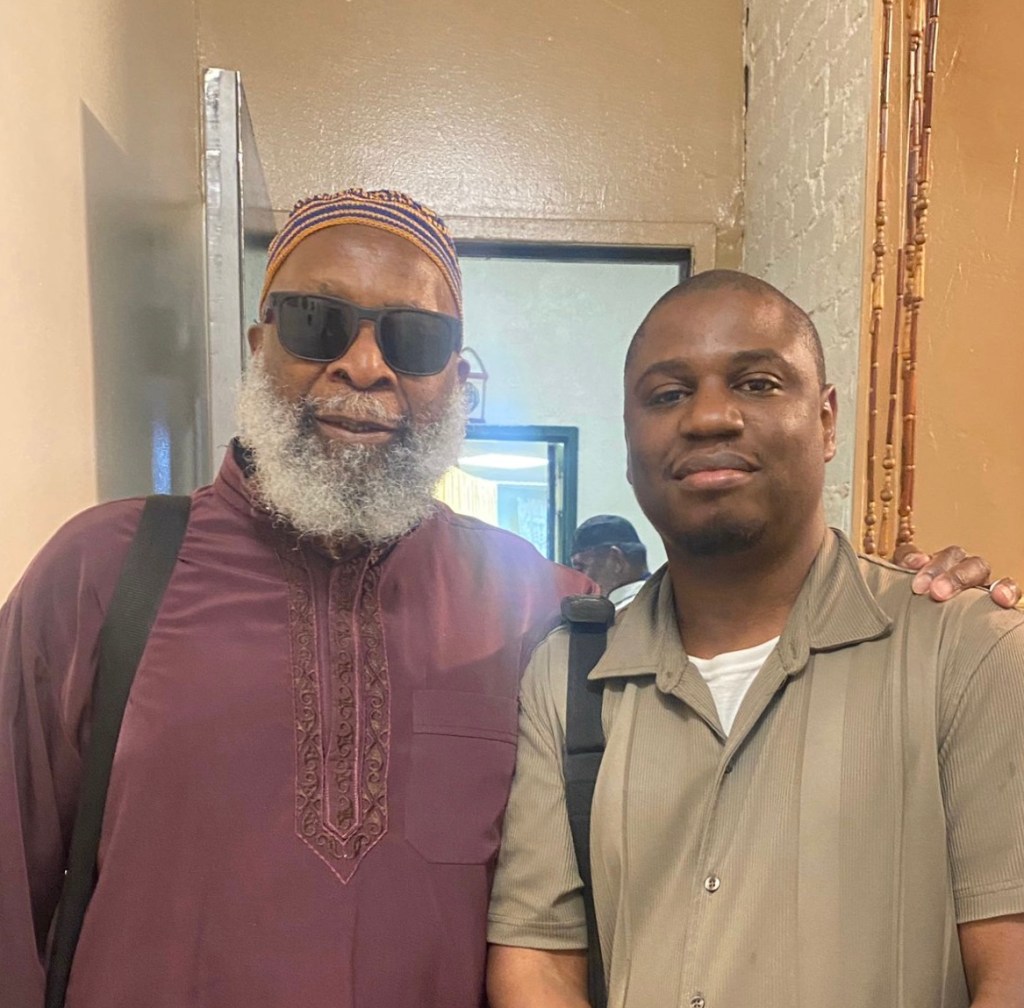
Baba Sekou and I at Masjid M.I.B. in Harlem (17 June, 2023)

El-Hajj Salahdeen “Aba” Shakur was a member of both Addeynu Allahe Arabic Association under Imam Hesham Jaaber and Malcolm X’s Organization of Afro-American Unity. He was the father of the revolutionaries, Zayd Malik Shakur and Lumumba Shakur. As members of their circle embraced Islam and political consciousness, they were absorbed into the Shakur family similar to the mawālāt system in early Islam in which Arab Muslim tribes would adopt non-Arab Muslim groups, eventually absorbing them into the tribe. Baba Sekou was from that circle and upheld his commitment to the political struggle as well as to his Islam until his death.[2]

The Shakur tribe of Hamitic Arabs have militantly stood against the oppression of Black people in the United States as well as oppressed people around the world. They serve as the bridge between the younger generations and the generation of Prof. Ezzeldeen, Malcolm, Shaykh Daoud Faisal, and our Maroon ancestors, merging social justice with the moral rectitude of Islam. Much of this story has yet to be told.

Notes

[1] It has yet to be determined the influence of the Young Muslim Men’s Association (Jamʿīyat Al-Shubbān al-Muslimūn) in Cairo, which sought to revive the Arab identity and culture in the early half of the 20th century. If he was involved with this organization during the 1930’s when he was there, he would have rubbed elbows with the likes of a young Maḥmūd Shākir and ʿIzz al-Dīn al-Qassām, two figures who would defend the Arab world in drastically different ways.

[2] Special thanks to Akil Fahd for compiling much of this information.