
If you can control a man’s thinking you do not have to worry about his action. When you determine what a man shall think you do not have to concern yourself about what he will do. If you make a man feel that he is inferior, you do not have to compel him to accept an inferior status, for he will seek it himself. If you make a man think that he is justly an outcast, you do not have to order him to the back door. He will go without being told; and if there is no back door, his very nature will demand one.(Woodson, 1933, pp. 84-85)

Ryan Coogler’s Sinners attempts to bite the neck of black consciousness and drive a stake through the heart of whatever is left of it. In a day and age when “wokeness” has been weaponized against the people it was designed to inform, it is surprising to see my people blinded by yet another co-opting of and profiteering from our intellectual heritage. What’s worse is the uncritical nature in which large segments of our community have embraced this co-opting and appropriation. This is undoubtedly due to our continued miseducation and psychological entrapment that somehow we have grown to love.
The greater issue at hand is that the so-called conscious ones among us are some of the most miseducated. They have “suspended their disbelief” in American popular culture and media, the true religion of America, and have drunk the proverbial kool aid and are now sacrificing their moral integrity at the alter of the cinemas. Over the years, I have witnessed our people take events and symbols in movies as educational tools. While there is no doubt that Netflix, movie theaters, podcasts, and YouTube have replaced our once literate culture, they still do not realize how much facts and symbols can be distorted to fit someone else’s agenda. Despite the outdated themes addressed in Sinners, which has allowed it to be heralded as a beacon of wokeness, its themes appear carefully curated for domesticated Blacks. In this post, I will criticize the film for its promotion of three concepts that are leading to the death of black consciousness: 1) Black Hedonism, 2) Afro-Fetishism, and 3) Domestication.
Black Hedonism
A major aspect of the American racism project is to portray people of African descent as immoral and governed by their passions. Margaret Mitchell, author of Gone With the Wind, writes in the 1930s of African Americans who took part of the Great Migration:
…the former field hands found themselves suddenly elevated to the seats of the mighty. There they conducted themselves as creatures of small intelligence might naturally be expected to do. Like monkeys or small children turned loose among treasured objects whose value is beyond their comprehension, they ran wild–either from perverse pleasure in destruction or simply because of their ignorance. (Mitchell, 1936, p. 1249)
Sinners reinforces this stereotype. It portrays the Smoke-Stack twins as protagonists and heroes despite their link with the criminal underbelly of 1920s- 30s Chicago. According to the film’s backstory, they survived a brutal and treacherous life in the city to return to their hometown in Mississippi, home of the blues, and start a business, a juke joint, the early 20th century equivalent to a club. Much of the film’s rising action centers on their preparation and advertising for this club. In one scene, one of the twins shoots his friend in the buttocks unknowingly for rummaging through his truck. He then coldly shoots the man’s young accomplice in the legs. What is the point of this? Is black consciousness now promoting wanton black on black violence?
A common pretext of lynchings historically has been the ease with which official channels (law enforcement, media, etc.) can shape public opinion to believe that any black person who is accused of committing a crime must be guilty because black people are somehow predisposed to illegal and immoral behavior. Instead of opposing this construct by showing how European dominance is illegal and immoral in a universal sense, the writers of Sinners have embraced the hedonistic image of black people. This image makes crime, addiction, lack of sexual discipline, and violence a natural part of black culture. Not only have they accepted this image for their own generation, but have projected this image on generations past. This is not to say that there was no black underworld or social ills, but it is not representative of all black culture but for some reason it is repeatedly highlighted in American media.

Sinners also promotes loose sexual behavior that is not even justified by secular culture. The fact that both Mary and Pearline are married to other men but are entertaining Stack and Sammie respectively as love interests promotes adulterous behavior that has historically destroyed our communities. The animosity and broken homes that result from adultery is debilitating to any type of black unity or solidarity. Even princes of Pan-Afrikanism, conscious kings, and champions of Black women like Dr. Umar Johnson and Brother Polight lose all credibility due to their lack of sexual discipline. Yet the same people blame religion for the problems of the Black community, when in actuality the average church, mosque, and temple only warns us of the dangers of self-destructive behavior. In actuality, people don’t have a problem with religion. They have a problem with self-control. They have a problem with accountability. They have a problem with systematic learning. And most of all they have a problem with discipline.
Additionally, the rhetoric of some pro-Black spiritualists that “religion” was forced on black people needs to stop. They have not yet received the memo that: “We is free now” and black people have been choosing their religion freely in the U.S. for over a century. When they say “religion” they usually mean Christianity, but extend this to mean Islam as well. Their logic is that Christianity was forced on enslaved Africans in the Americas. Enslaved Africans in America are Africans and Christianity is a religion. Therefore, all religions were forced on all Africans. The analogy is so weak that even a child can see the gaping hole in it. Just because Europeans forced Christianity on some Africans in the past does not mean that Christianity and other religions that Africans happen to follow was forced on them and will be perpetually in the future. Also, now that African Americans are no longer enslaved, whatever religion they choose to practice is of their own free will, be it Christianity, Islam, or Yoruba.
Our treatment of Christianity with regards to African populations must be studied in context, whether in Africa or in the Americas. Christianity in the context of colonial Nigeria was liberating in some regards. Conversion to Christianity gave rural Nigerians access to skills and resources that they could use to gain upward mobility and compete with more urbanized Nigerians. However, in the Americas conversion to Christianity did not accompany such perks. In Catholic controlled colonies, conversion was mandatory. And although Africans were baptized en masse, they received little to no religious instruction. So there is no wonder why the African expressions of Catholicism are folk and syncretic in nature.
In Protestant controlled colonies, African conversion to Christianity was treated with caution. On the one hand, the initial justification for the slavery of Africans was the fact that they were not Christians. Once they embraced Christianity their servitude should have been void but it was not. For this clear hypocrisy, Protestants feared the conversion of enslaved Africans and they tried unsuccessfully to emphasize verses encouraging submission to their human masters rather than the powerful narrative of Moses leading his people out of bondage (Curry, 1997, pp. 24-26). This fact is corroborated by Carter G. Woodson in his Education of the Negro. In the early 19th century, religious education for enslaved Africans was equivalent to training them for insurrection.
The push against organized religion in popular American culture is more of an emotional response to perceptions of religious institutions than an intellectual one. Most have never bothered to read widely and deeply on the histories of religions and it shows. Religious institutions have historically been one of our strongest institutions because they have brought people of like minds together, served as a base for exchanging ideas, and offered charitable services. Institutions, religious, political, financial, educational, or social, are means to power, influence, and freedom. Instead of strengthening our religious institutions, which we still retain some control over, black hedonists have worked to weaken these institutions in favor of fragmented and individualistic Afro-fetishism.

Afro-Fetishism
Afro-fetishism has risen in prominence since the inception of Afrocentrism. It is the tendency of African Americans to romanticize things they consider to be authentic African culture. In Sinners it manifests itself with the romanticism of southern root doctors, conjuring spirits, and the conflation of entertainment (music and dance) with spirituality. In reality, there is no one thing called “African spirituality.” Simply put, “spirituality” is a European concept developed primarily by Theosophists and occultists, which seeks to separate spirituality from religion. It represents one of the modern iterations of the so-called European Enlightenment, which promotes a Eurocentric view of religion and religious history; a history not experienced by most of the people of Africa.
Every religious system has a spiritual aim. “Religion” – as Afro-fetishists might call it – is the exoteric outer core that houses the esoteric inner core or “spirituality.” The doctrines, rules, rites, and rituals of religion must be upheld for people to achieve their spiritual goals. The morality, meanings, and heart-felt connection is cultivated through religious discipline. Both are necessary, otherwise, confusion and delusion prevails.
We witness this in Sinners and in real life. For instance, Smoke rightfully questions Annie’s Hoodoo practices, which she believes protected Smoke and Stack as they led a life of crime in Chicago. Yet, these same practices were not sufficient to thwart the death of Smoke and Annie’s baby daughter. Although, her herbs and concoctions helped her defend the non-dead at the juke box against the dead, we should remember that vampires are fantasy. Not only that, but potions and fetishes often tied to “African spirituality” are powerless against the spells of “niggerdom” and white supremacy.
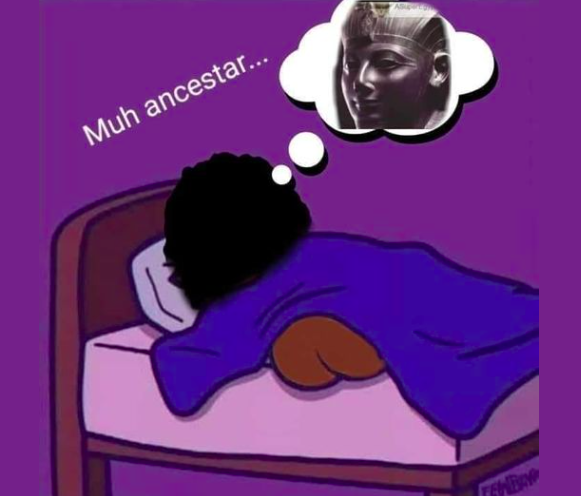
The fact that their daughter passed away also poses an interesting question to those who venerate the ancestors. Is their daughter an ancestor because she passed away before her parents or is she still their “descendant?” Moreover, many of the people who talk about conjuring the spirits of the ancestors also speak about inter-generational curses and barely get along with their living family members. Why are they calling on the same people who caused the curse? Why do they want to build/continue relationships with the dead rather than the living? Are they not inviting vampires in their home?
Furthermore, every individual has an exponential number of ancestors, represented by the following equation: x=2n. This means that after three generations, a person has eight grandparents; after four generations, a person has sixteen grandparents, and so on. Once a person goes back ten generations, for instance, they have over a thousand grandparents. That is a lot of ancestors to make shrines to. Hardly anyone can remember the names of all of them let alone find pictures or memorabilia for them.
When people claim communion with the ancestors, how do they determine which ones to commune with? And if the ancestors speak to them, how do they know the person speaking from beyond the grave is not an imposter? The truth is that while it is essential to honor one’s ancestors by not speaking ill of them, speaking their names for as long as possible, and fulfilling any of their good endeavors, they are in more need of us than we are of them. Their lives are over and their affair is with their Creator. It is on us to live our lives, honor, and speak to our loved ones while they are still alive instead of seeking out mystical ways of communicating with them after they are gone.
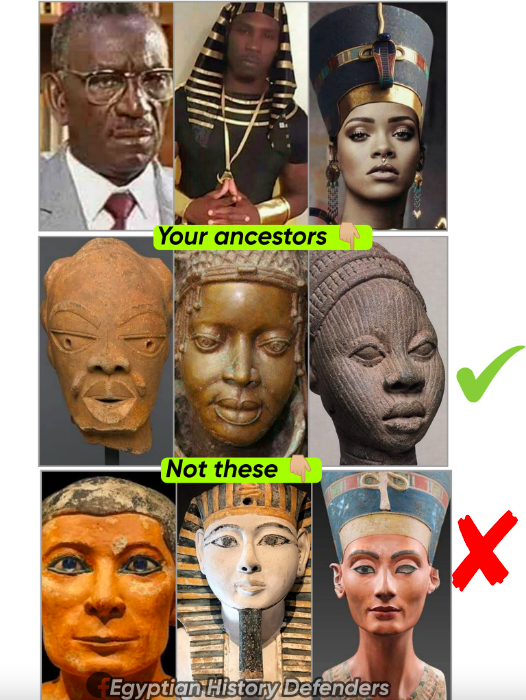
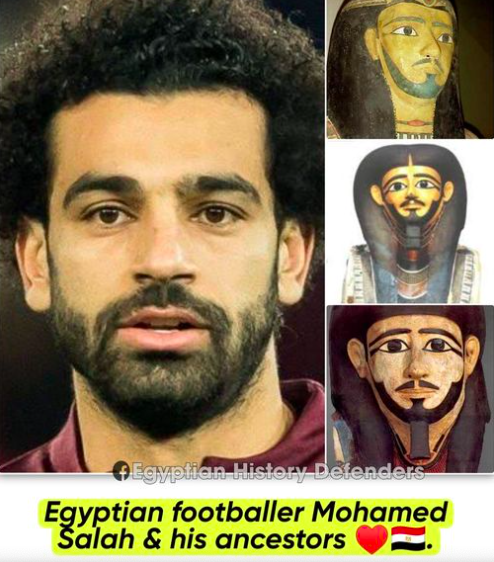
While I understand the need of our people to connect with their roots, which were severed from us during our oppression in the western hemisphere, African Americans have the tendency to perform these so-called connections in a very superficial way that is more indicative of their Americanness than any real connection with actual Africans. Furthermore, much Afro-fetishism is based on marketing and consumerism. Things like red black and green flags, ankh jewelry, and incense are mainstays of an Afrocentric esthetic but are not items indigenous to Africa or are staples of any contemporary African culture. Yet, someone has convinced us through strategic marketing to pay top dollar for these things. From tours of ancient Egyptian temples to pathways towards citizenship for African Americans, even people from the continent have thought of ways to market to the emotional sentiments of African Americans because at the end of the day we are just consumers with US dollars.

Domestication
Finally, Sinners speaks to the domestication of black consciousness. Domesticated black consciousness can only be militant about safe topics related to racial bigotry, cultural autonomy, and other corny topics that get black people riled up but will never spark a revolutionary consciousness or affect real change. The film is set in the 1930s and features a lot of details and covert commentary on that era but misses several opportunities to draw parallels and commentary to current events. However, as the famous Mozart quote goes: “The music is not in the notes, but in the silence between.”
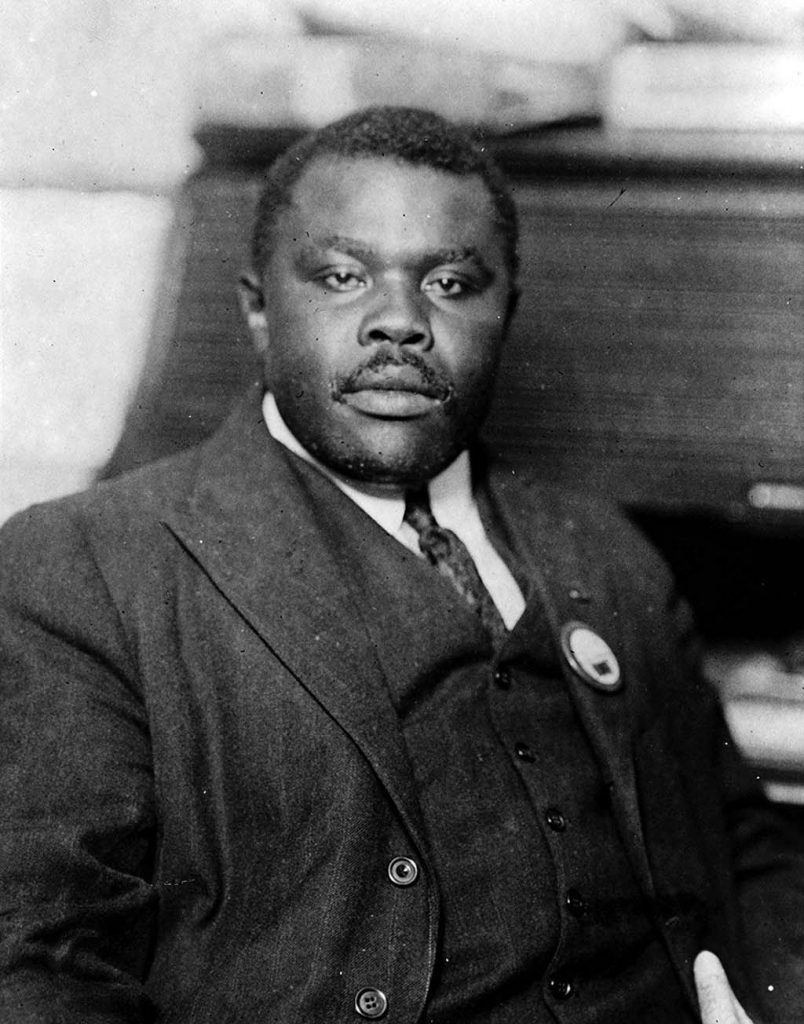
While the film attempts to highlight complex racial dynamics from the 1930s such as colorism, European ethnic dynamics, Asian immigration, labor inequality, etc., it is completely silent on actual movements of Black people from that era to improve their political and social conditions. No attention is given to the influence of Marcus Garvey from the 1920s and the Communist movement of the 1930s. Garvey instilled pride in blackness and self-determining industriousness that had nothing to do with organized crime. Still intelligence agencies identified Garvey as an existential threat to the American order who would lead a Bolshevik-style revolution among African Americans. As perhaps the first target of J. Edgar Hoover’s terror campaign, Garvey became a victim of a government set up, which led to his imprisonment and deportation. In an odd, yet correct move, President Biden pardoned Garvey fully and unconditionally as one of his last acts as president. Nevertheless, a movie supposedly made for Black people of conscious did not even hint at the power the Garvey movement had on African American communities as well as its parallels to the current political climate.
Another footnote of history that Sinners neglected is the fact that Communism had spread across Black America. Inspired by the 1917 Soviet revolution but not controlled by it, many African Americans were attracted to Communism and Socialism during the period the film is set in. The likes of Shirley Graham Du Bois, W.E.B. Du Bois, Benjamin Davis Jr., and Paul Robeson had adopted the ideals of the revolutionary left. This was because of the all-too-familiar trap of the two-party system: the Democrats, who were then the preferred party of the Ku Klux Klan and segregationists, and the Republicans, the party to whom most African Americans were loyal because it was the party of president Abraham Lincoln, who supposedly “freed the slaves.” At that historical moment, with the onset of economic depression, the white Republicans’ growing disinterest in the black community, and the Democrats’ deconstruction of the Reconstruction in the form of Jim Crow segregation laws left very few viable political alternatives for African Americans. There is a lesson there for people who reflect on our current situation as America teeters on yet another great depression, the Democrats’ obsession with only symbolic progress for blacks, and the Trump-led Republicans reversal of some our domestic victories in the form of Civil Rights.
While the Communist Party may not be the most viable direction now, where are the black conscious thinkers, artists, and filmmakers to groom the next generations of Martin Luther Kings, Malcolm X’s, and Shirley Chisholms? Who are the people who will use their platforms to organize around the African Union Symposium of 2025 in which reparations for the African diaspora will be a key issue? Who will educate the masses about conflicts in the Congo and Sudan? Who will meet with forward-thinking African leaders like Ibrahim Traore, Assimi Goïta, and Julius Malema on our behalf? Sinners has looked deeply into the “safe” aspects of African American history like the Great Migration, the Blues, and even lives of ethnic groups like the Chinese, Irish, and Native Americans in rural Mississippi, but cannot find the bandwidth to dig into the aspects of black history that will make us reflect on and correct our current conditions.
Conclusion
Carter G. Woodson is probably rolling in his grave to find that his book the Miseducation of the Negro still applies almost word for word to 21st century Negroes. Coogler and the cast of Sinners has effectively carved out a back door for African Americans to re-enter into American society. This is a door in which we only seek validation from a pat on the head for our musical and athletic prowess. This is a door in which we can only move forward in society if we wait until someone lets us by. This is a door in which we literally stay in our places and have no global scope for our economic future. We are only content with ratchet and hustle culture.
As black social media applauds the symbolism in the film Sinners and the many social issues it raises, corporate America has yet again blindsided them by ignoring, if not suppressing, many latent histories and current events. However, as the last visages of black consciousness, we must reject hedonism and embrace discipline in all aspects of our lives. We must reject Afro-fetishism and the shallow consumerist mindset that is meant to derail us from our true purpose. And we must reject the domestication of our purpose, which will keep us from thinking globally and connecting our ideas from the past to benefit our future. As the sun rises in the west, I hope the vampires of black consciousness are laid to rest and we can resurrect our consciousness for the generations to come.
Suggested Readings:
Curry, Mary Cuthrell. Making the Gods in New York: The Yoruba Religion in the African American Community. Studies in African American History and Culture. New York: Garland Pub., 1997.
Horne, Gerald. Black Liberation/Red Scare: Ben Davis and the Communist Party. Toronto: Associated University Presses, 1994.
———. Race Woman: The Lives of Shirley Graham Du Bois. New York: New York University Press, 2000.
Mitchell, Margaret. Gone With the Wind. New York: MacMillan Company, 1936.
OnGenealogy. “Do the Math – How Many Ancestors Do I Have?,” 2025. https://www.ongenealogy.com/do-the-math-how-many-ancestors-do-i-have/.
Woodson, Carter G. The Education Of The Negro Prior To 1861 A History Of The Education Of The Colored People Of The United States From The Beginning Of Slavery To The Civil War. Project Gutenberg, 1919.
Woodson, Carter Godwin. The Mis-Education of the Negro. Khalifah’s Booksellers & Associates, 1933.





 The Maurchives
