Choosing Evil: The Ideology of Destruction

There’s this thing where ethics aren’t what they used to be. This idea that people are trying to replace the ideas of good and bad with better or worse… and that is incorrect. You gotta keep your ethics intact because good and bad is a compass that helps you find the way. And a person that only does what’s better or worse is the easiest type of person to control. They are a mouse in a maze that just finds the cheese. But the one who knows about good and bad will realize that he’s in a maze.

Dave Chappelle at Allen University (South Carolina) March 20, 2017

I have paid close attention to every presidential election since the beginning of my adult life. Without fail, the debate ensues around voting for the lesser of two evils in many progressive circles. This is in lieu of any viable progressive rivals, who the American people are told are “unelectable,” a status that is reinforced by state-level interventions to keep them off the ballots. While the decision to vote for a softer, friendlier (usually Democratic) candidate seems to make sense in the moment, this reactionary strategy has only emboldened those candidates to become more evil and take the progressive (especially African American) vote for granted. Yet, the question remains: “at what point will we stop voting for evil?” While comedian Dave Chappelle’s words from 2017 may seem prophetic to some, the ideology of the lesser of two evils has been rejected by Ḥanīfs of ancient times, not the least of which appears in the story of Hārūt and Mārūt.

Hārūt and Mārūt

According to Imam Jalāl al-Dīn al-Suyūṭī in his book on angelology Al-Ḥabā’ik fī Akhbār al-Malā’ik, Hārūt and Mārūt are first alluded to in the Qur’an in al-Baqarah: 30 where we first encounter a conversation between God and the angels concerning the creation of mankind:

{وَإِذۡ قَالَ رَبُّكَ لِلۡمَلَـٰٓئِكَةِ إِنِّي جَاعِلٞ فِي ٱلۡأَرۡضِ خَلِيفَةٗۖ قَالُوٓاْ أَتَجۡعَلُ فِيهَا مَن يُفۡسِدُ فِيهَا وَيَسۡفِكُ ٱلدِّمَآءَ وَنَحۡنُ نُسَبِّحُ بِحَمۡدِكَ وَنُقَدِّسُ لَكَۖ قَالَ إِنِّيٓ أَعۡلَمُ مَا لَا تَعۡلَمُونَ}

˹Remember˺ when your Lord said to the angels, “I am going to place a successive ˹human˺ authority on earth.” They asked ˹Allah˺, “Will You place in it someone who will spread corruption there and shed blood while we glorify Your praises and proclaim Your holiness?” Allah responded, “I know what you do not know.”

The Clear Qur’an translation

The second allusion to Hārūt and Mārūt appears later in the sūrah in verse 102 concerning the false accusations of Prophet Solomon practicing magic. Hārūt and Mārūt warned people about practicing magic and taught people how to differentiate between miracles and magic.

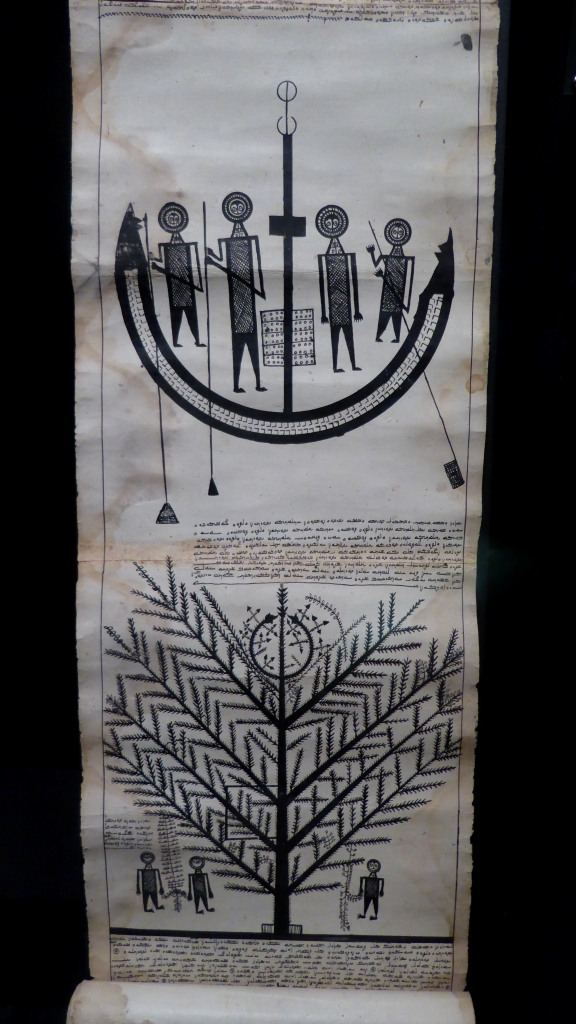
18th century Ottoman representation of Hārūt and Mārūt courtesy of Wikipedia Commons.

“The Lesser Evil”: An Angelic Refutation

The backstory to these angels offers us some wisdom about the dangers of “the lesser evil” ideology. According to tradition, Hārūt and Mārūt were sent to earth where they ruled during the time of the Prophet Idrīs or Enoch. They were given the appetite and desires of people (shahwah) in order to test if they, who had once lived as angels, would behave differently when faced with the same temptations of normal men. Their story is as follows:

And it was said to them: ‘Choose from amongst you the two best angels and I will give the two of them a task; and I will prohibit the two of them [from doing certain things].’ And they chose Hārūt and Mārūt. So the two of them were sent down to Earth and the desires of the sons of Adam were aroused in them. [God] ordered the two that they should serve Him and not associate anything with Him. He banned them from killing prohibited individuals, from eating prohibited foods and from fornicating, stealing and drinking wine. The two remained on the Earth for a time ruling the people with justice. This was during the time of Enoch. And at that time there was a woman, who was the most beautiful woman, just as the beauty of Venus is amongst the rest of the stars. The two of them came to her, spoke softly to her, and wanted her on her own; but she refused unless the two took her orders and her faith. So the two asked her about her faith and she brought out to them an idol and said: ‘This is what I worship.’ And the two said: ‘There is no need for us to worship this.’ So they went and stayed away for a while. Then the two came to her and they wanted her on her own and she said as she had said before, so they went away. Then they came to her [again] and they wanted her on her own, and when she saw that they refused to worship the idol, she said to the two of them: ‘Choose one of three faults: worshiping this idol, killing this person, or drinking wine.’ And the two said: ‘None of these are right, but the least contemptible of the three is drinking the wine.’ So they drank the wine. [The wine] was taken from them both and they fornicated with the woman. The two then feared that the person would reveal what they had done, so they killed him. When the drunkenness lifted from them and they realised what sin they had done, they wanted to go up to heaven; but they could not, as it had been made inaccessible to them. And the cover that was between the two of them and between the people of heaven was lifted up, and the angels looked down at what had come to pass. They wondered with great wonder and they came to understand that whoever is hidden [from God], is the one with less fear. After that they began to ask for forgiveness for whoever was on the earth.

It was said to the two of them: ‘Choose between the punishment of this world and the punishment of the next.’ The two said: ‘As for the punishment of this world, it will come to an end and it will pass. As for the pain of the Angels and theology next world, it will not come to an end.’ So they chose the punishment of this world. The two stayed in Babylon and they were punished.

(Burge and Suyūṭī, 2012, pp. 94-95)

In this story, Hārūt and Mārūt were tricked into committing greater evil by doing what they perceived as a lesser evil. In reality, the lesser evil was simply a gateway into more evil. It was presented as a thing that would satisfy their immediate desire for drink and sustenance; something that is permissible under normal circumstances. However, compromising their principles by the seemingly innocent act of drinking the wine led to intoxication which led to committing fornication which led to murder. How many a prisoner sits in his cell pondering a similar scenario?

Conclusion

This story was intended to refute the Sabian position that gave favor to angels over men. It demonstrates that humans have favor because in order to avoid sin they must overcome their desires, while angels simply do not sin because they do not have  such desires. However, there is also wisdom in this story for the average American voter who are forced to choose between duplicitous politicians of either the Democratic or Republican party. Politicians from the local to federal levels insist on doing the bidding of narcissistic, unethical, and devilish entities instead of the will of citizens who entrust them with their money and power. In choosing to stick with the status quo of Democratic and Republican party leadership we have taken that intoxicating sip that has put us on the path of destruction.

The 2024 elections have been a dirty game given the Republicans’ assassination shenanigans and the Democrats’ shiesty switcheroo. Both Democrats and Republicans have shown to be abetters of genocide and endless war, with blatant corruption among their ranks as witnessed in cases of Dem. Bob Menendez, Dem. George Norcross, Rep. George Santos, not to mention Trump himself. We at the Maurchives advocate for justice and non-violent, creative, and – dare I say – revolutionary solutions to human problems. Therefore, it is with the revolutionary spirit that we endorse Jill Stein’s presidential bid on the Green Party ticket.

Dr. Jill Stein and Butch Ware (Green Party Presidential and Vice Presidential Candidates)

References

Burge, S. R., and Suyūṭī. Angels in Islam: Jalal al-Din al-Suyuṭī’s al-Ḥabāʼik Fī Akhbār al-Malāʼik. Routledge, 2012.

Suyūṭī, Jalāl al-Dīn al-. Al-Ḥabā’ik Fī Akhbār al-Malā’ik. Dār al-Kutub al-ʿIlmīyyah, 1988.

Renshaw, Jarrett. “How US States Make It Tough for Third Parties in Elections.” Reuters, 18 Jan. 2024. http://www.reuters.com, https://www.reuters.com/world/us/how-us-states-make-it-tough-third-parties-elections-2024-01-18/.

Eyes on the Skies: Prophecy Eclipses Astrology

On Monday, April 8, 2024 eyes were on the skies in North America. Day turned to night in the path of totality extending from Mazatlan, Mexico to Elliston, Nova Scotia in Canada. As the Moon and Sun danced in the shadows of the sky some awaited a cataclysm while others cherished the spiritual moment. As the temperature dropped and the day drew dim, there descended a strange serenity that interrupted our usually busy weekday afternoons. The conscious Ḥanīf was most likely bowing in extended moments in prayer, while the Sabian probably pondered the ill omen behind the event.

Ancient religion was always tied to celestial phenomena. First, we know that in the ancient Egyptian religion, ṣ-b-3 meant star and words derived from it signified religious teachings. Its cognate in Semitic languages like Hebrew, Aramaic, and Hebrew would have similar connotations (Sayyār, 2020). The Egyptians based much of their religious beliefs and holidays on what they knew of the stars. Likewise, the Mysteries were made up of two levels, the Lesser Mysteries and the Greater Mysteries. The Lesser Mysteries were known for studying terrestrial phenomena, while the Greater Mysteries were known for studying celestial phenomena. To most historians of religion, the ancients ignorantly followed superstitious beliefs about natural phenomena and deified features and creatures of nature. But our studies of Sabianism and the Mystery Schools afford us a much more nuanced view.

Sabians intently studied the stars to understand what the angels or spirits were trying to tell them about the past, present, and future state of the world and those in it. This included predicting the weather, fortune-telling, creating calendars, creating talismans, studying the properties of elements, etc. There was no distinction made between astronomy and astrology. Nowadays, only the former is accepted as an empirical science while the latter is considered a pseudoscience; although it remains a fixture in the popular psyche. It is important to note how this came to be.

“Star Gazing” AI generated image by Hotpot.

Astrology in the Ancient World

In ancient Rome, the term Chaldean was equivalent to astronomer and they were credited with inventing the gnomon device, which is a triangular blade that casts shadows on a sundial used to tell time (Thompson, 1929, p. 39). Bayard Dodge also states that the term Chaldean meant astrologer and notes that it was associated with people who were known as Sabians who claimed Hermes and the Philosophers as their teachers (Ibn al-Nadīm, 1970, pp. 745-746). For most of the history of the world, religion, philosophy, and astronomy were closely associated.

Their rationale was as the Central Asian polymath, Muhammad al-Shahrastānī stated in the 12th century (Shahrastānī and Muhammad, 1992, 354-359):

  1. They began with a belief in a singular transcendent deity, who they later saw as unconcerned with creation.
  2. They believed that spirits, which we know as angels, governed worldly phenomena such as planets, stars, moon, etc. Due to their active role in our lives and their proximity to the Creator, they are worthy of worship and can relay the benedictions of humans to the Creator.
  3. They then adopted the belief that they should worship something tangible and that the planets, stars, and so on were the bodies of those spirits.
  4. Then they adopted the belief that the heavenly bodies cannot always be seen, so they made shrines on Earth that aligned with certain astronomical significance and put in them idols and other images to represent the celestial bodies of worship.

The Ḥanīf criticism of the Sabians was not their study of the heavens, but the theology, mythology, and dangerous practices they constructed around it, such as human sacrifice and violent orgies. These criticisms are apparent were we to examine the life of Abraham (Ibrāhīm), the quintessential Ḥanīf and prime Sabian/Chaldean antagonist. The story of Abraham and the near sacrifice of his son serves on a prohibition of human sacrifice. While it is said that Abraham supplicated against his people causing them to all die after witnessing them in an orgy (Ṭāwus, 1949, p. 25).

We also find in his narrative a clear polemic against astral worship in his disputes with his people (Al-Anʿām: 74-79). As I explained in Islam and the Ancient Mysteries Vol. 1, when Abraham was shown the truth behind the celestial realm he exclaimed “this is my lord!” However, this did not mean that he was deifying the stars, moon, and sun. No prophet is guilty of such polytheistic behavior. Rather, Abraham, in a moment of awe, made the elliptical statement as if to say, “this is the handiwork of my lord” or “this is the magnificence of my lord.”

Total Solar Eclipse from Carbondale, IL (image courtesy of NASA)

Astrology in Islam

Within the Islamic tradition, astrology is largely disproved of, with very few dispensations. The Prophet Muhammad is reported as saying the following concerning eclipses, after it was said that a solar eclipse occurred due to the death of his son, Ibrāhīm:

The sun and the moon are two signs amongst the signs of Allah; they do not eclipse on the death or life of anyone. So when you see the eclipse, remember Allah and say “Allah is the greatest,” pray and give charity.

The Prophet Muhammad is also reported as saying: “If the stars are mentioned then be silent.” and “Learn of the stars as much as you are guided with in the land and sea, then stop at that.” (Shahrastānī and Muhammad, 1992, 350) The Prophet Muhammad is also recorded as prohibiting the study of the stars to predict the future and engage in other occult practices. One hadith reads:

The Messenger of Allah (may peace and blessings be upon him) led the morning prayer at Hudaybiya. There were some marks of the rainfall during the night. At the conclusion of prayer he turned towards people and observed: Do you know what your Lord has said? They replied: Allah and His Messenger know best. Upon this he (the Holy Prophet) remarked: He (Allah) said: Some of My bondsmen entered the morning as My believers and some as unbelievers. He who said: We have had a rainfall due to the Blessing and Mercy of Allah, he is My believer and a disbeliever of stars, and who said: We have had a rainfall due to the rising of such and such (star) disbelieved Me and affirmed his faith in the stars.

Despite the seemingly clear prohibition of such practices, Muslims studied and practiced astrology throughout much of their history. Imam Jaʿfar al-Ṣādiq was reported to be knowledgeable of astrology and said that Imam ʿAli ibn Abī Ṭalib was also very knowledgeable of it. Even mainstream Sunni scholars like Fakhr al-Dīn al-Rāzī, Ibn Qutaybah, and Ṣāʿid al-Andalusī have produced books on astrology and related sciences. Imam Jaʿfar gave permission to the Āli Nawbakht family to practice it, who were employed by the Abbasids. The Ottomans were also known to use astrology to predict the outcomes of battles.

Al-Maqqarī notes that astrology, although taboo, certain Andalusian scholars knew it well, but did not broadcast this out of fear from the masses. If a scholar was known to speak or practice astrology. he would be labeled an atheist (zindīq) and possibly burned to death by a mob before the issue reaches the sultan. If the issue reaches the sultan, then the scholar must be executed in order to appease the people regardless of the facts. Usually, the sultan only ordered that their books be burned (Maqqarī, 1968, p. 221). Ṭāwūs reported that an astrologer was about to be crucified when he was asked “Did you see this in your stars?” He said “I saw an elevation, but I didn’t know it was above wood.” (Ṭāwus, 1949, p. 192)

There are a number of rationale as to why astrology is prohibited from an Islamic viewpoint. One is that predicting the future with the stars is opposed to the guidance and predictive aspects of prophethood. If one could accurately predict events using the stars then they would not be in need of prophetic guidance or prophesy.

Astrology: A Decisive View

The grey area in the religious rulings lies in the empirical elements of the study of the stars. Ibn Rushd, the grandfather, states in his Al-Bayān wa al-Taḥṣīl that calculating the time of an eclipse, telling the weather, or measuring the placement of the stars are not claims to knowing the unseen. However, publicizing this knowledge is blameworthy because it does not concern everybody, especially simpletons without discernment (Ibn Rushd al-Jadd and Hajji, 1974, p. 345). vol 9

Other scholars have taken the position that calculating the astronomical phenomena is a communal obligation (farḍ kifāyah) and forecasting is analogous to a doctor’s prognosis. Studying the stars is only prohibited when the practitioner makes a claim to know the unseen and if their practice is associated with magic, fortune-telling, and the like (Kuwait Ministry of Endowments and Islamic Affairs, 1988, pp. 52-54).

One scholar deduced the prohibition to three reasons (Kuwait Ministry of Endowments and Islamic Affairs, 1988, p. 54):

  1. Negative psychological associations with the appearance of certain constellations, even if they have no meaning.
  2. Although the Prophet Idrīs was gifted with the miracle of predicting events by the stars, in current times it amounts to conjecture because it is not a precise science.
  3. Astrology is useless. Even if one can know the future, there is nothing they can do to change it.

Likewise, in the modern day, astronomer Andrew Fraknoi wrote an article titled “Your Astrology Defense Kit,” in which he examines 10 questions that pick at the veracity of astrology (Fraknoi, 1989):

QuestionSummary
What is the likelihood that one-twelfth of the world’s population?Challenges the probability aspect of astrology
Why is the moment of birth, rather than conception, crucial for astrology?Questions the timing of events and the accuracy of astrological predictions
If the mother’s womb can keep out astrological influence until birth?Compares astrological influence to a hypothetical situation involving a pregnant mother
If astrologers are as good as they claim, why aren’t they richer?Raises doubt about the validity of astrological predictions based on the financial success of astrologers
Are all horoscopes done before the discovery of the two outermost planets?Implies that the discovery of new celestial bodies should have affected astrological practices, questioning the accuracy of previous horoscopes
Shouldn’t we condemn astrology as a form of bigotry?Suggests that astrology may have cultural implications and questionable validity
Why do different schools of astrology disagree so strongly with each other?Challenges the scholarly differences and variations within the field of astrology
If the astrological influence is carried by a known force, why do the planets dominate?Questions the dominance of planets in astrological influences if the force behind astrology is known
If astrological influence is carried by an unknown force, why is it independent of distance?Raises doubt about the independence of astrological influences from distance, including a critique of the force behind astrology
If astrological influences don’t depend on distance, why is there no astrology of stars, galaxies, and quasars?Questions the absence of astrology relating to other celestial bodies, challenging the universal applicability of astrological influences based on the distance of celestial bodies

These questions challenge the astrologer’s probability, timing of events, accuracy, validity, cultural implications, its scholarly differences, and the fact that it has not advanced due to new astronomical discoveries. In other words, astrology is a pseudo-science that does not meet the standards of empirical study.

There is no doubt that our fascination with celestial phenomena will endure as it has endured until now. The 2024 eclipse was nestled closely to other strange and cataclysmic phenomena: an earthquake in the Northeast United States, talk of sacrificing red heifers in Israel, a genocide in Gaza, and an initiation of attacks in the greater Near East. Yet our “faith” in the stars should be tempered by the Ḥanīf approach, which accepts the study of astronomy (the outward science), while reserving our doubt for astronomy (the inward science) that was lost and eclipsed with our knowledge of the prophets.

References

Fraknoi, Andrew. “Your Astrology Defense Kit.” Sky and Telescope, vol. 78, Aug. 1989, p. 146.

Grant, Robert M. Augustus to Constantine: The Rise and Triumph of Christianity in the Roman World. 1st ed., Westminster John Knox Press, 2004.

Ibn Rushd al-Jadd, Abū Walīd Muḥammad ibn Aḥmad, and Muhammad Hajji. Al-Bayān Wa’l-Taḥṣīl Wa’l-Sharḥ Wa’l-Tawjīh Wa’l-Ta’līl Fī Wasā’il al-Mustakhrija. Dār al-Maghrib al-Islāmī, 1974.

Kuwait Ministry of Endowments and Islamic Affairs. Al-Mawsūʿah al-Fiqhīyyah. 2nd ed., Kuwait Ministry of Endowments and Islamic Affairs, 1988.

Maqqarī, Aḥmad al-. Nafḥ Al-Ṭīb Min Ghuṣn al-Andalus al-Raṭīb. Edited by Iḥsān ’Abbās, Dār Ṣādir, 1968.

Sayyār, Nadīm al-. Laysū Āliha Wa Lākin Malā’ika. 2020.

Shahrastānī, Muhammad ibn ʿAbd al-Karīm al-, and Ahmad Fahmi Muhammad. Al-Milal Wa al-Niḥal. 2nd ed., Dār al-Kutub al-ʿIlmīyyah, 1992.

Ṭāwus, Al-Sayyid ibn. Farj Al-Mahūm Fī’l Ḥalāl Wa’l Ḥarām Min ’Ilm al-Nujūm. Dār al-Dhakhā’ir, 1949, https://ar.lib.eshia.ir/71550/1/189#.

Thompson, C. J. S. The Mystery and Romance of Astrology. Brentano’s, 1929.

X Marks the Spot: Malcolm X, the Bridge Between Sabians and Hanifs

Sunday May 19, 2024 marked the 59th Ziyara (commemorative visitation) to the grave site of El Hajj Malik Shabazz (Malcolm X) and Dr. Betty Shabazz at Ferncliff Cemetary in Hartsdale, NY. As many know, the African American community cannot agree on many things but Malcolm is a rallying point for the forward-thinking trajectories within the community. This was evidenced by the peaceful coexistence of Sabian and Hanif traditions practiced by the intellectual, political, and spiritual offspring of Malik Shabazz at the annual Ziyara.

It was not always this way. In the aftermath of Malcolm’s murder it was a struggle to to keep his name alive let alone his ideas and his work. Only a few brave souls had the guts to open their doors and speak at his funeral. Joseph E. Hall and the Unity Funeral Home allowed the viewing of his body, the Faith Temple Church of God in Christ, allowed his wake, Shaykh Hesham Jaaber, who along with Shaykh Ahmad Hassoun washed and wrapped his body according to the Islamic tradition, Ahmad Osman, Ossie Davis who spoke, and the list of attendees like the late John Lewis, James Farmer, Andrew Young and many others… Their names will be forever etched in history. Similarly, Malcolm’s older sister and confidant Ella Collins sought to keep an accurate depiction of his character, philosophy, and direction by holding the annual Ziyara.

I will point out that these brave people were Hanifs. Despite the association of Hanif religions with conformity and reactionary politics the Black resistance to oppression required the strength and courage only inspired by true faith. That was the place of Malcolm, Betty Shabazz, Ella Collins, Martin Luther King, James Farmer, Mutulu Shakur, Sekou Odinga and countless other freedom fighters. Many of whom were practicing Muslims and Christians.

The Sabian dimension, like their ancient counterparts, has always contributed to the philosophical development of our people. A philosophy that pushes the boundaries of intellectual inquiry and imagination of how Africans can be in this world spiritually, mentally, and physically. Their contributions on the Black intellectual tradition should not be disregarded, as it was the likes of John Henrik Clarke and Dr. Ben Jochanan (both intellectual offspring of Malcolm), who forged a path for Black Studies in the universities to the chagrin of white intellectuals who controlled the narrative on African history. They were able to pry open the  grip that white Africanists had on the field prior to the 1960’s. Their contributions continue to reverberate with regards to the study of ancient Egypt (Kemet), which Africans on the continent and in the Diaspora rightfully claim a connection to despite the protests of some modern Egyptians.

This is not to say that they did not have lapses in knowledge, especially regarding the history of Islam. Their lack of contact with learned continental African Muslims and lack of acquaintance with the Islamic intellectual tradition in Africa and around the world has led to their over reliance on the sources of white Africanist and Orientalist scholars. Similarly, their logical fallacies that equate the Islamic experience with the Christian experience and inability to view things outside of the American paradigm has crippled their understanding of Hanif religions and led to an uncritical embrace of Sabian religion and spiritual thought. Their rejection of religion, while claiming a form of “spirituality,” has warranted them the label Sabian, whose etymological meaning refers to “one who has left religion.”

Beyond the ceremonious nature of the gathering, there was undoubtedly a political message. One that stood on the legacy of the Black Radical Tradition. This was orchestrated by Prof. James Small, a living progenitor of Malcolm. Not only was he the body guard of Malcolm’s older sister Ella Collins, but he was also imam of Muslim Mosque, Inc. and a leader within the Organization for Afro-American Unity (OAAU), the two organizations started by Malcolm before his death. Not only that, but he later acquired authorizations in the priesthoods of several African systems of spirituality and served as a point person for many Black revolutionary activists and freedom fighters since the 60’s. He is therefore an authority in African American Sabian, Hanif, and radical political traditions. As he emceed the event, he stressed the universality of these traditions and some of the speakers’ connection to Islam. He introduced the all-star round up of speakers consisting of scholars, revolutionaries, and leaders of the past and the future, like Dr. Leonard and Rosalind Jeffries, Sundiata Acoli, Pam Africa, Mfundishi Jhutyms, Jihad Abdul Mumit, Baba Zayid, Brother Reggie, Adéyínká “Muhammad” Mendes, and others. They shared prayers and spoke in brief about the legacy of Malcolm. Imam Talib Abdurrashid was noticeably absent from this gathering due to health issues, but members of the Mosque of Islamic Brotherhood (MIB) in Harlem as well as the Jamaat of Shehu Uthman Dan Fodio were delegated to represent him in his absence.

A final point was made about the link between the Pan African struggle and that of Palestine. Contrary to the sentiments of Pan African social media influencers and personalities, who claim that Palestine is not a “black issue,” the veterans and students of Malcolm say it is, because the Black radical tradition stands for justice everywhere. Additionally, we should not allow morally degenerate politicians and media executives to frame our issues for us. The issues of Palestine are not race, religion, terrorism, anti-Semitism, or even freedom of speech. Rather they are colonialism, the right to self-determination, and the right to self-defense. Likewise, these were the issues of the Black Power struggle in the U.S.; a struggle I would deem as successful in many ways. Although police brutality remains a salient issue for many Black communities, there are undoubtedly marked changes from the Jim Crow era to now that almost no elder will deny. But those improvements were not made from the kindness of the hearts of politicians and law enforcement, they were made from decades of political pressure applied by the likes of Martin Luther King and Malcolm X and those who upheld their intellectual, political and spiritual legacies.

The Myth of “Arabized Islam” & Other Fallacies of Pseudo-Islam (Part 1)

Whoever the Most High is a witness for Truth, he need not claim it. The claim is a sign of his veiling from Truth and Peace.

A quote from dhū al-nūn from al-Sha’rānī, ’Abd al-Wahhāb. Lawāqiḥ Al-Anwār al-Qudusīyya Fī Manāqib al-ʿUlamā Wa al-Ṣūfīyya. Maktabat al-Thaqāfa al-Dīnīyya, 2005, p. 129.

In recent years, the Moorish Science Temple (MST) has become one of the many groups on the conscious chit’lin circuit; some of them Hanifs, most of them Sabians. Unfortunately, the unscrupulous reader might mistake the Sabians among them for Muslims or, even worse, a factual representation of history. As a Muslim researcher with a specialization in the Arabic language and Islamic history, it is my responsibility to debunk the bogus claims propagated by such groups.

In one recent YouTube presentation on TITANS TV, a Moorish Science researcher and self-proclaimed Arabic teacher by the name of Kemetian Adept Hieruphant attempted to advocate for his Sabian-inspired MST doctrine using George G. M. James’ Stolen Legacy, orientalist mythology about the Egyptian Sufi, Dhū al-Nūn (more on this in another post), and a hodgepodge of information to confuse you. I beseech the reader not to confuse claims to knowledge for actual knowledge, as was the message of Dhū al-Nūn. In this post, I will focus on deconstructing Kemetian’s treatment of Stolen Legacy and the history of the Moors.  

While Kemetian uncritically accepts James’ thesis, he provides little to no detail to demonstrate the MST position. Kemetian throws a lot of images and texts at you, but his attempt to connect the so-called Moors to the ancient Egyptians is weak because it has no basis in the actual history of North Africa or the Islamic world. He, like many so-called conscious folk, suffers from debilitating confirmation bias; believing his point of view is the only way of seeing the information. Why does he perpetuate a bogus conspiracy theory about the death of James? (A past professor of mine researched and debunked this claim) Why does he think that by virtue of genetic lineage he has a rightful claim to the knowledge of ancient Kemet without actually studying it? And what is a mystery school today other than a university? Kemetian’s misinformation not only reduces his credibility but also the credibility of anyone who takes this topic seriously.

Kemetian Adept | Moors Custodians Of Kemet’s Wisdom Teachings

George GM James’ Misunderstood Stolen Legacy

Kemetian introduces his presentation with the passage from Stolen Legacy that opens Islam and the Ancient Mysteries Vol. 1. In my book, I put forth a better way to understand James’ thesis, which lies in answering three main questions:

  1. Who were the Moors discussed by James.
  2. What knowledge did the ancient Egyptians possess?
  3. How did the Moors acquire ancient Egyptian knowledge?

First, the Moors of history were not followers of Noble Drew Ali or members of an organization called the Moorish Science Temple. “Moor” was an epithet used by Europeans during the Middle Ages to refer to people with dark features and Muslims in general, and North African Muslims specifically. Whatever its original meaning, it was lost on European people by the Middle Ages. They were not calling North African Muslims “gods” or anything of that nature.

If we take the European usage of Moor at face value, it means someone who is dark (relative to the average European phenotype) and/or from North Africa and/or Muslim. This is a broad span of people, which can encompass SubSaharans, Berbers, Arabs, Persians, and Indians and often times it has referred to Jews, Christians, and Muslims living in Muslim-controlled lands.

Johannes Andreas Maurus, a Spanish convert from Islam to Christianity (original pen and ink drawing by Maurice Hines)

Secondly, we must have an understanding of what knowledge was attributed to the ancient Egyptians. While James touches on this, he is not completely clear as to what that knowledge was. On the one hand, James characterizes this ancient knowledge as a secret, exclusively for Egyptians, transmitted orally from teacher to student, and forbidden to be written down. On the other hand, he writes that this knowledge was kept in books at temples and libraries, which were eventually copied and plagiarized by the Greeks (particularly Aristotle), and then they became the domain of the Greeks, Freemasons, Theosophists, and occultists. How James deduces this can be challenged on the grounds that he retrofits the concepts of contemporary esoteric movements on to ancient Egyptian Mystery Schools. This is only James’ speculation, not concrete proof.

Additionally, James reconstructs the ancient Egyptian curriculum using a mixture of Christian and pre-Christian Greek sources, whose works he sees to be untrustworthy since the pre-Christian Greeks allegedly stole knowledge from the Egyptian Mysteries and the Christians attempted to annihilate them. Nevertheless, the curriculum according to James was made up of the seven liberal arts, secret languages and mathematical symbolism, as well as magic. This included memorizing the books of Hermes that teach the hieroglyphs, cosmography, geography, astronomy, typography, how to slaughter animals, law, theology, medicine, among other subjects.

Many of these subjects where known and practiced all over the ancient world including ancient Babylon and India, as James alludes to, as well as in Europe and the Americas. There simply is no concrete proof that this curriculum originated in Egypt, no matter how much we want to believe it. In one aspect, it was a secret that died with the last Egyptian priest. Any other empirical knowledge they developed could also be reconstructed by other people with similar aims. Not only that, but both the Islamic civilization and later the current European civilization surpassed the ancient Egyptians in the empirical sciences (no matter what our criticisms of those civilizations are). It is also much more logical and backed by evidence to think that the world’s knowledge was an intergenerational, multi-ethnic collective effort rather than the work of one people.

Finally, how did ancient knowledge transfer to the the hands of the so-called Moors and then to Western Europe? I demonstrate this process in Islam and the Ancient Mysteries Vol. 1. I firmly demonstrate that Muslim civilization under the Hanif creed absorbed the knowledge of ancient Near East, serving as a bridge between the ancient and modern world. The following is a summary of this history.

The True History of the Moors

What’s lost on Kemetian and the Moors are the key players in history that represented this passage of knowledge. If we were to question MST folk to name some of the Moors who conveyed knowledge from the ancient Mysteries, they would be hard pressed to name one. Yet, I have researched several of them for my book: the Ḥarrānian Thābit ibn Qurrah, the Persian family Āli Nawbakht, the Abbasid Translation Movement, and particular Muslim philosophers like Ibn Sina, al-Ghazali, and Ibn Rushd and their respective philosophical positions. There are countless more that historians have researched.

A synopsis of this history starts with the decline of the Mysteries, prior to Christianity. In the Greco-Persian wars, Alexander massacred Iran and sought to extinguish the Persian-Babylonian Mysteries and the knowledge they acquired. He brought their manuscripts to current-day Egypt and had them translated into Greek and Coptic and destroyed the Persian originals. The Greeks were therefore consolidating the knowledge of ancient Egypt and Babylon. As of the 4th and 3rd centuries BCE, this knowledge was most readily available in Greek and Coptic (an advanced form of the ancient Egyptian language).

Christianity was a Hanif system that challenged the Sabianism that proliferated among Judaism and the so-called Philosophers. The disciples spread the monotheistic message of Jesus, which eventually became mixed with the ideas of gnostics (i.e. Sabians), such as Simon Magus, Menander, and yes, Paul. The early scholars of Christianity were educated in the schools of the Greeks and were able to argue the Sabians in their own terms. Though the Christians opposed the Sabians, they ended up absorbing much of the ancient knowledge in the Eastern Church, which split from the Western Church relatively early in the history of Christiandom.

In the meanwhile, the Persians sought to reconstruct their mysteries by reviving the manuscripts found at the extremities of the Persian empire near India and China. They were open to various sects of Christianity such as the Nestorians. Many of those Christians preserved ancient knowledge they inherited from the Greeks in the Syriac language. By the time the Muslims conquered, these works began to be translated into Arabic. This proliferated during the Abbasid Caliphate that funded the Translation Movement; translating the works of the ancient mysteries primarily from Greek, Syriac, and Persian, because knowledge from the ancient world was largely consolidated in these languages.

While the likes of Thābit ibn Qurrah, the Nawbakht family, and Ibn Muqaffaʿ played key roles in this Translation Movement, the effort cannot be attributed to one tribe, ethnic group, race, or religion. Thābit’s ethnicity cannot be ascertained although he was a native Syriac speaker and also spoke Greek and Arabic. The Nawbakht family were from a lineage of Persian Magians who specialized in astrology. Likewise, Ibn Muqaffaʿ was a Persian litterateur responsible for translating numerous books from the Persian and Indian literary heritage. Muslim and Arabic-speaking scholars of other faiths engaged these works for nearly a millennium, including the questionable works on astrology and magic. Yet, the most controversial issues centered on the philosophical concepts of the creation of the universe, pantheism, and the like, which I covered in the post Is God the Universe?  

Social media scholars from the MST and other so-called conscious groups cannot accurately describe how or why this passed from Muslim lands to Western Europe. The Christian Crusades against Muslims began in the 11th century, at the height of the Translation Movement. One should also observe that during this time, many Europeans were “orientalists,” meaning that they admired Arabic language, culture, and knowledge; see (Burnett, 2008, p. 22). Many in Western Europe, who have long since been cut off from the ancient Greeks, rediscovered the knowledge compiled in Greek through Arabic. As political enmity grew between Western European Christiandom and Islamdom, the intellectual affinity grew. One might notice that some of the most erudite scholars from Andalus, migrated to Egypt during the Inquisitions such as al-Qurṭubī and Abū Ḥayyān al-Andalusī, etc. Khaled El-Rouayheb performed an excellent study on the influence of Maghribī scholars on theology and logic in Ottoman-controlled Egypt and prior. Many of whom were from the Ṣanhajah Berber ethnic group.

No narrative about the Moors’ passage of knowledge to Europe would be complete without mentioning the 12th century CE polymath Ibn Rushd (the grandson). In addition to being from a scholarly lineage based in Córdoba, he was a jurist, physician, and Aristotelian philosopher. In fact, he was known as the chief commentator on the works attributed to Aristotle. The untrained reader must remember that Aristotelian philosophy was at the core of Sabian doctrine, which was a proponent of the eternity of the universe. Ibn Rushd wrote a vehement defense of philosophy and Aristotelian concepts in his Faṣl al-Maqāl and Tahāfut al-Tahāfut against Abū Ḥāmid al-Ghazālī’s Tahāfut al-Filāsifah. Although Ibn Rushd’s positions were rejected by most Muslim scholars, many European orientalists were enamored with his works. This even prompted the Christian theologian, Thomas Aquinas to write a response opposing the eternity of the universe.

Conclusion

The perspectives propagated by the Sabian factions of the MST amounts to nothing short of pseudoscience and a creative re-telling of history. Only simpletons are impressed. History does not begin with the interpretations of pseudo-scholars, but the collective evidence established by a body of researchers. Unfortunately, the MST lacks members who have advanced through the degrees of scholarship: sufficient tertiary education, specializations, peer-reviewed publications, academic integrity and humility, etc. Furthermore, there is nothing novel about their teachings. Their teachings are simply Sabian-Noir doctrines; the same doctrines that have confused our people for generations. In another post, I will unravel some of their doctrines and their erroneous characterizations of Sufism.

Sabian Mumbo Jumbo: Ishmael Reed and the Polemics of the Modern Sabians

Ishmael Reed’s 1972 Afrofuturist novel, Mumbo Jumbo, is a classic and masterful literary work. However, behind the words on its pages lies a modern Sabian polemic and interpretatio afro-americana. The novel is set in a pandemic-era 1920’s America. The disease was a Vodoun-inspired, dance and free-love hysteria called “Jes Grew” that primarily infected African Americans, who needed to be quarantined if they succumb to the disease. It is obvious that Reed aligns with this behavior and sees it as the true means to liberation, while he directs his sharpest criticism to the “Atonists,” monotheists who follow a traditional religion but are secretly controlled by a Freemasonic cabal called the Wallflower Order. In other words, he believes that Traditionalists/Hanifs are close-minded prudes who oppose the essential elements of humanity.

Such a perspective is not new. The dialectic between Sabian/Spiritualists and Hanif/Traditionalists has been at the heart of metaphysical debates since the inception of religious history. Perhaps the fact that he was on of the first to articulate this concept in an African American context is his greatest feat and few, if any, have discussed this aspect of his book. In this post, I will examine Ishmael Reed’s novel in light of what we know of Sabianism. We will uncover his Sabian polemics, counter-narratives, and his vision for Black liberation.

Sabian Polemic

Mumbo Jumbo represents a modern-day Sabian polemic against the Hanifs of our times, or as he refers to them, the Atonists. Throughout the novel, Reed characterizes the Atonists as anti-nature, anti-fun, authoritarians who have made the world a terrible place to live by enforcing laws, making people work, and limiting freedom. They thrive on paranoia and a sense of control over people’s actions as demonstrated by his pairing the malevolent Wallflower Order with monotheism and the righteous virus known as Jes Grew with polytheism and liberation.

Reed constantly mocks Christian and Muslim sentiments throughout the novel. In Reed’s world, they are on the side of the Wallflower Order who oppress those they consider heretics and apostates. There is a Muslim character by the name Abdul Sufi Hamid (an allusion to Abdul Hamid Sufi, the Harlemite convert to Islam and labor leader who died in 1938) who had possession of an ancient Egyptian text that held the secret wisdom of the Black man. He is part of the Black resistance along with Papa LaBas (a Vodoun priest and the book’s protagonist) and Black Herman (a medicine man). However, because Abdul is Muslim he is incapacitated by his  “Atonist” belief that the people infected by the Jes Grew “Epidemic” are just primitive, superstitious heathens. He does not identify with them because he is an arbiter of people’s tastes and clings to a belief that Muslims are superior to pagans. In one instance, he belittles the epidemic by claiming it’s “a lot of people twisting they butts and getting happy. Old, primitive, superstitious jungle ways. Allah is the way. Allah be praised.”

In a dialogue in which Abdul attempts to distance himself from Christianity, Papa LaBas goes on a diatribe stating that Islam derived from Christianity. He repeats the theories of Orientalists who believe that Muhammad wanted to impress Christians with his knowledge of the Bible. He goes on to say that both Christianity and Islam find women to be evil and acknowledge the same angels like Gabriel and prophets like Abraham, Isaac, and Moses. Then he says that they both condemn the Jews because of the “pantheistic contingent” among them. Here he points out that the Jews are God’s chosen people and yet there are Sabians among them who do not deny the worship of other gods. Black Herman brings up the fact that the “Koran” has been accused of lacking chronology and Muhammad of being ambiguous and inaccurate with regards to the identity of Miriam, Moses’ sister, and Mary, the mother of Jesus. Abdul has no response but a scripted intolerant retort telling them not to criticize his religion. “Atonists Christians and Muslims don’t tolerate those who refuse to accept their modes,” he claims. Abdul is said to have “picked up the old Plymouth Rock bug and [is] calling it Mecca.” LaBas says that the images in the temples of ancient Egypt were so explicit that other nations burned them and called it obscene and pornographic.

While these extensive dialogues feature between the plot of the novel, they tell us a lot about the position of the author and the debates that existed in the Black community at the time of the book’s publishing. Reed skillfully brings the ancient Sabian polemic to 20th century Black urban America, a population situated for such influences. As Sabian movements with Islamic overtones like the Nation of Islam and Moorish Science Temple directed people from Christianity with their harsh critiques of the religion, their orientation to their roots, and programs for Black liberation, the Afrocentrists went one step further by calling Black people to reject the monotheistic Hanif paths all together and to join them in their polytheistic Sabian paths. This coupled with the Free Love Movement of the 60’s made Sabian-inspired ideas particularly attractive during that era.

Sabianism as Liberation

It is clear that Reed’s idea of Black liberation is a syncretic hedonism linked to jazz music and diasporic African cultures, a position taken by many Black cultural nationalists of the 60’s and 70’s. As early as 1962, Oseijeman Adefunmi (formerly Serge King), founder of the Yoruba Temple in Harlem, articulated a sentiment aimed to critique Islam’s austerity: “The African, being supremely creative and cosmopolitan, will eventually revolt against a culture which debars plastic sculpture and other traditionally African expressions such as dancing, syncopated singing, smoking and drinking.”

Moreover, Adefunmi challenged Islam’s efficacy in protesting White supremacy. He believed, as Reed insinuates, that Islam and Muslims detests the same things the White power structure hates about Africans: its pantheon of gods, dancing, and drumming. As such, Islam is not sufficiently African and is thus, more tolerated by White supremacists. The Islam of enslaved African Muslims, he contends, vanished because it was not authentically African, as opposed to other African spiritual and cultural elements that survived slavery. Of course, Adefunmi brings up the East African slave trade as another reason as to why Blacks should reject Islam. (Adefunmi, Oseijeman. Tribal Origins of African-Americans. New Oyo [Harlem]:Yoruba Temple, 1962, 1, cited in Knight, 2020, p. 33).

In my estimation, the things to which Afrocentric Sabians are calling are not a means to liberation but they are the means to bondage both physically and spiritually. Did the Europeans not trade alcohol for slaves? Did this addiction not lead certain tribes to fight others and sell them into slavery? Does sexual promiscuity not lead to broken families and disease; the exact things that destroy our communities in the U.S.? Were African people not singing and dancing before, during, and after slavery? If so, what difference does it make if they choose not to now? While it is natural for people to enjoy themselves (according to their personal tastes, which might or might not include singing and dancing), fun is not a sole means to ending oppression and other social ills.

Moreover, practicing a tribal religion did not protect Africans from capture and enslavement any more than practicing Islam or Christianity. At least Islamic law regulates the trade and treatment of slaves and prohibits slavery on the basis of race. The Mamluks of medieval Egypt were not Africans but Eastern Europeans and Central Asians. Likewise, the African Tippu Tib played a major role in the East African slave trade just as much as the Ibāḍī sultans from southern Arabia.

What is more, African Muslims played just as much a role in fighting the European slave trade as their participation in it. In fact, more Africans (including those who practice traditional religions) participated in the slave trade than Europeans. The Europeans that traded in slaves were a minority of rich and opportunistic royalty and businessmen. The peasants of Western Europe were not part of this.

Counternarratives and Interpretatio Afro-americana

Even deeper than than their challenge against a single Abrahamic religion is the neo-Sabian tendency to create counter-narratives to what we know of the scriptures. Starting in Chapter 52, Reed recounts a history of religious figures that has no basis in tradition or scripture. Rather, it is a myth (i.e. false story) that serves the purpose of undermining people’s beliefs about the prophets and their works.

In Reed’s myth, Osiris is the hero and hip prophetic personality who spread knowledge of agriculture, music, and most importantly dance. He was an Egyptian prince who studied at a university in the Arabian town of Nysa. He typified the Jes Grew infection discussed previously in the novel. Osiris even ventured to Teotihuacán and Olmeca in South America to spread his knowledge.

The first villain was Set, who opposed his brother, Osiris. Set was obsessed with war, hated nature and agriculture, and had an egotistical jealousy of Osiris. Plus the fact that Osiris married their sister, Isis, further intensified Set’s hatred. Reed writes of Set in the following words:

He went down as the 1st man to shut nature out of himself. He called it discipline. He is also the deity of the modern clerk, always tabulating, and perhaps invented taxes.

The next villain was Akhenaton, the devotee to Aton, from which the Atonists in the novel take their name. The Egyptians rejected his creed of monotheism and killed him.

Next in his succession of villains is Moses, the adopted son of a Pharaoh and initiate of the Osirian Mysteries. He sought leadership in the order by tricking Jethro, a genuine follower of Osiris, into teaching him the secret tunes that he inherited from Osiris as well as the Book of Thoth acquired from a conjured vision of Isis. Yet, his plan did not work. Moses only attained from it the aggressive and violent magic, which made the people mock and hate him. As a result, he loathed the book and hid it in a tabernacle.

The next villains were the Knights Templar, a Christian Atonist group modeled after the rogue Ismāʿīlī Assassins. A librarian for the Knights Templar named Hinckle Von Vampton found the copy of the Book of Thoth in their library. As the Knights Templar were being executed throughout Europe for worshiping the “Black god Baphomet,” Hinckle escaped with the book and lived for hundreds of years. He eventually ended up in the U.S., where the Wildflower Order, created by the Atonists, aimed to find him and the book in order to put an end to the Jes Grew pandemic, which evoked fun and benevolent magic.

These counter-narratives are reminiscent of the Mandaean (Sabian) narratives about Noah, Moses, Abraham, and Jesus. As we know, rejection of the prophets or a selection of them is a common trait of Sabianism. Beyond their simple rejection of the Hanif prophets is the Sabian proclivity to invert prophetic narratives to demean them and champion their beliefs. This inversion lies at the heart of the Sabian/Hanif divide and is at the heart of many religious conflicts as alluded to in the novel. I would even argue that this is why non-canonical texts like the Book of Enoch and the Nag Hammadi were rejected from inclusion in the Bible by some religious denominations. These books’ presentations of the prophets align too much with the counter-narratives of the Sabians. As the Hanifs sought to subdue the slander, turmoil, and licentiousness of the Sabians and prevailed, the Sabian response was to operate secretly and to foment doubt and rebellion from behind the scenes. The Afrocentrist, with his worship of ancient Kemet and infatuation with traditional African religions has succumb to the Jes Grew disease, and it has stunted their intellectual and spiritual growth as liberators for the Black community because they focus their efforts against the Hanifs among them. This mantle was picked up by Ishmael Reed in his novel. Though it will go down in history as a post-modern literary masterpiece it will forever be cast in the heap of Sabian mumbo jumbo.

References

Adefunmi, Oseijeman. Tribal Origins of African-Americans. New Oyo [Harlem]:Yoruba Temple, 1962

Knight, Michael Muhammad. Metaphysical Africa: Truth and Blackness in the Ansaru Allah Community. Pen State University Press, 2020.

Reed, Ishmael. Mumbo Jumbo: A Novel. Ebook. New York: Open Road Integrated Media, 1972.

The Mawlid: Between Sabians and Hanifs

Love for the Prophet Muhammad is an indisputable cornerstone of the Islamic faith, but the celebration of the Prophet’s birth has in modern times surfaced as a matter of contention. Despite its long-standing and widespread tradition, modern detractors have insisted that it is a blameworthy invention within the religion because it was not observed during the lifetime of the Prophet or his immediate predecessors. Others see it as an odd parallel to Christmas and a segue to the excesses of the Christians in their love for Jesus. While I will leave the legal debates to the experts, I seek to offer an additional perspective on the Mawlid. Given what we know of Sabian views on prophets and angels, there is more wisdom to celebrating the advent of the prophet than we may think.

Angels vs. Prophets

As mentioned in previous posts, one of the core disagreements between the Sabians and Hanifs according to Muhammad al-Shahrastani was the issue of prophecy and prophethood. The Sabians glorified the angels and deemed them superior to human prophets, because they are sinless and pure. To them, man is tainted both physically and spiritually because he is subject to carnal desires and temptations that distract his worship of God. The Hanifs, on the other hand, exalted the human prophets as God’s chosen guides to mankind. They believed that human beings who have overcome their desires and temptations through the grace of God, such as prophets, have more merit. They contend that angels have no choice but to worship God at all times and there is no merit in compulsion (Shahrastānī and Muhammad, 1993, 16-22).

By no means did these debates end in pre-Islamic times. Rather, they ensued well into Abbasid-era Islamic scholarly discourse and beyond. Ibn Rawandi, a Mu’tazilite scholar turned skeptic, was in conversation with a Sabian group called the Brahmins concerning the role of the intellect in religion. This group argued that the intellect was a sufficient alternative to revelation. They figured that even if the prophets brought teachings that were compatible with the intellect, the prophet would be superfluous because humans were already endowed with intellect. Likewise, they reasoned that sanctuaries in Mecca like the Kaʿba, Black Stone, Ṣafā, and Marwa, etc. were no different from other places in the world. So it made no sense to perform rituals at these sites to the exclusion of others and this was thus opposed to the intellect. Similarly, they deemed the prophets no different from other men even if they could predict future events. This is because they could determine the future by the stars and are thus in no need of prophets (Lawrence, 1976, 80).

The 15th century Egyptian scholar, Jalāl al-Dīn al-Suyūṭī wrote a book on Islamic angelology titled, Al-Ḥabā’ik fī Akhbār al-Malā’ik (The Arrangement Concerning the Traditions of the Angels), in which he collected the opinions of various Muslim scholars concerning the merits of angels versus human prophets. In a section, not featured in its English translation, he enumerates the various opinions of Muslim scholars on the preference of human prophets or angels. In summary, he states that there were three main positions:

1) the prophets are greater than the angels. This is the majority opinion for Sunnis and Shi’as.

2) the angels are greater than the prophets. This is the position of the Muʿtazilites, but there are some Sunni scholars who hold this opinion.

3) that there is no comparison; except that all are agreed that the Prophet Muhammad is the best of creation. (Suyūṭī, 1988, 203)

We find here, that the Muʿtazilites inherited the positions of the Sabian philosophers with regards to the angels and prophets. It is therefore the reemergence of Sabian thought within the Islamic umma that seeks to belittle the prophets to the level of ordinary men, rather than guides and examples who should be followed and celebrated. It is the core Hanif strain within Islam that opposes this diminution of the prophets and exalts their status and benefits for all of mankind.

References

Lawrence, Bruce B. Shahrastani on the Indian Religions. De Gruyter, 1976.

Shahrastānī, Muhammad ibn ʿAbd al-Karīm al-, and Ahmad Fahmi Muhammad. Al-Milal Wa al-Niḥal. 2nd ed., Dār al-Kutub al-ʿIlmīyyah, 1992.

Suyūṭī, Jalāl al-Dīn al-. Al-Ḥabā’ik Fī Akhbār al-Malā’ik. Dār al-Kutub al-ʿIlmīyyah, 1988.

Islam and the Ancient Mystery Schools (Part 11)

If we cede that the primordial religion was a comprehensive spiritual and intellectual tradition resembling what we know as the Ancient Mystery Schools, then we should be able to map them to a single origin, whose name and appearance differed throughout time and space, but whose essence remained the same.To better illustrate the relationship between the major religions of the Near East and the Ancient Mystery Schools see the graphic below. Following that, I will provide a brief description of each of these names for Near Eastern religions with the aims of illuminating the similarities and differences.

The various forms of Near Eastern Mystery Schools

Chaldeans

The priests of the Mystery Schools in Prophet Ibrahim’s day were referred to as the Chaldeans. This is the Latinized form of the Semitic term, Kasdīm. Seated in ancient Iraq, they were known for their knowledge of astrology and worshipful reverence of the stars. When they went astray, Ibrahim was sent to rectify their religion. Those that followed him were known as Ḥanīfs. The Muslim polymath, al-Fārābī believed that the Chaldeans were the first to harvest the “wisdom teachings,” which they transmitted to the Egyptians, who transmitted them to the Greeks, who transmitted them to the Syrians (i.e. Naṣārā), who ultimately transmitted them to the Arab Muslims (43).

Sabians

The leaders of the Mystery Schools of Egypt and the lands that fell under their rule were known as Sabians (Ṣābi’a). This is attested to in Mandaean sources as well as in hieroglyphics. Dr. Nadim al-Sayyar found in a papyrus scroll that the word for knowledge was ṣabāwi (صباوٍ), which is derived from the word ṣabā, which means guidance in the ancient Egyptian language. Moreover, another derivative of this root is the word for teachings, ṣabāyat, which also indicates a scripture or a message (Sayyār, 1995, 274-5). He also demonstrates that this root carried connotations to the stars (Sayyār, 2020, 142).

How this Egyptian term entered the Arabic lexicon is a matter of speculation, but it suffices us to say that historians writing in Arabic after the advent of Islam used the term to refer to the unreformed Mystery Schools and the antithesis to Ḥanīf. This is attested to by the Andalusian Jewish scholar, Maimonides in his Guide For the Perplexed, Ṣa’id al-Andalusī’s Biographies of the Nations, and Muhammad al-Shahrastānī’s Sects and Creeds.

Ḥanīfs

Though the term Ḥanīf referred to Ibrahim and his followers who taught an unwavering monotheism and deference to human prophets as opposed to the angels, the term was inverted by many Semitic languages and religions. Other groups took it to mean pagan among other things discussed in Part 10 of this series. The Arabic of the Qur’an corrected this understanding and freed Ibrahim of any allegations of polytheism (as discussed in Part 9).

In later Arabic writings, the term Ḥanīf could be understood as the reformed versions of the Mystery Schools guided by the prophets as opposed to the Sabians, who represented the unreformed versions. While Muslim jurists, theologians, and historians acknowledged that Sabian beliefs had a foundation in monotheism, they also invented ideas that misled the masses into polytheism. Therefore, later religions would lie on the continuum between Sabian, a kind of proto-polytheism, and Ḥanīf, an orthodox monotheism.

Yahūd

It is my understanding that the Bani Isra’il (the Children of Israel) represented the Ḥanīf opposition to Egyptian, Chaldean, and Arabian Sabianism, as expounded by Maimonides. The Yahūd, on the other hand, are frequently spoken of negatively in the Qur’an, in contrast to Bānī Isrā’īl. Thus it is plausible that the Yahūd were those Jewish priests who relapsed into the practices and beliefs of the Sabians, particularly those of Northern Arabia where the kingdoms of Israel and Judah (perhaps a cognate to the Arabic word, Yahūd) were located. As we know, the Kingdom of Judah was conquered by the Assyrians and fell under the influence of the Chaldeans of their day.

One should note that the Mandaean Sabians believed themselves to have once been of the Jews, who were called Yahutai in Aramaic. However, they were from the faction who doubted the immaculate conception of Miriam (Buckley, 4), meaning they contributed to the distortion of the revealed doctrine. It should also be noted that Madaeans see the ancient Yahutai (i.e. Yahūd) and the Chaldeans (their spiritual predecessors) as one and the same. This can account for the Qur’an’s repeated critique of the Yahūd and other Sabian-style beliefs. A deeper look into the language of the Qur’an will reveal that most of their mentions in the Qur’an refer to them as “those who claim to be Jews” (الذين هادوا) revealing that God is casting doubt on their claims.

http://history-of-israel.org/history/chronological_presentation11.php

Philosophers

The Greek Philosophers, though not mentioned directly in the Qur’an, are generally known as Sabians among Muslim scholars. Ibn Taymīya, for instance, stated as such in his Al-Radd ʿalā al-Shādhulī. He believed that the philosophers were originally rightly guided (al-Ṣābi’a al-Ḥunafā’), just as the Yahūd and Naṣārā were originally rightly guided. However, only those among them who did not contradict the prophets remained guided (Ibn Taymīya, 136-7). We should also note that the Greek philosophers are also most commonly associated with the Mystery Schools. The likes of Pythagoras, Socrates, and Zeno were all associated with versions of the Mysteries, although there were philosophers also not associated with a particular Mystery school.

Naṣārā

As discussed in Part 10 of this series, the Naṣārā were most likely the Nasoraeans, a Neo-Platonic priestly class that became infused with the prophetic lineage (i.e. Ḥanīf) following the advent of Īsā. They were apparently Judeo-Christian in their beliefs and practice, but they retained a philosophical element inherited from the Sabians that influenced their approach to the prophetic tradition. As such, God in the Qur’an rebukes those beliefs that came from the Sabians such as the Trinity, the divinity of Christ, and his sonship of God, while affirming the Ḥanīfs among them as Ahl al-Kitāb (People of the Book). The concepts of the Trinity, divination of man, and pantheism are all recurring themes in Sabianism and the ancient Egyptian, Greek, and Roman mysteries.

Majūs

As for the Majūs, they are only mentioned once in the Qur’an among those who claim to be Jews, Sabians, and Naṣārā. They were the priestly class of the Zoroastrians, the Persian Mystery Schools. Medieval European Biblical scholars referred to Zoroastrians as Eastern Chaldeans and Sabians (Elukin, 624).

The Abbasid court astrologer, Abū Sahl ibn Nawbakht, gives a testimony to the Persian Mysteries in Ibn al-Nadīm’s al-Fihrist. According to Abū Sahl, Hermes taught the “wisdom teachings” to the people of Babylon, which included present-day Iran, then he traveled to Egypt to teach to them. The knowledge taught by Hermes remained in Persia uninterrupted until the invasion of Alexander, in which he killed the leader Dara II, defaced the inscriptions on their buildings, and looted all their manuscripts. Alexander then took these works on medicine, astronomy, etc. and had them translated into Greek and Coptic, then burned the Persian originals. Following this catastrophe, the Persian kings began the process of reconstructing their knowledge by acquiring manuscripts from the peripheries of the Persian Empire like those of India and China and re-establishing their chains of transmission in Persia. This project persisted into the Muslim conquest of Persia and was continued until the height of the Abbasid empire (Ibn al-Nadīm, 333-4).

Summary

Now that we have provided a synopsis for each of these terms, we see that the common denominator is that these terms primarily referred to the learned class within their respective traditions, whose nomenclature varied depending on the locale and time period. Secondly, these traditions all had similar trajectories. For instance, they all excelled at the empirical and occult sciences, especially astrology. However, the standard for measuring the veracity of a tradition was how close it conformed to the Ḥanīf system, which was championed by the prophets, as opposed to the Sabian system, championed by the polytheists (i.e. Mushrikūn). Finally, many exegetes of the Qur’an interpreted al-Baqara: 62 and its cognate verses to mean: Whosoever affirms a belief in God as taught by the Prophet Muhammad among the Yahūd, Sabians, Naṣārā, and Majūs will not be treated unjustly by God in the end. An unraveling of this nomenclature and their respective beliefs has relevance for 21st century America. As many individuals, young and old, gravitate to expressions of Sabianism in one form or another, it is necessary to know where these ideas came from and the pre-modern debates that ensued around them. I will touch on these discussions in subsequent posts.

References

Buckley, Jorunn Jacobsen. The Mandaeans: Ancient Texts and Modern People. Oxford University Press, 2002.

Elukin, Jonathan. “Maimonides and the Rise and Fall of the Sabians: Explaining Mosaic Laws and the Limits of Scholarship.” Journal of the History of Ideas, vol. 63, no. 4, 2002, pp. 619–37. JSTORhttps://doi.org/10.2307/3654163.

Farabi al-. Al-Farabi’s Philosophy of Plato and Aristotle. Translated by Muhsin Mahdi, Free Press of Glencoe, 1962.

Ibn Nadīm, Abū al-Faraj Muḥammad ibn Isḥaq. Al-Fihrist. Dar al-Ma’rifah, 937.

Ibn Taymiyya, Taqī al-Dīn Abū’l-’Abbās Aḥmad, and ʿAlī Muhammad ʿUmrān. Al-Radd ʿalā al-Shādhulī Fī Ḥizbayhi Wa Mā Ṣannafahu Fī Ādāb al-Ṭarīq. Dār ʿĀlam al-Fawā’id, 2008.

Sayyār, Nadīm al-. Qudamāʼ Al-Misṛīyīn Awwal al-Muwahḥịdīn. 2nd ed., 1995.

Sayyār, Nadīm al-. Laysū Āliha Wa Lākin Malā’ika. 2020.

Is Fusha Elitist? The Maurchives

This episode is also available as a blog post: https://maurchives.com/2020/05/22/is-fusha-elitist/
  1. Is Fusha Elitist?
  2. Sabian Mumbo Jumbo: Ishmael Reed and the Polemics of the Modern Sabians
  3. Nationalism in the Nile: Egyptians, Afrocentrism, and Kevin Hart
  4. Is God the Universe?
  5. America is Not Egypt

Islam and the Ancient Mystery Schools (Part 10)

In this post, I would like to revisit the notion of Naṣarā mentioned in Islam and the Ancient Mystery Schools (Part 5). If you recall, the results from our readings of Fadil al- Rabi’i’s were inconclusive. Upon further exploration, I have come across some information that has provided me a bit more perspective on who was intended by this term in the Quran. However, before we get into this exploration, let’s review some of the most compelling arguments espoused by Al-Rabi’i:

  • Nasrani/Naṣarā is not a relative adjective describing a person from Nazareth. This means that the Naṣarā are not called as such solely on their affiliation with Jesus of Nazareth.
  • The root of the word Naṣarā is related to the word meaning to be “uncircumcised.” This means that the Naṣarā were known for their opposition to or at least their ambivalence to the practice.
  • In Muslim writings, the pre-Islamic Naṣarā were few in number and often associated with the Hanifs. This should make us ask: why do these few people warrant such attention in the Quran? If they were Christians, why didn’t they build a church? And why have they been historically classified as Hanifs?
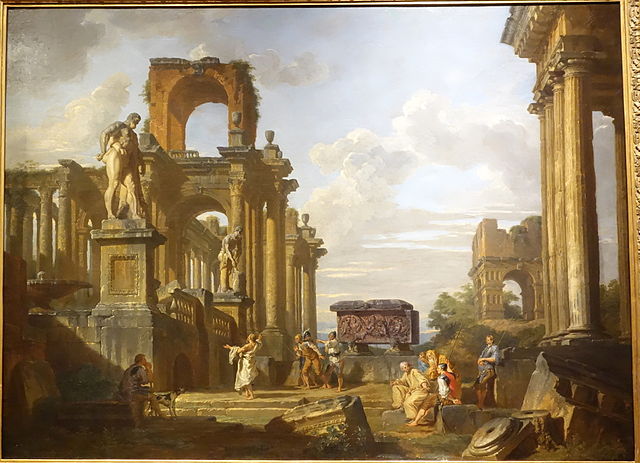
Panini, Giovanni Paolo. An Architectural Capriccio of the Roman Forum with Philosophers and Soldiers among Ancient Ruins. oil on canvas, c.  -1750 1745, https://commons.wikimedia.org/wiki/File:An_Architectural_Capriccio_of_the_Roman_Forum_with_Philosophers_and_Soldiers_among_Ancient_Ruins_…,_by_Giovanni_Paolo_Panini,_c._1745-1750,_oil_on_canvas_-_National_Museum_of_Western_Art,_Tokyo_-_DSC08515.JPG. National Museum of Western Art, Tokyo, Japan.

I posit that the Naṣarā were a type of Hanīf or Sabian that was found in pre-Islamic Arabia. Most likely remnants of Neoplatonic Mysteries from the Roman Empire, who were dispersed into Asia Minor, Persia, Arabia, and the interior of Africa. More specifically, they probably considered themselves a priestly class of the Greater Mysteries who pontificated on a number of metaphysical matters of the day, which fomented much confusion in pre-Islamic times. Let’s first look at the historical links between the Mystery Schools of Rome and religion in pre-Islamic Arabia.

Christianity and the Mystery Schools

Christianity emerged in the Roman Empire as a reviled religion, with clear Semitic roots. It was opposed by the emperors because they were considered the ultimate legal and religious authorities. They believed that there was only one religion, the Mysteries. Different schools of the Mysteries had different expressions of it based on their culture and language because religion was associated with citizenship (Ando, 2021,13). Constantine, upon his conversion to Christianity in the early 4th century was the first Roman emperor to ease the repression of Christians in the empire. By the end of the century, Theodosious would make Christianity the official religion of the Roman Empire and commence the official closing of the Mystery Schools. Justinian would continue this project of closing the Mysteries in the 6th century. In turn, many of its die-hard members who refused to convert to the state religion fled to Asia Minor, like the city of Ḥarrān, Persia, the Arabian peninsula, and the interior of Africa (Errington, 2006, 249-52).

Quraysh and the Mystery Schools

As for those who fled to the Arabian peninsula, it is possible that the Quraysh tribe was one such group. Scholars are unsure of their exact origins, but some have proposed that they were one of the groups that who fled Byzantium. This would make sense since the Quraysh only emerge in the 5th century and appear to take over the most important shrine in Arabia (Ḍayf, 1960, 49). Furthermore, prior to the prophetic mission of Muhammad, the Quraysh exhibited traits common to followers of the Mysteries. First, the Dār al-Nadwa that managed the affairs of Mecca only allowed wealthy men over the age of forty. In the Mysteries, this age was significant because it represented the age at which men attained wisdom and the position of teacher and leadership. They were also learned in advanced mathematics because they set interest rates and performed the duties of bankers. Similarly, they were also the religious authorities because they controlled the rites of the pilgrimage to the Kaʿba, which they believed to be a Saturnalia shrine. For these reasons, it is likely that there was a substantial influence on the pre-Islamic Arabs from the Ancient Mystery Schools.

Naṣārā and the Mystery Schools

When we look into the Qur’an, we find numerous mentions of Naṣārā, but never of Masīḥiyīn, a more direct translation of the word Christians. I believe this was the case because Naṣārā actually referred to a group known as the Nāṣūrati or Nasoraeans, who scholars call a Jewish-Christian Gnostic sect that emerged during the post-Christian religious milieu in the Near East (Bladel, 2017, 6). However, they are more commonly associated with the Mandaeans of southern Iraq; the only group in the world commonly labeled Sabians. Members of their priestly class are called Nasoraeans, who assiduously guard the secret rituals and doctrines of the Mandaeans, which they perceive as having a more ancient origin. Much like the Mystery Schools, the Nasoraeans function as the Greater Mysteries that requires a much more rigorous training in the secret arts, while the rank-and-file Mandaean constitutes the Lesser Mysteries that is open to those who are inclined to Gnosticism. Their doctrine consists of a worshipful regard for angels and the stars and opposition to the practice of circumcision. Indeed, they are those that many Muslim jurists, historians, and theologians identified as the last visages of the Qur’anic Sabians.

Concluding Remarks

With the above understanding, we can gather that:

1) the Nasoraeans were around and active in the Near East before and during the time of the Prophet Muhammad

2) the Nasoraeans constitute a hybrid of the Ancient Mystery Schools and Judeo-Christian beliefs and practices

3) the Nasoraean’s minority status and secretive nature explains why no “Naṣrānī” church was established in the heart of Arabia

4) if the Naṣārā are the Nasoraeans, then this is cause to reconsider the identities of the Yahūd (or “those who became Jews”) and the Majūs

Linking the Naṣārā of the Qur’an to the Nasoraeans of the Mandaean religion will introduce us to a different way of understanding certain arguments put forth in the Qur’an. I will show in future posts how verses that discuss the angels and pre-Islamic ideas about nature and prophethood are actually a polemic against the positions of the Nasoraeans. In addition, we will see that the Qur’an’s criticism of other religions is based on the degree to which they adopted beliefs associated with the Nasoraeans and other Sabians, which were remnants of the Ancient Mystery Schools in Islamic lands. The Naṣārā who were deemed as Christians were those who were closer to the Ḥanīfs in their beliefs. Not only will we witness the historical implications of this information, but we will begin to see how these doctrines continue to shape the current religious discourse.

References

Ando, Clifford. “Religious Affiliation and Political Belonging from Cicero to Theodosius.” Acta Classica, vol. 64, no. 1, 2021, pp. 9–28. https://doi.org/10.1353/acl.2021.0013.

Bladel, Kevin Thomas Van. From Sasanian Mandaeans to Ṣābians of the Marshes. Brill, 2017.

Ḍayf, Shawqi. Al-ʿAṣr al-Jāhilī. 11th ed., vol. 1, Dār al-Ma’ārif, 1960.

Errington, R. M. Roman Imperial Policy from Julian to Theodosius. University of North Carolina Press, 2006.

Islam and the Ancient Mystery Schools ( Part 9)

In the year 377 AH/987 CE, at the heart of the Abbasid Caliphate in Baghdad, a bookseller and lover of the Prophet Muhammad’s family by the name of Ibn al-Nadīm published a catalog of books that were in circulation throughout the Islamic-controlled world at the time. Al-Fihrist (The Catalog), as it was called, went beyond simply listing books and their authors, it also included a survey of scholarship in all fields of knowledge, pivotal scholars, and often times excerpts from works that may or may not be extant today. Through his work we can deduce that Muslims throughout the Ummayad period and well into the Abbasid period primarily studied the works of the ancients prior to the codification of the transmitted Islamic sciences. Al-Fihrist is cited by Islamic and western scholars alike for its information on ancient people and their knowledge. In fact, he transmits a few interesting takes on Sabianism. I will present two in this post. Then I will show how the two different narratives bring us closer to understanding the differences between the Sabians and the Ḥanīfs.

Al-Kindī’s View of Sabianism:

Al-Kindī was considered the first Arab philosopher, who took knowledge from the ancient Sabians. His student, Ahmad ibn al-Ṭayyib, recorded his description of the Sabians, which is related in al-Fihrist. To him, the Sabians were a monotheistic people who believed in a transcendent deity who was unlike His creation in every way. He selected purified individuals to be guides to people, such as Arānī, Aghāthādhīmīn, and Hirmīs (Heron, Agathodaemon, and Hermes Trismegistus), and some even included Solon, one of the grandparents of Plato. They prayed three times a day with ablution facing the North Star. They shunned people who were missing body parts or suffered from contagious diseases like leprosy. They did not eat pork and avoided some other types of meat and vegetables. (Ibn al-Nadīm, Al-Fihrist, 442-4)

Abū Saʿīd Wahb ibn Ibn Ibrāhīm

Abū Saʿīd was a Christian writer and the Christians were usually no friends of the Sabians. With this caveat, his depiction of the Sabians was completely different from al-Kindī’s. It gives a detailed account of monthly rituals, which include animal and human sacrifices to “gods, jinns, devils, and spirits.” In the month of August (Āb), they made wine to their gods and sacrificed a newborn child. They ground its flesh into powder and baked it into small disks. They then distributed these disks to all sane free male onlookers. In addition, Abū Saʿīd gives the Sabian names for the days of the week as corresponding with celestial deities, not unlike the origins of the day names used in European Romance languages (Ibn Nadīm, Al-Fihrist, 447-8).

Ethan Doyle White. Scroll of Abathur. 18th century, https://commons.wikimedia.org/w/index.php?curid=68493361. Bodleian Library.

One Eye, Two Heads: Alternating the Narratives

These two characterizations of Sabians put forth by Ibn al-Nadīm from his sources are starkly contrast. Al-Kindī depicts them as a monotheistic, gnostic, proto-Islamic group, while Abū Saʿīd depicts them as a heathenistic, pagan cult. Which characterization is correct?

I believe them both to be correct characterizations of two different Sabian factions. The former was known as Ḥanīfs and the latter retained the name of Sabian. If we look into the Qur’an, we will find 12 instances of the word Ḥanīf (plural Ḥunafā‘), most of them in reference to the Prophet Abraham (Ibrāhīm). These references contrast him to the mushrikūn (polytheists). Take Surat al-Naḥl: 120 for instance, which can be translated as: Indeed Abraham was an ummah, obedient to God as a Ḥanīf, and he was not of the polytheists. It appears to be common knowledge by anyone reading or hearing the words of the Qur’an that Abraham was not a polytheist, so why is the elaboration needed?

Apparently, the Mandaeans (known to Arabs as the only extant Sabians) have an alternate narrative of the story of Abraham in which he was on his way to becoming a high priest (Nāṣūrā’ī – more on this term later) among the Chaldean Sabians of Babylon. However, they believe he came under the possession of an evil spirit named Yūrbā who over powered him to circumcise himself. As mentioned a in al-Fihrist, Sabians believed that missing any part of the body or illness rendered a person impure, and thus Abraham was no longer qualified to become a high priest. Instead, the Mandaeans claim that he became an outcast and he was followed by lepers, amputees, and other reprobates. He then, in the name of Yūrbā, attacked the peaceful Sabians of Babylon, forcibly circumcising the men (Samak, Al-Ṣābi’ūn, 42-43).

The Qur’an is obviously seeking to clarify a narrative that was once misunderstood and continues to be misunderstood. François de Blois, a linguist of Semitic and Iranian languages and historian of ancient Near Eastern religions, notes that the cognates to Ḥanīf in Syriac, Aramaic, Mandaic, and Hebrew, hn-p, all carry negative connotations like pagan, false god, hypocrite, and pollution (Blois, Naṣrānī and Ḥanīf, 19). It was only the Arabic of the Qur’an that converted it to a positive meaning. We have seen how a look into the Sabian narrative adds another dimension to our understanding of the word Ḥanīf as used in the Qur’an, as well as the lines of division in the Ancient Mystery Schools. Reading into this narrative can also do the same for the use of the word Naṣarā as we will see in future posts.

References

Blois, François de. “Naṣrānī (Ναζωραȋος) and Ḥanīf (Ἐθνικός): Studies on the Religious Vocabulary of Christianity and of Islam.” Bulletin of the School of Oriental and African Studies, University of London, vol. 65, no. 1, 2002, pp. 1–30.

Ibn Nadīm, Abū al-Faraj Muḥammad ibn Isḥaq. Al-Fihrist. Dar al-Ma’rifah, 937. http://archive.org/details/alfihrist-alma3rifa.

Samak, ʿAbdullah ʿAlī. Al-Ṣābiʼūn. 1st ed., Maktabat al-Ādāb, 1995.

Islam and the Ancient Mystery Schools (Part 6)

In my post, Islam and the Ancient Mystery Schools (Part 5), I stated the theory of the contemporary Iraqi thinker, Fadil al-Rabi’i, that identified the Nasara of the Qur’an as the Hanifs. In this post, I will examine the linguistic evidence for his theory.

Raphael Tuck & Sons, The Holy Land. Nazareth, Fountain of the Virgin, Post Card, 1903, The Newberry Library, https://archive.org/details/nby_LL8170/page/n1/mode/1up.

Al-Rabi’i is from the line of scholarship that does not believe that the prophet ‘Isa/Jesus (peace be upon him) was from Palestine. Therefore, he rejects the claim that the word Nasara is related to the Palestinian town of Nazareth, the purported birthplace of ‘Isa. If this was the case, he argues, then everyone from this area would be called Nasara regardless of their religious affiliation. Jews, pagans, and other religious groups who happened to be from this town will thus be labeled Nasara, but this was never the case.

He subsequently follows up on the problematic etymology of the word initiated by Arabic language scholars such as Ibn Manzur (d. 1311/1312), author of the authoritative Arabic lexicon, Lisan al-“Arab. Al-Rabi’i finds doubt in Ibn Manzur’s treatment of the word. When discussing the words Nazareth and Nasara under the root nasara (ن – ص – ر), Ibn Manzur adds the statement of Ibn Sidah’s that this is a weak opinion and rare for a relative adjective (nisba) to take this form.

In addition, al-Rabi’i identifies the verb, ansara (أنصر), to be uncircumcised, as the origin of the word Nasara. In a hadith of the Prophet Muhammad (prayers and peace be upon him), he stated:

You should not let an uncircumcised man lead you, nor one who holds his bladder or one who is habitually delusional.

The word anṣar, as used in this hadith, means uncircumcised. Al-Rabi’i believes that the word Nasara is really derived from this aspect of the word and was thus used for any group that did not practice circumcision. These groups sought to distinguish themselves from the Jews. Although, it was used for Christians and pagans who did not practice circumcision, it remained a term reserved for the Christians who continued not to practice it or did not see it as a religious duty.

Interestingly, some Arab tribes who rejected circumcision, practiced slitting the ears of a she-camel as a symbolic alternative to circumcision. This can be witnessed in the practice of the people of Salih, who were commanded not to abuse the she-camel that God provided to them.[1]

While al-Rabi’i makes some convincing claims, he also complicates our understanding of the Hanifs. According to this information, the Hanifs, if synonymous with Nasara, did not systematically practice circumcision as is commonly thought. Rather, it was left optional, leaving some to continue the practice and others to abandon it altogether. Al-Rabi’i’s theory is significant to unfolding the mystery of the Hanifs, but it is not conclusive. Yet no conversation on pre-Islamic religious history can be complete without an exploration of Sabianism, which I will undertake in a future post.

[1] Fadel al-Rabi’i, Al-Masih al-Arabi: Al-Nasraniyyah Fi al-Jazira al-Arabiyya Wa al-Sira’ al-Bizanti al-Farisi (Beirut: Riad El-Rayyes Books, 2009), 27-31.