The Myth of “Arabized Islam” & Other Fallacies of Pseudo-Islam (Part 3)

There are a multitude of scholarly opinions in the tradition of Islam about a number of matters: who were the Ṣābi’ūn, what is the nature of prophecy, and what are the parameters of Sufism? Unfortunately, Kemetian Adept’s depiction of these are not represented in this scholarly tradition. In this post, I will not only demonstrate that his ideas have no merit, but I will show that he is clearly not qualified to speak on these topics.

Sabianism

Abdullah Samak presents seven opinions on the meaning of the word Ṣābi’. I will enumerate them in brief below:

  1. It is an Arabic word meaning to exit, convert, change, or switch religions.
  2. It is an Arabic word meaning to incline, detract, or long for (usually associated with young children).
  3. It is of Aramaic origin meaning to be submerged in water, bathe, purify, or baptize.
  4. It is of Hebrew origin meaning to cover in water.
  5. It is derived from the Hebrew word Ṣabāwūth, meaning warriors of the sky (i.e., the stars).
  6. It is derived from the names of two people mentioned in history: 1) Ṣābī the son of Methusaleh and 2) Ṣābī ibn Mārī, a contemporary of Abraham.
  7. It is related to the Yemeni city of Saba (Sheba) mentioned in the Qur’an, but this is an obvious mistake in Arabic because the words have two different etymologies (س rather than ص).
Kemetian promotes erroneous ideas about the Qur’an, Sabianism, and much more.

In one video, Kemetian admits that he and his brand of MST are Moors are Sabians, but it is obvious that he does not understand the implications of this claim. He attempts to provide his own interpretation of al-Baqarah: 62. He clumsily reads through the Arabic and comes to the word “Ṣābi’īn.” He starts to pontificate on his interpretation of the verse. He accuses “the Arab” of going against the meaning of this verse. Again, he makes another straw man argument, insinuating that Arab Muslims tell Christians that they are going to hell for what they believe in. While some individuals might have done this, it has never been the manner of Muslims (Arab or otherwise) to condemn Christians to hell.

The meaning of the al-Baqarah: 62 is that those amongst those who claim to be Jews, Christians, and Sabians who believe in God according to the teachings of the Prophet Muhammad, believe in the Last Day (as opposed to the eternity of the universe), and work deeds of righteousness they should not worry about the future nor should they grieve about their past. This is the traditional understanding of the verse. It is not a confirmation of all the beliefs of the above-mentioned classifications.

While insisting that “our ancestors” were the Sabians, not only does he reveal his lack of understanding of who the Sabians were, but also his lack of knowledge of the Arabic language. He corresponds the Ṣābi’īn mentioned in al-Baqarah: 62 with the people of Saba’ for which the 34th chapter of the Qur’an is named. This is a layman’s mistake, as mentioned by Samak. Although the two words look similar in English, they have two different roots in Arabic. He mischaracterizes the chapter Saba’ from the Qur’an, claiming that it gives a history of the Sabian people and how they went astray. This is not accurate. The Qur’an is not a history book and only scantly touches on the history of Saba’, who we know as the people of Sheba. Furthermore, if the Qur’an is describing how the Sabians went astray by being ungrateful, this would contradict his understanding of al-Baqarah: 62, which he claims validates the beliefs of all different religions.

He also claims that Sheba (Saba’) is where the word Shabazz comes from. This is yet another linguistic slip up. For one, its usage can be attributed to Fard Muhammad in the 120 Lessons in the early 20th century. However, its etymology is not known. We can say that it is most likely from the Persian shah baz, falcon king, but we cannot definitively claim its origin without solid historical evidence. Kemetian’s attempt to draw some connection between Sheba and Shabazz is pure speculation.

Prophecy

Kemetian attempts to use al-Naḥl: 89 to dispute the notion that the Prophet Muhammad was the last of the prophets. He claims that this verse alludes to God sending a prophet to every people from among themselves. In his teaching, a prophet is “a thought of Allah made manifest in the flesh,” a definition that has no basis in the Qur’an.

While his reading of the verse and its accompanying diatribe sounds as if he has definitively contradicted the orthodox view of Islam, he parades his fallacy in front of us as he fumbles through a reading of the word shahīd. No where in the verse is the word nabī (prophet) or rasūl (messenger) mentioned. A shahīd is not a prophet, but a prophet can be a shahīd. The explanation of the verse lies in knowing other verses from the Qur’an. For instance, al-Baqarah: 143 states: As such, We have made you a just ummah (religion/nation/epoch) in order to be witnesses over people, and the Messenger (Muhammad, not Drew Ali) is a witness over you…

Muhammad al-Qurṭubī, a true Moorish scholar of Islam who died in 1273, stated that the meaning of the verse was on that day (i.e., the Day of Judgment), God will bring forth in every ummah a witness from among themselves; they are the prophets who testify (i.e., bare witness) that they have conveyed the message from God to their respective ummahs and called them to faith. In every time there is a witness even if there is no prophet.

In other places in the Qur’an, God explains the people upon whom His grace is bestowed, as is repeated by Muslims in their reading of al-Fātiḥah. They are: al-nabīyyīn, al-ṣiddiqīn, al-shuhadā’, and al-ṣāliḥīn as explicated in al-Nisā: 69. These are clearly separate levels of people who will receive God’s grace. According to the exegete ʿAbd al-Raḥmān al-Saʿdī, everyone who obeys Allah and His messenger according to his state and measure of what is incumbent upon him – whether male or female, young or old – those are the people that God will bestow His greatest blessings upon. This blessing brings the highest level of perfection, success, and felicity.

The prophets are those who Allah has favored with revelation to call people to faith in God (not Kemetian’s made up definition). The affirmers of truth are those who affirmed what the prophet has taught with certainty and acted upon that truth with everything they had. The witnesses or martyrs are those who have fought to raise the word of God and died in the process. The righteous are those whose inner states are purified and matches their outward behavior. All of these people will be granted the company of each other in paradise.

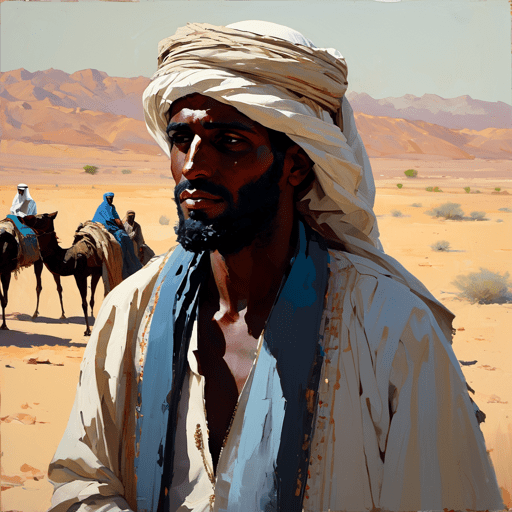
The verse was revealed to console the deep-rooted longing of Muhammad’s disciples to dwell with him eternally in paradise, which is a level of love and spirituality that the likes of Kemetian cannot comprehend because his understanding of Islam is too shallow. A true Muslim can connect to the Prophet Muhammad by following his Sunnah and through remembrance. Many Muslims see him in dreams and in an awakened state and continue to receive guidance and blessings from him to this day.

AI generated image with Hotpot.

Sufism

With regards to taṣawwuf, it is clear that Kemetian has no conception of it. Rather, he follows the footsteps of many Western Orientalists who deemed taṣawwuf as an Islamic form of “mysticism” and the pursuit of paranormal phenomena. This was the opinion of European Orientalists Henri Bergson and Reynold Nicholson. Rene Guenon, however, challenged them on the ground that mysticism is a Western concept equivalent to heresy, magic, occultism, which only leads to confusion and distraction from the true path of esoteric knowledge (i.e., taṣawwuf).

On the topic of Dhū al-Nūn, Kemetian contends that he was not Muslim and supposedly practiced ancient Egyptian mysticism which he inherited from Tahuti. In turn, he uses these baseless claims to assert that taṣawwuf is not Islam. I happened to write a paper for graduate school refuting this Orientalist view of mysticism, who attempted to change Dhū al-Nūn from a pious Muslim ascetic to a syncretic mystic. Nicholson characterized Dhū al-Nūn as a mystic, moving a sofa with his thoughts, which caused spectators to die out of astonishment. Yet I found none of this in his earliest biographical sources: Ṭabaqāt al-Ṣūfīyya by Abū ‘Abd al-Raḥmān al-Sullamī (d. 412/1021), Ḥilyat al-Awliyāʾ wa Ṭabaqāt al-Aṣfiyāʾ by Abū Nuʿaym al-Iṣfahānī (d. 430/1039), and al-Ṭabaqāt al-Kubrā al-Musammā Lawāqiḥ al-Anwār al-Qudusīyya fī Manāqib al-‘Ulamā wa’l-Sūfīyya by ‘Abd al-Wahhāb al- Sha’rānī (d. 973/1565).

From these works we can ascertain that Dhū al-Nūn was clearly an Islamic scholar who is listed in the chains of hadith narrators along with Mālik ibn Anas, Layth ibn Sa’d, and Sufyān ibn ‘Uyayna, a science Kemetian rejects. Al-Sullamī confirmed that he was a Nubian from Akhmīm, a city in the Sohag state of Upper Egypt. This is a site of ancient Egyptian temples, but the biographers do not relate much information about his background. They only relate that he his teachings as a true Sufi. He emphasized divine love (maḥabba), humility (tawāḍu’), repentance (tawba), sincerity (ikhlās), solitude (waḥda), and truthfulness (ṣidq). Furthermore, he stressed that people not make claims to gnosis (maʿrifa), which is a trope of Sabian groups who believe they have some secret knowledge that is not attainable by all people.

Al-Sha’rānī relates Dhū al-Nūn’s encounter with the Abbasid caliph al-Mutawakkil, which demonstrates his brand of Sufism. After being accused of heresy, he was marched to Baghdad in chains. On the way, an old woman advised him not to be in awe of the caliph nor to look down on him or argue his case. Dhū al-Nūn thus avoided responding to the accusations. When asked why he did not answer, he said that if he denied the claims he would have made liars of Muslims, and if he confirmed them, then he would have lied about himself. So he left the decision up to the caliph. Upon hearing this al-Mutawakkil declared him innocent.

There was nothing “mystical” about Dhū al-Nūn’s Sufism and there is nothing to suggest that he secretly practiced ancient Egyptian mysticism. His earliest biographers reported about his loyalty to Islam and Sufism and did not report instances of telekinesis and other paranormal activity. Therefore, how can a 20th century European writer with no ties to Sufism bring a new report about him? It is clear that Kemetian is citing the European tradition of mysticism and not the African tradition of Sufism with regards to Dhū al-Nūn.

Kemetian presents the Orientalist perspective on Dhū al-Nūn.

Conclusion

The ability to create YouTube channels and gain recognition from less informed people has emboldened people to share half-baked theories and misinformation on the web. No qualifications or prior experience needed. It is noble the Mr. Kemetian is compiling information and pondering these topics, but his level of knowledge is premature and lacks the proper orientation. His information is faulty because he is not qualified to speak on much of what he claims to know. Experts can easily recognize other experts and he is surely not one of them. This is just a warning: although internet Sabians may seem smart and dazzling, it is important to supplement one’s understanding with actual source materials on the given topic and consult with experts. Or else you will be deceived into the crooked path of modern Sabianism.

References:

Guenon, Rene. Perspectives on Initiation. Edited by Samuel D. Fohr, Translated by Henry D. Fohr, Sophia Perennis, 1946.

Guenon, Rene. The Crisis of the Modern World. Translated by Marco Pallis et al., Sophia Perennis, 1946.

Iṣfahānī, Abū Nuʿaym al-. Ḥilyat Al-Awliyāʾ Wa Ṭabaqāt al-Aṣfiyāʾ. Dār al-Fikr, 1996.

Nicholson, Reynold Alleyne, et al. The Mystics of Islam. G. Bell and Sons, 1914.

Qurṭubī, Abū ʿAbd Allah Muḥammad ibn ʾAẖmad al-ʾAnṣārī. Al-Jāmiʿ Li ’Aḥkām al-Qur’ān. Dar Alam al-Kutub, 2003.

Samak, ʿAbdullah ʿAlī. Al-Ṣābiʼūn. 1st ed., Maktabat al-Ādāb, 1995.

Sha’rānī, ’Abd al-Wahhāb. Lawāqiḥ Al-Anwār al-Qudusīyya Fī Manāqib al-ʿUlamā Wa al-Ṣūfīyya. Maktabat al-Thaqāfa al-Dīnīyya, 2005.

Sullamī, Abū ’Abd al-Raḥmān al-. Ṭabaqāt Al-Ṣūfīyya. Maktabat al-Khanji, 1986.
The Myth of “Arabized Islam” & Other Fallacies of Pseudo-Islam (Part 2)

The charge that “orthodox” Islam is Arabism or Arab Islam is based on ignorance and prejudice. It’s based on an ignorance of Islamic history and prejudice against people who identify as Arabs. On top of that, it is based on ad populum rhetoric, which is a type of logical fallacy that seeks to sway people to their opinion, not by engaging the merits of the ideas, but by stirring up prejudice against a people that they know their audience might dislike.

The facts, however, are against Kemetian. Some of the greatest scholars of Islam throughout history have not been Arab. Someone like Sībawayh, who wrote one of the most definitive works on Arabic grammar, was a Persian. Likewise, Abū Ḥāmid al-Ghazālī who wrote on numerous subjects such as philosophy, Islamic law, and Sufism was also Persian. Al-Buṣīrī the poet who wrote the Sufi Burdah poem in honor of the Prophet Muhammad was a real Moor from the Ṣanhājah Berber tribe.

Kemetian conflates a traditional understanding of Islam from its historical sources with Arabism. He does this to make you doubt  its veracity while promoting his non-historical personal understanding of religion. Traditional Islamic scholarship has a system of checks and balances to ensure no one makes up deviant doctrines according to their own preferences based on scriptural and textual evidence. The MST is in shambles precisely because they have no such mechanism. Yet, this is the nature of Sabianism. As the Christian heresiographer, Irenaeus, said of the early Christian Sabian groups:

…many offshoots of many heresies have come into existence because many-or indeed all -of them wish to be teachers and to leave the sect in which they were ; composing another doctrine from another opinion, and then another from another, they drive onwards to teach in a new way, describing themselves as the discoverers of whatever opinion they have concocted.

(Grant, R. 1978, p. 47)
AI generated image from Hotpot

As for Kemetian’s prejudice against Arabs, it is indicative of many in the so-called conscious community. They match a contemporary post-9/11 image of Arabs with their misreadings of history. The truth is that the Arab identity is much like the Latin identity, in which people of different races, ethnicities and geographies are connected through a common cultural-linguistic identity. Ignorant Blacks who only know the racial constructs of the United States often do not understand this fact and constantly try to force others into their own racial paradigm. Furthermore, these so called conscious folk have no sense of the religious, ethnic, and linguistic diversity in the Arab world, which consists of Nubians, Copts, Berbers, Kurds, Armenians, and Chaldeans to name a few. All Black Americans can see is black and white.

Additionally, there is nothing inherently wrong with being Arab no more than there is anything wrong with being African. Anyone who has ever lived in or visited regular people in the Arab world would know that the vast majority of them exhibit manners that the average American can only dream about. They are very hospitable, generous, and genuinely friendly. Perhaps the marketplace, in traffic, or politics are not the best places to witness these good manners, but they are there. They are not without their prejudices, but their prejudices are commonly directed at other Arabs, Jews, and SubSaharan Africans. Yet when Arabs are confronted about their prejudices, they usually back down.

Much of the Muslim world might hold Arabness in some esteem because of their love for the Prophet Muhammad and his family, who were Arabs. That aside, the Muslim world has not been dominated by Arabs since the Umayyad dynasty. it must be noted that only 20% of the Muslim world is Arab. The majority of the world’s Muslims are in Asia and their scholars have had a great influence on the Muslim world for centuries. Why aren’t the pseudo-Muslims decrying an Asian Islam?

The erroneous idea that Arabs run everything in Islam just like Europeans run Christianity is a false analogy and just plain wrong. For instance, black and white orientalists talk about an Arab slave trade, but never a European slave trade. They think that because Arabs were involved, they must have run it. Ignoring the fact that slave trading has always existed in the region and involved Arabs, Africans, Persians, Indians, Turks, and more. Moreover, the enslaved were not only black, but from these various races as well. This does not excuse any atrocities committed by Arabs or other people. It only serves to disrupt the narrative that so-called white Moors (i.e., Arabs) enslaved black Moors. Dark skin people are not the perennial victims of history.

The charge from Moors, NOI, Nuwaupians, Afrocentrics, and other so-called conscious groups that orthodox Muslims follow an “Arabized Islam” is baseless, which exposes their lack of knowledge and bigotry. It is simply a flimsy argument they use to keep from discussing Islam on its own terms. If anything, orthodox Islam reflects intergenerational, interethnic, intercivilizational, and international networks of knowledge that is not rivaled by any religious system today. In the next part of this series, I will address some of the specific fallacies Neo-Sabians fall into when approaching Islamic concepts, which cause them to completely misunderstand the religion.

The Myth of “Arabized Islam” & Other Fallacies of Pseudo-Islam (Part 1)

Whoever the Most High is a witness for Truth, he need not claim it. The claim is a sign of his veiling from Truth and Peace.

A quote from dhū al-nūn from al-Sha’rānī, ’Abd al-Wahhāb. Lawāqiḥ Al-Anwār al-Qudusīyya Fī Manāqib al-ʿUlamā Wa al-Ṣūfīyya. Maktabat al-Thaqāfa al-Dīnīyya, 2005, p. 129.

In recent years, the Moorish Science Temple (MST) has become one of the many groups on the conscious chit’lin circuit; some of them Hanifs, most of them Sabians. Unfortunately, the unscrupulous reader might mistake the Sabians among them for Muslims or, even worse, a factual representation of history. As a Muslim researcher with a specialization in the Arabic language and Islamic history, it is my responsibility to debunk the bogus claims propagated by such groups.

In one recent YouTube presentation on TITANS TV, a Moorish Science researcher and self-proclaimed Arabic teacher by the name of Kemetian Adept Hieruphant attempted to advocate for his Sabian-inspired MST doctrine using George G. M. James’ Stolen Legacy, orientalist mythology about the Egyptian Sufi, Dhū al-Nūn (more on this in another post), and a hodgepodge of information to confuse you. I beseech the reader not to confuse claims to knowledge for actual knowledge, as was the message of Dhū al-Nūn. In this post, I will focus on deconstructing Kemetian’s treatment of Stolen Legacy and the history of the Moors.  

While Kemetian uncritically accepts James’ thesis, he provides little to no detail to demonstrate the MST position. Kemetian throws a lot of images and texts at you, but his attempt to connect the so-called Moors to the ancient Egyptians is weak because it has no basis in the actual history of North Africa or the Islamic world. He, like many so-called conscious folk, suffers from debilitating confirmation bias; believing his point of view is the only way of seeing the information. Why does he perpetuate a bogus conspiracy theory about the death of James? (A past professor of mine researched and debunked this claim) Why does he think that by virtue of genetic lineage he has a rightful claim to the knowledge of ancient Kemet without actually studying it? And what is a mystery school today other than a university? Kemetian’s misinformation not only reduces his credibility but also the credibility of anyone who takes this topic seriously.

Kemetian Adept | Moors Custodians Of Kemet’s Wisdom Teachings

George GM James’ Misunderstood Stolen Legacy

Kemetian introduces his presentation with the passage from Stolen Legacy that opens Islam and the Ancient Mysteries Vol. 1. In my book, I put forth a better way to understand James’ thesis, which lies in answering three main questions:

  1. Who were the Moors discussed by James.
  2. What knowledge did the ancient Egyptians possess?
  3. How did the Moors acquire ancient Egyptian knowledge?

First, the Moors of history were not followers of Noble Drew Ali or members of an organization called the Moorish Science Temple. “Moor” was an epithet used by Europeans during the Middle Ages to refer to people with dark features and Muslims in general, and North African Muslims specifically. Whatever its original meaning, it was lost on European people by the Middle Ages. They were not calling North African Muslims “gods” or anything of that nature.

If we take the European usage of Moor at face value, it means someone who is dark (relative to the average European phenotype) and/or from North Africa and/or Muslim. This is a broad span of people, which can encompass SubSaharans, Berbers, Arabs, Persians, and Indians and often times it has referred to Jews, Christians, and Muslims living in Muslim-controlled lands.

Johannes Andreas Maurus, a Spanish convert from Islam to Christianity (original pen and ink drawing by Maurice Hines)

Secondly, we must have an understanding of what knowledge was attributed to the ancient Egyptians. While James touches on this, he is not completely clear as to what that knowledge was. On the one hand, James characterizes this ancient knowledge as a secret, exclusively for Egyptians, transmitted orally from teacher to student, and forbidden to be written down. On the other hand, he writes that this knowledge was kept in books at temples and libraries, which were eventually copied and plagiarized by the Greeks (particularly Aristotle), and then they became the domain of the Greeks, Freemasons, Theosophists, and occultists. How James deduces this can be challenged on the grounds that he retrofits the concepts of contemporary esoteric movements on to ancient Egyptian Mystery Schools. This is only James’ speculation, not concrete proof.

Additionally, James reconstructs the ancient Egyptian curriculum using a mixture of Christian and pre-Christian Greek sources, whose works he sees to be untrustworthy since the pre-Christian Greeks allegedly stole knowledge from the Egyptian Mysteries and the Christians attempted to annihilate them. Nevertheless, the curriculum according to James was made up of the seven liberal arts, secret languages and mathematical symbolism, as well as magic. This included memorizing the books of Hermes that teach the hieroglyphs, cosmography, geography, astronomy, typography, how to slaughter animals, law, theology, medicine, among other subjects.

Many of these subjects where known and practiced all over the ancient world including ancient Babylon and India, as James alludes to, as well as in Europe and the Americas. There simply is no concrete proof that this curriculum originated in Egypt, no matter how much we want to believe it. In one aspect, it was a secret that died with the last Egyptian priest. Any other empirical knowledge they developed could also be reconstructed by other people with similar aims. Not only that, but both the Islamic civilization and later the current European civilization surpassed the ancient Egyptians in the empirical sciences (no matter what our criticisms of those civilizations are). It is also much more logical and backed by evidence to think that the world’s knowledge was an intergenerational, multi-ethnic collective effort rather than the work of one people.

Finally, how did ancient knowledge transfer to the the hands of the so-called Moors and then to Western Europe? I demonstrate this process in Islam and the Ancient Mysteries Vol. 1. I firmly demonstrate that Muslim civilization under the Hanif creed absorbed the knowledge of ancient Near East, serving as a bridge between the ancient and modern world. The following is a summary of this history.

The True History of the Moors

What’s lost on Kemetian and the Moors are the key players in history that represented this passage of knowledge. If we were to question MST folk to name some of the Moors who conveyed knowledge from the ancient Mysteries, they would be hard pressed to name one. Yet, I have researched several of them for my book: the Ḥarrānian Thābit ibn Qurrah, the Persian family Āli Nawbakht, the Abbasid Translation Movement, and particular Muslim philosophers like Ibn Sina, al-Ghazali, and Ibn Rushd and their respective philosophical positions. There are countless more that historians have researched.

A synopsis of this history starts with the decline of the Mysteries, prior to Christianity. In the Greco-Persian wars, Alexander massacred Iran and sought to extinguish the Persian-Babylonian Mysteries and the knowledge they acquired. He brought their manuscripts to current-day Egypt and had them translated into Greek and Coptic and destroyed the Persian originals. The Greeks were therefore consolidating the knowledge of ancient Egypt and Babylon. As of the 4th and 3rd centuries BCE, this knowledge was most readily available in Greek and Coptic (an advanced form of the ancient Egyptian language).

Christianity was a Hanif system that challenged the Sabianism that proliferated among Judaism and the so-called Philosophers. The disciples spread the monotheistic message of Jesus, which eventually became mixed with the ideas of gnostics (i.e. Sabians), such as Simon Magus, Menander, and yes, Paul. The early scholars of Christianity were educated in the schools of the Greeks and were able to argue the Sabians in their own terms. Though the Christians opposed the Sabians, they ended up absorbing much of the ancient knowledge in the Eastern Church, which split from the Western Church relatively early in the history of Christiandom.

In the meanwhile, the Persians sought to reconstruct their mysteries by reviving the manuscripts found at the extremities of the Persian empire near India and China. They were open to various sects of Christianity such as the Nestorians. Many of those Christians preserved ancient knowledge they inherited from the Greeks in the Syriac language. By the time the Muslims conquered, these works began to be translated into Arabic. This proliferated during the Abbasid Caliphate that funded the Translation Movement; translating the works of the ancient mysteries primarily from Greek, Syriac, and Persian, because knowledge from the ancient world was largely consolidated in these languages.

While the likes of Thābit ibn Qurrah, the Nawbakht family, and Ibn Muqaffaʿ played key roles in this Translation Movement, the effort cannot be attributed to one tribe, ethnic group, race, or religion. Thābit’s ethnicity cannot be ascertained although he was a native Syriac speaker and also spoke Greek and Arabic. The Nawbakht family were from a lineage of Persian Magians who specialized in astrology. Likewise, Ibn Muqaffaʿ was a Persian litterateur responsible for translating numerous books from the Persian and Indian literary heritage. Muslim and Arabic-speaking scholars of other faiths engaged these works for nearly a millennium, including the questionable works on astrology and magic. Yet, the most controversial issues centered on the philosophical concepts of the creation of the universe, pantheism, and the like, which I covered in the post Is God the Universe?  

Social media scholars from the MST and other so-called conscious groups cannot accurately describe how or why this passed from Muslim lands to Western Europe. The Christian Crusades against Muslims began in the 11th century, at the height of the Translation Movement. One should also observe that during this time, many Europeans were “orientalists,” meaning that they admired Arabic language, culture, and knowledge; see (Burnett, 2008, p. 22). Many in Western Europe, who have long since been cut off from the ancient Greeks, rediscovered the knowledge compiled in Greek through Arabic. As political enmity grew between Western European Christiandom and Islamdom, the intellectual affinity grew. One might notice that some of the most erudite scholars from Andalus, migrated to Egypt during the Inquisitions such as al-Qurṭubī and Abū Ḥayyān al-Andalusī, etc. Khaled El-Rouayheb performed an excellent study on the influence of Maghribī scholars on theology and logic in Ottoman-controlled Egypt and prior. Many of whom were from the Ṣanhajah Berber ethnic group.

No narrative about the Moors’ passage of knowledge to Europe would be complete without mentioning the 12th century CE polymath Ibn Rushd (the grandson). In addition to being from a scholarly lineage based in Córdoba, he was a jurist, physician, and Aristotelian philosopher. In fact, he was known as the chief commentator on the works attributed to Aristotle. The untrained reader must remember that Aristotelian philosophy was at the core of Sabian doctrine, which was a proponent of the eternity of the universe. Ibn Rushd wrote a vehement defense of philosophy and Aristotelian concepts in his Faṣl al-Maqāl and Tahāfut al-Tahāfut against Abū Ḥāmid al-Ghazālī’s Tahāfut al-Filāsifah. Although Ibn Rushd’s positions were rejected by most Muslim scholars, many European orientalists were enamored with his works. This even prompted the Christian theologian, Thomas Aquinas to write a response opposing the eternity of the universe.

Conclusion

The perspectives propagated by the Sabian factions of the MST amounts to nothing short of pseudoscience and a creative re-telling of history. Only simpletons are impressed. History does not begin with the interpretations of pseudo-scholars, but the collective evidence established by a body of researchers. Unfortunately, the MST lacks members who have advanced through the degrees of scholarship: sufficient tertiary education, specializations, peer-reviewed publications, academic integrity and humility, etc. Furthermore, there is nothing novel about their teachings. Their teachings are simply Sabian-Noir doctrines; the same doctrines that have confused our people for generations. In another post, I will unravel some of their doctrines and their erroneous characterizations of Sufism.

Islam and the Ancient Mystery Schools Part 12

I would like to return to my original thesis that was sparked by George G.M. James’ Stolen Legacy several years ago (see Islam and the Ancient Mysteries Part 1and Part 2). Although this thesis has undergone modifications since I began my research, the premise has remained the same. In the midst of this series I have found that the word Ṣābi’a is the general term in Arabic for the Ancient Mystery Schools, while theorizing that other terms such as Naṣārā and Chaldean refer to the leaders of temporal and geographic Mystery Schools. In the following post, I will summarize my theory and trace the genealogy of Sabian/Mystery School thought to this day.

Islam and the Revival of the Ancient Mysteries

The Sabians mentioned throughout classical Arabic literature are what the Greeks called the Mysteries. Like the Jews and Christians before them, the Muslims wrestled with the perceived harms and benefits of Sabian thought. On the one hand, the scriptures of the Abrahamic traditions were deeply critical of the theological distortions in Sabian doctrine. Abrahamic doctrines and rituals were in response to the beliefs and practices of the Sabians, which opened up the gates of polytheism among the unlearned laymen. On the other hand, the Sabians had benefited the world by their advances in other areas of human knowledge. The Abbasid Caliphate, like Eastern Christianity, came to terms with the knowledge produced by the Sabians. However, the Muslims strived not to take the road of the Christians, whose doctrine ultimately succumbed to the philosophical influences of the Sabians.

What we witness from the 9th to 11th century in the Islamic world with the codification of both traditional religious knowledge as well as the translation of ancient empirical and occult texts, is a race to retain knowledge of the Prophet Muhammad, while also reviving the knowledge of the Sabians (i.e. the Mystery Schools). The Islamic empire and its scholars sought to uphold the Abrahamic doctrine in the face of Sabian doctrine by calling people to Islam and granting protection (i.e. dhimmi status) to the People of the Book, i.e. Jews and Christians. At the same time, they were vehemently opposed to the polytheistic elements of Sabian thought.

As such, the Muslims had revived the Mystery Schools under the Abrahamic creed of Islam. This, however, was not without its conflicts. As certain groups of Muslims had the tendency to slip back into the beliefs of the Sabians, such as:

  • The Khawārij, who embraced the Stoic (Mystery School) concept of perfection and sinlessness as a sign of righteousness.
  • The Muʿtazilites would later stress the primacy of reason over revelation, which placed the philosopher sage on level with and sometimes over the prophets and rekindle the notion that human beings attain prophethood through their own efforts and merits rather than the grace and ordinance of God.
  • Al-Ghazālī’s criticism of the Muslim philosophers (primarily Ibn Sīnā) in his Incoherence of the Philosophers, identifies certain ancient beliefs held by these philosophers, which he believes led them to apostasy. This, while maintaining the utility of ancient Sabian empirical knowledge.
  • Ibn Rushd (Averroes) would later take issue with al-Ghazālī’s conclusions, claiming that the “craft of ḥikma” (wisdom/ancient knowledge) needed to be passed down like any other craft.

Ibn Rushd’s defense of Sabian philosophy would be rejected or ignored by the greater Muslim world, but the means by which Sabian knowledge would gain interest and popularity in Western Europe.

Modern Day Mysteries

In the last few centuries, Western civilization has become the battleground between Abrahamic and Sabian thought since the so-called European Renaissance. As such, Renè Guenon considered the beginning of the West’s decline to be Renè Descartes’ hyper-skepticism. Even as the West was philosophizing itself out of the Abrahamic tradition, it was making a dash for Eastern empirical and esoteric knowledge, which they harbored in their secret societies. This would lead to the separation of religion from science, politics, sociology, and the many other sciences needed for human civilization.

In the 20th century, Western philosophy and esotericism trickled down to the populace by way of clandestine organizations, theosophy, and counterculture movements. In no place were these ideas more prevalent than in the United States. As a result, we witness Sabian thought proliferate in the society everyday. More specifically, Sabian thought has entered African American communities through such groups as the Moorish Science Temple, the Nation of Islam, the Five Percenters, Nuwaubians, and Afrocentrists. All of these groups have explicitly or implicitly embraced the erroneous notion that they can reconstruct the Mystery Schools. I understand that this is a bold claim, but I will show the parallels between their theosophies and ancient Sabian thought. I will argue that they based their movements on incomplete knowledge of the ancient Mysteries because they did not received their knowledge through an unbroken chain of living teachers. This knowledge of the Mysteries/Sabians has been filtered by the Abrahamic faiths, primarily Islam in the current day, and cannot be accessed except through these traditional channels.

The Truth of Translation: The Sunni – Moorish Debate

On Apr 19, 2022, a livestream debate between the Baltimore-based Moorish Science Temple representative, Taharka Bey, and the D.C. area-based Sunni Muslim, Tariq Ibn Jamil, was posted to the Moorish World Tv YouTube channel. The stated topic was “Can the Qur’an be translated?” With Tariq arguing the affirmative and Taharka arguing the negative. I find in this debate many teachable moments in terms of Islamic literacy, linguistics, the rules of engagement with regards to intellectual debate, and simple logic.

After hearing both sides of the core debate (there are many tangential debates), I will have to say that Taharka Bey is the victor for reasons that I will explore in this post.

Taharka Bey’s Argument

Taharka’s presentation of his position was stronger due to some key strategies that are align with sound scholarship and argumentation, which I will enumerate below. I will also point out flaws in his argument and gaps in his knowledge.

1) He argued the majority opinion.

The common position of Muslims is that the Qur’an is inimitable and it cannot be precisely translated, only explained through the lens of a combination of auxiliary sciences, not the least of which is Arabic linguistics. Arguing the majority opinion has its benefits in a debate. It makes supporting evidence easier to access and counterarguments easier to make because predecessors have already done the work.

2) He had a logical sequence.

Taharka has a clear logic. He begins by stating his premise, which is that in the “Common Tradition:”

Any translation of the Quran will be termed inauthentic if it goes against the established hadith (sayings and actions) of the Prophet and against the understandings of the companions of the Prophet.

45:00

According to the epistemology of Black Orientalists, transmitted reports are not valid evidence of a fact, which is diametrically opposed to the underlying epistemology of hadith science. Orientalists often use this as the first mode of attack, because in the modern age, oral transmissions are no longer perceived as valid. They prefer written evidence and documentation.

He uses this premise to make a number of points, before moving on to his next point:

In order to extrapolate the meaning of a particular Quranic verse, Muslims rely on exegesis, or commentary rather than a direct translation of the text.

49:00

He then makes a distinction between exegesis/commentary and translation. For instance, he takes a number of different English translations of a verse that uses the word taqwā to demonstrate that the various translators are making an exegesis of the word, because there is no direct equivalent in English.

2) He used substantial evidence that was relevant to the argument he was attempting to make.

Taharka’s used a mixture of primary and secondary source evidence. The examples of Qur’anic words without easy English equivalents were clear and plentiful (primary). Then he used statements from experts on the subject to back up his point (secondary). Taharka even cited an academic journal article, whose main author was a Libyan linguist who looks like an African American. The article can be found here: http://www.ijssh.net/papers/178-A10061.pdf.

He made a good point when he said that knowledge of linguistics is a prerequisite for translation (1:01:00). Unfortunately, not all translators have this background. Reading knowledge of a language alone does not always suffice for translation. Linguistics often gives the translator a bird’s eye view of how the two different languages function.

For more reading on this topic, you might want to read Ethico-Religious Concepts in the Qurʹān by the Japanese scholar Toshihiko Izutsu. He was not a Muslim, but his work is respected in the Muslim world due to his ontological approach to Qur’anic ethical terminology.

Critiques of Taharka Bey

1) He began his argument on a faulty premise.

Taharka’s first premise, whose source he begged the audience not to ask about, though logical, is faulty because it is simply not true. While hadith and the understandings of the companions can contribute to the understanding of the Qur’an, they are not the primary determinants of a valid translation. For instance, the Shi’ah have different standards of hadith and do not accept the understandings of all the companions, but this does not render their translations of the Qur’an invalid. What renders a translation invalid is if it is not consistent with the original language and apparent meaning of the Qur’an.

However, I understand that the epistemology of Western Orientalism (in this case Black Orientalism) does not accept orally transmitted reports as valid evidence of a fact. Although this was the epistemology of the ancient world. They often claim to prefer written reports (“receipts” if you will). However, they do not acknowledge that they too accept oral transmission of information, as evidenced by the fact that they are engaging in a live oral debate rather than an exchange of written publications.

Also, when Tariq was showing a number of books to say that a translator needed to study a number of subjects to produce a translation, I noticed a few comments in the chat:

Showing off books is a weird way to prove a point. You should be able to recite and orate the contents of the books without referencing them. This guy only knows how to recite stories

ALL BOOKS ARE MAN MADE AND CAN BE TRANSLATED BY MAN WOMAN AND CHILD

Black Orientalists still have reservations about the written word despite their rhetoric about wanting “receipts” and written documents.

2) He relied on a few straw man arguments.

A straw man argument is a fallacy many debaters fall into when constructing arguments agains their opponents. Taharka’s first premise was a prime example of this. It was as if he propped up a dummy to beat up on to show that he is tough. Of course, we know dummies don’t hit back.

He also used a straw man argument on his point about the translation of the term maqām as “shrine” in surat al-Baqarah: 125. He used the most strict (Salafi) interpretation of Muhsin Khan’s Noble Qur’an to establish that the word “shrine” is a mistranslation. Khan translates it as “stone on which Ibrāhim (Abraham) stood.” However, this is an argument over semantics and what people understand when they hear a word in a particular language. It is possible that “shrine” is the most appropriate equivalence for the word maqām as understood by Arabic speakers. But the issue is that Taharka assumes that Muhsin Khan has the correct opinion with regard to Muslims creating shrines (which in the context of the verse is an anachronism because it is referring to Abraham, who predates historical Islam). This causes Taharka not to question Muhsin Khan’s word choice, which might be influenced by his Salafi ideology, or his understanding of the word shrine, which some English speakers might associate with pagan worship.

To further drive home my point, he used the example of the word kāfir to say that words have “implied meaning” (as do all words in any language) and an exegesis is needed to reveal its connotations (1:00:00). I would argue that the English language has a single equivalent to the word kāfir in the word “infidel.” The root k-f-r (ك – ف – ر) has a connotation to ingratitude, betrayal, and infidelity as evidenced in other the Qur’anic verses (see surat al-Isrā: 27 and surat Ibrāhīm: 7). However, modern translators avoid the word “infidel” because they are aware that it carries negative connotations in the English-speaking world, even though it might be loyal to the Arabic meaning (no pun intended). The avoidance of the term demonstrates my point about semantics, mental associations, and ideology.

3) He differentiated between exegesis (commentary) and translation.

This point is a matter of personal opinion, but one that is backed up by some scholars of translation theory. I believe that translation is a type of commentary. A translation should not simply be reduced to an exchange of words in one language to another. A translator looks at more than just the lexical meanings of words. A good translator is looking at the overall effect of the work. While I understand the distinction Taharka is trying to make, I simply do not agree.

SUNNI’S Al ISLAM vs. MOORISH SCIENCE’S ISLAMISM
Tariq Ibn Jamil vs. Taharka Bey

Tariq ibn Jamil’s Argument

As for our friend, Tariq, there are a few reasons as to why he lost the debate.

1) His presentation was not compelling.

Quite frankly, I think he bored the listeners because his points were not easy to follow. He was also very cerebral and soft-spoken. Furthermore, he interspersed his speech with too much Arabic terminology and quotations of Arabic passages. This shows a disregard for his audience, who primarily do not speak Arabic.

Moreover, his approach resembled that of a traditional Muslim scholar rather than a “hotep” debate. In these types of venues, a Muslim cannot appear to be too academic, because in the minds of the audience he will be acting “too white.” Likewise, if his approach is too “traditionally Muslim,” then he would be deemed “too Arab.” These are unfortunate facts.

2) He attempted to argue a minority opinion.

Those who argue a minority or unpopular opinion have an uphill battle. Not only are they less likely to have a wealth of supporting evidence, but their arguments and primary sources must be overwhelmingly convincing.

Tariq presented his argument in the form of a rare narrative gathered from an uncited Sunni tradition. His focus was on a translation of the Qur’an officiated by Salmān al-Farsī. By this, he demonstrated that it “can” be translated and it “was,” but his evidence was not strong enough to show that his translation was a complete or quality translation.

First of all, the story of Salmān al-Farsī’s translation of the Qur’an into Persian is not common knowledge, even among Muslims. So he has the added task of proving the existence of this translation. Otherwise, the listener will need to take his word for it. But even if he could produce this early Persian translation of the Qur’an (which I do not believe is extant), his audience would not have the tools to determine its accuracy, because the majority of the audience does not read Persian or Arabic.

Although I would not have taken his approach, Tariq could have emphasized more the fact that Salmān al-Farsī was not an Arab, but a Persian; although most Americans probably cannot differentiate between the two. A historical approach does not usually hold up in a debate unless it is backed up with a clear purpose and sound logic.

3) He entered a lot of unclear and irrelevant information.

The many details of Salmān al-Farsī’s story, the showing of books, and preachy statements were not relevant to his argument.Therefore, he lost momentum and wasted a lot of time speaking on the contours of his argument but making very few points.

Additionally, I don’t think the points he did make were clear to the audience. He could have devoted more time to discussing how vital the various subjects he mentioned in the books he displayed were to translating the Qur’an. Yet, he should have had a better selection of books because those that he presented were mostly not pivotal works in the fields he was referring to. However, the true scope of these fields would have required much more than 30 minutes.

Finally, there was also a woman (I’m assuming) named, Amutalha Abdul Rahman, who sought to aid Tariq’s argument, but it was not coherent. What I understood from it was that the Tafsir of Ibn Kathīr (mistakenly wrote Ibn Khair) had an AEU seal of authenticity. These things needed to be explained exactly how it contributes to the argument.

Concluding Remarks

As we can clearly see, there is a lot to learn from this debate. However, one thing lingered in my mind throughout. Why were they debating such a pointless topic? The answer to the debaters’ central question: Can the Qur’an be translated? is an emphatic yes. There have been multiple attempts at translating the Qur’an in various languages. Each attempt could be placed on a scale of subjectivity to just how loyal the translation is to the Arabic original. However, they could have asked a better question.

The Free National Name of the Copts

The declaration of a free national name and religion is a concept that was popularized by Noble Drew Ali, founder of the Moorish Science Temple. He rejected a color-based identity in favor of one based on heritage. While I am not an expert on Moorish Science, I found a fitting parallel to this concept in the history of Copts in Egypt, one of the oldest Christian sect in the world.

Some years ago, I came across a documentary series about various Arab religious communities on Al Jazeera. In the episode about the Copts, there was an interesting remark made by Pope Shenouda III, the Patriarch of the Coptic Orthodox Church in Alexandria, Egypt. Starting around the 5:20 until the 5:40 mark he states what can be translated as:

“The origins of the Copts are Pharaonic and not Arabic. However, they now possess Arab citizenship and the Arabic language, but their origins are not Arab.”

Arabization in Egypt

The Coptic Christian community of Egypt are not ethnically Arabs, despite being native Arabic speakers and being physically indistinguishable from other Egyptians. Technically, their ethnicity should represent the majority in Egypt and their presence predates Arab Muslim hegemony in the region. The same can be said of Berbers in Northwest Africa. How is it, then, did they assume an Arab identity?

It suffices us to know that Arabization in Egypt, like much of North Africa, was a slow and complicated process. The early Muslims played a major role in ending Byzantine oppression of indigenous Christian sects in Egypt and the rest of North Africa in 7th century CE. Their initial social contract was that of a dhimmi status, which guaranteed them protection as long as they paid the jizyah tax.

The Cairo Geniza papers reveal the rich linguistic environment of the Nile between the 3rd century BCE and the 7th century CE. These papers consist of papyri written in languages such as Hebrew, Syrian, Ethiopian, Middle Persian, and hieroglyphics to name a few. However, the majority of these documents are in Arabic, Coptic, and Greek. They suggest that by the 7th century Arabic was used side-by-side with Coptic and Greek until 705 when a decree made Arabic the official administrative language.

We know that by the 12th century Pope Gabriel II (Ibn Turayk) had officially made Arabic the language of Coptic liturgy. His reasoning for this was that Copts had already been Arabized and that they should worship in a language they understand.[1] Of course, the true extent of Arabization at this point in time is debatable. Perhaps only urbanized Copts had become comfortable with conversing in Arabic, while rural Copts were not.

Furthermore, scholarship on the topic shows that there were a number of factors that led to the ultimate Arabization of Egypt.These factors were an interplay of “Arab” migration, their intermarriage with Coptic women, willing and coerced conversion to Islam, popular Muslim distrust of and violence against Copts, and official policies of the state. (To learn more read: Coptic Conversion and the Islamization of Egypt and Coptic Language and Identity in Ayyūbid Egypt).

Coptic monks in the Church of the Holy Sepulchre. Accessed from: https://commons.wikimedia.org/wiki/File:Church_of_the_Holy_Sepulchre_-_Coptic_monks_(2).jpg

Lessons for America

Even after a difficult history under Muslim rule, the Coptic population has survived as Egypt’s largest national minority. While their Arabness is a topic of continued debate in their communities and within Egypt, I will suggest a few lessons that the so-called African American can learn from this history.

  • As we note from Pope Shenouda II’s statement, the Coptic community is an indigenous community with a distinct heritage. While their heritage is initially Pharaonic, it is their Christian heritage that allows them to maintain a social contract under Muslim rule. It is an Islamic belief that Islam abrogated Christianity, just as Christianity abrogated Judaism and so forth, which might have served as the basis for Muslims’ harsh treatment of the Copts throughout history, especially after the Crusades.
  • However, it was only after they proclaimed their free national and religious identity that they were able to attain Arab citizenship. While much was lost in this transaction, they were also able to maintain their legal sovereignty in a nation ruled by Islamic law. In fact, Islamic law, like American law, guaranteed them the right to govern themselves.
  • Additionally, by Arabizing their heritage they were able to preserve what they could of their history in a living language. This is an important point for so-called African Americans, as the language of our history and scholarship provides access to different audiences and influences the types of discussions we have around topics of concern to us.
  • Finally, their citizenship is not simply tied to a nation (Egyptian), but to a heritage (Arab). As Arab citizens, the Copts were not only able to secure a place within Egyptian society, but in the greater Arab world. As Arab citizens, they have the right to produce culture, scholarship, and engage in the current events of the Arab world.

[1] This argument is reminiscent of the contemporary argument for the use of colloquial Arabic in the Arab world. See Is Fusha Elitist?
