Choosing Evil: The Ideology of Destruction

There’s this thing where ethics aren’t what they used to be. This idea that people are trying to replace the ideas of good and bad with better or worse… and that is incorrect. You gotta keep your ethics intact because good and bad is a compass that helps you find the way. And a person that only does what’s better or worse is the easiest type of person to control. They are a mouse in a maze that just finds the cheese. But the one who knows about good and bad will realize that he’s in a maze.

Dave Chappelle at Allen University (South Carolina) March 20, 2017

I have paid close attention to every presidential election since the beginning of my adult life. Without fail, the debate ensues around voting for the lesser of two evils in many progressive circles. This is in lieu of any viable progressive rivals, who the American people are told are “unelectable,” a status that is reinforced by state-level interventions to keep them off the ballots. While the decision to vote for a softer, friendlier (usually Democratic) candidate seems to make sense in the moment, this reactionary strategy has only emboldened those candidates to become more evil and take the progressive (especially African American) vote for granted. Yet, the question remains: “at what point will we stop voting for evil?” While comedian Dave Chappelle’s words from 2017 may seem prophetic to some, the ideology of the lesser of two evils has been rejected by Ḥanīfs of ancient times, not the least of which appears in the story of Hārūt and Mārūt.

Hārūt and Mārūt

According to Imam Jalāl al-Dīn al-Suyūṭī in his book on angelology Al-Ḥabā’ik fī Akhbār al-Malā’ik, Hārūt and Mārūt are first alluded to in the Qur’an in al-Baqarah: 30 where we first encounter a conversation between God and the angels concerning the creation of mankind:

{وَإِذۡ قَالَ رَبُّكَ لِلۡمَلَـٰٓئِكَةِ إِنِّي جَاعِلٞ فِي ٱلۡأَرۡضِ خَلِيفَةٗۖ قَالُوٓاْ أَتَجۡعَلُ فِيهَا مَن يُفۡسِدُ فِيهَا وَيَسۡفِكُ ٱلدِّمَآءَ وَنَحۡنُ نُسَبِّحُ بِحَمۡدِكَ وَنُقَدِّسُ لَكَۖ قَالَ إِنِّيٓ أَعۡلَمُ مَا لَا تَعۡلَمُونَ}

˹Remember˺ when your Lord said to the angels, “I am going to place a successive ˹human˺ authority on earth.” They asked ˹Allah˺, “Will You place in it someone who will spread corruption there and shed blood while we glorify Your praises and proclaim Your holiness?” Allah responded, “I know what you do not know.”

The Clear Qur’an translation

The second allusion to Hārūt and Mārūt appears later in the sūrah in verse 102 concerning the false accusations of Prophet Solomon practicing magic. Hārūt and Mārūt warned people about practicing magic and taught people how to differentiate between miracles and magic.

18th century Ottoman representation of Hārūt and Mārūt courtesy of Wikipedia Commons.

“The Lesser Evil”: An Angelic Refutation

The backstory to these angels offers us some wisdom about the dangers of “the lesser evil” ideology. According to tradition, Hārūt and Mārūt were sent to earth where they ruled during the time of the Prophet Idrīs or Enoch. They were given the appetite and desires of people (shahwah) in order to test if they, who had once lived as angels, would behave differently when faced with the same temptations of normal men. Their story is as follows:

And it was said to them: ‘Choose from amongst you the two best angels and I will give the two of them a task; and I will prohibit the two of them [from doing certain things].’ And they chose Hārūt and Mārūt. So the two of them were sent down to Earth and the desires of the sons of Adam were aroused in them. [God] ordered the two that they should serve Him and not associate anything with Him. He banned them from killing prohibited individuals, from eating prohibited foods and from fornicating, stealing and drinking wine. The two remained on the Earth for a time ruling the people with justice. This was during the time of Enoch. And at that time there was a woman, who was the most beautiful woman, just as the beauty of Venus is amongst the rest of the stars. The two of them came to her, spoke softly to her, and wanted her on her own; but she refused unless the two took her orders and her faith. So the two asked her about her faith and she brought out to them an idol and said: ‘This is what I worship.’ And the two said: ‘There is no need for us to worship this.’ So they went and stayed away for a while. Then the two came to her and they wanted her on her own and she said as she had said before, so they went away. Then they came to her [again] and they wanted her on her own, and when she saw that they refused to worship the idol, she said to the two of them: ‘Choose one of three faults: worshiping this idol, killing this person, or drinking wine.’ And the two said: ‘None of these are right, but the least contemptible of the three is drinking the wine.’ So they drank the wine. [The wine] was taken from them both and they fornicated with the woman. The two then feared that the person would reveal what they had done, so they killed him. When the drunkenness lifted from them and they realised what sin they had done, they wanted to go up to heaven; but they could not, as it had been made inaccessible to them. And the cover that was between the two of them and between the people of heaven was lifted up, and the angels looked down at what had come to pass. They wondered with great wonder and they came to understand that whoever is hidden [from God], is the one with less fear. After that they began to ask for forgiveness for whoever was on the earth.

It was said to the two of them: ‘Choose between the punishment of this world and the punishment of the next.’ The two said: ‘As for the punishment of this world, it will come to an end and it will pass. As for the pain of the Angels and theology next world, it will not come to an end.’ So they chose the punishment of this world. The two stayed in Babylon and they were punished.

(Burge and Suyūṭī, 2012, pp. 94-95)

In this story, Hārūt and Mārūt were tricked into committing greater evil by doing what they perceived as a lesser evil. In reality, the lesser evil was simply a gateway into more evil. It was presented as a thing that would satisfy their immediate desire for drink and sustenance; something that is permissible under normal circumstances. However, compromising their principles by the seemingly innocent act of drinking the wine led to intoxication which led to committing fornication which led to murder. How many a prisoner sits in his cell pondering a similar scenario?

Conclusion

This story was intended to refute the Sabian position that gave favor to angels over men. It demonstrates that humans have favor because in order to avoid sin they must overcome their desires, while angels simply do not sin because they do not have  such desires. However, there is also wisdom in this story for the average American voter who are forced to choose between duplicitous politicians of either the Democratic or Republican party. Politicians from the local to federal levels insist on doing the bidding of narcissistic, unethical, and devilish entities instead of the will of citizens who entrust them with their money and power. In choosing to stick with the status quo of Democratic and Republican party leadership we have taken that intoxicating sip that has put us on the path of destruction.

The 2024 elections have been a dirty game given the Republicans’ assassination shenanigans and the Democrats’ shiesty switcheroo. Both Democrats and Republicans have shown to be abetters of genocide and endless war, with blatant corruption among their ranks as witnessed in cases of Dem. Bob Menendez, Dem. George Norcross, Rep. George Santos, not to mention Trump himself. We at the Maurchives advocate for justice and non-violent, creative, and – dare I say – revolutionary solutions to human problems. Therefore, it is with the revolutionary spirit that we endorse Jill Stein’s presidential bid on the Green Party ticket.

Dr. Jill Stein and Butch Ware (Green Party Presidential and Vice Presidential Candidates)

References

Burge, S. R., and Suyūṭī. Angels in Islam: Jalal al-Din al-Suyuṭī’s al-Ḥabāʼik Fī Akhbār al-Malāʼik. Routledge, 2012.

Suyūṭī, Jalāl al-Dīn al-. Al-Ḥabā’ik Fī Akhbār al-Malā’ik. Dār al-Kutub al-ʿIlmīyyah, 1988.

Renshaw, Jarrett. “How US States Make It Tough for Third Parties in Elections.” Reuters, 18 Jan. 2024. http://www.reuters.com, https://www.reuters.com/world/us/how-us-states-make-it-tough-third-parties-elections-2024-01-18/.

Imposter Syndrome: Unraveling Jewish Identity Through Qur’anic Terminology

Is it true that Ashkenazis are fake Jews or “converts” at best? Are the claims of a stolen Israelite legacy made by Black Hebrew Israelites substantiated? Are the claims of some anti-Zionist Jews that Judaism is primarily a religious designation rather than an ethnic one substantiated? And what clarifications can a close reading of the Qur’anic revelation offer us on this topic?

The Qur’an offers some interesting insights into the dubious identity of a segment of the population that identifies as Jews. The key to gaining these insights is through a close reading of the Qur’anic terms for Jews. Throughout the Qur’an we find four references to this population. The first is the overarching term ahl al-kitāb, commonly translated as “People of the Book.” The second is Banū Isrā’īl, the Children of Israel. The third is Yahūd (plural Hūd) and the fourth is alladhīna hādū, both of which are usually  translated as “Jews” but I will discuss the difference momentarily.

Ahl al-Kitāb

Ahl al-Kitāb can refer to “people” who followed revealed scriptures, primarily the Torah and the Gospels, or religions that follow a revealed law. This designation conveys a privileged status according to Islamic law and governance. Socially, this means that Muslims can eat their slaughtered meat, Muslim men can marry their women, and they can freely express their religion. Under an Islamic government, then Ahl al-Kitāb must pay a special tax, called jizyah, they can bear arms to defend themselves against external enemies as well as receive protection from a Muslim army, and they can govern themselves according to their own sacred law. Alternatively, the word ahl can refer to the “qualified” people of those religions i.e. the religious scholars and priests.

Muhammad al-Shahrastānī divides Ahl al-Kitāb into two groups. One that retains the name Ahl al-Kitāb and the other is called Ummī. Ummī can mean those who are illiterate or had no written scripture. To use the terms of the Jews and Christians they would be considered Goyim or Gentiles.

As for the Ahl al-Kitāb, they were the Jews and Christians that lived in Medina. They followed the religious methodology of the twelve sons of Israel (i.e. the Prophet Jacob or Yaʿqūb), who followed the apparent meaning of scripture and upheld the sacred law. Their direction of prayer was the Holy Sanctuary of Jerusalem and they opposed the blatant blasphemy of the likes of Pharaoh.

As for the Ummī, their capital was Mecca. Although they also claimed to follow the religious methodology of the Children of Israel, their direction of prayer was the Holy Sanctuary of Mecca (i.e. the Kaʿbah). They believed that they preserved the inner meanings of the sacred law and their enemies were the idolators and those who worshiped the heavenly bodies. (Shahrastānī and Muhammad, 1992, vol. 2, pp. 227-228). Shahrastānī’s description of the Ummī can be understood as the Ḥanīfs of Arabia.

Children of Israel

The term Children of Israel is often mentioned in a positive light throughout the Qur’an. From the lineage of Abraham, Israel refers to the prophet Jacob or Yaʿqūb the son of Isaac or Isḥāq, who had twelve sons:

  1. Reuben (Hebrew רְאוּבֵן‎ Rəʼūḇēn)
  2. Simeon (שִׁמְעוֹן‎ Šīməʻōn)
  3. Levi (לֵוִי‎ Lēwī)
  4. Judah (יְהוּדָה‎ Yəhūdā)
  5. Issachar (יִשָּׂשכָר‎ Yīssāḵār)
  6. Zebulun (זְבוּלֻן‎ Zəḇūlun)
  7. Dan (דָּן‎ Dān)
  8. Naphtali (נַפְתָּלִי‎ Nap̄tālī)
  9. Gad (גָּד‎ Gāḏ)
  10. Asher (אָשֵׁר‎ ’Āšēr)
  11. Benjamin (בִּנְיָמִן‎ Bīnyāmīn)
  12. Joseph (יוֹסֵף‎ Yōsēp̄)

It is said that their origin was from Canaan (current-day Palestine), but migrated to Miṣr (Miṣrīm) according to both the Biblical and Qur’anic narrative of the prophet Joseph or Yūsuf. I doubt that the Miṣr mentioned in the Bible and the Qur’an is present-day Egypt, as most of us commonly believe. There is substantial evidence to doubt the common belief but not enough evidence to establish its location definitively. However, Miṣr is suspected to be somewhere on the Arabian Peninsula. (For more on this topic see the works of Kamal Salibi and those who built on his theory).

Nevertheless, the Children of Israel were considered the correct believers in God and recipients of the succession of Biblical prophets until Jesus or ʿĪsā. God in the Qur’an speaks of a covenant He made with the Children of Israel. They were given blessings and merit over all people if they upheld certain commandments like only worshiping God, being good to their parents, family, orphans, and the poor. They were commanded to be good to people and to establish prayer and give charity as expressed in al-Baqarah: 83 for instance:

وَإِذْ أَخَذْنَا مِيثَاقَ بَنِي إِسْرَائِيلَ لَا تَعْبُدُونَ إِلَّا اللَّهَ وَبِالْوَالِدَيْنِ إِحْسَانًا وَذِي الْقُرْبَىٰ وَالْيَتَامَىٰ وَالْمَسَاكِينِ وَقُولُوا لِلنَّاسِ حُسْنًا وَأَقِيمُوا الصَّلَاةَ وَآتُوا الزَّكَاةَ ثُمَّ تَوَلَّيْتُمْ إِلَّا قَلِيلًا مِّنكُمْ وَأَنتُم مُّعْرِضُونَ

Remember when We took a covenant from the Children of Israel, [saying]: Do not worship but God and be good to parents, family, orphans, and the poor; and speak good to people, establish regular prayer, and give charity. Then you turned away except a few of you, and you are resistant.

As the Qur’an indicates, not all of the Children of Israel maintain their covenant with God. Some even committed the egregious sin of worshiping a golden calf during the time of Moses (Mūsā) and Aaron (Hārūn). While Biblical accounts attribute the creation of this idol to Aaron as his brother Moses received the Ten Commandments from God, the Qur’an absolves Aaron of such a deed and instead attributes to a man only known as al-Ṣāmirī.

The mandate for the Children of Israel was to maintain the apparent form of the sacred law. Shahrastānī states that the “divine light” of revelation was split between two camps: 1) the Children of Israel and 2) the Children of Ishmael. Israel represented its outer with its succession of prophets. Ishmael represented its inner dimensions by preserving its rituals and symbols, and concealing the state of the prophets (Shahrastānī and Muhammad, 1992, vol. 2, page 228).

The Killing of Prophets and the Disobedience of the Israelites from Blogging Theology

Yahūd

As noted above, one of the sons of Jacob was named Judah, whose Arabized name was Yahūd. In the 11th century BCE, this tribe conquered Canaan and established the Kingdom of Judah in the southern Levant next to the sister Kingdom of Israel. The Jewish religion is named for the tribe of Judah. The kingdom would eventually succumb to the Babylonians under the king Nebuchadnezzar II in 586 BCE. Solomon’s temple was destroyed and the Jews were exiled to Babylon. It was during this exile that a number of Jews begin to embrace aspects of the ancient Babylonian religion. The religion of Babylon, if we remember, is the Chaldean religion of the people of Abraham, which he refuted. They were also known as Sabians and Magians.

Alladhīna Hādū

In addition to Yahūd, the Qur’an uses a peculiar phrase to reference this group: alladhīna hādū, which either means “those who claim to be Jews” or “those who became Jews.” The word hādū is a past tense verb conjugated in the third-person plural form as opposed to Yahūd, which is a noun.

It is my opinion that “those who claimed to be Jews” and “those who became Jews” were a faction of the Sabians who adopted Jewish customs and rituals but secretly maintained their belief in Sabian doctrines such as the eternity of the universe, a belief in a demiurge, the worship of intermediary spirits, the use of occult sciences, killing the prophets, etc. The likes of the Persian polymath Abū Rayyān al-Bīrūnī claims that the true Sabians were the Jews of Babylon, who mixed the rites of Judaism with Magianism (Bīrūnī and Sachau, 1879, p. 188).

It is important to note that the Mandaeans of Iraq, a group Muslim sources have always identified as Sabians, claim to have once been of the Jews. However, they split from the body of Jews over the issue of Mary’s (Miryam) immaculate conception of Jesus. The Mandaeans as “those who claimed to be Jews” slandered Mary and opposed Jesus. Although the Mandaeans saw Mary as one of them, they claimed that she became pregnant by witchcraft and that Jesus was a demon and false prophet (Buckley, 2002, p. 4). This is alluded to in al-Nisā‘: 155-157:

فَبِمَا نَقْضِهِم مِّيثَـٰقَهُمْ وَكُفْرِهِم بِـَٔايَـٰتِ ٱللَّهِ وَقَتْلِهِمُ ٱلْأَنۢبِيَآءَ بِغَيْرِ حَقٍّۢ وَقَوْلِهِمْ قُلُوبُنَا غُلْفٌۢ ۚ بَلْ طَبَعَ ٱللَّهُ عَلَيْهَا بِكُفْرِهِمْ فَلَا يُؤْمِنُونَ إِلَّا قَلِيلًۭا ١٥٥

وَبِكُفْرِهِمْ وَقَوْلِهِمْ عَلَىٰ مَرْيَمَ بُهْتَـٰنًا عَظِيمًۭا ١٥٦

وَقَوْلِهِمْ إِنَّا قَتَلْنَا ٱلْمَسِيحَ عِيسَى ٱبْنَ مَرْيَمَ رَسُولَ ٱللَّهِ وَمَا قَتَلُوهُ وَمَا صَلَبُوهُ وَلَـٰكِن شُبِّهَ لَهُمْ ۚ وَإِنَّ ٱلَّذِينَ ٱخْتَلَفُوا۟ فِيهِ لَفِى شَكٍّۢ مِّنْهُ ۚ مَا لَهُم بِهِۦ مِنْ عِلْمٍ إِلَّا ٱتِّبَاعَ ٱلظَّنِّ ۚ وَمَا قَتَلُوهُ يَقِينًۢا ١٥٧

[The Children of Israel were condemned] for breaking their covenant, rejecting the signs of God, killing the prophets unjustly, and for saying, “Our hearts are locked!” Rather, it is God Who has sealed their hearts due to their disbelief. For none of them truly believe except for a few.

As well as for their slander against Mary.

And their claim, “We killed the Messiah, Jesus, son of Mary, the messenger of Allah.”

The Mandaean Sabians served as the wedge between the Yahūd and Naṣārā (Jews and Christians). Had the Sabians not slandered and caused confusion about Mary and Jesus then the Jews would have accepted them and the Christians would have continued to the practice the laws of the Children of Israel.

Concluding Thoughts

If understood properly, the Qur’an has accurately described the population associated with Judaism. The Qur’an often addresses them with linguistic nuance that can be understood through the lens of history. However, because these concepts are not commonly known there is still much research that must be done on them. Not the least of which is the ethnic and racial component. For instance, many Islamic historians who speak of Jews in Arabia do not make an ethnic distinction between pagans, Jews, and Christians on the peninsula. In fact, historians speak of them of having a common origin from Abraham, who simply differed in location, political affiliation (Rome or Persia), and religious law. Plainly speaking, the original Hebrews were not ethnically or racially distinct from the Arab peoples. Their differences were in religious methodology.

As Shahrastānī suggests, the Hebrew mandate was the preservation of the outer form of the divine law. This is the understanding of their “choseness,” which was conditional upon their adherence to the law set by the prophets and not changing scripture. However, they broke this covenant by constantly breaking the laws, killing the prophets, and corrupting the scripture.

Another insight from Shahrastānī that is often not addressed by historians is that of the numbers of the Children of Israel. Shahrastānī mentions that their ummah (religious community) was greater than that of the Christians (Shahrastānī and Muhammad, vol. 2, 1992, p. 229). If we think about it, the religion of the Children of Israel existed longer and existed among many tribes. As mentioned above, they were twelve tribes, only one of whom carried the name Yahūd (Jew). In much Islamic historical literature, the Jews or Children of Israel are represented in Arabia more than the Christians in early Islam.

There are currently about 15 million Jews in the world and almost 2.5 billion Christians. If the Children of Israel and their religion – not just the Jews and Judaism – endured until now, then where and what is their religion? Of course, the Black Hebrew Israelites in their various expressions attempt to address this question by proposing that the European Jews are imposters and do not represent the totality of the House of Israel and by theorizing that the tribes of Israel ended up in the Americas. However, their movement could benefit from a Qur’anic perspective and more rigorous and realistic look at history.

It is clear to me that the religion of the House of Israel was lost and distorted throughout time. If it was not, then there would have never been a need for a succession of prophets. Judaism represents a reconstruction of this religion by their scholars and rabbis without a divine chain to the prophets Jesus and Muhammad. As for the remaining tribes, then it would be realistic to look into the genealogies of the people of Arabia and greater Near East to understand their diffusion throughout the earth.

References

Buckley, Jorunn Jacobsen. The Mandaeans: Ancient Texts and Modern People. Oxford University Press, 2002.

Shahrastānī, Muhammad ibn ʿAbd al-Karīm al-, and Ahmad Fahmi Muhammad. Al-Milal Wa al-Niḥal. 2nd ed., Dār al-Kutub al-ʿIlmīyyah, 1992.

The Myth of “Arabized Islam” & Other Fallacies of Pseudo-Islam (Part 3)

There are a multitude of scholarly opinions in the tradition of Islam about a number of matters: who were the Ṣābi’ūn, what is the nature of prophecy, and what are the parameters of Sufism? Unfortunately, Kemetian Adept’s depiction of these are not represented in this scholarly tradition. In this post, I will not only demonstrate that his ideas have no merit, but I will show that he is clearly not qualified to speak on these topics.

Sabianism

Abdullah Samak presents seven opinions on the meaning of the word Ṣābi’. I will enumerate them in brief below:

  1. It is an Arabic word meaning to exit, convert, change, or switch religions.
  2. It is an Arabic word meaning to incline, detract, or long for (usually associated with young children).
  3. It is of Aramaic origin meaning to be submerged in water, bathe, purify, or baptize.
  4. It is of Hebrew origin meaning to cover in water.
  5. It is derived from the Hebrew word Ṣabāwūth, meaning warriors of the sky (i.e., the stars).
  6. It is derived from the names of two people mentioned in history: 1) Ṣābī the son of Methusaleh and 2) Ṣābī ibn Mārī, a contemporary of Abraham.
  7. It is related to the Yemeni city of Saba (Sheba) mentioned in the Qur’an, but this is an obvious mistake in Arabic because the words have two different etymologies (س rather than ص).
Kemetian promotes erroneous ideas about the Qur’an, Sabianism, and much more.

In one video, Kemetian admits that he and his brand of MST are Moors are Sabians, but it is obvious that he does not understand the implications of this claim. He attempts to provide his own interpretation of al-Baqarah: 62. He clumsily reads through the Arabic and comes to the word “Ṣābi’īn.” He starts to pontificate on his interpretation of the verse. He accuses “the Arab” of going against the meaning of this verse. Again, he makes another straw man argument, insinuating that Arab Muslims tell Christians that they are going to hell for what they believe in. While some individuals might have done this, it has never been the manner of Muslims (Arab or otherwise) to condemn Christians to hell.

The meaning of the al-Baqarah: 62 is that those amongst those who claim to be Jews, Christians, and Sabians who believe in God according to the teachings of the Prophet Muhammad, believe in the Last Day (as opposed to the eternity of the universe), and work deeds of righteousness they should not worry about the future nor should they grieve about their past. This is the traditional understanding of the verse. It is not a confirmation of all the beliefs of the above-mentioned classifications.

While insisting that “our ancestors” were the Sabians, not only does he reveal his lack of understanding of who the Sabians were, but also his lack of knowledge of the Arabic language. He corresponds the Ṣābi’īn mentioned in al-Baqarah: 62 with the people of Saba’ for which the 34th chapter of the Qur’an is named. This is a layman’s mistake, as mentioned by Samak. Although the two words look similar in English, they have two different roots in Arabic. He mischaracterizes the chapter Saba’ from the Qur’an, claiming that it gives a history of the Sabian people and how they went astray. This is not accurate. The Qur’an is not a history book and only scantly touches on the history of Saba’, who we know as the people of Sheba. Furthermore, if the Qur’an is describing how the Sabians went astray by being ungrateful, this would contradict his understanding of al-Baqarah: 62, which he claims validates the beliefs of all different religions.

He also claims that Sheba (Saba’) is where the word Shabazz comes from. This is yet another linguistic slip up. For one, its usage can be attributed to Fard Muhammad in the 120 Lessons in the early 20th century. However, its etymology is not known. We can say that it is most likely from the Persian shah baz, falcon king, but we cannot definitively claim its origin without solid historical evidence. Kemetian’s attempt to draw some connection between Sheba and Shabazz is pure speculation.

Prophecy

Kemetian attempts to use al-Naḥl: 89 to dispute the notion that the Prophet Muhammad was the last of the prophets. He claims that this verse alludes to God sending a prophet to every people from among themselves. In his teaching, a prophet is “a thought of Allah made manifest in the flesh,” a definition that has no basis in the Qur’an.

While his reading of the verse and its accompanying diatribe sounds as if he has definitively contradicted the orthodox view of Islam, he parades his fallacy in front of us as he fumbles through a reading of the word shahīd. No where in the verse is the word nabī (prophet) or rasūl (messenger) mentioned. A shahīd is not a prophet, but a prophet can be a shahīd. The explanation of the verse lies in knowing other verses from the Qur’an. For instance, al-Baqarah: 143 states: As such, We have made you a just ummah (religion/nation/epoch) in order to be witnesses over people, and the Messenger (Muhammad, not Drew Ali) is a witness over you…

Muhammad al-Qurṭubī, a true Moorish scholar of Islam who died in 1273, stated that the meaning of the verse was on that day (i.e., the Day of Judgment), God will bring forth in every ummah a witness from among themselves; they are the prophets who testify (i.e., bare witness) that they have conveyed the message from God to their respective ummahs and called them to faith. In every time there is a witness even if there is no prophet.

In other places in the Qur’an, God explains the people upon whom His grace is bestowed, as is repeated by Muslims in their reading of al-Fātiḥah. They are: al-nabīyyīn, al-ṣiddiqīn, al-shuhadā’, and al-ṣāliḥīn as explicated in al-Nisā: 69. These are clearly separate levels of people who will receive God’s grace. According to the exegete ʿAbd al-Raḥmān al-Saʿdī, everyone who obeys Allah and His messenger according to his state and measure of what is incumbent upon him – whether male or female, young or old – those are the people that God will bestow His greatest blessings upon. This blessing brings the highest level of perfection, success, and felicity.

The prophets are those who Allah has favored with revelation to call people to faith in God (not Kemetian’s made up definition). The affirmers of truth are those who affirmed what the prophet has taught with certainty and acted upon that truth with everything they had. The witnesses or martyrs are those who have fought to raise the word of God and died in the process. The righteous are those whose inner states are purified and matches their outward behavior. All of these people will be granted the company of each other in paradise.

The verse was revealed to console the deep-rooted longing of Muhammad’s disciples to dwell with him eternally in paradise, which is a level of love and spirituality that the likes of Kemetian cannot comprehend because his understanding of Islam is too shallow. A true Muslim can connect to the Prophet Muhammad by following his Sunnah and through remembrance. Many Muslims see him in dreams and in an awakened state and continue to receive guidance and blessings from him to this day.

AI generated image with Hotpot.

Sufism

With regards to taṣawwuf, it is clear that Kemetian has no conception of it. Rather, he follows the footsteps of many Western Orientalists who deemed taṣawwuf as an Islamic form of “mysticism” and the pursuit of paranormal phenomena. This was the opinion of European Orientalists Henri Bergson and Reynold Nicholson. Rene Guenon, however, challenged them on the ground that mysticism is a Western concept equivalent to heresy, magic, occultism, which only leads to confusion and distraction from the true path of esoteric knowledge (i.e., taṣawwuf).

On the topic of Dhū al-Nūn, Kemetian contends that he was not Muslim and supposedly practiced ancient Egyptian mysticism which he inherited from Tahuti. In turn, he uses these baseless claims to assert that taṣawwuf is not Islam. I happened to write a paper for graduate school refuting this Orientalist view of mysticism, who attempted to change Dhū al-Nūn from a pious Muslim ascetic to a syncretic mystic. Nicholson characterized Dhū al-Nūn as a mystic, moving a sofa with his thoughts, which caused spectators to die out of astonishment. Yet I found none of this in his earliest biographical sources: Ṭabaqāt al-Ṣūfīyya by Abū ‘Abd al-Raḥmān al-Sullamī (d. 412/1021), Ḥilyat al-Awliyāʾ wa Ṭabaqāt al-Aṣfiyāʾ by Abū Nuʿaym al-Iṣfahānī (d. 430/1039), and al-Ṭabaqāt al-Kubrā al-Musammā Lawāqiḥ al-Anwār al-Qudusīyya fī Manāqib al-‘Ulamā wa’l-Sūfīyya by ‘Abd al-Wahhāb al- Sha’rānī (d. 973/1565).

From these works we can ascertain that Dhū al-Nūn was clearly an Islamic scholar who is listed in the chains of hadith narrators along with Mālik ibn Anas, Layth ibn Sa’d, and Sufyān ibn ‘Uyayna, a science Kemetian rejects. Al-Sullamī confirmed that he was a Nubian from Akhmīm, a city in the Sohag state of Upper Egypt. This is a site of ancient Egyptian temples, but the biographers do not relate much information about his background. They only relate that he his teachings as a true Sufi. He emphasized divine love (maḥabba), humility (tawāḍu’), repentance (tawba), sincerity (ikhlās), solitude (waḥda), and truthfulness (ṣidq). Furthermore, he stressed that people not make claims to gnosis (maʿrifa), which is a trope of Sabian groups who believe they have some secret knowledge that is not attainable by all people.

Al-Sha’rānī relates Dhū al-Nūn’s encounter with the Abbasid caliph al-Mutawakkil, which demonstrates his brand of Sufism. After being accused of heresy, he was marched to Baghdad in chains. On the way, an old woman advised him not to be in awe of the caliph nor to look down on him or argue his case. Dhū al-Nūn thus avoided responding to the accusations. When asked why he did not answer, he said that if he denied the claims he would have made liars of Muslims, and if he confirmed them, then he would have lied about himself. So he left the decision up to the caliph. Upon hearing this al-Mutawakkil declared him innocent.

There was nothing “mystical” about Dhū al-Nūn’s Sufism and there is nothing to suggest that he secretly practiced ancient Egyptian mysticism. His earliest biographers reported about his loyalty to Islam and Sufism and did not report instances of telekinesis and other paranormal activity. Therefore, how can a 20th century European writer with no ties to Sufism bring a new report about him? It is clear that Kemetian is citing the European tradition of mysticism and not the African tradition of Sufism with regards to Dhū al-Nūn.

Kemetian presents the Orientalist perspective on Dhū al-Nūn.

Conclusion

The ability to create YouTube channels and gain recognition from less informed people has emboldened people to share half-baked theories and misinformation on the web. No qualifications or prior experience needed. It is noble the Mr. Kemetian is compiling information and pondering these topics, but his level of knowledge is premature and lacks the proper orientation. His information is faulty because he is not qualified to speak on much of what he claims to know. Experts can easily recognize other experts and he is surely not one of them. This is just a warning: although internet Sabians may seem smart and dazzling, it is important to supplement one’s understanding with actual source materials on the given topic and consult with experts. Or else you will be deceived into the crooked path of modern Sabianism.

References:

Guenon, Rene. Perspectives on Initiation. Edited by Samuel D. Fohr, Translated by Henry D. Fohr, Sophia Perennis, 1946.

Guenon, Rene. The Crisis of the Modern World. Translated by Marco Pallis et al., Sophia Perennis, 1946.

Iṣfahānī, Abū Nuʿaym al-. Ḥilyat Al-Awliyāʾ Wa Ṭabaqāt al-Aṣfiyāʾ. Dār al-Fikr, 1996.

Nicholson, Reynold Alleyne, et al. The Mystics of Islam. G. Bell and Sons, 1914.

Qurṭubī, Abū ʿAbd Allah Muḥammad ibn ʾAẖmad al-ʾAnṣārī. Al-Jāmiʿ Li ’Aḥkām al-Qur’ān. Dar Alam al-Kutub, 2003.

Samak, ʿAbdullah ʿAlī. Al-Ṣābiʼūn. 1st ed., Maktabat al-Ādāb, 1995.

Sha’rānī, ’Abd al-Wahhāb. Lawāqiḥ Al-Anwār al-Qudusīyya Fī Manāqib al-ʿUlamā Wa al-Ṣūfīyya. Maktabat al-Thaqāfa al-Dīnīyya, 2005.

Sullamī, Abū ’Abd al-Raḥmān al-. Ṭabaqāt Al-Ṣūfīyya. Maktabat al-Khanji, 1986.

Islam and the Ancient Mystery Schools (Part 11)

If we cede that the primordial religion was a comprehensive spiritual and intellectual tradition resembling what we know as the Ancient Mystery Schools, then we should be able to map them to a single origin, whose name and appearance differed throughout time and space, but whose essence remained the same.To better illustrate the relationship between the major religions of the Near East and the Ancient Mystery Schools see the graphic below. Following that, I will provide a brief description of each of these names for Near Eastern religions with the aims of illuminating the similarities and differences.

The various forms of Near Eastern Mystery Schools

Chaldeans

The priests of the Mystery Schools in Prophet Ibrahim’s day were referred to as the Chaldeans. This is the Latinized form of the Semitic term, Kasdīm. Seated in ancient Iraq, they were known for their knowledge of astrology and worshipful reverence of the stars. When they went astray, Ibrahim was sent to rectify their religion. Those that followed him were known as Ḥanīfs. The Muslim polymath, al-Fārābī believed that the Chaldeans were the first to harvest the “wisdom teachings,” which they transmitted to the Egyptians, who transmitted them to the Greeks, who transmitted them to the Syrians (i.e. Naṣārā), who ultimately transmitted them to the Arab Muslims (43).

Sabians

The leaders of the Mystery Schools of Egypt and the lands that fell under their rule were known as Sabians (Ṣābi’a). This is attested to in Mandaean sources as well as in hieroglyphics. Dr. Nadim al-Sayyar found in a papyrus scroll that the word for knowledge was ṣabāwi (صباوٍ), which is derived from the word ṣabā, which means guidance in the ancient Egyptian language. Moreover, another derivative of this root is the word for teachings, ṣabāyat, which also indicates a scripture or a message (Sayyār, 1995, 274-5). He also demonstrates that this root carried connotations to the stars (Sayyār, 2020, 142).

How this Egyptian term entered the Arabic lexicon is a matter of speculation, but it suffices us to say that historians writing in Arabic after the advent of Islam used the term to refer to the unreformed Mystery Schools and the antithesis to Ḥanīf. This is attested to by the Andalusian Jewish scholar, Maimonides in his Guide For the Perplexed, Ṣa’id al-Andalusī’s Biographies of the Nations, and Muhammad al-Shahrastānī’s Sects and Creeds.

Ḥanīfs

Though the term Ḥanīf referred to Ibrahim and his followers who taught an unwavering monotheism and deference to human prophets as opposed to the angels, the term was inverted by many Semitic languages and religions. Other groups took it to mean pagan among other things discussed in Part 10 of this series. The Arabic of the Qur’an corrected this understanding and freed Ibrahim of any allegations of polytheism (as discussed in Part 9).

In later Arabic writings, the term Ḥanīf could be understood as the reformed versions of the Mystery Schools guided by the prophets as opposed to the Sabians, who represented the unreformed versions. While Muslim jurists, theologians, and historians acknowledged that Sabian beliefs had a foundation in monotheism, they also invented ideas that misled the masses into polytheism. Therefore, later religions would lie on the continuum between Sabian, a kind of proto-polytheism, and Ḥanīf, an orthodox monotheism.

Yahūd

It is my understanding that the Bani Isra’il (the Children of Israel) represented the Ḥanīf opposition to Egyptian, Chaldean, and Arabian Sabianism, as expounded by Maimonides. The Yahūd, on the other hand, are frequently spoken of negatively in the Qur’an, in contrast to Bānī Isrā’īl. Thus it is plausible that the Yahūd were those Jewish priests who relapsed into the practices and beliefs of the Sabians, particularly those of Northern Arabia where the kingdoms of Israel and Judah (perhaps a cognate to the Arabic word, Yahūd) were located. As we know, the Kingdom of Judah was conquered by the Assyrians and fell under the influence of the Chaldeans of their day.

One should note that the Mandaean Sabians believed themselves to have once been of the Jews, who were called Yahutai in Aramaic. However, they were from the faction who doubted the immaculate conception of Miriam (Buckley, 4), meaning they contributed to the distortion of the revealed doctrine. It should also be noted that Madaeans see the ancient Yahutai (i.e. Yahūd) and the Chaldeans (their spiritual predecessors) as one and the same. This can account for the Qur’an’s repeated critique of the Yahūd and other Sabian-style beliefs. A deeper look into the language of the Qur’an will reveal that most of their mentions in the Qur’an refer to them as “those who claim to be Jews” (الذين هادوا) revealing that God is casting doubt on their claims.

http://history-of-israel.org/history/chronological_presentation11.php

Philosophers

The Greek Philosophers, though not mentioned directly in the Qur’an, are generally known as Sabians among Muslim scholars. Ibn Taymīya, for instance, stated as such in his Al-Radd ʿalā al-Shādhulī. He believed that the philosophers were originally rightly guided (al-Ṣābi’a al-Ḥunafā’), just as the Yahūd and Naṣārā were originally rightly guided. However, only those among them who did not contradict the prophets remained guided (Ibn Taymīya, 136-7). We should also note that the Greek philosophers are also most commonly associated with the Mystery Schools. The likes of Pythagoras, Socrates, and Zeno were all associated with versions of the Mysteries, although there were philosophers also not associated with a particular Mystery school.

Naṣārā

As discussed in Part 10 of this series, the Naṣārā were most likely the Nasoraeans, a Neo-Platonic priestly class that became infused with the prophetic lineage (i.e. Ḥanīf) following the advent of Īsā. They were apparently Judeo-Christian in their beliefs and practice, but they retained a philosophical element inherited from the Sabians that influenced their approach to the prophetic tradition. As such, God in the Qur’an rebukes those beliefs that came from the Sabians such as the Trinity, the divinity of Christ, and his sonship of God, while affirming the Ḥanīfs among them as Ahl al-Kitāb (People of the Book). The concepts of the Trinity, divination of man, and pantheism are all recurring themes in Sabianism and the ancient Egyptian, Greek, and Roman mysteries.

Majūs

As for the Majūs, they are only mentioned once in the Qur’an among those who claim to be Jews, Sabians, and Naṣārā. They were the priestly class of the Zoroastrians, the Persian Mystery Schools. Medieval European Biblical scholars referred to Zoroastrians as Eastern Chaldeans and Sabians (Elukin, 624).

The Abbasid court astrologer, Abū Sahl ibn Nawbakht, gives a testimony to the Persian Mysteries in Ibn al-Nadīm’s al-Fihrist. According to Abū Sahl, Hermes taught the “wisdom teachings” to the people of Babylon, which included present-day Iran, then he traveled to Egypt to teach to them. The knowledge taught by Hermes remained in Persia uninterrupted until the invasion of Alexander, in which he killed the leader Dara II, defaced the inscriptions on their buildings, and looted all their manuscripts. Alexander then took these works on medicine, astronomy, etc. and had them translated into Greek and Coptic, then burned the Persian originals. Following this catastrophe, the Persian kings began the process of reconstructing their knowledge by acquiring manuscripts from the peripheries of the Persian Empire like those of India and China and re-establishing their chains of transmission in Persia. This project persisted into the Muslim conquest of Persia and was continued until the height of the Abbasid empire (Ibn al-Nadīm, 333-4).

Summary

Now that we have provided a synopsis for each of these terms, we see that the common denominator is that these terms primarily referred to the learned class within their respective traditions, whose nomenclature varied depending on the locale and time period. Secondly, these traditions all had similar trajectories. For instance, they all excelled at the empirical and occult sciences, especially astrology. However, the standard for measuring the veracity of a tradition was how close it conformed to the Ḥanīf system, which was championed by the prophets, as opposed to the Sabian system, championed by the polytheists (i.e. Mushrikūn). Finally, many exegetes of the Qur’an interpreted al-Baqara: 62 and its cognate verses to mean: Whosoever affirms a belief in God as taught by the Prophet Muhammad among the Yahūd, Sabians, Naṣārā, and Majūs will not be treated unjustly by God in the end. An unraveling of this nomenclature and their respective beliefs has relevance for 21st century America. As many individuals, young and old, gravitate to expressions of Sabianism in one form or another, it is necessary to know where these ideas came from and the pre-modern debates that ensued around them. I will touch on these discussions in subsequent posts.

References

Buckley, Jorunn Jacobsen. The Mandaeans: Ancient Texts and Modern People. Oxford University Press, 2002.

Elukin, Jonathan. “Maimonides and the Rise and Fall of the Sabians: Explaining Mosaic Laws and the Limits of Scholarship.” Journal of the History of Ideas, vol. 63, no. 4, 2002, pp. 619–37. JSTORhttps://doi.org/10.2307/3654163.

Farabi al-. Al-Farabi’s Philosophy of Plato and Aristotle. Translated by Muhsin Mahdi, Free Press of Glencoe, 1962.

Ibn Nadīm, Abū al-Faraj Muḥammad ibn Isḥaq. Al-Fihrist. Dar al-Ma’rifah, 937.

Ibn Taymiyya, Taqī al-Dīn Abū’l-’Abbās Aḥmad, and ʿAlī Muhammad ʿUmrān. Al-Radd ʿalā al-Shādhulī Fī Ḥizbayhi Wa Mā Ṣannafahu Fī Ādāb al-Ṭarīq. Dār ʿĀlam al-Fawā’id, 2008.

Sayyār, Nadīm al-. Qudamāʼ Al-Misṛīyīn Awwal al-Muwahḥịdīn. 2nd ed., 1995.

Sayyār, Nadīm al-. Laysū Āliha Wa Lākin Malā’ika. 2020.

Is Fusha Elitist? The Maurchives

This episode is also available as a blog post: https://maurchives.com/2020/05/22/is-fusha-elitist/
  1. Is Fusha Elitist?
  2. Sabian Mumbo Jumbo: Ishmael Reed and the Polemics of the Modern Sabians
  3. Nationalism in the Nile: Egyptians, Afrocentrism, and Kevin Hart
  4. Is God the Universe?
  5. America is Not Egypt

Islam and the Ancient Mystery Schools (Part 10)

In this post, I would like to revisit the notion of Naṣarā mentioned in Islam and the Ancient Mystery Schools (Part 5). If you recall, the results from our readings of Fadil al- Rabi’i’s were inconclusive. Upon further exploration, I have come across some information that has provided me a bit more perspective on who was intended by this term in the Quran. However, before we get into this exploration, let’s review some of the most compelling arguments espoused by Al-Rabi’i:

  • Nasrani/Naṣarā is not a relative adjective describing a person from Nazareth. This means that the Naṣarā are not called as such solely on their affiliation with Jesus of Nazareth.
  • The root of the word Naṣarā is related to the word meaning to be “uncircumcised.” This means that the Naṣarā were known for their opposition to or at least their ambivalence to the practice.
  • In Muslim writings, the pre-Islamic Naṣarā were few in number and often associated with the Hanifs. This should make us ask: why do these few people warrant such attention in the Quran? If they were Christians, why didn’t they build a church? And why have they been historically classified as Hanifs?
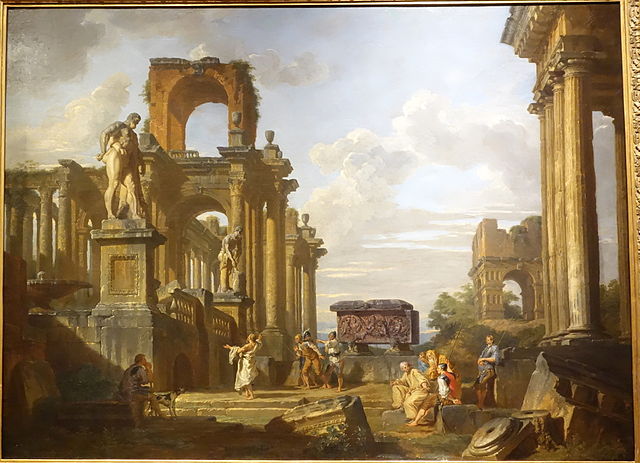
Panini, Giovanni Paolo. An Architectural Capriccio of the Roman Forum with Philosophers and Soldiers among Ancient Ruins. oil on canvas, c.  -1750 1745, https://commons.wikimedia.org/wiki/File:An_Architectural_Capriccio_of_the_Roman_Forum_with_Philosophers_and_Soldiers_among_Ancient_Ruins_…,_by_Giovanni_Paolo_Panini,_c._1745-1750,_oil_on_canvas_-_National_Museum_of_Western_Art,_Tokyo_-_DSC08515.JPG. National Museum of Western Art, Tokyo, Japan.

I posit that the Naṣarā were a type of Hanīf or Sabian that was found in pre-Islamic Arabia. Most likely remnants of Neoplatonic Mysteries from the Roman Empire, who were dispersed into Asia Minor, Persia, Arabia, and the interior of Africa. More specifically, they probably considered themselves a priestly class of the Greater Mysteries who pontificated on a number of metaphysical matters of the day, which fomented much confusion in pre-Islamic times. Let’s first look at the historical links between the Mystery Schools of Rome and religion in pre-Islamic Arabia.

Christianity and the Mystery Schools

Christianity emerged in the Roman Empire as a reviled religion, with clear Semitic roots. It was opposed by the emperors because they were considered the ultimate legal and religious authorities. They believed that there was only one religion, the Mysteries. Different schools of the Mysteries had different expressions of it based on their culture and language because religion was associated with citizenship (Ando, 2021,13). Constantine, upon his conversion to Christianity in the early 4th century was the first Roman emperor to ease the repression of Christians in the empire. By the end of the century, Theodosious would make Christianity the official religion of the Roman Empire and commence the official closing of the Mystery Schools. Justinian would continue this project of closing the Mysteries in the 6th century. In turn, many of its die-hard members who refused to convert to the state religion fled to Asia Minor, like the city of Ḥarrān, Persia, the Arabian peninsula, and the interior of Africa (Errington, 2006, 249-52).

Quraysh and the Mystery Schools

As for those who fled to the Arabian peninsula, it is possible that the Quraysh tribe was one such group. Scholars are unsure of their exact origins, but some have proposed that they were one of the groups that who fled Byzantium. This would make sense since the Quraysh only emerge in the 5th century and appear to take over the most important shrine in Arabia (Ḍayf, 1960, 49). Furthermore, prior to the prophetic mission of Muhammad, the Quraysh exhibited traits common to followers of the Mysteries. First, the Dār al-Nadwa that managed the affairs of Mecca only allowed wealthy men over the age of forty. In the Mysteries, this age was significant because it represented the age at which men attained wisdom and the position of teacher and leadership. They were also learned in advanced mathematics because they set interest rates and performed the duties of bankers. Similarly, they were also the religious authorities because they controlled the rites of the pilgrimage to the Kaʿba, which they believed to be a Saturnalia shrine. For these reasons, it is likely that there was a substantial influence on the pre-Islamic Arabs from the Ancient Mystery Schools.

Naṣārā and the Mystery Schools

When we look into the Qur’an, we find numerous mentions of Naṣārā, but never of Masīḥiyīn, a more direct translation of the word Christians. I believe this was the case because Naṣārā actually referred to a group known as the Nāṣūrati or Nasoraeans, who scholars call a Jewish-Christian Gnostic sect that emerged during the post-Christian religious milieu in the Near East (Bladel, 2017, 6). However, they are more commonly associated with the Mandaeans of southern Iraq; the only group in the world commonly labeled Sabians. Members of their priestly class are called Nasoraeans, who assiduously guard the secret rituals and doctrines of the Mandaeans, which they perceive as having a more ancient origin. Much like the Mystery Schools, the Nasoraeans function as the Greater Mysteries that requires a much more rigorous training in the secret arts, while the rank-and-file Mandaean constitutes the Lesser Mysteries that is open to those who are inclined to Gnosticism. Their doctrine consists of a worshipful regard for angels and the stars and opposition to the practice of circumcision. Indeed, they are those that many Muslim jurists, historians, and theologians identified as the last visages of the Qur’anic Sabians.

Concluding Remarks

With the above understanding, we can gather that:

1) the Nasoraeans were around and active in the Near East before and during the time of the Prophet Muhammad

2) the Nasoraeans constitute a hybrid of the Ancient Mystery Schools and Judeo-Christian beliefs and practices

3) the Nasoraean’s minority status and secretive nature explains why no “Naṣrānī” church was established in the heart of Arabia

4) if the Naṣārā are the Nasoraeans, then this is cause to reconsider the identities of the Yahūd (or “those who became Jews”) and the Majūs

Linking the Naṣārā of the Qur’an to the Nasoraeans of the Mandaean religion will introduce us to a different way of understanding certain arguments put forth in the Qur’an. I will show in future posts how verses that discuss the angels and pre-Islamic ideas about nature and prophethood are actually a polemic against the positions of the Nasoraeans. In addition, we will see that the Qur’an’s criticism of other religions is based on the degree to which they adopted beliefs associated with the Nasoraeans and other Sabians, which were remnants of the Ancient Mystery Schools in Islamic lands. The Naṣārā who were deemed as Christians were those who were closer to the Ḥanīfs in their beliefs. Not only will we witness the historical implications of this information, but we will begin to see how these doctrines continue to shape the current religious discourse.

References

Ando, Clifford. “Religious Affiliation and Political Belonging from Cicero to Theodosius.” Acta Classica, vol. 64, no. 1, 2021, pp. 9–28. https://doi.org/10.1353/acl.2021.0013.

Bladel, Kevin Thomas Van. From Sasanian Mandaeans to Ṣābians of the Marshes. Brill, 2017.

Ḍayf, Shawqi. Al-ʿAṣr al-Jāhilī. 11th ed., vol. 1, Dār al-Ma’ārif, 1960.

Errington, R. M. Roman Imperial Policy from Julian to Theodosius. University of North Carolina Press, 2006.