Choosing Evil: The Ideology of Destruction

There’s this thing where ethics aren’t what they used to be. This idea that people are trying to replace the ideas of good and bad with better or worse… and that is incorrect. You gotta keep your ethics intact because good and bad is a compass that helps you find the way. And a person that only does what’s better or worse is the easiest type of person to control. They are a mouse in a maze that just finds the cheese. But the one who knows about good and bad will realize that he’s in a maze.

Dave Chappelle at Allen University (South Carolina) March 20, 2017

I have paid close attention to every presidential election since the beginning of my adult life. Without fail, the debate ensues around voting for the lesser of two evils in many progressive circles. This is in lieu of any viable progressive rivals, who the American people are told are “unelectable,” a status that is reinforced by state-level interventions to keep them off the ballots. While the decision to vote for a softer, friendlier (usually Democratic) candidate seems to make sense in the moment, this reactionary strategy has only emboldened those candidates to become more evil and take the progressive (especially African American) vote for granted. Yet, the question remains: “at what point will we stop voting for evil?” While comedian Dave Chappelle’s words from 2017 may seem prophetic to some, the ideology of the lesser of two evils has been rejected by Ḥanīfs of ancient times, not the least of which appears in the story of Hārūt and Mārūt.

Hārūt and Mārūt

According to Imam Jalāl al-Dīn al-Suyūṭī in his book on angelology Al-Ḥabā’ik fī Akhbār al-Malā’ik, Hārūt and Mārūt are first alluded to in the Qur’an in al-Baqarah: 30 where we first encounter a conversation between God and the angels concerning the creation of mankind:

{وَإِذۡ قَالَ رَبُّكَ لِلۡمَلَـٰٓئِكَةِ إِنِّي جَاعِلٞ فِي ٱلۡأَرۡضِ خَلِيفَةٗۖ قَالُوٓاْ أَتَجۡعَلُ فِيهَا مَن يُفۡسِدُ فِيهَا وَيَسۡفِكُ ٱلدِّمَآءَ وَنَحۡنُ نُسَبِّحُ بِحَمۡدِكَ وَنُقَدِّسُ لَكَۖ قَالَ إِنِّيٓ أَعۡلَمُ مَا لَا تَعۡلَمُونَ}

˹Remember˺ when your Lord said to the angels, “I am going to place a successive ˹human˺ authority on earth.” They asked ˹Allah˺, “Will You place in it someone who will spread corruption there and shed blood while we glorify Your praises and proclaim Your holiness?” Allah responded, “I know what you do not know.”

The Clear Qur’an translation

The second allusion to Hārūt and Mārūt appears later in the sūrah in verse 102 concerning the false accusations of Prophet Solomon practicing magic. Hārūt and Mārūt warned people about practicing magic and taught people how to differentiate between miracles and magic.

18th century Ottoman representation of Hārūt and Mārūt courtesy of Wikipedia Commons.

“The Lesser Evil”: An Angelic Refutation

The backstory to these angels offers us some wisdom about the dangers of “the lesser evil” ideology. According to tradition, Hārūt and Mārūt were sent to earth where they ruled during the time of the Prophet Idrīs or Enoch. They were given the appetite and desires of people (shahwah) in order to test if they, who had once lived as angels, would behave differently when faced with the same temptations of normal men. Their story is as follows:

And it was said to them: ‘Choose from amongst you the two best angels and I will give the two of them a task; and I will prohibit the two of them [from doing certain things].’ And they chose Hārūt and Mārūt. So the two of them were sent down to Earth and the desires of the sons of Adam were aroused in them. [God] ordered the two that they should serve Him and not associate anything with Him. He banned them from killing prohibited individuals, from eating prohibited foods and from fornicating, stealing and drinking wine. The two remained on the Earth for a time ruling the people with justice. This was during the time of Enoch. And at that time there was a woman, who was the most beautiful woman, just as the beauty of Venus is amongst the rest of the stars. The two of them came to her, spoke softly to her, and wanted her on her own; but she refused unless the two took her orders and her faith. So the two asked her about her faith and she brought out to them an idol and said: ‘This is what I worship.’ And the two said: ‘There is no need for us to worship this.’ So they went and stayed away for a while. Then the two came to her and they wanted her on her own and she said as she had said before, so they went away. Then they came to her [again] and they wanted her on her own, and when she saw that they refused to worship the idol, she said to the two of them: ‘Choose one of three faults: worshiping this idol, killing this person, or drinking wine.’ And the two said: ‘None of these are right, but the least contemptible of the three is drinking the wine.’ So they drank the wine. [The wine] was taken from them both and they fornicated with the woman. The two then feared that the person would reveal what they had done, so they killed him. When the drunkenness lifted from them and they realised what sin they had done, they wanted to go up to heaven; but they could not, as it had been made inaccessible to them. And the cover that was between the two of them and between the people of heaven was lifted up, and the angels looked down at what had come to pass. They wondered with great wonder and they came to understand that whoever is hidden [from God], is the one with less fear. After that they began to ask for forgiveness for whoever was on the earth.

It was said to the two of them: ‘Choose between the punishment of this world and the punishment of the next.’ The two said: ‘As for the punishment of this world, it will come to an end and it will pass. As for the pain of the Angels and theology next world, it will not come to an end.’ So they chose the punishment of this world. The two stayed in Babylon and they were punished.

(Burge and Suyūṭī, 2012, pp. 94-95)

In this story, Hārūt and Mārūt were tricked into committing greater evil by doing what they perceived as a lesser evil. In reality, the lesser evil was simply a gateway into more evil. It was presented as a thing that would satisfy their immediate desire for drink and sustenance; something that is permissible under normal circumstances. However, compromising their principles by the seemingly innocent act of drinking the wine led to intoxication which led to committing fornication which led to murder. How many a prisoner sits in his cell pondering a similar scenario?

Conclusion

This story was intended to refute the Sabian position that gave favor to angels over men. It demonstrates that humans have favor because in order to avoid sin they must overcome their desires, while angels simply do not sin because they do not have  such desires. However, there is also wisdom in this story for the average American voter who are forced to choose between duplicitous politicians of either the Democratic or Republican party. Politicians from the local to federal levels insist on doing the bidding of narcissistic, unethical, and devilish entities instead of the will of citizens who entrust them with their money and power. In choosing to stick with the status quo of Democratic and Republican party leadership we have taken that intoxicating sip that has put us on the path of destruction.

The 2024 elections have been a dirty game given the Republicans’ assassination shenanigans and the Democrats’ shiesty switcheroo. Both Democrats and Republicans have shown to be abetters of genocide and endless war, with blatant corruption among their ranks as witnessed in cases of Dem. Bob Menendez, Dem. George Norcross, Rep. George Santos, not to mention Trump himself. We at the Maurchives advocate for justice and non-violent, creative, and – dare I say – revolutionary solutions to human problems. Therefore, it is with the revolutionary spirit that we endorse Jill Stein’s presidential bid on the Green Party ticket.

Dr. Jill Stein and Butch Ware (Green Party Presidential and Vice Presidential Candidates)

References

Burge, S. R., and Suyūṭī. Angels in Islam: Jalal al-Din al-Suyuṭī’s al-Ḥabāʼik Fī Akhbār al-Malāʼik. Routledge, 2012.

Suyūṭī, Jalāl al-Dīn al-. Al-Ḥabā’ik Fī Akhbār al-Malā’ik. Dār al-Kutub al-ʿIlmīyyah, 1988.

Renshaw, Jarrett. “How US States Make It Tough for Third Parties in Elections.” Reuters, 18 Jan. 2024. http://www.reuters.com, https://www.reuters.com/world/us/how-us-states-make-it-tough-third-parties-elections-2024-01-18/.

Eyes on the Skies: Prophecy Eclipses Astrology

On Monday, April 8, 2024 eyes were on the skies in North America. Day turned to night in the path of totality extending from Mazatlan, Mexico to Elliston, Nova Scotia in Canada. As the Moon and Sun danced in the shadows of the sky some awaited a cataclysm while others cherished the spiritual moment. As the temperature dropped and the day drew dim, there descended a strange serenity that interrupted our usually busy weekday afternoons. The conscious Ḥanīf was most likely bowing in extended moments in prayer, while the Sabian probably pondered the ill omen behind the event.

Ancient religion was always tied to celestial phenomena. First, we know that in the ancient Egyptian religion, ṣ-b-3 meant star and words derived from it signified religious teachings. Its cognate in Semitic languages like Hebrew, Aramaic, and Hebrew would have similar connotations (Sayyār, 2020). The Egyptians based much of their religious beliefs and holidays on what they knew of the stars. Likewise, the Mysteries were made up of two levels, the Lesser Mysteries and the Greater Mysteries. The Lesser Mysteries were known for studying terrestrial phenomena, while the Greater Mysteries were known for studying celestial phenomena. To most historians of religion, the ancients ignorantly followed superstitious beliefs about natural phenomena and deified features and creatures of nature. But our studies of Sabianism and the Mystery Schools afford us a much more nuanced view.

Sabians intently studied the stars to understand what the angels or spirits were trying to tell them about the past, present, and future state of the world and those in it. This included predicting the weather, fortune-telling, creating calendars, creating talismans, studying the properties of elements, etc. There was no distinction made between astronomy and astrology. Nowadays, only the former is accepted as an empirical science while the latter is considered a pseudoscience; although it remains a fixture in the popular psyche. It is important to note how this came to be.

“Star Gazing” AI generated image by Hotpot.

Astrology in the Ancient World

In ancient Rome, the term Chaldean was equivalent to astronomer and they were credited with inventing the gnomon device, which is a triangular blade that casts shadows on a sundial used to tell time (Thompson, 1929, p. 39). Bayard Dodge also states that the term Chaldean meant astrologer and notes that it was associated with people who were known as Sabians who claimed Hermes and the Philosophers as their teachers (Ibn al-Nadīm, 1970, pp. 745-746). For most of the history of the world, religion, philosophy, and astronomy were closely associated.

Their rationale was as the Central Asian polymath, Muhammad al-Shahrastānī stated in the 12th century (Shahrastānī and Muhammad, 1992, 354-359):

  1. They began with a belief in a singular transcendent deity, who they later saw as unconcerned with creation.
  2. They believed that spirits, which we know as angels, governed worldly phenomena such as planets, stars, moon, etc. Due to their active role in our lives and their proximity to the Creator, they are worthy of worship and can relay the benedictions of humans to the Creator.
  3. They then adopted the belief that they should worship something tangible and that the planets, stars, and so on were the bodies of those spirits.
  4. Then they adopted the belief that the heavenly bodies cannot always be seen, so they made shrines on Earth that aligned with certain astronomical significance and put in them idols and other images to represent the celestial bodies of worship.

The Ḥanīf criticism of the Sabians was not their study of the heavens, but the theology, mythology, and dangerous practices they constructed around it, such as human sacrifice and violent orgies. These criticisms are apparent were we to examine the life of Abraham (Ibrāhīm), the quintessential Ḥanīf and prime Sabian/Chaldean antagonist. The story of Abraham and the near sacrifice of his son serves on a prohibition of human sacrifice. While it is said that Abraham supplicated against his people causing them to all die after witnessing them in an orgy (Ṭāwus, 1949, p. 25).

We also find in his narrative a clear polemic against astral worship in his disputes with his people (Al-Anʿām: 74-79). As I explained in Islam and the Ancient Mysteries Vol. 1, when Abraham was shown the truth behind the celestial realm he exclaimed “this is my lord!” However, this did not mean that he was deifying the stars, moon, and sun. No prophet is guilty of such polytheistic behavior. Rather, Abraham, in a moment of awe, made the elliptical statement as if to say, “this is the handiwork of my lord” or “this is the magnificence of my lord.”

Total Solar Eclipse from Carbondale, IL (image courtesy of NASA)

Astrology in Islam

Within the Islamic tradition, astrology is largely disproved of, with very few dispensations. The Prophet Muhammad is reported as saying the following concerning eclipses, after it was said that a solar eclipse occurred due to the death of his son, Ibrāhīm:

The sun and the moon are two signs amongst the signs of Allah; they do not eclipse on the death or life of anyone. So when you see the eclipse, remember Allah and say “Allah is the greatest,” pray and give charity.

The Prophet Muhammad is also reported as saying: “If the stars are mentioned then be silent.” and “Learn of the stars as much as you are guided with in the land and sea, then stop at that.” (Shahrastānī and Muhammad, 1992, 350) The Prophet Muhammad is also recorded as prohibiting the study of the stars to predict the future and engage in other occult practices. One hadith reads:

The Messenger of Allah (may peace and blessings be upon him) led the morning prayer at Hudaybiya. There were some marks of the rainfall during the night. At the conclusion of prayer he turned towards people and observed: Do you know what your Lord has said? They replied: Allah and His Messenger know best. Upon this he (the Holy Prophet) remarked: He (Allah) said: Some of My bondsmen entered the morning as My believers and some as unbelievers. He who said: We have had a rainfall due to the Blessing and Mercy of Allah, he is My believer and a disbeliever of stars, and who said: We have had a rainfall due to the rising of such and such (star) disbelieved Me and affirmed his faith in the stars.

Despite the seemingly clear prohibition of such practices, Muslims studied and practiced astrology throughout much of their history. Imam Jaʿfar al-Ṣādiq was reported to be knowledgeable of astrology and said that Imam ʿAli ibn Abī Ṭalib was also very knowledgeable of it. Even mainstream Sunni scholars like Fakhr al-Dīn al-Rāzī, Ibn Qutaybah, and Ṣāʿid al-Andalusī have produced books on astrology and related sciences. Imam Jaʿfar gave permission to the Āli Nawbakht family to practice it, who were employed by the Abbasids. The Ottomans were also known to use astrology to predict the outcomes of battles.

Al-Maqqarī notes that astrology, although taboo, certain Andalusian scholars knew it well, but did not broadcast this out of fear from the masses. If a scholar was known to speak or practice astrology. he would be labeled an atheist (zindīq) and possibly burned to death by a mob before the issue reaches the sultan. If the issue reaches the sultan, then the scholar must be executed in order to appease the people regardless of the facts. Usually, the sultan only ordered that their books be burned (Maqqarī, 1968, p. 221). Ṭāwūs reported that an astrologer was about to be crucified when he was asked “Did you see this in your stars?” He said “I saw an elevation, but I didn’t know it was above wood.” (Ṭāwus, 1949, p. 192)

There are a number of rationale as to why astrology is prohibited from an Islamic viewpoint. One is that predicting the future with the stars is opposed to the guidance and predictive aspects of prophethood. If one could accurately predict events using the stars then they would not be in need of prophetic guidance or prophesy.

Astrology: A Decisive View

The grey area in the religious rulings lies in the empirical elements of the study of the stars. Ibn Rushd, the grandfather, states in his Al-Bayān wa al-Taḥṣīl that calculating the time of an eclipse, telling the weather, or measuring the placement of the stars are not claims to knowing the unseen. However, publicizing this knowledge is blameworthy because it does not concern everybody, especially simpletons without discernment (Ibn Rushd al-Jadd and Hajji, 1974, p. 345). vol 9

Other scholars have taken the position that calculating the astronomical phenomena is a communal obligation (farḍ kifāyah) and forecasting is analogous to a doctor’s prognosis. Studying the stars is only prohibited when the practitioner makes a claim to know the unseen and if their practice is associated with magic, fortune-telling, and the like (Kuwait Ministry of Endowments and Islamic Affairs, 1988, pp. 52-54).

One scholar deduced the prohibition to three reasons (Kuwait Ministry of Endowments and Islamic Affairs, 1988, p. 54):

  1. Negative psychological associations with the appearance of certain constellations, even if they have no meaning.
  2. Although the Prophet Idrīs was gifted with the miracle of predicting events by the stars, in current times it amounts to conjecture because it is not a precise science.
  3. Astrology is useless. Even if one can know the future, there is nothing they can do to change it.

Likewise, in the modern day, astronomer Andrew Fraknoi wrote an article titled “Your Astrology Defense Kit,” in which he examines 10 questions that pick at the veracity of astrology (Fraknoi, 1989):

QuestionSummary
What is the likelihood that one-twelfth of the world’s population?Challenges the probability aspect of astrology
Why is the moment of birth, rather than conception, crucial for astrology?Questions the timing of events and the accuracy of astrological predictions
If the mother’s womb can keep out astrological influence until birth?Compares astrological influence to a hypothetical situation involving a pregnant mother
If astrologers are as good as they claim, why aren’t they richer?Raises doubt about the validity of astrological predictions based on the financial success of astrologers
Are all horoscopes done before the discovery of the two outermost planets?Implies that the discovery of new celestial bodies should have affected astrological practices, questioning the accuracy of previous horoscopes
Shouldn’t we condemn astrology as a form of bigotry?Suggests that astrology may have cultural implications and questionable validity
Why do different schools of astrology disagree so strongly with each other?Challenges the scholarly differences and variations within the field of astrology
If the astrological influence is carried by a known force, why do the planets dominate?Questions the dominance of planets in astrological influences if the force behind astrology is known
If astrological influence is carried by an unknown force, why is it independent of distance?Raises doubt about the independence of astrological influences from distance, including a critique of the force behind astrology
If astrological influences don’t depend on distance, why is there no astrology of stars, galaxies, and quasars?Questions the absence of astrology relating to other celestial bodies, challenging the universal applicability of astrological influences based on the distance of celestial bodies

These questions challenge the astrologer’s probability, timing of events, accuracy, validity, cultural implications, its scholarly differences, and the fact that it has not advanced due to new astronomical discoveries. In other words, astrology is a pseudo-science that does not meet the standards of empirical study.

There is no doubt that our fascination with celestial phenomena will endure as it has endured until now. The 2024 eclipse was nestled closely to other strange and cataclysmic phenomena: an earthquake in the Northeast United States, talk of sacrificing red heifers in Israel, a genocide in Gaza, and an initiation of attacks in the greater Near East. Yet our “faith” in the stars should be tempered by the Ḥanīf approach, which accepts the study of astronomy (the outward science), while reserving our doubt for astronomy (the inward science) that was lost and eclipsed with our knowledge of the prophets.

References

Fraknoi, Andrew. “Your Astrology Defense Kit.” Sky and Telescope, vol. 78, Aug. 1989, p. 146.

Grant, Robert M. Augustus to Constantine: The Rise and Triumph of Christianity in the Roman World. 1st ed., Westminster John Knox Press, 2004.

Ibn Rushd al-Jadd, Abū Walīd Muḥammad ibn Aḥmad, and Muhammad Hajji. Al-Bayān Wa’l-Taḥṣīl Wa’l-Sharḥ Wa’l-Tawjīh Wa’l-Ta’līl Fī Wasā’il al-Mustakhrija. Dār al-Maghrib al-Islāmī, 1974.

Kuwait Ministry of Endowments and Islamic Affairs. Al-Mawsūʿah al-Fiqhīyyah. 2nd ed., Kuwait Ministry of Endowments and Islamic Affairs, 1988.

Maqqarī, Aḥmad al-. Nafḥ Al-Ṭīb Min Ghuṣn al-Andalus al-Raṭīb. Edited by Iḥsān ’Abbās, Dār Ṣādir, 1968.

Sayyār, Nadīm al-. Laysū Āliha Wa Lākin Malā’ika. 2020.

Shahrastānī, Muhammad ibn ʿAbd al-Karīm al-, and Ahmad Fahmi Muhammad. Al-Milal Wa al-Niḥal. 2nd ed., Dār al-Kutub al-ʿIlmīyyah, 1992.

Ṭāwus, Al-Sayyid ibn. Farj Al-Mahūm Fī’l Ḥalāl Wa’l Ḥarām Min ’Ilm al-Nujūm. Dār al-Dhakhā’ir, 1949, https://ar.lib.eshia.ir/71550/1/189#.

Thompson, C. J. S. The Mystery and Romance of Astrology. Brentano’s, 1929.

X Marks the Spot: Malcolm X, the Bridge Between Sabians and Hanifs

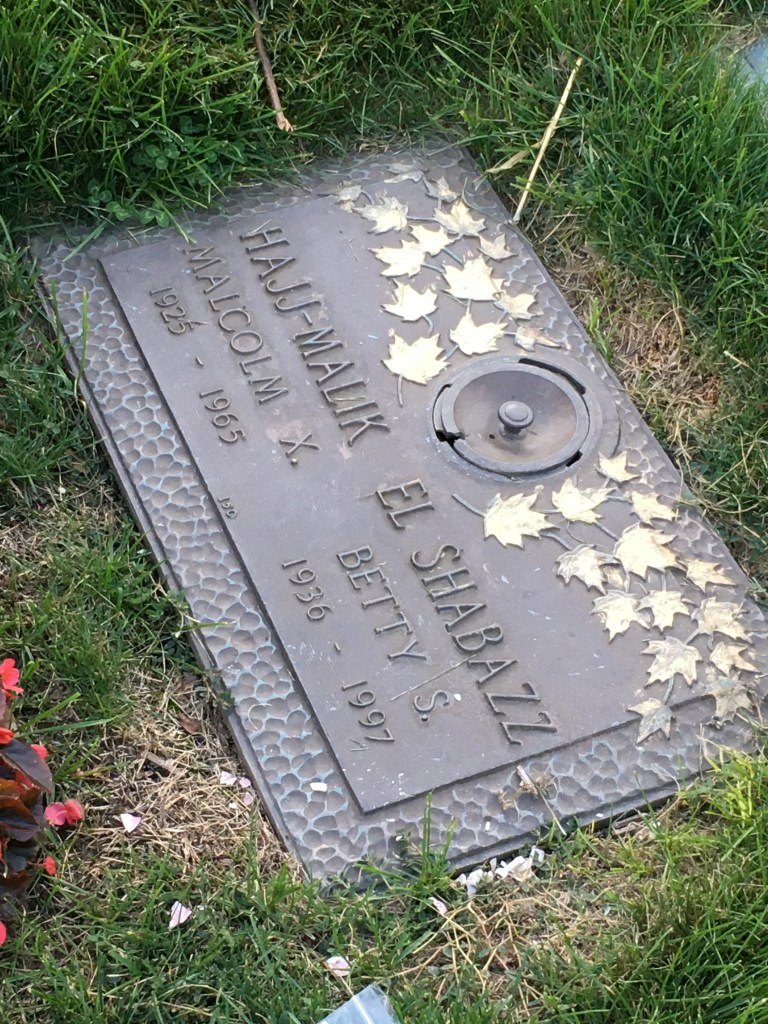
Sunday May 19, 2024 marked the 59th Ziyara (commemorative visitation) to the grave site of El Hajj Malik Shabazz (Malcolm X) and Dr. Betty Shabazz at Ferncliff Cemetary in Hartsdale, NY. As many know, the African American community cannot agree on many things but Malcolm is a rallying point for the forward-thinking trajectories within the community. This was evidenced by the peaceful coexistence of Sabian and Hanif traditions practiced by the intellectual, political, and spiritual offspring of Malik Shabazz at the annual Ziyara.

It was not always this way. In the aftermath of Malcolm’s murder it was a struggle to to keep his name alive let alone his ideas and his work. Only a few brave souls had the guts to open their doors and speak at his funeral. Joseph E. Hall and the Unity Funeral Home allowed the viewing of his body, the Faith Temple Church of God in Christ, allowed his wake, Shaykh Hesham Jaaber, who along with Shaykh Ahmad Hassoun washed and wrapped his body according to the Islamic tradition, Ahmad Osman, Ossie Davis who spoke, and the list of attendees like the late John Lewis, James Farmer, Andrew Young and many others… Their names will be forever etched in history. Similarly, Malcolm’s older sister and confidant Ella Collins sought to keep an accurate depiction of his character, philosophy, and direction by holding the annual Ziyara.

I will point out that these brave people were Hanifs. Despite the association of Hanif religions with conformity and reactionary politics the Black resistance to oppression required the strength and courage only inspired by true faith. That was the place of Malcolm, Betty Shabazz, Ella Collins, Martin Luther King, James Farmer, Mutulu Shakur, Sekou Odinga and countless other freedom fighters. Many of whom were practicing Muslims and Christians.

The Sabian dimension, like their ancient counterparts, has always contributed to the philosophical development of our people. A philosophy that pushes the boundaries of intellectual inquiry and imagination of how Africans can be in this world spiritually, mentally, and physically. Their contributions on the Black intellectual tradition should not be disregarded, as it was the likes of John Henrik Clarke and Dr. Ben Jochanan (both intellectual offspring of Malcolm), who forged a path for Black Studies in the universities to the chagrin of white intellectuals who controlled the narrative on African history. They were able to pry open the  grip that white Africanists had on the field prior to the 1960’s. Their contributions continue to reverberate with regards to the study of ancient Egypt (Kemet), which Africans on the continent and in the Diaspora rightfully claim a connection to despite the protests of some modern Egyptians.

This is not to say that they did not have lapses in knowledge, especially regarding the history of Islam. Their lack of contact with learned continental African Muslims and lack of acquaintance with the Islamic intellectual tradition in Africa and around the world has led to their over reliance on the sources of white Africanist and Orientalist scholars. Similarly, their logical fallacies that equate the Islamic experience with the Christian experience and inability to view things outside of the American paradigm has crippled their understanding of Hanif religions and led to an uncritical embrace of Sabian religion and spiritual thought. Their rejection of religion, while claiming a form of “spirituality,” has warranted them the label Sabian, whose etymological meaning refers to “one who has left religion.”

Beyond the ceremonious nature of the gathering, there was undoubtedly a political message. One that stood on the legacy of the Black Radical Tradition. This was orchestrated by Prof. James Small, a living progenitor of Malcolm. Not only was he the body guard of Malcolm’s older sister Ella Collins, but he was also imam of Muslim Mosque, Inc. and a leader within the Organization for Afro-American Unity (OAAU), the two organizations started by Malcolm before his death. Not only that, but he later acquired authorizations in the priesthoods of several African systems of spirituality and served as a point person for many Black revolutionary activists and freedom fighters since the 60’s. He is therefore an authority in African American Sabian, Hanif, and radical political traditions. As he emceed the event, he stressed the universality of these traditions and some of the speakers’ connection to Islam. He introduced the all-star round up of speakers consisting of scholars, revolutionaries, and leaders of the past and the future, like Dr. Leonard and Rosalind Jeffries, Sundiata Acoli, Pam Africa, Mfundishi Jhutyms, Jihad Abdul Mumit, Baba Zayid, Brother Reggie, Adéyínká “Muhammad” Mendes, and others. They shared prayers and spoke in brief about the legacy of Malcolm. Imam Talib Abdurrashid was noticeably absent from this gathering due to health issues, but members of the Mosque of Islamic Brotherhood (MIB) in Harlem as well as the Jamaat of Shehu Uthman Dan Fodio were delegated to represent him in his absence.

A final point was made about the link between the Pan African struggle and that of Palestine. Contrary to the sentiments of Pan African social media influencers and personalities, who claim that Palestine is not a “black issue,” the veterans and students of Malcolm say it is, because the Black radical tradition stands for justice everywhere. Additionally, we should not allow morally degenerate politicians and media executives to frame our issues for us. The issues of Palestine are not race, religion, terrorism, anti-Semitism, or even freedom of speech. Rather they are colonialism, the right to self-determination, and the right to self-defense. Likewise, these were the issues of the Black Power struggle in the U.S.; a struggle I would deem as successful in many ways. Although police brutality remains a salient issue for many Black communities, there are undoubtedly marked changes from the Jim Crow era to now that almost no elder will deny. But those improvements were not made from the kindness of the hearts of politicians and law enforcement, they were made from decades of political pressure applied by the likes of Martin Luther King and Malcolm X and those who upheld their intellectual, political and spiritual legacies.

The Myth of “Arabized Islam” & Other Fallacies of Pseudo-Islam (Part 3)

There are a multitude of scholarly opinions in the tradition of Islam about a number of matters: who were the Ṣābi’ūn, what is the nature of prophecy, and what are the parameters of Sufism? Unfortunately, Kemetian Adept’s depiction of these are not represented in this scholarly tradition. In this post, I will not only demonstrate that his ideas have no merit, but I will show that he is clearly not qualified to speak on these topics.

Sabianism

Abdullah Samak presents seven opinions on the meaning of the word Ṣābi’. I will enumerate them in brief below:

  1. It is an Arabic word meaning to exit, convert, change, or switch religions.
  2. It is an Arabic word meaning to incline, detract, or long for (usually associated with young children).
  3. It is of Aramaic origin meaning to be submerged in water, bathe, purify, or baptize.
  4. It is of Hebrew origin meaning to cover in water.
  5. It is derived from the Hebrew word Ṣabāwūth, meaning warriors of the sky (i.e., the stars).
  6. It is derived from the names of two people mentioned in history: 1) Ṣābī the son of Methusaleh and 2) Ṣābī ibn Mārī, a contemporary of Abraham.
  7. It is related to the Yemeni city of Saba (Sheba) mentioned in the Qur’an, but this is an obvious mistake in Arabic because the words have two different etymologies (س rather than ص).
Kemetian promotes erroneous ideas about the Qur’an, Sabianism, and much more.

In one video, Kemetian admits that he and his brand of MST are Moors are Sabians, but it is obvious that he does not understand the implications of this claim. He attempts to provide his own interpretation of al-Baqarah: 62. He clumsily reads through the Arabic and comes to the word “Ṣābi’īn.” He starts to pontificate on his interpretation of the verse. He accuses “the Arab” of going against the meaning of this verse. Again, he makes another straw man argument, insinuating that Arab Muslims tell Christians that they are going to hell for what they believe in. While some individuals might have done this, it has never been the manner of Muslims (Arab or otherwise) to condemn Christians to hell.

The meaning of the al-Baqarah: 62 is that those amongst those who claim to be Jews, Christians, and Sabians who believe in God according to the teachings of the Prophet Muhammad, believe in the Last Day (as opposed to the eternity of the universe), and work deeds of righteousness they should not worry about the future nor should they grieve about their past. This is the traditional understanding of the verse. It is not a confirmation of all the beliefs of the above-mentioned classifications.

While insisting that “our ancestors” were the Sabians, not only does he reveal his lack of understanding of who the Sabians were, but also his lack of knowledge of the Arabic language. He corresponds the Ṣābi’īn mentioned in al-Baqarah: 62 with the people of Saba’ for which the 34th chapter of the Qur’an is named. This is a layman’s mistake, as mentioned by Samak. Although the two words look similar in English, they have two different roots in Arabic. He mischaracterizes the chapter Saba’ from the Qur’an, claiming that it gives a history of the Sabian people and how they went astray. This is not accurate. The Qur’an is not a history book and only scantly touches on the history of Saba’, who we know as the people of Sheba. Furthermore, if the Qur’an is describing how the Sabians went astray by being ungrateful, this would contradict his understanding of al-Baqarah: 62, which he claims validates the beliefs of all different religions.

He also claims that Sheba (Saba’) is where the word Shabazz comes from. This is yet another linguistic slip up. For one, its usage can be attributed to Fard Muhammad in the 120 Lessons in the early 20th century. However, its etymology is not known. We can say that it is most likely from the Persian shah baz, falcon king, but we cannot definitively claim its origin without solid historical evidence. Kemetian’s attempt to draw some connection between Sheba and Shabazz is pure speculation.

Prophecy

Kemetian attempts to use al-Naḥl: 89 to dispute the notion that the Prophet Muhammad was the last of the prophets. He claims that this verse alludes to God sending a prophet to every people from among themselves. In his teaching, a prophet is “a thought of Allah made manifest in the flesh,” a definition that has no basis in the Qur’an.

While his reading of the verse and its accompanying diatribe sounds as if he has definitively contradicted the orthodox view of Islam, he parades his fallacy in front of us as he fumbles through a reading of the word shahīd. No where in the verse is the word nabī (prophet) or rasūl (messenger) mentioned. A shahīd is not a prophet, but a prophet can be a shahīd. The explanation of the verse lies in knowing other verses from the Qur’an. For instance, al-Baqarah: 143 states: As such, We have made you a just ummah (religion/nation/epoch) in order to be witnesses over people, and the Messenger (Muhammad, not Drew Ali) is a witness over you…

Muhammad al-Qurṭubī, a true Moorish scholar of Islam who died in 1273, stated that the meaning of the verse was on that day (i.e., the Day of Judgment), God will bring forth in every ummah a witness from among themselves; they are the prophets who testify (i.e., bare witness) that they have conveyed the message from God to their respective ummahs and called them to faith. In every time there is a witness even if there is no prophet.

In other places in the Qur’an, God explains the people upon whom His grace is bestowed, as is repeated by Muslims in their reading of al-Fātiḥah. They are: al-nabīyyīn, al-ṣiddiqīn, al-shuhadā’, and al-ṣāliḥīn as explicated in al-Nisā: 69. These are clearly separate levels of people who will receive God’s grace. According to the exegete ʿAbd al-Raḥmān al-Saʿdī, everyone who obeys Allah and His messenger according to his state and measure of what is incumbent upon him – whether male or female, young or old – those are the people that God will bestow His greatest blessings upon. This blessing brings the highest level of perfection, success, and felicity.

The prophets are those who Allah has favored with revelation to call people to faith in God (not Kemetian’s made up definition). The affirmers of truth are those who affirmed what the prophet has taught with certainty and acted upon that truth with everything they had. The witnesses or martyrs are those who have fought to raise the word of God and died in the process. The righteous are those whose inner states are purified and matches their outward behavior. All of these people will be granted the company of each other in paradise.

The verse was revealed to console the deep-rooted longing of Muhammad’s disciples to dwell with him eternally in paradise, which is a level of love and spirituality that the likes of Kemetian cannot comprehend because his understanding of Islam is too shallow. A true Muslim can connect to the Prophet Muhammad by following his Sunnah and through remembrance. Many Muslims see him in dreams and in an awakened state and continue to receive guidance and blessings from him to this day.

AI generated image with Hotpot.

Sufism

With regards to taṣawwuf, it is clear that Kemetian has no conception of it. Rather, he follows the footsteps of many Western Orientalists who deemed taṣawwuf as an Islamic form of “mysticism” and the pursuit of paranormal phenomena. This was the opinion of European Orientalists Henri Bergson and Reynold Nicholson. Rene Guenon, however, challenged them on the ground that mysticism is a Western concept equivalent to heresy, magic, occultism, which only leads to confusion and distraction from the true path of esoteric knowledge (i.e., taṣawwuf).

On the topic of Dhū al-Nūn, Kemetian contends that he was not Muslim and supposedly practiced ancient Egyptian mysticism which he inherited from Tahuti. In turn, he uses these baseless claims to assert that taṣawwuf is not Islam. I happened to write a paper for graduate school refuting this Orientalist view of mysticism, who attempted to change Dhū al-Nūn from a pious Muslim ascetic to a syncretic mystic. Nicholson characterized Dhū al-Nūn as a mystic, moving a sofa with his thoughts, which caused spectators to die out of astonishment. Yet I found none of this in his earliest biographical sources: Ṭabaqāt al-Ṣūfīyya by Abū ‘Abd al-Raḥmān al-Sullamī (d. 412/1021), Ḥilyat al-Awliyāʾ wa Ṭabaqāt al-Aṣfiyāʾ by Abū Nuʿaym al-Iṣfahānī (d. 430/1039), and al-Ṭabaqāt al-Kubrā al-Musammā Lawāqiḥ al-Anwār al-Qudusīyya fī Manāqib al-‘Ulamā wa’l-Sūfīyya by ‘Abd al-Wahhāb al- Sha’rānī (d. 973/1565).

From these works we can ascertain that Dhū al-Nūn was clearly an Islamic scholar who is listed in the chains of hadith narrators along with Mālik ibn Anas, Layth ibn Sa’d, and Sufyān ibn ‘Uyayna, a science Kemetian rejects. Al-Sullamī confirmed that he was a Nubian from Akhmīm, a city in the Sohag state of Upper Egypt. This is a site of ancient Egyptian temples, but the biographers do not relate much information about his background. They only relate that he his teachings as a true Sufi. He emphasized divine love (maḥabba), humility (tawāḍu’), repentance (tawba), sincerity (ikhlās), solitude (waḥda), and truthfulness (ṣidq). Furthermore, he stressed that people not make claims to gnosis (maʿrifa), which is a trope of Sabian groups who believe they have some secret knowledge that is not attainable by all people.

Al-Sha’rānī relates Dhū al-Nūn’s encounter with the Abbasid caliph al-Mutawakkil, which demonstrates his brand of Sufism. After being accused of heresy, he was marched to Baghdad in chains. On the way, an old woman advised him not to be in awe of the caliph nor to look down on him or argue his case. Dhū al-Nūn thus avoided responding to the accusations. When asked why he did not answer, he said that if he denied the claims he would have made liars of Muslims, and if he confirmed them, then he would have lied about himself. So he left the decision up to the caliph. Upon hearing this al-Mutawakkil declared him innocent.

There was nothing “mystical” about Dhū al-Nūn’s Sufism and there is nothing to suggest that he secretly practiced ancient Egyptian mysticism. His earliest biographers reported about his loyalty to Islam and Sufism and did not report instances of telekinesis and other paranormal activity. Therefore, how can a 20th century European writer with no ties to Sufism bring a new report about him? It is clear that Kemetian is citing the European tradition of mysticism and not the African tradition of Sufism with regards to Dhū al-Nūn.

Kemetian presents the Orientalist perspective on Dhū al-Nūn.

Conclusion

The ability to create YouTube channels and gain recognition from less informed people has emboldened people to share half-baked theories and misinformation on the web. No qualifications or prior experience needed. It is noble the Mr. Kemetian is compiling information and pondering these topics, but his level of knowledge is premature and lacks the proper orientation. His information is faulty because he is not qualified to speak on much of what he claims to know. Experts can easily recognize other experts and he is surely not one of them. This is just a warning: although internet Sabians may seem smart and dazzling, it is important to supplement one’s understanding with actual source materials on the given topic and consult with experts. Or else you will be deceived into the crooked path of modern Sabianism.

References:

Guenon, Rene. Perspectives on Initiation. Edited by Samuel D. Fohr, Translated by Henry D. Fohr, Sophia Perennis, 1946.

Guenon, Rene. The Crisis of the Modern World. Translated by Marco Pallis et al., Sophia Perennis, 1946.

Iṣfahānī, Abū Nuʿaym al-. Ḥilyat Al-Awliyāʾ Wa Ṭabaqāt al-Aṣfiyāʾ. Dār al-Fikr, 1996.

Nicholson, Reynold Alleyne, et al. The Mystics of Islam. G. Bell and Sons, 1914.

Qurṭubī, Abū ʿAbd Allah Muḥammad ibn ʾAẖmad al-ʾAnṣārī. Al-Jāmiʿ Li ’Aḥkām al-Qur’ān. Dar Alam al-Kutub, 2003.

Samak, ʿAbdullah ʿAlī. Al-Ṣābiʼūn. 1st ed., Maktabat al-Ādāb, 1995.

Sha’rānī, ’Abd al-Wahhāb. Lawāqiḥ Al-Anwār al-Qudusīyya Fī Manāqib al-ʿUlamā Wa al-Ṣūfīyya. Maktabat al-Thaqāfa al-Dīnīyya, 2005.

Sullamī, Abū ’Abd al-Raḥmān al-. Ṭabaqāt Al-Ṣūfīyya. Maktabat al-Khanji, 1986.

The Myth of “Arabized Islam” & Other Fallacies of Pseudo-Islam (Part 2)

The charge that “orthodox” Islam is Arabism or Arab Islam is based on ignorance and prejudice. It’s based on an ignorance of Islamic history and prejudice against people who identify as Arabs. On top of that, it is based on ad populum rhetoric, which is a type of logical fallacy that seeks to sway people to their opinion, not by engaging the merits of the ideas, but by stirring up prejudice against a people that they know their audience might dislike.

The facts, however, are against Kemetian. Some of the greatest scholars of Islam throughout history have not been Arab. Someone like Sībawayh, who wrote one of the most definitive works on Arabic grammar, was a Persian. Likewise, Abū Ḥāmid al-Ghazālī who wrote on numerous subjects such as philosophy, Islamic law, and Sufism was also Persian. Al-Buṣīrī the poet who wrote the Sufi Burdah poem in honor of the Prophet Muhammad was a real Moor from the Ṣanhājah Berber tribe.

Kemetian conflates a traditional understanding of Islam from its historical sources with Arabism. He does this to make you doubt  its veracity while promoting his non-historical personal understanding of religion. Traditional Islamic scholarship has a system of checks and balances to ensure no one makes up deviant doctrines according to their own preferences based on scriptural and textual evidence. The MST is in shambles precisely because they have no such mechanism. Yet, this is the nature of Sabianism. As the Christian heresiographer, Irenaeus, said of the early Christian Sabian groups:

…many offshoots of many heresies have come into existence because many-or indeed all -of them wish to be teachers and to leave the sect in which they were ; composing another doctrine from another opinion, and then another from another, they drive onwards to teach in a new way, describing themselves as the discoverers of whatever opinion they have concocted.

(Grant, R. 1978, p. 47)
AI generated image from Hotpot

As for Kemetian’s prejudice against Arabs, it is indicative of many in the so-called conscious community. They match a contemporary post-9/11 image of Arabs with their misreadings of history. The truth is that the Arab identity is much like the Latin identity, in which people of different races, ethnicities and geographies are connected through a common cultural-linguistic identity. Ignorant Blacks who only know the racial constructs of the United States often do not understand this fact and constantly try to force others into their own racial paradigm. Furthermore, these so called conscious folk have no sense of the religious, ethnic, and linguistic diversity in the Arab world, which consists of Nubians, Copts, Berbers, Kurds, Armenians, and Chaldeans to name a few. All Black Americans can see is black and white.

Additionally, there is nothing inherently wrong with being Arab no more than there is anything wrong with being African. Anyone who has ever lived in or visited regular people in the Arab world would know that the vast majority of them exhibit manners that the average American can only dream about. They are very hospitable, generous, and genuinely friendly. Perhaps the marketplace, in traffic, or politics are not the best places to witness these good manners, but they are there. They are not without their prejudices, but their prejudices are commonly directed at other Arabs, Jews, and SubSaharan Africans. Yet when Arabs are confronted about their prejudices, they usually back down.

Much of the Muslim world might hold Arabness in some esteem because of their love for the Prophet Muhammad and his family, who were Arabs. That aside, the Muslim world has not been dominated by Arabs since the Umayyad dynasty. it must be noted that only 20% of the Muslim world is Arab. The majority of the world’s Muslims are in Asia and their scholars have had a great influence on the Muslim world for centuries. Why aren’t the pseudo-Muslims decrying an Asian Islam?

The erroneous idea that Arabs run everything in Islam just like Europeans run Christianity is a false analogy and just plain wrong. For instance, black and white orientalists talk about an Arab slave trade, but never a European slave trade. They think that because Arabs were involved, they must have run it. Ignoring the fact that slave trading has always existed in the region and involved Arabs, Africans, Persians, Indians, Turks, and more. Moreover, the enslaved were not only black, but from these various races as well. This does not excuse any atrocities committed by Arabs or other people. It only serves to disrupt the narrative that so-called white Moors (i.e., Arabs) enslaved black Moors. Dark skin people are not the perennial victims of history.

The charge from Moors, NOI, Nuwaupians, Afrocentrics, and other so-called conscious groups that orthodox Muslims follow an “Arabized Islam” is baseless, which exposes their lack of knowledge and bigotry. It is simply a flimsy argument they use to keep from discussing Islam on its own terms. If anything, orthodox Islam reflects intergenerational, interethnic, intercivilizational, and international networks of knowledge that is not rivaled by any religious system today. In the next part of this series, I will address some of the specific fallacies Neo-Sabians fall into when approaching Islamic concepts, which cause them to completely misunderstand the religion.

The Myth of “Arabized Islam” & Other Fallacies of Pseudo-Islam (Part 1)

Whoever the Most High is a witness for Truth, he need not claim it. The claim is a sign of his veiling from Truth and Peace.

A quote from dhū al-nūn from al-Sha’rānī, ’Abd al-Wahhāb. Lawāqiḥ Al-Anwār al-Qudusīyya Fī Manāqib al-ʿUlamā Wa al-Ṣūfīyya. Maktabat al-Thaqāfa al-Dīnīyya, 2005, p. 129.

In recent years, the Moorish Science Temple (MST) has become one of the many groups on the conscious chit’lin circuit; some of them Hanifs, most of them Sabians. Unfortunately, the unscrupulous reader might mistake the Sabians among them for Muslims or, even worse, a factual representation of history. As a Muslim researcher with a specialization in the Arabic language and Islamic history, it is my responsibility to debunk the bogus claims propagated by such groups.

In one recent YouTube presentation on TITANS TV, a Moorish Science researcher and self-proclaimed Arabic teacher by the name of Kemetian Adept Hieruphant attempted to advocate for his Sabian-inspired MST doctrine using George G. M. James’ Stolen Legacy, orientalist mythology about the Egyptian Sufi, Dhū al-Nūn (more on this in another post), and a hodgepodge of information to confuse you. I beseech the reader not to confuse claims to knowledge for actual knowledge, as was the message of Dhū al-Nūn. In this post, I will focus on deconstructing Kemetian’s treatment of Stolen Legacy and the history of the Moors.  

While Kemetian uncritically accepts James’ thesis, he provides little to no detail to demonstrate the MST position. Kemetian throws a lot of images and texts at you, but his attempt to connect the so-called Moors to the ancient Egyptians is weak because it has no basis in the actual history of North Africa or the Islamic world. He, like many so-called conscious folk, suffers from debilitating confirmation bias; believing his point of view is the only way of seeing the information. Why does he perpetuate a bogus conspiracy theory about the death of James? (A past professor of mine researched and debunked this claim) Why does he think that by virtue of genetic lineage he has a rightful claim to the knowledge of ancient Kemet without actually studying it? And what is a mystery school today other than a university? Kemetian’s misinformation not only reduces his credibility but also the credibility of anyone who takes this topic seriously.

Kemetian Adept | Moors Custodians Of Kemet’s Wisdom Teachings

George GM James’ Misunderstood Stolen Legacy

Kemetian introduces his presentation with the passage from Stolen Legacy that opens Islam and the Ancient Mysteries Vol. 1. In my book, I put forth a better way to understand James’ thesis, which lies in answering three main questions:

  1. Who were the Moors discussed by James.
  2. What knowledge did the ancient Egyptians possess?
  3. How did the Moors acquire ancient Egyptian knowledge?

First, the Moors of history were not followers of Noble Drew Ali or members of an organization called the Moorish Science Temple. “Moor” was an epithet used by Europeans during the Middle Ages to refer to people with dark features and Muslims in general, and North African Muslims specifically. Whatever its original meaning, it was lost on European people by the Middle Ages. They were not calling North African Muslims “gods” or anything of that nature.

If we take the European usage of Moor at face value, it means someone who is dark (relative to the average European phenotype) and/or from North Africa and/or Muslim. This is a broad span of people, which can encompass SubSaharans, Berbers, Arabs, Persians, and Indians and often times it has referred to Jews, Christians, and Muslims living in Muslim-controlled lands.

Johannes Andreas Maurus, a Spanish convert from Islam to Christianity (original pen and ink drawing by Maurice Hines)

Secondly, we must have an understanding of what knowledge was attributed to the ancient Egyptians. While James touches on this, he is not completely clear as to what that knowledge was. On the one hand, James characterizes this ancient knowledge as a secret, exclusively for Egyptians, transmitted orally from teacher to student, and forbidden to be written down. On the other hand, he writes that this knowledge was kept in books at temples and libraries, which were eventually copied and plagiarized by the Greeks (particularly Aristotle), and then they became the domain of the Greeks, Freemasons, Theosophists, and occultists. How James deduces this can be challenged on the grounds that he retrofits the concepts of contemporary esoteric movements on to ancient Egyptian Mystery Schools. This is only James’ speculation, not concrete proof.

Additionally, James reconstructs the ancient Egyptian curriculum using a mixture of Christian and pre-Christian Greek sources, whose works he sees to be untrustworthy since the pre-Christian Greeks allegedly stole knowledge from the Egyptian Mysteries and the Christians attempted to annihilate them. Nevertheless, the curriculum according to James was made up of the seven liberal arts, secret languages and mathematical symbolism, as well as magic. This included memorizing the books of Hermes that teach the hieroglyphs, cosmography, geography, astronomy, typography, how to slaughter animals, law, theology, medicine, among other subjects.

Many of these subjects where known and practiced all over the ancient world including ancient Babylon and India, as James alludes to, as well as in Europe and the Americas. There simply is no concrete proof that this curriculum originated in Egypt, no matter how much we want to believe it. In one aspect, it was a secret that died with the last Egyptian priest. Any other empirical knowledge they developed could also be reconstructed by other people with similar aims. Not only that, but both the Islamic civilization and later the current European civilization surpassed the ancient Egyptians in the empirical sciences (no matter what our criticisms of those civilizations are). It is also much more logical and backed by evidence to think that the world’s knowledge was an intergenerational, multi-ethnic collective effort rather than the work of one people.

Finally, how did ancient knowledge transfer to the the hands of the so-called Moors and then to Western Europe? I demonstrate this process in Islam and the Ancient Mysteries Vol. 1. I firmly demonstrate that Muslim civilization under the Hanif creed absorbed the knowledge of ancient Near East, serving as a bridge between the ancient and modern world. The following is a summary of this history.

The True History of the Moors

What’s lost on Kemetian and the Moors are the key players in history that represented this passage of knowledge. If we were to question MST folk to name some of the Moors who conveyed knowledge from the ancient Mysteries, they would be hard pressed to name one. Yet, I have researched several of them for my book: the Ḥarrānian Thābit ibn Qurrah, the Persian family Āli Nawbakht, the Abbasid Translation Movement, and particular Muslim philosophers like Ibn Sina, al-Ghazali, and Ibn Rushd and their respective philosophical positions. There are countless more that historians have researched.

A synopsis of this history starts with the decline of the Mysteries, prior to Christianity. In the Greco-Persian wars, Alexander massacred Iran and sought to extinguish the Persian-Babylonian Mysteries and the knowledge they acquired. He brought their manuscripts to current-day Egypt and had them translated into Greek and Coptic and destroyed the Persian originals. The Greeks were therefore consolidating the knowledge of ancient Egypt and Babylon. As of the 4th and 3rd centuries BCE, this knowledge was most readily available in Greek and Coptic (an advanced form of the ancient Egyptian language).

Christianity was a Hanif system that challenged the Sabianism that proliferated among Judaism and the so-called Philosophers. The disciples spread the monotheistic message of Jesus, which eventually became mixed with the ideas of gnostics (i.e. Sabians), such as Simon Magus, Menander, and yes, Paul. The early scholars of Christianity were educated in the schools of the Greeks and were able to argue the Sabians in their own terms. Though the Christians opposed the Sabians, they ended up absorbing much of the ancient knowledge in the Eastern Church, which split from the Western Church relatively early in the history of Christiandom.

In the meanwhile, the Persians sought to reconstruct their mysteries by reviving the manuscripts found at the extremities of the Persian empire near India and China. They were open to various sects of Christianity such as the Nestorians. Many of those Christians preserved ancient knowledge they inherited from the Greeks in the Syriac language. By the time the Muslims conquered, these works began to be translated into Arabic. This proliferated during the Abbasid Caliphate that funded the Translation Movement; translating the works of the ancient mysteries primarily from Greek, Syriac, and Persian, because knowledge from the ancient world was largely consolidated in these languages.

While the likes of Thābit ibn Qurrah, the Nawbakht family, and Ibn Muqaffaʿ played key roles in this Translation Movement, the effort cannot be attributed to one tribe, ethnic group, race, or religion. Thābit’s ethnicity cannot be ascertained although he was a native Syriac speaker and also spoke Greek and Arabic. The Nawbakht family were from a lineage of Persian Magians who specialized in astrology. Likewise, Ibn Muqaffaʿ was a Persian litterateur responsible for translating numerous books from the Persian and Indian literary heritage. Muslim and Arabic-speaking scholars of other faiths engaged these works for nearly a millennium, including the questionable works on astrology and magic. Yet, the most controversial issues centered on the philosophical concepts of the creation of the universe, pantheism, and the like, which I covered in the post Is God the Universe?  

Social media scholars from the MST and other so-called conscious groups cannot accurately describe how or why this passed from Muslim lands to Western Europe. The Christian Crusades against Muslims began in the 11th century, at the height of the Translation Movement. One should also observe that during this time, many Europeans were “orientalists,” meaning that they admired Arabic language, culture, and knowledge; see (Burnett, 2008, p. 22). Many in Western Europe, who have long since been cut off from the ancient Greeks, rediscovered the knowledge compiled in Greek through Arabic. As political enmity grew between Western European Christiandom and Islamdom, the intellectual affinity grew. One might notice that some of the most erudite scholars from Andalus, migrated to Egypt during the Inquisitions such as al-Qurṭubī and Abū Ḥayyān al-Andalusī, etc. Khaled El-Rouayheb performed an excellent study on the influence of Maghribī scholars on theology and logic in Ottoman-controlled Egypt and prior. Many of whom were from the Ṣanhajah Berber ethnic group.

No narrative about the Moors’ passage of knowledge to Europe would be complete without mentioning the 12th century CE polymath Ibn Rushd (the grandson). In addition to being from a scholarly lineage based in Córdoba, he was a jurist, physician, and Aristotelian philosopher. In fact, he was known as the chief commentator on the works attributed to Aristotle. The untrained reader must remember that Aristotelian philosophy was at the core of Sabian doctrine, which was a proponent of the eternity of the universe. Ibn Rushd wrote a vehement defense of philosophy and Aristotelian concepts in his Faṣl al-Maqāl and Tahāfut al-Tahāfut against Abū Ḥāmid al-Ghazālī’s Tahāfut al-Filāsifah. Although Ibn Rushd’s positions were rejected by most Muslim scholars, many European orientalists were enamored with his works. This even prompted the Christian theologian, Thomas Aquinas to write a response opposing the eternity of the universe.

Conclusion

The perspectives propagated by the Sabian factions of the MST amounts to nothing short of pseudoscience and a creative re-telling of history. Only simpletons are impressed. History does not begin with the interpretations of pseudo-scholars, but the collective evidence established by a body of researchers. Unfortunately, the MST lacks members who have advanced through the degrees of scholarship: sufficient tertiary education, specializations, peer-reviewed publications, academic integrity and humility, etc. Furthermore, there is nothing novel about their teachings. Their teachings are simply Sabian-Noir doctrines; the same doctrines that have confused our people for generations. In another post, I will unravel some of their doctrines and their erroneous characterizations of Sufism.

From Darkness to “Polight”: A Prospectus on Sabianism and Ritual Sacrifice

We at the Maurchives normally refrain from commenting on the personal shortcomings of our interlocutors in our critiques, with aims at maintaining the intellectual integrity of our positions. However, the recent revelations of the so-called black conscious influencer known as “Brother Polight” (Michael Noak Jr.) has ignited passions and outrage from within the black community. Given the sordid nature of the crime – taking sexual liberties with the daughter of a mistress among other things – and as a survivor of abuse, I take his despicable acts personal and denounce him for them. I am admittedly disgusted, angry, and disappointed with the so-called conscious community, but I am not surprised.

Contrary to popular belief, Polight is not “sick,” “crazy,” or “mentally ill.” His public profile over the years has suggested that he is a very intelligent, deliberate, and charming individual who can sway the hearts and minds of people with his words. Unfortunately, the criminal acts that he pled guilty to are the modus operandi for modern-day Sabians whose only pursuits are the trinkets of the sensory world. Given what we know of his character, we can only assume that he knew what he was doing, but what escapes most people’s grasp is why. Why would a grown man, who was seemingly on top of the world, who possessed fame, health, wealth, and women… why would he risk all of that for an act that if people found out about it would leave him penniless, isolated, incarcerated, and despised by people? Well the answer is clear if we peer into the history of the Sabians and their misuse of the occult sciences. In this post, I will shed some light on what could have been behind his dark acts.

Mugshots of Michael Noak Jr. (aka “Brother Polight”) and Dwight York (aka Malachi York).

Occult Sacrifice: A Brief History

Polight, like numerous other 20th century occultists, called to Sabianism as a seemingly enlightened spirituality that only served to disguise their magic and sorcery. From Charles Leadbeater and Aleister Crowley to the indecencies of Elijah Muhammad, Malachi York, and Jim Jones, spiritualist (Sabian) leaders have been accused of sex acts that traditionalists (Ḥanīfs) find repugnant. In Polight’s case, he almost killed the child he was accused of molesting by forcing on her drugs and alcohol. This act is strangely reminiscent of the rituals that brought down the Ancient Mystery Schools.

The practice of sexual orgies and human sacrifice were some of the practices that led to the decline of the Mysteries. Even prior to the spread of Christianity, the Roman government would crack down on the rites of the Baccchanalia Mysteries for their violent sexual orgies. Emperors Augustus and Claudius put stringent limitations on the Druid Mysteries of England and Gaul who used to practice human sacrifice (Grant, 2004, page 17-19).

The British Egyptologist, Margaret A. Murray described in her book, The Witch-Cult in Western Europe, the four different types sacrifices among practitioners of Witchcraft, who claimed to inherit the ancient Mysteries of Western Europe. Murray states that these sacrifices were: 1) blood sacrifices, 2) animal sacrifices, 3) child sacrifices, and 4) god sacrifices. Blood sacrifices entailed shedding a prick of blood for initiations and signing contracts (Murray, 2008, p. 152). Animal sacrifices including killing animals such as dogs, cats and fowls for the purpose of manifesting Satan (p. 154). Child sacrifices were used to obtain magical powers. They promise the Devil or their jinn an offering at a particular time to acquire these powers. They often use unbaptized children, those from irreligious homes, or their own children, usually poisoning them or sometimes by more brutal means (p. 158). God sacrifices were conducted to manifest the power of a certain Wiccan deity such as a fertility god. In ancient times, the ritual entailed a human being assuming the identity of the deity or allowing himself to be possessed it and then allowing himself to be killed, usually by fire. The ashes would then be collected and used in various other rituals. The Christians later banned this practice and took to replacing the human being with an animal or, in secret, an infant (p. 160-162).

In the Ḥanīf tradition, God shows Abraham a vision in which he is to sacrifice his son. The Judaic tradition believes this son to be Isaac while the Islamic tradition believes him to be Ishmael. Both Abraham and his son agree to the sacrifice and are prepared to carry it out for the sake of God. However, at the last moment God retracts the command and enjoins them to sacrifice a ram instead. Judaic commentaries insist this that this was not a pagan practice gone awry, but an injuction to categorically prohibit human and child sacrifices (Greenberg, 2011, p. 195).

On top of that, the Qur’an has already warned us about this end. Anyone calling to the worship of anything beside the true and living God, is an idolator. Idolators do not worship other gods per se, since there are no other gods. In actuality, they worship jinn, who seek to be worshiped as gods. These jinn promise them the fortune, fame, pleasures, and power that they seek, but demand that they perform disgusting and evil acts as devotion to them. These acts usually involve violating children, whether it’s rape, mutilation, or murder.

وَكَذَٰلِكَ زَيَّنَ لِكَثِيرٍۢ مِّنَ ٱلْمُشْرِكِينَ قَتْلَ أَوْلَـٰدِهِمْ شُرَكَآؤُهُمْ لِيُرْدُوهُمْ وَلِيَلْبِسُوا۟ عَلَيْهِمْ دِينَهُمْ ۖ وَلَوْ شَآءَ ٱللَّهُ مَا فَعَلُوهُ ۖ فَذَرْهُمْ وَمَا يَفْتَرُونَ ١٣٧

Similarly, their associate-gods have made the killing of their children seem fair to many mushriks (idolators), so that they may ruin them and may confuse their faith for them. Had Allah so willed, they would not have done that. So, leave them alone with what they fabricate.

Mufti taqi Usmani translation

When Polight would make his asinine comments about Islam many Muslims left him alone to his devices. The only “Muslims” who would engage him were those Moors, NOI, and Ahmadiyas whose doctrines would not allow them to defend the true Islamic tradition. The average listener was impressed by his diatribes because they never heard certain vocabulary words strung together. However, intelligent people knew that he had mastered the art of hypnotism, talking in circles at a loud volume in the style of his teacher, the convicted serial pedophile and high priest of the modern African American Sabians Malachi York, but much of what he said lacked substance and was never backed up by facts. His strategy was to interrogate the beliefs of others without being interrogated on his own beliefs. In the end, he called to the worship of “the black woman” and money. But the light has shown on the true depravity of his beliefs.

References

Grant, Robert M. Augustus to Constantine: The Rise and Triumph of Christianity in the Roman World. 1st ed, Westminster John Knox Press, 2004.

Greenberg, Irving. The Jewish Way. Touchstone, 2011.

Murray, Margaret Alice. The Witch-Cult in Western Europe. Forgotten Books, 2008.

Islam and the Ancient Mysteries Vol. 1: The Mystery Schools: Book Release

On July 22, 2023, I presented on my new book, Islam and the Ancient Mysteries Vol. 1: The Mystery Schools at Masjid Ashabul Yameen in East Orange, NJ. This is a humble beginning to the spread of a much-needed perspective that will help the Muslim Ummah in the West understand and navigate its current state with wisdom.

Volume one of this book series can be found on the Books from the Maurchives page along with other publications from the Maurchives. The Mystery Schools, seeks to draw the historical connections between the Sabians of Islamic times and what some know as the Mystery Schools of the ancient Near East. No scholar from the East or West has made this explicit connection before and I will expand on this thesis in subsequent volumes. Additionally, I will elucidate why it is relevant to religious discourse of the 21st century and beyond.

Sabian Mumbo Jumbo: Ishmael Reed and the Polemics of the Modern Sabians

Ishmael Reed’s 1972 Afrofuturist novel, Mumbo Jumbo, is a classic and masterful literary work. However, behind the words on its pages lies a modern Sabian polemic and interpretatio afro-americana. The novel is set in a pandemic-era 1920’s America. The disease was a Vodoun-inspired, dance and free-love hysteria called “Jes Grew” that primarily infected African Americans, who needed to be quarantined if they succumb to the disease. It is obvious that Reed aligns with this behavior and sees it as the true means to liberation, while he directs his sharpest criticism to the “Atonists,” monotheists who follow a traditional religion but are secretly controlled by a Freemasonic cabal called the Wallflower Order. In other words, he believes that Traditionalists/Hanifs are close-minded prudes who oppose the essential elements of humanity.

Such a perspective is not new. The dialectic between Sabian/Spiritualists and Hanif/Traditionalists has been at the heart of metaphysical debates since the inception of religious history. Perhaps the fact that he was on of the first to articulate this concept in an African American context is his greatest feat and few, if any, have discussed this aspect of his book. In this post, I will examine Ishmael Reed’s novel in light of what we know of Sabianism. We will uncover his Sabian polemics, counter-narratives, and his vision for Black liberation.

Sabian Polemic

Mumbo Jumbo represents a modern-day Sabian polemic against the Hanifs of our times, or as he refers to them, the Atonists. Throughout the novel, Reed characterizes the Atonists as anti-nature, anti-fun, authoritarians who have made the world a terrible place to live by enforcing laws, making people work, and limiting freedom. They thrive on paranoia and a sense of control over people’s actions as demonstrated by his pairing the malevolent Wallflower Order with monotheism and the righteous virus known as Jes Grew with polytheism and liberation.

Reed constantly mocks Christian and Muslim sentiments throughout the novel. In Reed’s world, they are on the side of the Wallflower Order who oppress those they consider heretics and apostates. There is a Muslim character by the name Abdul Sufi Hamid (an allusion to Abdul Hamid Sufi, the Harlemite convert to Islam and labor leader who died in 1938) who had possession of an ancient Egyptian text that held the secret wisdom of the Black man. He is part of the Black resistance along with Papa LaBas (a Vodoun priest and the book’s protagonist) and Black Herman (a medicine man). However, because Abdul is Muslim he is incapacitated by his  “Atonist” belief that the people infected by the Jes Grew “Epidemic” are just primitive, superstitious heathens. He does not identify with them because he is an arbiter of people’s tastes and clings to a belief that Muslims are superior to pagans. In one instance, he belittles the epidemic by claiming it’s “a lot of people twisting they butts and getting happy. Old, primitive, superstitious jungle ways. Allah is the way. Allah be praised.”

In a dialogue in which Abdul attempts to distance himself from Christianity, Papa LaBas goes on a diatribe stating that Islam derived from Christianity. He repeats the theories of Orientalists who believe that Muhammad wanted to impress Christians with his knowledge of the Bible. He goes on to say that both Christianity and Islam find women to be evil and acknowledge the same angels like Gabriel and prophets like Abraham, Isaac, and Moses. Then he says that they both condemn the Jews because of the “pantheistic contingent” among them. Here he points out that the Jews are God’s chosen people and yet there are Sabians among them who do not deny the worship of other gods. Black Herman brings up the fact that the “Koran” has been accused of lacking chronology and Muhammad of being ambiguous and inaccurate with regards to the identity of Miriam, Moses’ sister, and Mary, the mother of Jesus. Abdul has no response but a scripted intolerant retort telling them not to criticize his religion. “Atonists Christians and Muslims don’t tolerate those who refuse to accept their modes,” he claims. Abdul is said to have “picked up the old Plymouth Rock bug and [is] calling it Mecca.” LaBas says that the images in the temples of ancient Egypt were so explicit that other nations burned them and called it obscene and pornographic.

While these extensive dialogues feature between the plot of the novel, they tell us a lot about the position of the author and the debates that existed in the Black community at the time of the book’s publishing. Reed skillfully brings the ancient Sabian polemic to 20th century Black urban America, a population situated for such influences. As Sabian movements with Islamic overtones like the Nation of Islam and Moorish Science Temple directed people from Christianity with their harsh critiques of the religion, their orientation to their roots, and programs for Black liberation, the Afrocentrists went one step further by calling Black people to reject the monotheistic Hanif paths all together and to join them in their polytheistic Sabian paths. This coupled with the Free Love Movement of the 60’s made Sabian-inspired ideas particularly attractive during that era.

Sabianism as Liberation

It is clear that Reed’s idea of Black liberation is a syncretic hedonism linked to jazz music and diasporic African cultures, a position taken by many Black cultural nationalists of the 60’s and 70’s. As early as 1962, Oseijeman Adefunmi (formerly Serge King), founder of the Yoruba Temple in Harlem, articulated a sentiment aimed to critique Islam’s austerity: “The African, being supremely creative and cosmopolitan, will eventually revolt against a culture which debars plastic sculpture and other traditionally African expressions such as dancing, syncopated singing, smoking and drinking.”

Moreover, Adefunmi challenged Islam’s efficacy in protesting White supremacy. He believed, as Reed insinuates, that Islam and Muslims detests the same things the White power structure hates about Africans: its pantheon of gods, dancing, and drumming. As such, Islam is not sufficiently African and is thus, more tolerated by White supremacists. The Islam of enslaved African Muslims, he contends, vanished because it was not authentically African, as opposed to other African spiritual and cultural elements that survived slavery. Of course, Adefunmi brings up the East African slave trade as another reason as to why Blacks should reject Islam. (Adefunmi, Oseijeman. Tribal Origins of African-Americans. New Oyo [Harlem]:Yoruba Temple, 1962, 1, cited in Knight, 2020, p. 33).

In my estimation, the things to which Afrocentric Sabians are calling are not a means to liberation but they are the means to bondage both physically and spiritually. Did the Europeans not trade alcohol for slaves? Did this addiction not lead certain tribes to fight others and sell them into slavery? Does sexual promiscuity not lead to broken families and disease; the exact things that destroy our communities in the U.S.? Were African people not singing and dancing before, during, and after slavery? If so, what difference does it make if they choose not to now? While it is natural for people to enjoy themselves (according to their personal tastes, which might or might not include singing and dancing), fun is not a sole means to ending oppression and other social ills.

Moreover, practicing a tribal religion did not protect Africans from capture and enslavement any more than practicing Islam or Christianity. At least Islamic law regulates the trade and treatment of slaves and prohibits slavery on the basis of race. The Mamluks of medieval Egypt were not Africans but Eastern Europeans and Central Asians. Likewise, the African Tippu Tib played a major role in the East African slave trade just as much as the Ibāḍī sultans from southern Arabia.

What is more, African Muslims played just as much a role in fighting the European slave trade as their participation in it. In fact, more Africans (including those who practice traditional religions) participated in the slave trade than Europeans. The Europeans that traded in slaves were a minority of rich and opportunistic royalty and businessmen. The peasants of Western Europe were not part of this.

Counternarratives and Interpretatio Afro-americana

Even deeper than than their challenge against a single Abrahamic religion is the neo-Sabian tendency to create counter-narratives to what we know of the scriptures. Starting in Chapter 52, Reed recounts a history of religious figures that has no basis in tradition or scripture. Rather, it is a myth (i.e. false story) that serves the purpose of undermining people’s beliefs about the prophets and their works.

In Reed’s myth, Osiris is the hero and hip prophetic personality who spread knowledge of agriculture, music, and most importantly dance. He was an Egyptian prince who studied at a university in the Arabian town of Nysa. He typified the Jes Grew infection discussed previously in the novel. Osiris even ventured to Teotihuacán and Olmeca in South America to spread his knowledge.

The first villain was Set, who opposed his brother, Osiris. Set was obsessed with war, hated nature and agriculture, and had an egotistical jealousy of Osiris. Plus the fact that Osiris married their sister, Isis, further intensified Set’s hatred. Reed writes of Set in the following words:

He went down as the 1st man to shut nature out of himself. He called it discipline. He is also the deity of the modern clerk, always tabulating, and perhaps invented taxes.

The next villain was Akhenaton, the devotee to Aton, from which the Atonists in the novel take their name. The Egyptians rejected his creed of monotheism and killed him.

Next in his succession of villains is Moses, the adopted son of a Pharaoh and initiate of the Osirian Mysteries. He sought leadership in the order by tricking Jethro, a genuine follower of Osiris, into teaching him the secret tunes that he inherited from Osiris as well as the Book of Thoth acquired from a conjured vision of Isis. Yet, his plan did not work. Moses only attained from it the aggressive and violent magic, which made the people mock and hate him. As a result, he loathed the book and hid it in a tabernacle.

The next villains were the Knights Templar, a Christian Atonist group modeled after the rogue Ismāʿīlī Assassins. A librarian for the Knights Templar named Hinckle Von Vampton found the copy of the Book of Thoth in their library. As the Knights Templar were being executed throughout Europe for worshiping the “Black god Baphomet,” Hinckle escaped with the book and lived for hundreds of years. He eventually ended up in the U.S., where the Wildflower Order, created by the Atonists, aimed to find him and the book in order to put an end to the Jes Grew pandemic, which evoked fun and benevolent magic.

These counter-narratives are reminiscent of the Mandaean (Sabian) narratives about Noah, Moses, Abraham, and Jesus. As we know, rejection of the prophets or a selection of them is a common trait of Sabianism. Beyond their simple rejection of the Hanif prophets is the Sabian proclivity to invert prophetic narratives to demean them and champion their beliefs. This inversion lies at the heart of the Sabian/Hanif divide and is at the heart of many religious conflicts as alluded to in the novel. I would even argue that this is why non-canonical texts like the Book of Enoch and the Nag Hammadi were rejected from inclusion in the Bible by some religious denominations. These books’ presentations of the prophets align too much with the counter-narratives of the Sabians. As the Hanifs sought to subdue the slander, turmoil, and licentiousness of the Sabians and prevailed, the Sabian response was to operate secretly and to foment doubt and rebellion from behind the scenes. The Afrocentrist, with his worship of ancient Kemet and infatuation with traditional African religions has succumb to the Jes Grew disease, and it has stunted their intellectual and spiritual growth as liberators for the Black community because they focus their efforts against the Hanifs among them. This mantle was picked up by Ishmael Reed in his novel. Though it will go down in history as a post-modern literary masterpiece it will forever be cast in the heap of Sabian mumbo jumbo.

References

Adefunmi, Oseijeman. Tribal Origins of African-Americans. New Oyo [Harlem]:Yoruba Temple, 1962

Knight, Michael Muhammad. Metaphysical Africa: Truth and Blackness in the Ansaru Allah Community. Pen State University Press, 2020.

Reed, Ishmael. Mumbo Jumbo: A Novel. Ebook. New York: Open Road Integrated Media, 1972.

Is God the Universe?

It has become popular to refer to God as the Universe in recent years but few know that this practice is rooted in ancient philosophical debates over ḥulūl (pantheism) and the eternity of the universe. Sabians generally argued that the universe was eternal and thus equal to God. Because of this, they accepted the concept of pantheism, i.e. that God can be found within His creation as celestial bodies, inanimate objects, living things, a man or mankind in general, etc. On the other hand, Hanifs argued that eternity was an attribute of God alone and thus the universe was not eternal but a creation of God. As a consequence of this thinking, God was an entirely different genus from His creation and this, among other qualities, made Him worthy of worship.

While these debates are not prominent in popular contemporary discourse , they nonetheless influence much of our thinking, knowingly or unknowingly. Therefore, every time we hear someone praising the universe, we are hearing the residuals of Sabian thought echoing in the current day. While some might see these debates as benign or akin to splitting hairs, they most definitely have metaphysical, if not physical consequences on the masses past, present, and future. In this post, I will present the ancient debate and identify strains of Sabian thought in the modern day.

Al-Ghazālī vs. the Muslim Sabians

In the 11th century, Abū Ḥāmid al-Ghazālī penned his landmark work, Tahāfut al-Falāsifa (often translated as The Incoherence of the Philosophers). While the work is pivotal to Islamic theological debates as well as the intellectual history of philosophy from the ancient world to modern times, it is also relevant to the study of Sabian thought. Moreover, it allows us to understand the fallacies of Sabian thought from a Muslim perspective as well as how to recognize them and refute them in our times. He noticed a trend among the Muslim intellectuals of his day who, upon studying the works of the ancient Greeks, would adopt their philosophies uncritically. This meant that they embraced the belief of the eternity of the universe, which led to other blasphemous ideas such as the weakness of God, the possibility of two deities, and the purposelessness of existence.

In addition to this mistake having detrimental effects on the personal faith of these Muslim philosophers, they would also submerge Muslim civilization in the same theological turmoil that the Naṣārā (Christians) suffered. If we recall from Islam and the Mystery Schools Part 10, the Naṣārā of the Roman Empire, Persia, and beyond were plunged into the philosophical debates of the Mystery Schools i.e. Sabians. Although they won debates about the supremacy of the prophet of their time (i.e. Jesus Christ/ʿĪsā), they compromised on the topic of ḥulūl or pantheism, with the caveat that only Christ occupies the position of God to the exclusion of others in His Creation. In the Muslim Ummah, the likes of al-Farābī and Ibn Sīnā would spearhead this dangerous slip into Sabian philosophy. To others, it was Ibn ʿArabī’s concept of waḥdat al-wujūd (the unity of existence). Wherever the concept was raised it was refuted.

We should understand that al-Ghazālī did not categorically refute the knowledge of the Sabian philosophers. Rather he enumerated 20 points in which the philosophers went wrong and jeopardized their metaphysical futures. While seemingly benign, al-Ghazālī is serious about the magnitude of these mistakes. As I read his words, I cannot help but see some similitude to our current situation. Here, I will turn to al-Ghazālī’s criticisms that are related to the nature of the universe.

Ancient Sabian philosophers argued that it was impossible that a temporal creation emanate from an intemporal creator, i.e., that a finite universe proceed from an eternal God. Instead, they argued that the universe always existed or always had the potential to exist. So, if the universe came into existence at a particular point in time, then why? In their line of questioning, they asked: Was God incapable of bringing the world into existence before this point, thus changing from weakness to power or impossibility to possibility or futility to purpose? They contended that if God was All-Powerful and All-Knowing, then all the conditions were met to bring the universe into existence prior to its existence. So, there must have been some catalyst or cause to bring it into existence.

Al-Ghazālī responds to this conundrum by stating that the creation of the universe at the point that it came into existence was part of God’s eternal will and essentially that God sees the big picture and man does not and cannot. Man might ascribe perceived changes in God’s will to some sort of flaw based on man’s experience and dispositions but these experiences and dispositions do not apply to God. Therefore, the burden of proof is on the philosopher to demonstrate that the creation of the universe was not God’s will. (Ghazālī, 1963, 14-19) Indeed the entire debate is God’s will. We only need to choose the side on which we stand.

Malachi Z. York (leader of the Nuwaubians)

Sabians in the Modern Day

If we turn our attention to the current American metaphysical landscape, we find that our communities are infested with Sabian “manifestations” (or perhaps man-infestations). The New Age movements, Black conscious community, and woke culture represent Sabian thought in our day. Movements such as the Nation of Islam and the Five Percenters have adopted the concept of hulūl, when they deem the Black man as God. The Nuwaubians, with their multifarious deifications of Malachi York have done the same. Some Afrocentric Egyptophiles are also guilty of this in their claims that the Black woman is God, while also postulating their pseudo-intellectual arguments for the existence of multiple gods in the form of ancestors.

Even though modern-day Sabians often pose their questions as intellectual speculation, their intent is mostly mockery of God and His prophets with the aim of leading people to confusion and disbelief in God. Their speculation into the nature of God and the universe is not aimed at a higher Truth but confusion. You will barely find one who can understand the ancient arguments of the Sabians, let alone debate an intelligent Hanif. Their solution is to embrace a multitude of beliefs because in reality they do not believe in anything.

Though modern-day Sabians go by many names, they all have similar traits, like the veneration of the creation over the Creator. Equating the universe to God is tantamount to denying God because it omits the initial Cause and opens up the gates of pantheism, which allows creation to be regarded as God or part of God. These ideas were accepted by the ancient Sabians but opposed by the Hanifs, whose strongest proponents were the Muslims. Yet, within the ranks of the Muslim world these ideas would need to be refuted when they gained traction in its societies. But few among the Muslims are debating these ideas in our times. Even among the droves of Muslim students of knowledge, who study ʿaqīda, kalām, the works of al-Ghazālī, and Muslim philosophers, we have not raised conscious minds who understand the Sabian-Hanif dichotomy and can construct strong rebuttals of the modern Sabians. Rene Guenon (Abd al-Wahid Yahya) was perhaps one of the last to champion Traditional (Hanif) religion over the aberrations of the Spiritualists (Sabians) of his time. I call on my Hanif brethren among the Muslims and the People of the Book to stand up to the Sabian confusion of the current day with knowledge and grace by which we can restore the order of the universe to its proper place.

Reference

Ghazālī, Abu Hamid. Al-Ghazali’s Tahāfut al-Falāsifah: Incoherence of the Philosophers. Translated by Sabih Ahmad Kamali, Pakistan Philosophical Congress, 1963. lib.aucegypt.edu Library Catalog, https://www.ghazali.org/books/tf/index.htm.