The Myth of “Arabized Islam” & Other Fallacies of Pseudo-Islam (Part 3)

There are a multitude of scholarly opinions in the tradition of Islam about a number of matters: who were the Ṣābi’ūn, what is the nature of prophecy, and what are the parameters of Sufism? Unfortunately, Kemetian Adept’s depiction of these are not represented in this scholarly tradition. In this post, I will not only demonstrate that his ideas have no merit, but I will show that he is clearly not qualified to speak on these topics.

Sabianism

Abdullah Samak presents seven opinions on the meaning of the word Ṣābi’. I will enumerate them in brief below:

  1. It is an Arabic word meaning to exit, convert, change, or switch religions.
  2. It is an Arabic word meaning to incline, detract, or long for (usually associated with young children).
  3. It is of Aramaic origin meaning to be submerged in water, bathe, purify, or baptize.
  4. It is of Hebrew origin meaning to cover in water.
  5. It is derived from the Hebrew word Ṣabāwūth, meaning warriors of the sky (i.e., the stars).
  6. It is derived from the names of two people mentioned in history: 1) Ṣābī the son of Methusaleh and 2) Ṣābī ibn Mārī, a contemporary of Abraham.
  7. It is related to the Yemeni city of Saba (Sheba) mentioned in the Qur’an, but this is an obvious mistake in Arabic because the words have two different etymologies (س rather than ص).
Kemetian promotes erroneous ideas about the Qur’an, Sabianism, and much more.

In one video, Kemetian admits that he and his brand of MST are Moors are Sabians, but it is obvious that he does not understand the implications of this claim. He attempts to provide his own interpretation of al-Baqarah: 62. He clumsily reads through the Arabic and comes to the word “Ṣābi’īn.” He starts to pontificate on his interpretation of the verse. He accuses “the Arab” of going against the meaning of this verse. Again, he makes another straw man argument, insinuating that Arab Muslims tell Christians that they are going to hell for what they believe in. While some individuals might have done this, it has never been the manner of Muslims (Arab or otherwise) to condemn Christians to hell.

The meaning of the al-Baqarah: 62 is that those amongst those who claim to be Jews, Christians, and Sabians who believe in God according to the teachings of the Prophet Muhammad, believe in the Last Day (as opposed to the eternity of the universe), and work deeds of righteousness they should not worry about the future nor should they grieve about their past. This is the traditional understanding of the verse. It is not a confirmation of all the beliefs of the above-mentioned classifications.

While insisting that “our ancestors” were the Sabians, not only does he reveal his lack of understanding of who the Sabians were, but also his lack of knowledge of the Arabic language. He corresponds the Ṣābi’īn mentioned in al-Baqarah: 62 with the people of Saba’ for which the 34th chapter of the Qur’an is named. This is a layman’s mistake, as mentioned by Samak. Although the two words look similar in English, they have two different roots in Arabic. He mischaracterizes the chapter Saba’ from the Qur’an, claiming that it gives a history of the Sabian people and how they went astray. This is not accurate. The Qur’an is not a history book and only scantly touches on the history of Saba’, who we know as the people of Sheba. Furthermore, if the Qur’an is describing how the Sabians went astray by being ungrateful, this would contradict his understanding of al-Baqarah: 62, which he claims validates the beliefs of all different religions.

He also claims that Sheba (Saba’) is where the word Shabazz comes from. This is yet another linguistic slip up. For one, its usage can be attributed to Fard Muhammad in the 120 Lessons in the early 20th century. However, its etymology is not known. We can say that it is most likely from the Persian shah baz, falcon king, but we cannot definitively claim its origin without solid historical evidence. Kemetian’s attempt to draw some connection between Sheba and Shabazz is pure speculation.

Prophecy

Kemetian attempts to use al-Naḥl: 89 to dispute the notion that the Prophet Muhammad was the last of the prophets. He claims that this verse alludes to God sending a prophet to every people from among themselves. In his teaching, a prophet is “a thought of Allah made manifest in the flesh,” a definition that has no basis in the Qur’an.

While his reading of the verse and its accompanying diatribe sounds as if he has definitively contradicted the orthodox view of Islam, he parades his fallacy in front of us as he fumbles through a reading of the word shahīd. No where in the verse is the word nabī (prophet) or rasūl (messenger) mentioned. A shahīd is not a prophet, but a prophet can be a shahīd. The explanation of the verse lies in knowing other verses from the Qur’an. For instance, al-Baqarah: 143 states: As such, We have made you a just ummah (religion/nation/epoch) in order to be witnesses over people, and the Messenger (Muhammad, not Drew Ali) is a witness over you…

Muhammad al-Qurṭubī, a true Moorish scholar of Islam who died in 1273, stated that the meaning of the verse was on that day (i.e., the Day of Judgment), God will bring forth in every ummah a witness from among themselves; they are the prophets who testify (i.e., bare witness) that they have conveyed the message from God to their respective ummahs and called them to faith. In every time there is a witness even if there is no prophet.

In other places in the Qur’an, God explains the people upon whom His grace is bestowed, as is repeated by Muslims in their reading of al-Fātiḥah. They are: al-nabīyyīn, al-ṣiddiqīn, al-shuhadā’, and al-ṣāliḥīn as explicated in al-Nisā: 69. These are clearly separate levels of people who will receive God’s grace. According to the exegete ʿAbd al-Raḥmān al-Saʿdī, everyone who obeys Allah and His messenger according to his state and measure of what is incumbent upon him – whether male or female, young or old – those are the people that God will bestow His greatest blessings upon. This blessing brings the highest level of perfection, success, and felicity.

The prophets are those who Allah has favored with revelation to call people to faith in God (not Kemetian’s made up definition). The affirmers of truth are those who affirmed what the prophet has taught with certainty and acted upon that truth with everything they had. The witnesses or martyrs are those who have fought to raise the word of God and died in the process. The righteous are those whose inner states are purified and matches their outward behavior. All of these people will be granted the company of each other in paradise.

The verse was revealed to console the deep-rooted longing of Muhammad’s disciples to dwell with him eternally in paradise, which is a level of love and spirituality that the likes of Kemetian cannot comprehend because his understanding of Islam is too shallow. A true Muslim can connect to the Prophet Muhammad by following his Sunnah and through remembrance. Many Muslims see him in dreams and in an awakened state and continue to receive guidance and blessings from him to this day.

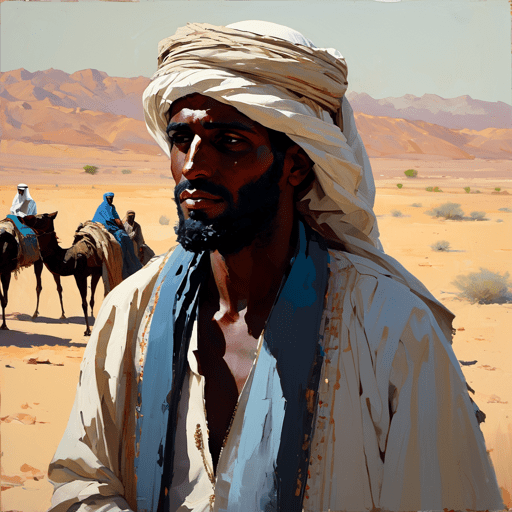
AI generated image with Hotpot.

Sufism

With regards to taṣawwuf, it is clear that Kemetian has no conception of it. Rather, he follows the footsteps of many Western Orientalists who deemed taṣawwuf as an Islamic form of “mysticism” and the pursuit of paranormal phenomena. This was the opinion of European Orientalists Henri Bergson and Reynold Nicholson. Rene Guenon, however, challenged them on the ground that mysticism is a Western concept equivalent to heresy, magic, occultism, which only leads to confusion and distraction from the true path of esoteric knowledge (i.e., taṣawwuf).

On the topic of Dhū al-Nūn, Kemetian contends that he was not Muslim and supposedly practiced ancient Egyptian mysticism which he inherited from Tahuti. In turn, he uses these baseless claims to assert that taṣawwuf is not Islam. I happened to write a paper for graduate school refuting this Orientalist view of mysticism, who attempted to change Dhū al-Nūn from a pious Muslim ascetic to a syncretic mystic. Nicholson characterized Dhū al-Nūn as a mystic, moving a sofa with his thoughts, which caused spectators to die out of astonishment. Yet I found none of this in his earliest biographical sources: Ṭabaqāt al-Ṣūfīyya by Abū ‘Abd al-Raḥmān al-Sullamī (d. 412/1021), Ḥilyat al-Awliyāʾ wa Ṭabaqāt al-Aṣfiyāʾ by Abū Nuʿaym al-Iṣfahānī (d. 430/1039), and al-Ṭabaqāt al-Kubrā al-Musammā Lawāqiḥ al-Anwār al-Qudusīyya fī Manāqib al-‘Ulamā wa’l-Sūfīyya by ‘Abd al-Wahhāb al- Sha’rānī (d. 973/1565).

From these works we can ascertain that Dhū al-Nūn was clearly an Islamic scholar who is listed in the chains of hadith narrators along with Mālik ibn Anas, Layth ibn Sa’d, and Sufyān ibn ‘Uyayna, a science Kemetian rejects. Al-Sullamī confirmed that he was a Nubian from Akhmīm, a city in the Sohag state of Upper Egypt. This is a site of ancient Egyptian temples, but the biographers do not relate much information about his background. They only relate that he his teachings as a true Sufi. He emphasized divine love (maḥabba), humility (tawāḍu’), repentance (tawba), sincerity (ikhlās), solitude (waḥda), and truthfulness (ṣidq). Furthermore, he stressed that people not make claims to gnosis (maʿrifa), which is a trope of Sabian groups who believe they have some secret knowledge that is not attainable by all people.

Al-Sha’rānī relates Dhū al-Nūn’s encounter with the Abbasid caliph al-Mutawakkil, which demonstrates his brand of Sufism. After being accused of heresy, he was marched to Baghdad in chains. On the way, an old woman advised him not to be in awe of the caliph nor to look down on him or argue his case. Dhū al-Nūn thus avoided responding to the accusations. When asked why he did not answer, he said that if he denied the claims he would have made liars of Muslims, and if he confirmed them, then he would have lied about himself. So he left the decision up to the caliph. Upon hearing this al-Mutawakkil declared him innocent.

There was nothing “mystical” about Dhū al-Nūn’s Sufism and there is nothing to suggest that he secretly practiced ancient Egyptian mysticism. His earliest biographers reported about his loyalty to Islam and Sufism and did not report instances of telekinesis and other paranormal activity. Therefore, how can a 20th century European writer with no ties to Sufism bring a new report about him? It is clear that Kemetian is citing the European tradition of mysticism and not the African tradition of Sufism with regards to Dhū al-Nūn.

Kemetian presents the Orientalist perspective on Dhū al-Nūn.

Conclusion

The ability to create YouTube channels and gain recognition from less informed people has emboldened people to share half-baked theories and misinformation on the web. No qualifications or prior experience needed. It is noble the Mr. Kemetian is compiling information and pondering these topics, but his level of knowledge is premature and lacks the proper orientation. His information is faulty because he is not qualified to speak on much of what he claims to know. Experts can easily recognize other experts and he is surely not one of them. This is just a warning: although internet Sabians may seem smart and dazzling, it is important to supplement one’s understanding with actual source materials on the given topic and consult with experts. Or else you will be deceived into the crooked path of modern Sabianism.

References:

Guenon, Rene. Perspectives on Initiation. Edited by Samuel D. Fohr, Translated by Henry D. Fohr, Sophia Perennis, 1946.

Guenon, Rene. The Crisis of the Modern World. Translated by Marco Pallis et al., Sophia Perennis, 1946.

Iṣfahānī, Abū Nuʿaym al-. Ḥilyat Al-Awliyāʾ Wa Ṭabaqāt al-Aṣfiyāʾ. Dār al-Fikr, 1996.

Nicholson, Reynold Alleyne, et al. The Mystics of Islam. G. Bell and Sons, 1914.

Qurṭubī, Abū ʿAbd Allah Muḥammad ibn ʾAẖmad al-ʾAnṣārī. Al-Jāmiʿ Li ’Aḥkām al-Qur’ān. Dar Alam al-Kutub, 2003.

Samak, ʿAbdullah ʿAlī. Al-Ṣābiʼūn. 1st ed., Maktabat al-Ādāb, 1995.

Sha’rānī, ’Abd al-Wahhāb. Lawāqiḥ Al-Anwār al-Qudusīyya Fī Manāqib al-ʿUlamā Wa al-Ṣūfīyya. Maktabat al-Thaqāfa al-Dīnīyya, 2005.

Sullamī, Abū ’Abd al-Raḥmān al-. Ṭabaqāt Al-Ṣūfīyya. Maktabat al-Khanji, 1986.

The Myth of “Arabized Islam” & Other Fallacies of Pseudo-Islam (Part 2)

The charge that “orthodox” Islam is Arabism or Arab Islam is based on ignorance and prejudice. It’s based on an ignorance of Islamic history and prejudice against people who identify as Arabs. On top of that, it is based on ad populum rhetoric, which is a type of logical fallacy that seeks to sway people to their opinion, not by engaging the merits of the ideas, but by stirring up prejudice against a people that they know their audience might dislike.

The facts, however, are against Kemetian. Some of the greatest scholars of Islam throughout history have not been Arab. Someone like Sībawayh, who wrote one of the most definitive works on Arabic grammar, was a Persian. Likewise, Abū Ḥāmid al-Ghazālī who wrote on numerous subjects such as philosophy, Islamic law, and Sufism was also Persian. Al-Buṣīrī the poet who wrote the Sufi Burdah poem in honor of the Prophet Muhammad was a real Moor from the Ṣanhājah Berber tribe.

Kemetian conflates a traditional understanding of Islam from its historical sources with Arabism. He does this to make you doubt  its veracity while promoting his non-historical personal understanding of religion. Traditional Islamic scholarship has a system of checks and balances to ensure no one makes up deviant doctrines according to their own preferences based on scriptural and textual evidence. The MST is in shambles precisely because they have no such mechanism. Yet, this is the nature of Sabianism. As the Christian heresiographer, Irenaeus, said of the early Christian Sabian groups:

…many offshoots of many heresies have come into existence because many-or indeed all -of them wish to be teachers and to leave the sect in which they were ; composing another doctrine from another opinion, and then another from another, they drive onwards to teach in a new way, describing themselves as the discoverers of whatever opinion they have concocted.

(Grant, R. 1978, p. 47)
AI generated image from Hotpot

As for Kemetian’s prejudice against Arabs, it is indicative of many in the so-called conscious community. They match a contemporary post-9/11 image of Arabs with their misreadings of history. The truth is that the Arab identity is much like the Latin identity, in which people of different races, ethnicities and geographies are connected through a common cultural-linguistic identity. Ignorant Blacks who only know the racial constructs of the United States often do not understand this fact and constantly try to force others into their own racial paradigm. Furthermore, these so called conscious folk have no sense of the religious, ethnic, and linguistic diversity in the Arab world, which consists of Nubians, Copts, Berbers, Kurds, Armenians, and Chaldeans to name a few. All Black Americans can see is black and white.

Additionally, there is nothing inherently wrong with being Arab no more than there is anything wrong with being African. Anyone who has ever lived in or visited regular people in the Arab world would know that the vast majority of them exhibit manners that the average American can only dream about. They are very hospitable, generous, and genuinely friendly. Perhaps the marketplace, in traffic, or politics are not the best places to witness these good manners, but they are there. They are not without their prejudices, but their prejudices are commonly directed at other Arabs, Jews, and SubSaharan Africans. Yet when Arabs are confronted about their prejudices, they usually back down.

Much of the Muslim world might hold Arabness in some esteem because of their love for the Prophet Muhammad and his family, who were Arabs. That aside, the Muslim world has not been dominated by Arabs since the Umayyad dynasty. it must be noted that only 20% of the Muslim world is Arab. The majority of the world’s Muslims are in Asia and their scholars have had a great influence on the Muslim world for centuries. Why aren’t the pseudo-Muslims decrying an Asian Islam?

The erroneous idea that Arabs run everything in Islam just like Europeans run Christianity is a false analogy and just plain wrong. For instance, black and white orientalists talk about an Arab slave trade, but never a European slave trade. They think that because Arabs were involved, they must have run it. Ignoring the fact that slave trading has always existed in the region and involved Arabs, Africans, Persians, Indians, Turks, and more. Moreover, the enslaved were not only black, but from these various races as well. This does not excuse any atrocities committed by Arabs or other people. It only serves to disrupt the narrative that so-called white Moors (i.e., Arabs) enslaved black Moors. Dark skin people are not the perennial victims of history.

The charge from Moors, NOI, Nuwaupians, Afrocentrics, and other so-called conscious groups that orthodox Muslims follow an “Arabized Islam” is baseless, which exposes their lack of knowledge and bigotry. It is simply a flimsy argument they use to keep from discussing Islam on its own terms. If anything, orthodox Islam reflects intergenerational, interethnic, intercivilizational, and international networks of knowledge that is not rivaled by any religious system today. In the next part of this series, I will address some of the specific fallacies Neo-Sabians fall into when approaching Islamic concepts, which cause them to completely misunderstand the religion.

The Myth of “Arabized Islam” & Other Fallacies of Pseudo-Islam (Part 1)

Whoever the Most High is a witness for Truth, he need not claim it. The claim is a sign of his veiling from Truth and Peace.

A quote from dhū al-nūn from al-Sha’rānī, ’Abd al-Wahhāb. Lawāqiḥ Al-Anwār al-Qudusīyya Fī Manāqib al-ʿUlamā Wa al-Ṣūfīyya. Maktabat al-Thaqāfa al-Dīnīyya, 2005, p. 129.

In recent years, the Moorish Science Temple (MST) has become one of the many groups on the conscious chit’lin circuit; some of them Hanifs, most of them Sabians. Unfortunately, the unscrupulous reader might mistake the Sabians among them for Muslims or, even worse, a factual representation of history. As a Muslim researcher with a specialization in the Arabic language and Islamic history, it is my responsibility to debunk the bogus claims propagated by such groups.

In one recent YouTube presentation on TITANS TV, a Moorish Science researcher and self-proclaimed Arabic teacher by the name of Kemetian Adept Hieruphant attempted to advocate for his Sabian-inspired MST doctrine using George G. M. James’ Stolen Legacy, orientalist mythology about the Egyptian Sufi, Dhū al-Nūn (more on this in another post), and a hodgepodge of information to confuse you. I beseech the reader not to confuse claims to knowledge for actual knowledge, as was the message of Dhū al-Nūn. In this post, I will focus on deconstructing Kemetian’s treatment of Stolen Legacy and the history of the Moors.  

While Kemetian uncritically accepts James’ thesis, he provides little to no detail to demonstrate the MST position. Kemetian throws a lot of images and texts at you, but his attempt to connect the so-called Moors to the ancient Egyptians is weak because it has no basis in the actual history of North Africa or the Islamic world. He, like many so-called conscious folk, suffers from debilitating confirmation bias; believing his point of view is the only way of seeing the information. Why does he perpetuate a bogus conspiracy theory about the death of James? (A past professor of mine researched and debunked this claim) Why does he think that by virtue of genetic lineage he has a rightful claim to the knowledge of ancient Kemet without actually studying it? And what is a mystery school today other than a university? Kemetian’s misinformation not only reduces his credibility but also the credibility of anyone who takes this topic seriously.

Kemetian Adept | Moors Custodians Of Kemet’s Wisdom Teachings

George GM James’ Misunderstood Stolen Legacy

Kemetian introduces his presentation with the passage from Stolen Legacy that opens Islam and the Ancient Mysteries Vol. 1. In my book, I put forth a better way to understand James’ thesis, which lies in answering three main questions:

  1. Who were the Moors discussed by James.
  2. What knowledge did the ancient Egyptians possess?
  3. How did the Moors acquire ancient Egyptian knowledge?

First, the Moors of history were not followers of Noble Drew Ali or members of an organization called the Moorish Science Temple. “Moor” was an epithet used by Europeans during the Middle Ages to refer to people with dark features and Muslims in general, and North African Muslims specifically. Whatever its original meaning, it was lost on European people by the Middle Ages. They were not calling North African Muslims “gods” or anything of that nature.

If we take the European usage of Moor at face value, it means someone who is dark (relative to the average European phenotype) and/or from North Africa and/or Muslim. This is a broad span of people, which can encompass SubSaharans, Berbers, Arabs, Persians, and Indians and often times it has referred to Jews, Christians, and Muslims living in Muslim-controlled lands.

Johannes Andreas Maurus, a Spanish convert from Islam to Christianity (original pen and ink drawing by Maurice Hines)

Secondly, we must have an understanding of what knowledge was attributed to the ancient Egyptians. While James touches on this, he is not completely clear as to what that knowledge was. On the one hand, James characterizes this ancient knowledge as a secret, exclusively for Egyptians, transmitted orally from teacher to student, and forbidden to be written down. On the other hand, he writes that this knowledge was kept in books at temples and libraries, which were eventually copied and plagiarized by the Greeks (particularly Aristotle), and then they became the domain of the Greeks, Freemasons, Theosophists, and occultists. How James deduces this can be challenged on the grounds that he retrofits the concepts of contemporary esoteric movements on to ancient Egyptian Mystery Schools. This is only James’ speculation, not concrete proof.

Additionally, James reconstructs the ancient Egyptian curriculum using a mixture of Christian and pre-Christian Greek sources, whose works he sees to be untrustworthy since the pre-Christian Greeks allegedly stole knowledge from the Egyptian Mysteries and the Christians attempted to annihilate them. Nevertheless, the curriculum according to James was made up of the seven liberal arts, secret languages and mathematical symbolism, as well as magic. This included memorizing the books of Hermes that teach the hieroglyphs, cosmography, geography, astronomy, typography, how to slaughter animals, law, theology, medicine, among other subjects.

Many of these subjects where known and practiced all over the ancient world including ancient Babylon and India, as James alludes to, as well as in Europe and the Americas. There simply is no concrete proof that this curriculum originated in Egypt, no matter how much we want to believe it. In one aspect, it was a secret that died with the last Egyptian priest. Any other empirical knowledge they developed could also be reconstructed by other people with similar aims. Not only that, but both the Islamic civilization and later the current European civilization surpassed the ancient Egyptians in the empirical sciences (no matter what our criticisms of those civilizations are). It is also much more logical and backed by evidence to think that the world’s knowledge was an intergenerational, multi-ethnic collective effort rather than the work of one people.

Finally, how did ancient knowledge transfer to the the hands of the so-called Moors and then to Western Europe? I demonstrate this process in Islam and the Ancient Mysteries Vol. 1. I firmly demonstrate that Muslim civilization under the Hanif creed absorbed the knowledge of ancient Near East, serving as a bridge between the ancient and modern world. The following is a summary of this history.

The True History of the Moors

What’s lost on Kemetian and the Moors are the key players in history that represented this passage of knowledge. If we were to question MST folk to name some of the Moors who conveyed knowledge from the ancient Mysteries, they would be hard pressed to name one. Yet, I have researched several of them for my book: the Ḥarrānian Thābit ibn Qurrah, the Persian family Āli Nawbakht, the Abbasid Translation Movement, and particular Muslim philosophers like Ibn Sina, al-Ghazali, and Ibn Rushd and their respective philosophical positions. There are countless more that historians have researched.

A synopsis of this history starts with the decline of the Mysteries, prior to Christianity. In the Greco-Persian wars, Alexander massacred Iran and sought to extinguish the Persian-Babylonian Mysteries and the knowledge they acquired. He brought their manuscripts to current-day Egypt and had them translated into Greek and Coptic and destroyed the Persian originals. The Greeks were therefore consolidating the knowledge of ancient Egypt and Babylon. As of the 4th and 3rd centuries BCE, this knowledge was most readily available in Greek and Coptic (an advanced form of the ancient Egyptian language).

Christianity was a Hanif system that challenged the Sabianism that proliferated among Judaism and the so-called Philosophers. The disciples spread the monotheistic message of Jesus, which eventually became mixed with the ideas of gnostics (i.e. Sabians), such as Simon Magus, Menander, and yes, Paul. The early scholars of Christianity were educated in the schools of the Greeks and were able to argue the Sabians in their own terms. Though the Christians opposed the Sabians, they ended up absorbing much of the ancient knowledge in the Eastern Church, which split from the Western Church relatively early in the history of Christiandom.

In the meanwhile, the Persians sought to reconstruct their mysteries by reviving the manuscripts found at the extremities of the Persian empire near India and China. They were open to various sects of Christianity such as the Nestorians. Many of those Christians preserved ancient knowledge they inherited from the Greeks in the Syriac language. By the time the Muslims conquered, these works began to be translated into Arabic. This proliferated during the Abbasid Caliphate that funded the Translation Movement; translating the works of the ancient mysteries primarily from Greek, Syriac, and Persian, because knowledge from the ancient world was largely consolidated in these languages.

While the likes of Thābit ibn Qurrah, the Nawbakht family, and Ibn Muqaffaʿ played key roles in this Translation Movement, the effort cannot be attributed to one tribe, ethnic group, race, or religion. Thābit’s ethnicity cannot be ascertained although he was a native Syriac speaker and also spoke Greek and Arabic. The Nawbakht family were from a lineage of Persian Magians who specialized in astrology. Likewise, Ibn Muqaffaʿ was a Persian litterateur responsible for translating numerous books from the Persian and Indian literary heritage. Muslim and Arabic-speaking scholars of other faiths engaged these works for nearly a millennium, including the questionable works on astrology and magic. Yet, the most controversial issues centered on the philosophical concepts of the creation of the universe, pantheism, and the like, which I covered in the post Is God the Universe?  

Social media scholars from the MST and other so-called conscious groups cannot accurately describe how or why this passed from Muslim lands to Western Europe. The Christian Crusades against Muslims began in the 11th century, at the height of the Translation Movement. One should also observe that during this time, many Europeans were “orientalists,” meaning that they admired Arabic language, culture, and knowledge; see (Burnett, 2008, p. 22). Many in Western Europe, who have long since been cut off from the ancient Greeks, rediscovered the knowledge compiled in Greek through Arabic. As political enmity grew between Western European Christiandom and Islamdom, the intellectual affinity grew. One might notice that some of the most erudite scholars from Andalus, migrated to Egypt during the Inquisitions such as al-Qurṭubī and Abū Ḥayyān al-Andalusī, etc. Khaled El-Rouayheb performed an excellent study on the influence of Maghribī scholars on theology and logic in Ottoman-controlled Egypt and prior. Many of whom were from the Ṣanhajah Berber ethnic group.

No narrative about the Moors’ passage of knowledge to Europe would be complete without mentioning the 12th century CE polymath Ibn Rushd (the grandson). In addition to being from a scholarly lineage based in Córdoba, he was a jurist, physician, and Aristotelian philosopher. In fact, he was known as the chief commentator on the works attributed to Aristotle. The untrained reader must remember that Aristotelian philosophy was at the core of Sabian doctrine, which was a proponent of the eternity of the universe. Ibn Rushd wrote a vehement defense of philosophy and Aristotelian concepts in his Faṣl al-Maqāl and Tahāfut al-Tahāfut against Abū Ḥāmid al-Ghazālī’s Tahāfut al-Filāsifah. Although Ibn Rushd’s positions were rejected by most Muslim scholars, many European orientalists were enamored with his works. This even prompted the Christian theologian, Thomas Aquinas to write a response opposing the eternity of the universe.

Conclusion

The perspectives propagated by the Sabian factions of the MST amounts to nothing short of pseudoscience and a creative re-telling of history. Only simpletons are impressed. History does not begin with the interpretations of pseudo-scholars, but the collective evidence established by a body of researchers. Unfortunately, the MST lacks members who have advanced through the degrees of scholarship: sufficient tertiary education, specializations, peer-reviewed publications, academic integrity and humility, etc. Furthermore, there is nothing novel about their teachings. Their teachings are simply Sabian-Noir doctrines; the same doctrines that have confused our people for generations. In another post, I will unravel some of their doctrines and their erroneous characterizations of Sufism.

From Darkness to “Polight”: A Prospectus on Sabianism and Ritual Sacrifice

We at the Maurchives normally refrain from commenting on the personal shortcomings of our interlocutors in our critiques, with aims at maintaining the intellectual integrity of our positions. However, the recent revelations of the so-called black conscious influencer known as “Brother Polight” (Michael Noak Jr.) has ignited passions and outrage from within the black community. Given the sordid nature of the crime – taking sexual liberties with the daughter of a mistress among other things – and as a survivor of abuse, I take his despicable acts personal and denounce him for them. I am admittedly disgusted, angry, and disappointed with the so-called conscious community, but I am not surprised.

Contrary to popular belief, Polight is not “sick,” “crazy,” or “mentally ill.” His public profile over the years has suggested that he is a very intelligent, deliberate, and charming individual who can sway the hearts and minds of people with his words. Unfortunately, the criminal acts that he pled guilty to are the modus operandi for modern-day Sabians whose only pursuits are the trinkets of the sensory world. Given what we know of his character, we can only assume that he knew what he was doing, but what escapes most people’s grasp is why. Why would a grown man, who was seemingly on top of the world, who possessed fame, health, wealth, and women… why would he risk all of that for an act that if people found out about it would leave him penniless, isolated, incarcerated, and despised by people? Well the answer is clear if we peer into the history of the Sabians and their misuse of the occult sciences. In this post, I will shed some light on what could have been behind his dark acts.

Mugshots of Michael Noak Jr. (aka “Brother Polight”) and Dwight York (aka Malachi York).

Occult Sacrifice: A Brief History

Polight, like numerous other 20th century occultists, called to Sabianism as a seemingly enlightened spirituality that only served to disguise their magic and sorcery. From Charles Leadbeater and Aleister Crowley to the indecencies of Elijah Muhammad, Malachi York, and Jim Jones, spiritualist (Sabian) leaders have been accused of sex acts that traditionalists (Ḥanīfs) find repugnant. In Polight’s case, he almost killed the child he was accused of molesting by forcing on her drugs and alcohol. This act is strangely reminiscent of the rituals that brought down the Ancient Mystery Schools.

The practice of sexual orgies and human sacrifice were some of the practices that led to the decline of the Mysteries. Even prior to the spread of Christianity, the Roman government would crack down on the rites of the Baccchanalia Mysteries for their violent sexual orgies. Emperors Augustus and Claudius put stringent limitations on the Druid Mysteries of England and Gaul who used to practice human sacrifice (Grant, 2004, page 17-19).

The British Egyptologist, Margaret A. Murray described in her book, The Witch-Cult in Western Europe, the four different types sacrifices among practitioners of Witchcraft, who claimed to inherit the ancient Mysteries of Western Europe. Murray states that these sacrifices were: 1) blood sacrifices, 2) animal sacrifices, 3) child sacrifices, and 4) god sacrifices. Blood sacrifices entailed shedding a prick of blood for initiations and signing contracts (Murray, 2008, p. 152). Animal sacrifices including killing animals such as dogs, cats and fowls for the purpose of manifesting Satan (p. 154). Child sacrifices were used to obtain magical powers. They promise the Devil or their jinn an offering at a particular time to acquire these powers. They often use unbaptized children, those from irreligious homes, or their own children, usually poisoning them or sometimes by more brutal means (p. 158). God sacrifices were conducted to manifest the power of a certain Wiccan deity such as a fertility god. In ancient times, the ritual entailed a human being assuming the identity of the deity or allowing himself to be possessed it and then allowing himself to be killed, usually by fire. The ashes would then be collected and used in various other rituals. The Christians later banned this practice and took to replacing the human being with an animal or, in secret, an infant (p. 160-162).

In the Ḥanīf tradition, God shows Abraham a vision in which he is to sacrifice his son. The Judaic tradition believes this son to be Isaac while the Islamic tradition believes him to be Ishmael. Both Abraham and his son agree to the sacrifice and are prepared to carry it out for the sake of God. However, at the last moment God retracts the command and enjoins them to sacrifice a ram instead. Judaic commentaries insist this that this was not a pagan practice gone awry, but an injuction to categorically prohibit human and child sacrifices (Greenberg, 2011, p. 195).

On top of that, the Qur’an has already warned us about this end. Anyone calling to the worship of anything beside the true and living God, is an idolator. Idolators do not worship other gods per se, since there are no other gods. In actuality, they worship jinn, who seek to be worshiped as gods. These jinn promise them the fortune, fame, pleasures, and power that they seek, but demand that they perform disgusting and evil acts as devotion to them. These acts usually involve violating children, whether it’s rape, mutilation, or murder.

وَكَذَٰلِكَ زَيَّنَ لِكَثِيرٍۢ مِّنَ ٱلْمُشْرِكِينَ قَتْلَ أَوْلَـٰدِهِمْ شُرَكَآؤُهُمْ لِيُرْدُوهُمْ وَلِيَلْبِسُوا۟ عَلَيْهِمْ دِينَهُمْ ۖ وَلَوْ شَآءَ ٱللَّهُ مَا فَعَلُوهُ ۖ فَذَرْهُمْ وَمَا يَفْتَرُونَ ١٣٧

Similarly, their associate-gods have made the killing of their children seem fair to many mushriks (idolators), so that they may ruin them and may confuse their faith for them. Had Allah so willed, they would not have done that. So, leave them alone with what they fabricate.

Mufti taqi Usmani translation

When Polight would make his asinine comments about Islam many Muslims left him alone to his devices. The only “Muslims” who would engage him were those Moors, NOI, and Ahmadiyas whose doctrines would not allow them to defend the true Islamic tradition. The average listener was impressed by his diatribes because they never heard certain vocabulary words strung together. However, intelligent people knew that he had mastered the art of hypnotism, talking in circles at a loud volume in the style of his teacher, the convicted serial pedophile and high priest of the modern African American Sabians Malachi York, but much of what he said lacked substance and was never backed up by facts. His strategy was to interrogate the beliefs of others without being interrogated on his own beliefs. In the end, he called to the worship of “the black woman” and money. But the light has shown on the true depravity of his beliefs.

References

Grant, Robert M. Augustus to Constantine: The Rise and Triumph of Christianity in the Roman World. 1st ed, Westminster John Knox Press, 2004.

Greenberg, Irving. The Jewish Way. Touchstone, 2011.

Murray, Margaret Alice. The Witch-Cult in Western Europe. Forgotten Books, 2008.

Islam and the Ancient Mysteries Vol. 1: The Mystery Schools: Book Release

On July 22, 2023, I presented on my new book, Islam and the Ancient Mysteries Vol. 1: The Mystery Schools at Masjid Ashabul Yameen in East Orange, NJ. This is a humble beginning to the spread of a much-needed perspective that will help the Muslim Ummah in the West understand and navigate its current state with wisdom.

Volume one of this book series can be found on the Books from the Maurchives page along with other publications from the Maurchives. The Mystery Schools, seeks to draw the historical connections between the Sabians of Islamic times and what some know as the Mystery Schools of the ancient Near East. No scholar from the East or West has made this explicit connection before and I will expand on this thesis in subsequent volumes. Additionally, I will elucidate why it is relevant to religious discourse of the 21st century and beyond.

The African American Muslim Summit 2023 – Reflections

Over the weekend of May 6-7, Masjid Muhammad of Atlantic City, New Jersey held their 5th annual African American Muslim Summit. I had the honor of attending the conference for the first time. It was also my first time attending a Muslim conference of this nature since my return to the U.S. In some ways, it had the vibe of a Muslim family reunion. In other ways, it was an intensive learning experience as speakers and attendees alike expressed their erudition on a broad range of topics dealing with not only the religious sciences of ʿaqīdah, fiqh, and taṣawwuf, but also on topics of finance, psychology, marriage, history, and politics. It could have used a panel about the revival of the Afrocentric Muslim, but that is the topic of another conversation. Beyond the speakers of the conference – many of whom the community benefits from year around in several online and localized venues – I would like to share a few take aways based on my conversations and reflections:

African American Islamic Summit

Photo credit: Islah Muhammad 2023

  1. The role of imam in an American Muslim community is a political role. The person in the position of imam should have as much political savvy as he does knowledge of Islamic sciences. Understanding the political terrain in the city, county, and state in which a masjid operates is key to the survival and growth of a community. New Jersey has a higher percentage of Muslims than any other state and these populations are used strategically by some local imams as well as politicians to achieve certain gains. This does not mean that communities located in places with less Muslims cannot play an effective political role in their locales. Politics is essentially about institutions working with other institutions. America is built on the mutual cooperation of these institutions. The sad truth is that those who are not affiliated with an institution are often ignored in American society.
  2. Every Muslim community should have a dār al-iftā run by qualified muftis/mujtahids, counselors, doctors, financial experts, lawyers, etc., who are sworn to the same ethical standards as therapists and social workers. Generally, American Muslims do not understand the purposes of the sacred law (Sharīʿah). This may be due to years of anti-Muslim propaganda or trauma related to dealing with secular law. However, we must understand that the Sharīʿah is not a Hammurabi’s Code of infractions and punishments. Rather it is about solving problems while keeping our dīn, hearts, and dignity intact. We know that international organizations like ICNA and some Mosques with qualified individuals have tried but more can be done. At any given moment, Muslims may deal with issues that require thoroughly researched responses. More often than not, they seek to resolve these issues by searching the web, social media, or Muslim gatherings where imams and knowledgeable people may be present. However, some issues require a personal touch and knowledge of disciplines beyond the traditional Islamic sciences. Imagine if such an institution was localized and widespread, solving everything from financial contracts to marital disputes.
  3. There is no benefit in intra-religeous polemical culture within Black Muslim communities. No matter how right one group is or how wrong another is, the harms outweigh the benefits and usually encourages people to double down on their positions. Black Muslims should understand how deeply these polemics divide our communities and destructive they can be. I find it just as disturbing coming out of the mouths of sufi madhhabis as I would from the mouths of salafis. I have listened and interacted with various elements of the African American Muslim community and found that most people just don’t understand each other and their doctrines completely. We should seek ways to cooperate with each other, even if we cannot convince each other of our ideas. The greater good of the community’s future is of more consequence. A simple exercise to keep ourselves in check is to imagine the impact you and your community will have on the history of Islam in America 100, 200, even 1,000 years from now. Ask yourself: how do you want to be remembered?

These are just a few of my thoughts that I hope we can realize sooner rather than later. Until then, I’m back to America and back to work.

Sabian Mumbo Jumbo: Ishmael Reed and the Polemics of the Modern Sabians

Ishmael Reed’s 1972 Afrofuturist novel, Mumbo Jumbo, is a classic and masterful literary work. However, behind the words on its pages lies a modern Sabian polemic and interpretatio afro-americana. The novel is set in a pandemic-era 1920’s America. The disease was a Vodoun-inspired, dance and free-love hysteria called “Jes Grew” that primarily infected African Americans, who needed to be quarantined if they succumb to the disease. It is obvious that Reed aligns with this behavior and sees it as the true means to liberation, while he directs his sharpest criticism to the “Atonists,” monotheists who follow a traditional religion but are secretly controlled by a Freemasonic cabal called the Wallflower Order. In other words, he believes that Traditionalists/Hanifs are close-minded prudes who oppose the essential elements of humanity.

Such a perspective is not new. The dialectic between Sabian/Spiritualists and Hanif/Traditionalists has been at the heart of metaphysical debates since the inception of religious history. Perhaps the fact that he was on of the first to articulate this concept in an African American context is his greatest feat and few, if any, have discussed this aspect of his book. In this post, I will examine Ishmael Reed’s novel in light of what we know of Sabianism. We will uncover his Sabian polemics, counter-narratives, and his vision for Black liberation.

Sabian Polemic

Mumbo Jumbo represents a modern-day Sabian polemic against the Hanifs of our times, or as he refers to them, the Atonists. Throughout the novel, Reed characterizes the Atonists as anti-nature, anti-fun, authoritarians who have made the world a terrible place to live by enforcing laws, making people work, and limiting freedom. They thrive on paranoia and a sense of control over people’s actions as demonstrated by his pairing the malevolent Wallflower Order with monotheism and the righteous virus known as Jes Grew with polytheism and liberation.

Reed constantly mocks Christian and Muslim sentiments throughout the novel. In Reed’s world, they are on the side of the Wallflower Order who oppress those they consider heretics and apostates. There is a Muslim character by the name Abdul Sufi Hamid (an allusion to Abdul Hamid Sufi, the Harlemite convert to Islam and labor leader who died in 1938) who had possession of an ancient Egyptian text that held the secret wisdom of the Black man. He is part of the Black resistance along with Papa LaBas (a Vodoun priest and the book’s protagonist) and Black Herman (a medicine man). However, because Abdul is Muslim he is incapacitated by his  “Atonist” belief that the people infected by the Jes Grew “Epidemic” are just primitive, superstitious heathens. He does not identify with them because he is an arbiter of people’s tastes and clings to a belief that Muslims are superior to pagans. In one instance, he belittles the epidemic by claiming it’s “a lot of people twisting they butts and getting happy. Old, primitive, superstitious jungle ways. Allah is the way. Allah be praised.”

In a dialogue in which Abdul attempts to distance himself from Christianity, Papa LaBas goes on a diatribe stating that Islam derived from Christianity. He repeats the theories of Orientalists who believe that Muhammad wanted to impress Christians with his knowledge of the Bible. He goes on to say that both Christianity and Islam find women to be evil and acknowledge the same angels like Gabriel and prophets like Abraham, Isaac, and Moses. Then he says that they both condemn the Jews because of the “pantheistic contingent” among them. Here he points out that the Jews are God’s chosen people and yet there are Sabians among them who do not deny the worship of other gods. Black Herman brings up the fact that the “Koran” has been accused of lacking chronology and Muhammad of being ambiguous and inaccurate with regards to the identity of Miriam, Moses’ sister, and Mary, the mother of Jesus. Abdul has no response but a scripted intolerant retort telling them not to criticize his religion. “Atonists Christians and Muslims don’t tolerate those who refuse to accept their modes,” he claims. Abdul is said to have “picked up the old Plymouth Rock bug and [is] calling it Mecca.” LaBas says that the images in the temples of ancient Egypt were so explicit that other nations burned them and called it obscene and pornographic.

While these extensive dialogues feature between the plot of the novel, they tell us a lot about the position of the author and the debates that existed in the Black community at the time of the book’s publishing. Reed skillfully brings the ancient Sabian polemic to 20th century Black urban America, a population situated for such influences. As Sabian movements with Islamic overtones like the Nation of Islam and Moorish Science Temple directed people from Christianity with their harsh critiques of the religion, their orientation to their roots, and programs for Black liberation, the Afrocentrists went one step further by calling Black people to reject the monotheistic Hanif paths all together and to join them in their polytheistic Sabian paths. This coupled with the Free Love Movement of the 60’s made Sabian-inspired ideas particularly attractive during that era.

Sabianism as Liberation

It is clear that Reed’s idea of Black liberation is a syncretic hedonism linked to jazz music and diasporic African cultures, a position taken by many Black cultural nationalists of the 60’s and 70’s. As early as 1962, Oseijeman Adefunmi (formerly Serge King), founder of the Yoruba Temple in Harlem, articulated a sentiment aimed to critique Islam’s austerity: “The African, being supremely creative and cosmopolitan, will eventually revolt against a culture which debars plastic sculpture and other traditionally African expressions such as dancing, syncopated singing, smoking and drinking.”

Moreover, Adefunmi challenged Islam’s efficacy in protesting White supremacy. He believed, as Reed insinuates, that Islam and Muslims detests the same things the White power structure hates about Africans: its pantheon of gods, dancing, and drumming. As such, Islam is not sufficiently African and is thus, more tolerated by White supremacists. The Islam of enslaved African Muslims, he contends, vanished because it was not authentically African, as opposed to other African spiritual and cultural elements that survived slavery. Of course, Adefunmi brings up the East African slave trade as another reason as to why Blacks should reject Islam. (Adefunmi, Oseijeman. Tribal Origins of African-Americans. New Oyo [Harlem]:Yoruba Temple, 1962, 1, cited in Knight, 2020, p. 33).

In my estimation, the things to which Afrocentric Sabians are calling are not a means to liberation but they are the means to bondage both physically and spiritually. Did the Europeans not trade alcohol for slaves? Did this addiction not lead certain tribes to fight others and sell them into slavery? Does sexual promiscuity not lead to broken families and disease; the exact things that destroy our communities in the U.S.? Were African people not singing and dancing before, during, and after slavery? If so, what difference does it make if they choose not to now? While it is natural for people to enjoy themselves (according to their personal tastes, which might or might not include singing and dancing), fun is not a sole means to ending oppression and other social ills.

Moreover, practicing a tribal religion did not protect Africans from capture and enslavement any more than practicing Islam or Christianity. At least Islamic law regulates the trade and treatment of slaves and prohibits slavery on the basis of race. The Mamluks of medieval Egypt were not Africans but Eastern Europeans and Central Asians. Likewise, the African Tippu Tib played a major role in the East African slave trade just as much as the Ibāḍī sultans from southern Arabia.

What is more, African Muslims played just as much a role in fighting the European slave trade as their participation in it. In fact, more Africans (including those who practice traditional religions) participated in the slave trade than Europeans. The Europeans that traded in slaves were a minority of rich and opportunistic royalty and businessmen. The peasants of Western Europe were not part of this.

Counternarratives and Interpretatio Afro-americana

Even deeper than than their challenge against a single Abrahamic religion is the neo-Sabian tendency to create counter-narratives to what we know of the scriptures. Starting in Chapter 52, Reed recounts a history of religious figures that has no basis in tradition or scripture. Rather, it is a myth (i.e. false story) that serves the purpose of undermining people’s beliefs about the prophets and their works.

In Reed’s myth, Osiris is the hero and hip prophetic personality who spread knowledge of agriculture, music, and most importantly dance. He was an Egyptian prince who studied at a university in the Arabian town of Nysa. He typified the Jes Grew infection discussed previously in the novel. Osiris even ventured to Teotihuacán and Olmeca in South America to spread his knowledge.

The first villain was Set, who opposed his brother, Osiris. Set was obsessed with war, hated nature and agriculture, and had an egotistical jealousy of Osiris. Plus the fact that Osiris married their sister, Isis, further intensified Set’s hatred. Reed writes of Set in the following words:

He went down as the 1st man to shut nature out of himself. He called it discipline. He is also the deity of the modern clerk, always tabulating, and perhaps invented taxes.

The next villain was Akhenaton, the devotee to Aton, from which the Atonists in the novel take their name. The Egyptians rejected his creed of monotheism and killed him.

Next in his succession of villains is Moses, the adopted son of a Pharaoh and initiate of the Osirian Mysteries. He sought leadership in the order by tricking Jethro, a genuine follower of Osiris, into teaching him the secret tunes that he inherited from Osiris as well as the Book of Thoth acquired from a conjured vision of Isis. Yet, his plan did not work. Moses only attained from it the aggressive and violent magic, which made the people mock and hate him. As a result, he loathed the book and hid it in a tabernacle.

The next villains were the Knights Templar, a Christian Atonist group modeled after the rogue Ismāʿīlī Assassins. A librarian for the Knights Templar named Hinckle Von Vampton found the copy of the Book of Thoth in their library. As the Knights Templar were being executed throughout Europe for worshiping the “Black god Baphomet,” Hinckle escaped with the book and lived for hundreds of years. He eventually ended up in the U.S., where the Wildflower Order, created by the Atonists, aimed to find him and the book in order to put an end to the Jes Grew pandemic, which evoked fun and benevolent magic.

These counter-narratives are reminiscent of the Mandaean (Sabian) narratives about Noah, Moses, Abraham, and Jesus. As we know, rejection of the prophets or a selection of them is a common trait of Sabianism. Beyond their simple rejection of the Hanif prophets is the Sabian proclivity to invert prophetic narratives to demean them and champion their beliefs. This inversion lies at the heart of the Sabian/Hanif divide and is at the heart of many religious conflicts as alluded to in the novel. I would even argue that this is why non-canonical texts like the Book of Enoch and the Nag Hammadi were rejected from inclusion in the Bible by some religious denominations. These books’ presentations of the prophets align too much with the counter-narratives of the Sabians. As the Hanifs sought to subdue the slander, turmoil, and licentiousness of the Sabians and prevailed, the Sabian response was to operate secretly and to foment doubt and rebellion from behind the scenes. The Afrocentrist, with his worship of ancient Kemet and infatuation with traditional African religions has succumb to the Jes Grew disease, and it has stunted their intellectual and spiritual growth as liberators for the Black community because they focus their efforts against the Hanifs among them. This mantle was picked up by Ishmael Reed in his novel. Though it will go down in history as a post-modern literary masterpiece it will forever be cast in the heap of Sabian mumbo jumbo.

References

Adefunmi, Oseijeman. Tribal Origins of African-Americans. New Oyo [Harlem]:Yoruba Temple, 1962

Knight, Michael Muhammad. Metaphysical Africa: Truth and Blackness in the Ansaru Allah Community. Pen State University Press, 2020.

Reed, Ishmael. Mumbo Jumbo: A Novel. Ebook. New York: Open Road Integrated Media, 1972.

Nationalism in the Nile: Egyptians, Afrocentrism, and Kevin Hart

A small faction of Egyptian neo-nationalists on social media has announced that the wholesome American comedian, Kevin Hart, is not welcome in Egypt leading up to his February 21, 2023 performance in the country. Behind this supposed “viral” campaign is a small cadre of under-educated Egyptians who have recently learned of something called Afrocentrism. In turn, they have erroneously made him the symbol of Afrocentrism due to some internet pictures of him dressed as an ancient Egyptian and some vague statements he made. A few people have brought this controversy to my attention and sought my opinion on it as someone who has bridged the gap between Afrocentricity and the Arab world in the past. As perhaps my final post from the city of Cairo, I will address this controversy and offer a voice of reason on the topic that I hope all interested parties can benefit from.

The Egyptian Neo-Nationalists Behind the Posts

The people behind the hashtags and the posts reflect a misplaced Egyptian nationalistic sentiment that only directs their energy at topics of no consequence for their country. They offer no solutions to class disparities, education, or discrimination within Egyptian society but they seem adamant that confronting Afrocentrism and banning African Americans will solve their problems. These neo-nationalists reject the fact that many of the ancient Egyptians were dark skinned; which can be considered a central tenant of Afrocentric thought. Furthermore, they might have encountered a hostile Hotep who might have spewed some rhetoric about taking back their ancestral homeland of Egypt in one of their vitriolic rants. But does this really warrant a protest movement? And what does it have to do with Kevin Hart?

Ahmad Youness

On December 13, he posted a video speaking out against the upcoming Kevin Hart show and Afrocentrism in general. He claims that the Egyptians of today are the Egyptians of the ancient past and he encouraged Egyptians to not tolerate the appropriation of their history by anyone, especially not “Africans.” Ahmad Youness is a 40-something year old radio personality who has been in the business since 2003. He is known for telling horror stories on the Radio 9090 station. According to his Wikipedia page, has a “license” (a low-level degree) in the English language but not much more of an educational background beyond that.

In one video, he states what could be translated as the following:

This is Ahmad Youness with you, an Egyptian media personality. Recently we heard about a show that will be held by the African actor, Kevin Hart. It should be a comedy show, but I don’t really see anything funny about it. The only funny thing about it is that there are people within Egypt who invited him and there is an Egyptian company that supports and organizes it…

This guy called Kevin Hart is one of the supporters of Afrocentrism. Afrocentrism, if you don’t know, is a movement that says that the ancient Egyptian civilization is not ours but it belongs to Africans and that we stole it. It has since then been falsely attributed to us and that they will take it back one way or another. They have a lot of supporters within and outside their ranks as well. There are also those who secretly support them. You might think that the idea is not widespread but it is very popular. The topic of Afrocentrism is one that has been discussed at length and there are big names that support it.

He shouldn’t come here to Egypt and we shouldn’t welcome him. He is not here. He is not welcome here. And he will not enter Egypt!

Of course, there are many things wrong with his diatribe. Kevin Hart is not an African actor but an American actor who happens to be African American. Racist Arabs often drop the American aspect of an African American’s identity to demean them. This was done to Barack Obama often in the Arab media throughout his presidency. While Kevin Hart might believe how most African Americans (and probably most non-Black Americans) believe, that the ancient Egyptians were Black Africans or dark skinned people, but he is not the poster boy for Afrocentrism by any means. In the US, Kevin Hart has a reputation as a wholesome comedian who is funny but not as edgy or raunchy as other well-known comedians such as Dave Chappelle or Chris Rock. His opposition to Kevin Hart amounts to nothing but a safe target of his campaign. Ahmad Youness is a labeling Kevin Hart with a term that he never claimed in the first place. And he is accusing him of something so minute that Hart probably has no clear recollection of.

Egyptian History Defenders

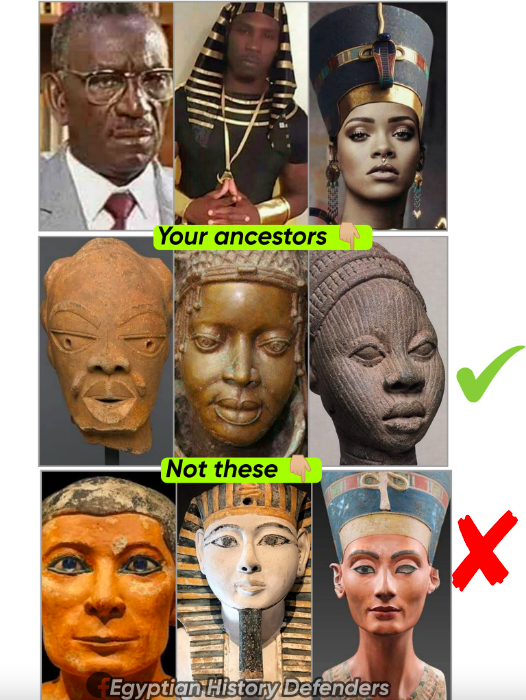
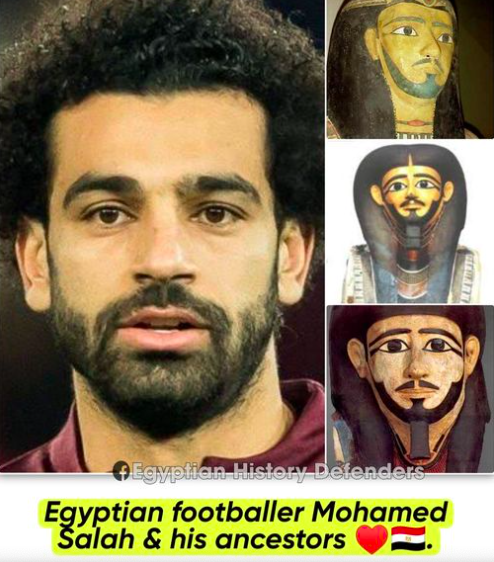
Another front in the campaign against Kevin Hart is the social media handle Egyptian History Defenders. Their social media accounts are full of anti-African American memes concerning their so-called appropriation of Egyptian history. These memes are directed at Afrocentric claims that Black people are at the root of Egyptian civilization. However, it is clear that they cannot differentiate between an Afrocentrist and an African American. Indeed, probably most African Americans believe that the ancient Egyptians were Black, but that does not make them Afrocentrists. This group probably only heard of the term Afrocentrism without researching it, then began to label everything that resembles it by that term. In truth, Afrocentrism is a scholarly approach stemming from the Black Studies movement that began to take shape in the mid-20th century. At its core, it intends to center the perspectives and experiences of Africans on the continent (Egyptians included) and throughout the diaspora in various fields of study starting with history. Molefi Asante, perhaps the most vocal proponent of the term who has since disavowed the concept, rejected the use of Afrocentrism as a response to Eurocentrism. Rather, he used the term Afrocentricity to denote a proactive cultural movement among Africans that shapes the adherent’s paradigm on various areas of human interest. The neo-nationalists have instead reduced Afrocentrism to a mere musing on the ancestors.

Interestingly enough, these Egyptian neo-nationalists in their anti-intellectualism have slipped into the same methodological fallacy as some Afrocentrists. Just as Afrocentrists juxtapose paintings and sculptures from ancient civilizations to pictures of contemporary African Americans to show that these ancient people would be classified as Black by present American standards, they too have taken to juxtaposing pictures of ancient Egyptians to show that they would be classified as Egyptians by today’s standards. While interesting to look at, this is not proof of descent, not for African Americans and not for current-day Egyptians.

On both sides, we should acknowledge that many changes have taken place on earth since the ancient days. While it is obvious that the original Egyptians were Black as we know it today that does not exclude any other people from greatness. Many of those dark skinned people continue to live in the region where you find most of the ancient Egyptian monuments in Luxor and Aswan along with many other Ṣaʿāyada (people of Upper Egypt), who all Egyptians identify as sumr (dark skinned). Why neo-nationalist Egyptians ignore them is indicative of their racism and colonial mindset. They are blinded by the metropolitan north which is dominated by descendants of Central Asians, Greeks, Anatolians, Circassians, and other people of European descent including the French and Germans, that they don’t even realize the dark skinned people that dominate the south of the country where the markers of ancient Egyptian civilization are found. But most Egyptians care nothing about ancient Egypt until foreigners show an interest in it.

No Protests Against European Egyptologists

Why don’t Egyptian neo-nationalists oppose European Egyptologists? They have done more damage than Afrocentrists ever have. In fact, Afrocentrists pose no threat to Egyptian society despite their fiery rhetoric. Yet, white Americans and Europeans are the only groups who have a proven track record of attacking Egypt and distorting its historical narrative under the guise of research. Not only did the French and British colonize Egypt, and the U.S. continues to influence its politics, but they stole artifacts, introduced the question of the ancient Egyptians’ race, and interfered in Egyptian politics, society, and media. Not only that, but it was the West who took the civilization away from Egypt and labeled it “world heritage,” effectively handing their history and artifacts over to the “world,” which just happens to be located in Western countries.

The debate over the race of the ancient Egyptians was started by European orientalists, who founded the field of Egyptology with the intention of barring indigenous scholarship and participation in it. But there are no hashtags and strong words from media personalities for them. The “red line” they draw supposedly at the tampering with Egyptian history is only for the imaginary threat of Black Americans and not the real threat of White Westerners. The neo-nationalist Egyptians should thank Africans and African Americans trained in the West like Carter G. Woodson, Cheikh Anta Diop, George G.M. James, Ivan van Sertima, and John Henrik Clarke among others, who loosened the grip of White colonialists on the narrative of ancient Egypt. In addition, it was the movie Black Panther that sparked the recent sentiment of returning antiquities to their countries of origin. This is an Afrocentric sentiment that Egyptians are tangibly benefiting from. If ancient Egypt is indeed world heritage, then scholars of all backgrounds with the interest and necessary qualifications should be able to contribute to the scholarship of that heritage.

Concluding Thoughts

One of the major accomplishments of the Afrocentric movement was that they dispelled the myth of colonizing European Egyptologists who spread the lie that the ancient Egyptians were “white” like them. I don’t know a single African American or other ethnicity from America for that fact who does not believe that the ancient Egyptians were dark skinned African people. Does Ahmad Youness and his cadre seek to disinvite all foreigners who hold these views regardless of race? Or is this ban exclusively for African Americans? I have lived in Egypt six years and met Egyptians who believe that the ancient Egyptians were Black Africans as well. Do they also think those Egyptians should be expelled? If so, when does the madness end?

Plus, who gave these people the authority to say who is and is not welcome in Egypt? They are not government officials or even intellectuals. They do not speak for the majority of Egyptians who have no idea what Afrocentrism is and more than likely do not care. Kevin Hart’s coming to Egypt would stimulate a depressed economy, which is suffering greatly now. It will also bring joy to a depressed people. Who are these protesters who care nothing about the poor condition of their country and their people? Tourists of all types, including African Americans, stimulate the Egyptian economy every year by taking tours throughout the country. What these protesters want to do effectively is deprive their country of this essential income for their economy. What did not make the headlines was the cancellation of the annual Afrocentric conference that takes place in Luxor. We can presume that it was at the behest of the same neo-nationalists. Baba James Small alerted me to this earlier in the year and I thought it was a bit uncharacteristic of the Egyptian tourist industry, which jumps at just about any and every opportunity to make a dollar. It is clear that Afrocentrism has benefited Egyptians financially and intellectually, more than it has harmed them. If only its detractors would research the matter more seriously.

What I see as vital to resolving the issues between my Afrocentric and Egyptian brethren is opening the lines of communication and the venues for dialogue. From my readings of contemporary Egyptian scholars like Okasha El Daly and Nadim al-Sayyar, as well as classical Arabic scholarship on ancient Egypt, I feel like the two sides have more in common than they might think. Currently, the exchange is almost all hostile and emotionally charged based on their own cultural sensitivities. But if a few level heads came together to discuss things on an intellectual level I am sure we will learn a lot from each other. If there is anyone out there interested in such an exchange please let me know. Until then, enjoy the Kevin Hart show.

Is God the Universe?

It has become popular to refer to God as the Universe in recent years but few know that this practice is rooted in ancient philosophical debates over ḥulūl (pantheism) and the eternity of the universe. Sabians generally argued that the universe was eternal and thus equal to God. Because of this, they accepted the concept of pantheism, i.e. that God can be found within His creation as celestial bodies, inanimate objects, living things, a man or mankind in general, etc. On the other hand, Hanifs argued that eternity was an attribute of God alone and thus the universe was not eternal but a creation of God. As a consequence of this thinking, God was an entirely different genus from His creation and this, among other qualities, made Him worthy of worship.

While these debates are not prominent in popular contemporary discourse , they nonetheless influence much of our thinking, knowingly or unknowingly. Therefore, every time we hear someone praising the universe, we are hearing the residuals of Sabian thought echoing in the current day. While some might see these debates as benign or akin to splitting hairs, they most definitely have metaphysical, if not physical consequences on the masses past, present, and future. In this post, I will present the ancient debate and identify strains of Sabian thought in the modern day.

Al-Ghazālī vs. the Muslim Sabians

In the 11th century, Abū Ḥāmid al-Ghazālī penned his landmark work, Tahāfut al-Falāsifa (often translated as The Incoherence of the Philosophers). While the work is pivotal to Islamic theological debates as well as the intellectual history of philosophy from the ancient world to modern times, it is also relevant to the study of Sabian thought. Moreover, it allows us to understand the fallacies of Sabian thought from a Muslim perspective as well as how to recognize them and refute them in our times. He noticed a trend among the Muslim intellectuals of his day who, upon studying the works of the ancient Greeks, would adopt their philosophies uncritically. This meant that they embraced the belief of the eternity of the universe, which led to other blasphemous ideas such as the weakness of God, the possibility of two deities, and the purposelessness of existence.

In addition to this mistake having detrimental effects on the personal faith of these Muslim philosophers, they would also submerge Muslim civilization in the same theological turmoil that the Naṣārā (Christians) suffered. If we recall from Islam and the Mystery Schools Part 10, the Naṣārā of the Roman Empire, Persia, and beyond were plunged into the philosophical debates of the Mystery Schools i.e. Sabians. Although they won debates about the supremacy of the prophet of their time (i.e. Jesus Christ/ʿĪsā), they compromised on the topic of ḥulūl or pantheism, with the caveat that only Christ occupies the position of God to the exclusion of others in His Creation. In the Muslim Ummah, the likes of al-Farābī and Ibn Sīnā would spearhead this dangerous slip into Sabian philosophy. To others, it was Ibn ʿArabī’s concept of waḥdat al-wujūd (the unity of existence). Wherever the concept was raised it was refuted.

We should understand that al-Ghazālī did not categorically refute the knowledge of the Sabian philosophers. Rather he enumerated 20 points in which the philosophers went wrong and jeopardized their metaphysical futures. While seemingly benign, al-Ghazālī is serious about the magnitude of these mistakes. As I read his words, I cannot help but see some similitude to our current situation. Here, I will turn to al-Ghazālī’s criticisms that are related to the nature of the universe.

Ancient Sabian philosophers argued that it was impossible that a temporal creation emanate from an intemporal creator, i.e., that a finite universe proceed from an eternal God. Instead, they argued that the universe always existed or always had the potential to exist. So, if the universe came into existence at a particular point in time, then why? In their line of questioning, they asked: Was God incapable of bringing the world into existence before this point, thus changing from weakness to power or impossibility to possibility or futility to purpose? They contended that if God was All-Powerful and All-Knowing, then all the conditions were met to bring the universe into existence prior to its existence. So, there must have been some catalyst or cause to bring it into existence.

Al-Ghazālī responds to this conundrum by stating that the creation of the universe at the point that it came into existence was part of God’s eternal will and essentially that God sees the big picture and man does not and cannot. Man might ascribe perceived changes in God’s will to some sort of flaw based on man’s experience and dispositions but these experiences and dispositions do not apply to God. Therefore, the burden of proof is on the philosopher to demonstrate that the creation of the universe was not God’s will. (Ghazālī, 1963, 14-19) Indeed the entire debate is God’s will. We only need to choose the side on which we stand.

Malachi Z. York (leader of the Nuwaubians)

Sabians in the Modern Day

If we turn our attention to the current American metaphysical landscape, we find that our communities are infested with Sabian “manifestations” (or perhaps man-infestations). The New Age movements, Black conscious community, and woke culture represent Sabian thought in our day. Movements such as the Nation of Islam and the Five Percenters have adopted the concept of hulūl, when they deem the Black man as God. The Nuwaubians, with their multifarious deifications of Malachi York have done the same. Some Afrocentric Egyptophiles are also guilty of this in their claims that the Black woman is God, while also postulating their pseudo-intellectual arguments for the existence of multiple gods in the form of ancestors.

Even though modern-day Sabians often pose their questions as intellectual speculation, their intent is mostly mockery of God and His prophets with the aim of leading people to confusion and disbelief in God. Their speculation into the nature of God and the universe is not aimed at a higher Truth but confusion. You will barely find one who can understand the ancient arguments of the Sabians, let alone debate an intelligent Hanif. Their solution is to embrace a multitude of beliefs because in reality they do not believe in anything.

Though modern-day Sabians go by many names, they all have similar traits, like the veneration of the creation over the Creator. Equating the universe to God is tantamount to denying God because it omits the initial Cause and opens up the gates of pantheism, which allows creation to be regarded as God or part of God. These ideas were accepted by the ancient Sabians but opposed by the Hanifs, whose strongest proponents were the Muslims. Yet, within the ranks of the Muslim world these ideas would need to be refuted when they gained traction in its societies. But few among the Muslims are debating these ideas in our times. Even among the droves of Muslim students of knowledge, who study ʿaqīda, kalām, the works of al-Ghazālī, and Muslim philosophers, we have not raised conscious minds who understand the Sabian-Hanif dichotomy and can construct strong rebuttals of the modern Sabians. Rene Guenon (Abd al-Wahid Yahya) was perhaps one of the last to champion Traditional (Hanif) religion over the aberrations of the Spiritualists (Sabians) of his time. I call on my Hanif brethren among the Muslims and the People of the Book to stand up to the Sabian confusion of the current day with knowledge and grace by which we can restore the order of the universe to its proper place.

Reference

Ghazālī, Abu Hamid. Al-Ghazali’s Tahāfut al-Falāsifah: Incoherence of the Philosophers. Translated by Sabih Ahmad Kamali, Pakistan Philosophical Congress, 1963. lib.aucegypt.edu Library Catalog, https://www.ghazali.org/books/tf/index.htm.

America is Not Egypt

It should go without saying that Egypt is not America. After all, they are two different places on two different continents. However, in the world of Wikipedia research, YouTube scholarship, and gullible social media disciples, this is one of the many theories that has been circulating that has no merit. While much of the current media hoopla about Ye and Kyrie Irving is indirectly a critique of the Hebrew Israelite claim that Africans in the Americas are the true Jews (yet another colonialist construct), they and their Moorish counterparts also promote a more extremely bogus theory: that ancient Egypt was in America.

Uriah Brandon*, in his YouTube series, America is Egypt, argues that there is a massive conspiracy to conceal the fact that the civilization, knowledge, and artifacts – attributed to the ancient African civilization Egypt – actually belonged to ancient Native Americans. What is more is that these ancient Native Americans were in actuality the so-called African Americans. The series raises a number of questions, to which Mr. Brandon attempts to answer with his America is Egypt theory. In Episode 4, he queries:

Shouldn’t the Egyptians aka Arabs have known about Egyptian history before the Europeans? So all of these ancient grandiose monuments sit abandoned in the desert in the middle of a trade highway between three continents and they were never studied or surveyed by the Arab population who had been living in the region for at least a thousand years?! How is it possible that supposed native Egyptians knew nothing about Egyptian culture or language until the invasion of the French? The Rosetta Stone and the pyramids had been there for thousands of years, yet the same people accredited with the some of the world’s most advanced knowledge hadn’t even cared to take a peak at a pyramid wall?

America Is Egypt Episode 4. America Is Egypt. UB TV, https://youtu.be/_0fIwWiGoiI. (5:04-6:05)

One of the foundational premises of his theory rests on the claim that Egyptians had no conceptualization, recollection or academic interest in their ancient past. This feeds into his conclusion that the Egyptian monuments and artifacts and even its historicity was concocted by European Jesuits and Freemasons. Mr. Brandon expounds upon this premise in Part 4 of his series, which I will demonstrate in this post is spurious.

Medieval Egyptology

Mr. Brandon did a good job of recounting the problematic origins of the Egyptology field and is right to question colonial scholarship on the ancient world, which is wrapped up in racialized and racist views of people and clear white supremacist motives. His deconstructions of race and language are also meritorious. However, he, like many Hebrew Israelites, Afrocentrists, Moors, and New Agers, suffer from the ailment of not reading widely enough, a lack of scholarly rigor, and debilitating confirmation bias.

Mr. Brandon exposes his ignorance of Egypt in his statement about Egyptians not bothering to look at the pyramids. Anyone who has been to the Pyramids of Giza knows that there are no hieroglyphic inscriptions on them or the Sphinx that sits in their vicinity. One will have to venture (by plane) to the southern part of Egypt to the city of Luxor to find hieroglyphic inscriptions on the walls of their temples and burial sites. On top of that, even the most ignorant Egyptian tour guide will point out that Coptic Christians used these temples and tombs as monasteries and hiding places from the Byzantines (i.e. Romans) who sought to impose their theology on the Egyptian Coptics.

Mr. Brandon might be surprised to learn that not only was there  continuity between ancient Egypt and medieval Egypt, but aspects of ancient Egyptian culture, language, and religious beliefs were retained and studied over the medieval period… in Arabic. Although the study of Egypt since the Islamic expansion to the region is an under-researched topic in English, there was a genre of writings in the Arabic language on ancient Egypt from the likes of Abu Al-ʿAbbās al-Maqrīzī, Jamāl al-Dīn al-Suyūṭī, Ibn Khaldūn, and more. Many of these sources are cited in the book  Egyptology: The Missing Millennium, Ancient Egypt in Medieval Arabic Writings by Ukasha El-Daly. I recently met the author at a talk he gave at the American Research Center in Egypt on Oct. 12, 2022. Although his research aims at correcting the Western academic narrative on the topic, he also answers the very questions Mr. Brandon poses concerning the Egyptians’ own knowledge of their ancient heritage.

Mr. Brandon embraces the same conclusions as the European Orientalists who believe that only they took an interest in unlocking the secrets of ancient Egypt. They carry the attitude that a people’s adoption of Christianity or Islam  automatically makes them religious bigots incapable of not only studying but remembering their ancient past. Yet El-Daly shows both empirically and anecdotally that this was not the case. Rather it was European and American Egyptologists who ignored all indigenous writings on ancient Egypt between the 7th and 16th centuries even though they were aware of them. El-Daly asserts that:

“The main reason was the desire of early Western Egyptologists and others to keep Egyptians out of Egyptology by discouraging them from participation and study, thus leading to their marginalisation and to inevitable Western dominance of the subject” (El-Daly, 2005, p. 4).

We know that early European Egyptologists were not oblivious to the works of the Arabs, Muslims, and Copts with regards to ancient Egypt. El-Daly points out that the British Orientalist, Joseph von Hammer, published an English translation of the 10th century scholar Ibn Waḥshīya’s** deciphering of ancient scripts along with its original Arabic. Others like Athanasius Kircher (17th century) and Wallis Budge (19th/20th century) were indebted to medieval Muslim and Coptic scholarship on the Demotic, Hieratic and Hieroglyphic.*** (El-Daly, 2005, pp. 57-58)

Chapter 5 of El-Daly’s book is titled, “Medieval Arab attempts to decipher ancient Egyptian scripts.” In this chapter, he documents Arab and Muslim attempts at deciphering the hieroglyphics. He says the first of them to take an interest in deciphering the scripts of the ancient Egyptians was the mid-7th century scholar Jābir ibn Ḥayān. Other Arab and Muslim scholars who wrote on the topic include Ayūb Ibn Maslama (9th century), Dhū al-Nūn al-Miṣrī (9th century), Ibn Waḥshīya (9th/10th centuries), and Abū al-Qāsim (El-Daly, 2005, p. 67).

El-Daly’s work introduces the English reader to a myriad of medieval writings in Arabic not the least of which is Anwār ʻUlwīyy al-Ajrām fī al-Kashf ʻan Asrār al-Ahrām by the 13th century scholar of Moroccan descent, Muhammad al-Idrīsī. It provides insights into the nature of medieval Arabic Egyptology. For instance, throughout the book it only mentions the presence of two pyramids. This is not because the others were built later, but because they were covered in sand and only the two largest ones were visible.

During al-Idrīsī’s time, there were a number of theories in circulation about who built the pyramids and for what purpose. One theory was that it was built by thirty consecutive kings of Egypt starting with Bayṣar, the son of Ḥām, and was used as a food repository during the time of Prophet Yūsuf. Some believed that Aristotle had the two pyramids built for himself and Alexander of Macedonia. (Idrīsī and Haarmann, 1991, p. 89). Some thought they were built by the people of ʿĀd, a race of giants from  Arabia (Idrīsī and Haarmann, 1991, p. 99). Others believed that the pyramids and the other monuments, statues, and structures (known as barbā) were built by Enoch (Prophet Idrīs) to preserve the world’s knowledge in preparation of the great cataclysm that was foreseen in the stars. They were not sure if the cataclysm would be in the form of a flood, fire, or invasion. Therefore, they build the structures out of stone and clay so that if the cataclysm was a flood, the stone would remain. If it was by fire then the clay would remain. And if it was by the sword, then everything would remain (Idrīsī and Haarmann, 1991, p. 94). Al-Idrīsī concluded that this latter theory was the most plausible and that the people of the Nile Valley collectively agreed to build these structures for the sake of mankind, showing that they did not believe that the pyramids were built with Israelite slave labor far before Western scholars came to this realization.

The linguistic terrain in Egypt was also complicated by the presence of a plethora of groups and languages in the region in late antiquity prior to Islamic hegemony. This linguistic diversity is best represented in the Genizah documents that were found in Old Cairo’s Ben Ezra Synagogue. In this collection of legal, religious, and mundane papyri documents, One can find Hebrew written in Arabic and Coptic scripts, Arabic written in Hebrew and Coptic scripts, Coptic written in Arabic and Hebrew scripts, as well as Persian and Ethiopic languages. This shows that Egypt was a linguistically plural society since the 6th century. So there is no wonder how lesser used, esoteric ancient languages can die out in such an environment.

In terms of continuity, Coptic is not just a sect of Christianity, but the cultural, ethnic, linguistic, and some would argue, the religious continuation of ancient Egypt. First, the word Egypt is derived from the word Copt, which is pronounced gipṭ. This is perhaps an adaptation of Qifṭ, the son of Miṣr, who was a grandson of Prophet Noah according to al-Masʿūdī (El-Daly, 2005, p. 21). Muslim historians from other lands often sat at the feet of Coptic monks to learn about ancient Egypt. Al-Idrīsī relates the anecdote of a non-Arab expert on Egyptology who used to collect ancient Egyptian texts. He found a mummy and a scroll in the monastery of Abū Hermes, but did not recognize the script. Believing it to be an ancient form of Coptic, he sought out a monk at the monastery of al-Qalamūn in Fayyum who could read it (Idrīsī and Haarmann, 1991, p. 100). This shows that the religious scholars among the Copts continued to retain knowledge of their ancient past at the time of Islamic expansion and Muslim scholars came to learn from them. This further demonstrates that neither the advent of Christianity or Islam eroded this knowledge and clearly they had a concept of ancient Egypt.

The Cairo Postcard Trust. Pyramid and Sphinx. Still Image, c. late 19th/early 20th century. Rare Books and Special Collections Library; American University in Cairo.

Egypt is Arabia

Mr. Brandon and those who believe that America is Egypt need not jump to far-fetched conclusions to explain anomalies in history, such as the lack of archaeological evidence for an Israelite presence in Egypt and the Levant. Indeed, there is a burgeoning school of thought that challenges classical Biblical scholarship on this matter. In 1985, Kamal Salibi, a Lebanese scholar of Christian background, published his controversial book, The Bible Came From Arabia. In light of the lack of physical evidence in the Levant and Egypt for an Israelite presence, he hypothesized that the events occurred further south. He laid a map of the Biblical place names over a map of current-day places in Arabia and was able to observe a correspondence.

Later, Salibi’s research was developed by the likes of Bernard Leeman in his Queen of Sheba and Biblical Scholarship, Dana Reynolds-Marniche’s The African and Arabian Origins of the Hebrew Bible: An Ethnohistorical Study, and the works of Fāḍil al-Rabīʿī. While I will admit that their work is inconclusive because the necessary archaeological excavations cannot be done at present due to conflict in the region, their hypothesis has some basis in logic and pre-modern texts such as al-Shahrastānī who believed that Jews, Christians, and Pagans in pre-Islamic Arabia were not ethnically distinct peoples, but rather their differences were theological (Shahrastānī and Muhammad, 1992, p. 227-228). Mandaean scriptures also corroborate a common Semitic genealogy among Jews, Christians, Mandaeans, and Egyptians and highlight the theological dichotomy between Sabians (represented by Mandaeans, Egyptians, Harranians, and the like) and Hanifs (Jews, Christians, and other followers of Abraham) (Samak, 1995, p. 38-39).

One might notice that Leeman is of European descent but was raised in Kilimanjaro, Tanzania, Reynolds-Marniche is an African American raised as a Theosophist and contributed a chapter to Ivan van Sertima’s Golden Age of the Moor, and al-Rabīʿī is an Iraqi leftist thinker and historian. Each author is from a different region and a different linguistic and educational background, which allows them to bring different expertise and perspectives to the topic. As such, scholarship is not a conspiracy, they are submitting their works to the scholarly community for review and criticism in order to arrive at a consensus.

Conclusion

It is possible for knowledge to be forgotten if the ones that possess it do not transmit it orally or in the written word. What most modern Sabian groups do not understand is that the nature of teaching in the ancient world was such that one had to have contact with a teacher or at least be taught how to read certain texts in order to acquire knowledge. This student-to-teacher transmission kept the links of knowledge alive. In times of war, disease, famine, and social upheaval the concerns of people turn away from knowledge acquisition to the issues of the time. So the number of people who devote their time to study and teaching diminishes and sometimes they die without transmitting certain knowledge. Thus, not ever omission of knowledge is a conspiracy or cover up. But perhaps the die-hard skeptical conspiracy theorist will dismiss the facts and references I posited here as well, wrapping me and the authors I cited into another layer of their elaborate conspiracy theory. But before they do, I will present this question to them: What is the difference between an age-old global conspiracy and your overall ignorance about a topic?

Notes:

*Mr. Brandon is a filmmaker out of North Carolina and graduate of North Carolina A&T in Greensboro. Like myself, he was influenced by the Afrocentric researcher, Steve Cokeley, who is responsible for giving countless lectures exposing the Black fraternal order of the Boulè Both Mr. Brandon and I grew up in the same state, had similar majors in college, similar interests, and influences. However, he is a much better filmmaker than I ever was but I am surely a better researcher. We further diverge on the level of philosophy. He seems to have embraced a strand of the Hebrew Israelite doctrine, while I am clearly a Muslim.

**Ibn Waḥshīya, though he wrote in Arabic, was not an Arab. He was of Aramaic Nabataean origin of southern Iraq.

***It must be noted that Hieroglyphics were not the everyday script of the ancient Egyptians. Demotic was found in more common use, while Hieratic was used by the scribes. Hieroglyphics was used as an esoteric script, reserved for only the high priests and kings (El-Daly, 2005, p. 60).

References:

El-Daly, Okasha. Egyptology: The Missing Millennium, Ancient Egypt in Medieval Arabic Writings. UCL Press, 2005.

Idrīsī, Muḥammad ibn ʻAbd al-ʻAzīz, and Ulrich Haarmann. Anwār ʻUlwīyy Al-Ajrām Fī al-Kashf ʻan Asrār al-Ahrām. Frānts Shtāyrir, 1991.

Samak, ʿAbdullah ʿAlī. Al-Ṣābiʼūn. 1st ed., Maktabat al-Ādāb, 1995.

Shahrastānī, Muhammad ibn ʿAbd al-Karīm al-, and Ahmad Fahmi Muhammad. Al-Milal Wa al-Niḥal. 2nd ed., Dār al-Kutub al-ʿIlmīyyah, 1992.

The Cairo Postcard Trust. Pyramid and Sphinx. Still Image, c. late 19th/early 20th century, https://digitalcollections.aucegypt.edu/digital/collection/p15795coll21/id/1609/rec/93. Rare Books and Special Collections Library; American University in Cairo.