The New African Gold Rush: Thoughts on Sudan (Part 2)

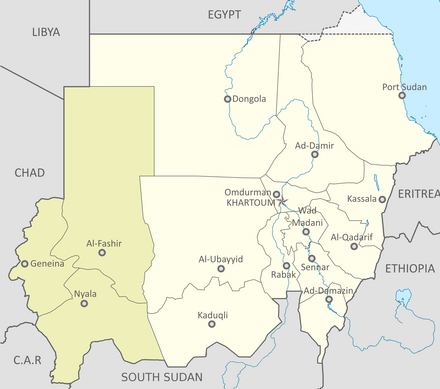
The images of horrific killings and explosive clashes currently shattering El Fashir and Kordofan are not simply the sights of a localized power struggle between two warring Sudanese military factions, they are the visual symptoms of a new global African Gold Rush. There are ideological or ethnic divides, but the big picture shows the usual suspects of multinational corporations and imperialist interests meddling behind the scenes. Sudan is but one site in the a multi-billion-dollar, transnational exploitation collage where natural resources are being siphoned off to power Big Tech and provide an insurance policy against the looming instability of Western currencies. In this post, I will discuss some of the actors driving the war in Sudan and their interests and how we in the US are complicit in it.
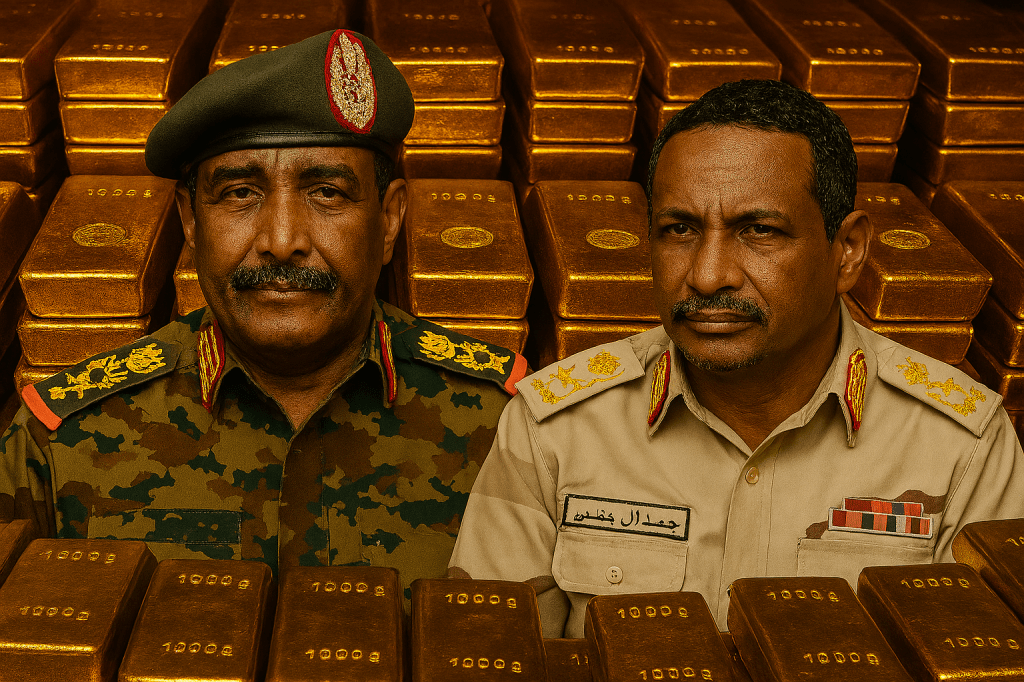
Actors and Interests

Two men stand at the center of the Sudanese conflict: General Abdul Fattāḥ al-Burhān of the Sudanese Armed Forces (SAF) and Muḥammad Ḥamdān “Hemedti” Dagalo of the Rapid Support Forces (RSF). Once friends, and fellow war criminals, the two men previously served as henchmen for former president ʿUmar al-Bashīr. Hemedti was a leader within the mercenary forces known as the Janjaweed, who in addition to  massacring hundreds of thousands of Darfurians, also fought against the people of Yemen and Libya.(Booty et al., 2025) Hemedti also became rich by controlling several gold mines in Darfur. While the two men were able to share in the overthrow of Bashīr, they were not able to share in their mutual avarice for power. Despite the people’s ardent rejection of military rule, the two men decided that their personal interests were more important than the will of the people. So they dragged the countrymen into a prolonged war to decide who will be the next leader of the Republic of Sudan.

In the words of Donald Trump, Sudan is just another sh•thole African country. So why would these two men fight over power in a country that has nothing? Again, the gullible American people have been lied to. Not only are states like Sudan, Niger, and Congo rich in minerals, they serve as the backbone of many American and European economies. Without them, the West would be full of… well… sh*thole countries.

This is the dark side of globalization that we used to hear about some 30 odd years ago. Every year, as much as $35 billion worth of gold produced by artisanal and small-scale mining (ASM) in Africa goes undeclared and is smuggled out. Between 80% and 85% of this illicit gold finds its way to the United Arab Emirates (UAE), which acts as a “golden gateway” of ill-gotten gold to the so-called legitimate world. (Soguel and Turuban, 2024) Apparently, owning gold mines is the secret to funding a paramilitary group which can operate beyond the reach of the local state, while avoiding being kidnapped in the darkness of night or bombed to smithereens by some of the world’s largest militaries. The money from this illicit trade could go to the Sudanese people to fund essential services like roads, health, and education. Instead, it is being used to beef up a murderous regime that seeks to establish their own state in Western Sudan at the very least.
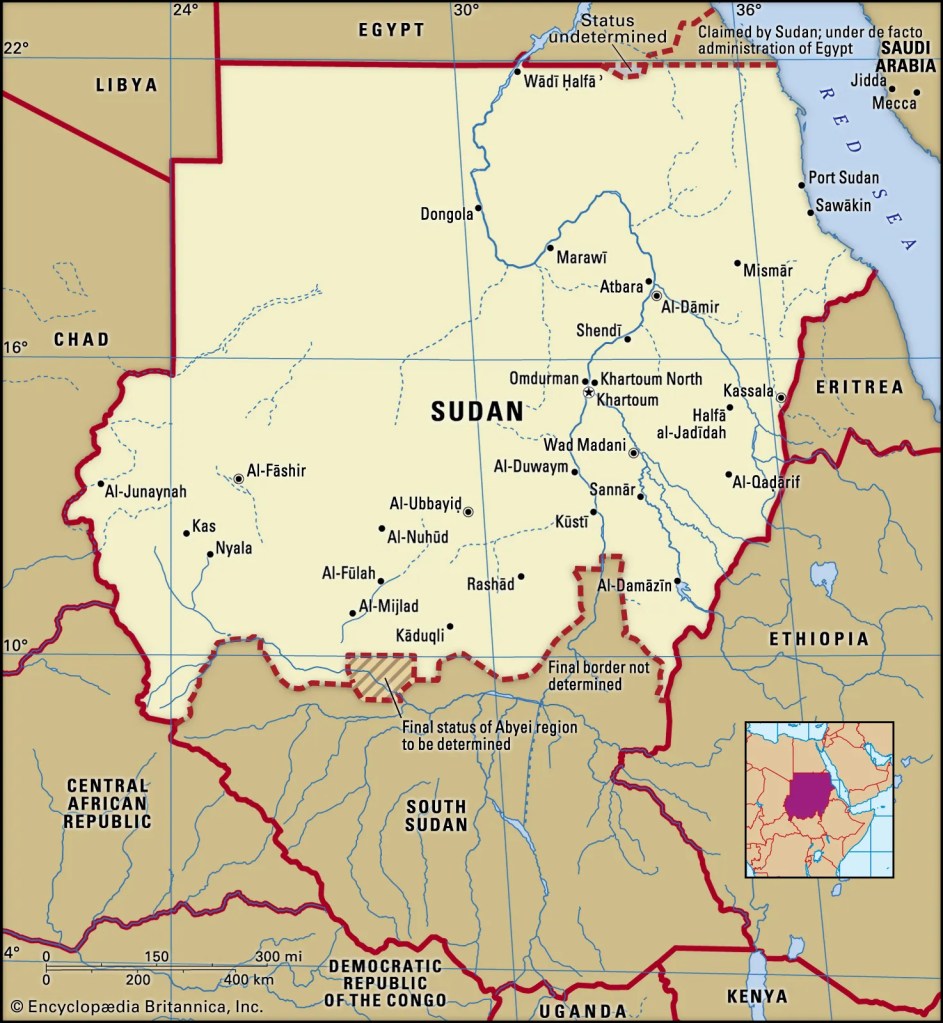
The Rush for Sudan

The Republic of Sudan sits on several reserves of natural resources in addition to gold and oil like chromium ore, iron ore, uranium, and manganese.(naturalresourceinfo, 2025) Sudan is also home to much arable land around the Nile, at least 180,000 hectares of it is already used to feed oil-rich Gulf nations.(Guo, 2025) Anyone who rules over such a resource rich terrain will be rolling in the dough no doubt. However, the two contenders must first overcome a comparable antagonistic military from within Sudan. Secondly, they must deal with the interests of the international community, not the least of which are the US and Russia with two polar opposite interests, as well as the UAE, Egypt, Ethiopia, Iran, among others. Thirdly, they must deal with an impoverished, traumatized, dispersed, and revolution-thirsty citizenry who have mentally checked out of capitalist military dictator rule. Finally, they must come to terms with a new global reality and decide which side they will fall on. They can either join the ranks of the Sahelian Alliance and BRICS who will manage their resources on their own terms or remain in the old neo-colonial order.

The demand for African resources is driven by Western greed for industrial gold, a critical component in the medical, electronics, automotive, and aerospace industries. Our smartphones, EV cars, and server farms (the backbone of Big Tech) come from unregulated streams of African resources. A destabilized Sudan comes just in a nick of time as the Sahelian Alliance nationalize their resources and wrangle themselves free from French and American neo-colonialism and as more countries see BRICS as a way out. Seeing that some nations are waking up, the West (primarily the US and Israel) is scrambling to weaken and divide unwitting nations to doubly exploit. Among them are the Sudan and Congo, but are soon to include the recently invaded Venezuela and other countries on their hit list.  

Beyond manufacturing, gold serves as the ultimate insurance policy against the inevitable collapse of the US dollar. This collapse results from over a century and running of senseless wars, corporate bailouts, and overall mismanagement of the US economy by the American status quo. Matthew Miller, vice president of the CFRA financial research firm, stated:

…this debasement of the U.S. dollar is the biggest reason why central banks continue to demand gold at a high level, despite really gold prices continuing to go up. Central banks are big buyers.(“How Illegally Smuggled Gold Is Fueling The U.S. Gold Boom”, 2025)

Sudan’s crisis is a Westerner’s convenience. By allowing this gold to enter the global market as refined, “legal” bars in Dubai, which then exports gold to Switzerland (the world’s top gold exporter), the UK, US, and Hong Kong, we choose to ignore that it was mined amidst genocide and ethnic cleansing. As long as the global high-tech and financial sectors require these materials to safeguard their own futures, the incentive to prolong the conflict in Sudan will continue.

Conclusion

In the 16th century, the Portuguese sought African gold and slaves to solve their domestic “bullion famine” and finance their presence in the world market.(Solow, 1993) Today, foreign interests deepen the Sudanese crisis by supplying weapons to ensure their continued access to these resources. This cycle of violence and extraction sacrifices the lives, sovereignty, and well-being of African for the prosperity of the global capitalist class.

The modern scramble for empire is like a screen time addicted child desperately looking for a charger. If we are not aware of global supply chains and if we do not hold guilty parties accountable for their smuggling and convenient oversights, luxuries will continue to come at the expense of African lives as we watch their massacres on devices made from the materials they dug up. The tragedy of the war in Sudan is not that the world has forgotten it, but that the world is actively, and profitably, ignorant of it. For the Sudanese, the price is of genocidal proportions; more than 150,000 people have died and 12 million have been displaced. While diplomats and corporations remain silent and social and traditional media misinform, the mines remain open and the minds remain closed. In the meanwhile, criminals continue to carry their heavy, golden cargo to Dubai, Switzerland and beyond.

References

Booty, Natasha, Farouk Chothia, and Wedaeli Chibelushi. “Sudan War: A Simple Guide to What Is Happening.” Africa. BBC News, November 13, 2025. https://www.bbc.com/news/articles/cjel2nn22z9o.

Guo, Zihao. “UAE Land Grabs in Sudan and Famine Mitigation by Local Resistance Committees.” The Global Horizon, March 6, 2025. https://www.theglobalhorizon.press/studentfeature/view/uae-land-grabs-in-sudan-and-famine-mitigation-by-local-resistance-committees.

Pettitt, Jeniece, dir. How Illegally Smuggled Gold Is Fueling The U.S. Gold Boom. Produced by Comfort Woode. With Zinhle Essamuah. CNBC, January 16, 2025. 10:57. https://www.youtube.com/watch?v=3YWEy0ijeuo.

Soguel, Dominique, and Pauline Turuban. “Hidden Wealth: Swiss NGO Maps Africa’s Undeclared Gold Flows.” SWI Swissinfo.Ch, May 29, 2024. https://www.swissinfo.ch/eng/multinational-companies/hidden-wealth-swiss-ngo-maps-africas-undeclared-gold-flows/79009684.

Solow, Barbara L. Slavery and the Rise of the Atlantic System. 1st ed. Cambridge University Press, 1993.

“Sudan’s Natural Resources: Locations, Discoveries, Viability, Export Potential, And Economic Impact.” Natural Resouce Info, April 29, 2025. https://naturalresourceinfo.com/sudans-natural-resources/.

Thoughts On Sudan (Part 1): The Pro-Black Deception

While most of the world focused on the atrocities happening in Gaza, despite the Sudan conflict predating it, I watched young Sudanese social media influencers struggle to gain their footing over the years. Most Americans had never even heard of Sudan unlike Palestine, which is understood to hold religious significance to even the most ignorant Americans. Israel is clearly the villain in Gaza and their crippling grip on U.S. politicians, media, business people, and intelligence agencies has been exposed. Unfortunately, the villains in the Sudan crisis were largely nameless and faceless until recently and it suffered the stigma of being “just another African conflict” that average Americans are helpless to solve.

Occasionally, misguided African American social media influencers would mention the Sudan (often in the same breath as the Congo) in a lame attempt to appear pro-black. While they rightly highlighted the racial dynamics with regards to international solidarity, they also effectively discouraged people from taking action on either of these causes, which I suspect is their mission.

I am a rare breed of African American Muslims who has lived in the Sudan for an extended period of time. Therefore, the Sudan crisis has been personal for me. I lived, learned, loved, and lamented in the Sudan for three years. Since, I published my memoirs from my sojourn, Thoughts From Sudan: An American Muslim Experience in 2022, I found it difficult to return to the words in my book. The years I spent in the Sudan from 2008 to 2011 seems so far removed from the current news I’ve been hearing about the Sudan, it might as well be Mars. But it’s not. And a friend of mine who has been trapped in Khartoum throughout the conflict has constantly reminded me that it’s the same Sudan. The problems I observed and wrote about in my memoirs are exactly the same problems we are seeing manifest on our social media feeds but the conflict is not as simple as we might think.

As someone raised in the ways of Black political consciousness, Afrocentrism, and African American Islam, I was able to make some pertinent observations in my book. And as someone who had acquired a level of proficiency in Arabic, I was able to interpret and articulate aspects of Sudanese culture and society in a way that is digestible to Black American audiences. I say this not to make some grandiose claim to authority, but to distinguish myself from the myriad of chatter from misinformed African Americans who have spoken publicly about the crisis in the Sudan. In this post and its follow-up, I will address some of the misinformation regarding Sudan emanating from the Black American community.

The Pro-Black Deception

When the Umar Johnson types make benign statements like “why doesn’t anyone talk about Sudan?” rarely is it followed up with a proper background and analysis of the situation. They are content to mic drop and high five each other for championing some sort of redneck-in-black-face sentiment, while leaving their ignorant followers in the dark about what is actually happening in the Sudan and Congo. Such disingenuous mumbo jumbo should not be taken seriously. They offer no information and no solutions; not even the innocuous “thoughts and prayers.” Additionally, some ill-informed Afrocentric historians, whose latest update on Sudan pertains to events that happened a thousand years ago, have popped up on the web to appear relevant and promote their inaccurate views of history. It is better for such people to remain silent, because their reactionary diatribes are counterproductive.

Until now, I have deferred to the international Sudanese diaspora to educate the public and advocate for their own solutions in public. The most notable analysis on the Sudan has come from journalist Ahmad Kaballo of the pan-African media organization Africa Stream, now “de-platformed.” I would also recommend the work of UK-based journalist Nesrine Malik. The strategy of most Sudanese youth in the West has been to target the government of the United Arab Emirates (UAE) for their support of the Rapid Support Forces (RSF) who have been responsible for the genocidal killings in Darfur and Kordofan that we have been witnessing lately.

The RSF, who were better known as the Janjaweed (Horseback Jinns) in the early 2000s, were also the so-called Arab militia the deposed president Omar Bashir used to subdue dissent in the Dar Fur region. The Arab identity of some RSF members has caused some race-conscious African Americans to conclude that the conflict is a concerted Arab genocide against Africans in the Sudan. They often conflate the Dar Fur conflict with the north’s dissension with South Sudan but interestingly they had nothing to say when South Sudan was suffering from its own civil war following their succession. In both situations, the main issue was not Arab vs. African or Muslim vs. non-Muslim and seeing it this way only obscures the real problems. In fact, the RSF brands themselves as being anti-Islamist, accusing the Sudan Armed Forces (SAF) as being led by the Muslim Brotherhood. I caution African Americans from approaching issues in Sudan and elsewhere through an Americanized lens that sees race as the only motivating factor in conflict between people, especially when they do not know what they are talking about.

Race & Ethnicity in Sudan

Sudan is an African country populated by African people. However, like many places in Africa, it is made up of a diverse conglomerate of people who, prior to European colonialism, never saw themselves as one people. They spoke different languages and had different ancestral lineages. They did not always get along with each other but there was some coexistence in the absence of firearms. There were many kingdoms and civilizations that persisted for hundreds of years, even beyond the well-known ancient civilizations of Kush and Nubia.

African Americans are sensitive to words that signify racial division: African, Arab, slavery, invasion, etc. However, understanding them only according to American and European sensibilities will not yield an accurate understanding of Sudanese ethnic conflicts. It was Africans’ contact with Europeans that made them one nation-state and one continent. In order for us to truly understand Africa, the African people, and their current events, we must understand them as they are and not as we imagine them to be.

Many associate north Sudan with Arabs, but the country covers a wide swathe of land consisting of many different ethnic groups. Sudan consists of the Red Sea Hills in the east, the Nile Valley, and the highlands in the west, which include the Nuba mountains and Dar Fur. The east consists of non-Arab Hamitic people like the Beja. The Nile Valley consists of the various Nubian tribes some of whom are the main propagators of Arabization in Sudan. In the west are Fur people and the other Nuba (who are considered African and distantly related to the Nubians of the Nile Valley). The Fur people are more closely related to the people of Chad and West Africa, but some consider themselves Arab. There are also states like Maiurno and Sennār that have significant Hausa and Fulbe speaking populations and Gaḍārif, and Kasala with large Tigray and Tigrinya speaking populations. Almost all of them are Muslims.

All Sudanese are Africans, but some of them also identify as Arabs. Arab identity is contested and debated among the Sudanese themselves. Arabness is defined as speaking Arabic as one’s first language and the absence of a raṭānah (an epithet for local African languages). There are real and imagined Arab identities in the Sudan. Some like the Rashāyidah only migrated within the borders of Sudan in the 19th century, while others like the Juhaynah and the Rufāʿah started to migrate there as early as the 15th century. While these groups are by necessity minorities in the Sudan, we can say that the primary ethnic group in North Sudan is Nubian. Among them there are families and sub-clans who intermarried with Arabs. Most Arabized Nubians trace their Arab ancestry to Ibrāhīm Jaʿal, who is said to be a descendant of the Prophet Muhammad’s uncle al-ʿAbbās. (Holt, 2011, p. 4) Hence, the name of one of the most powerful ethnic groups in the Sudan, the Jaʿalīyyah, to which former president Omar Bashir belongs.

While slavery had been practiced by the indigenous African populations in the Sudan, which included the Nubians the descendants of Kush, the Ottoman Turks (Central Asians/East Europeans) sought to acquire enslaved people for their armies under Muhammad ʿAli Pasha as his previous Albanian (Eastern European) servicemen were insubordinate. Since the Turks ruled Egypt, and the British eventually ruled the Turks, they sought incursions into current-day Sudan for economic and political reasons. The Sudanese saw all European-looking people as Turks (Khawājah), whether they were British or Albanian.(Holt, 2011, pp. 35-37)

Under the British-run Anglo-Egyptian Condominium (1899–1955), the English sought to exacerbate the tensions between the north and south by allowing missionaries to spread Christianity in the south in a way that fomented hatred against Muslims and Arabs.(Mahdi, 1965, p. 150) In the meanwhile, the north formed its own prejudices against the South. In post-independent Sudan, doctrines of Islamism, Arabism, and anti-African sentiment began to spread in the north culminating with Omar Bashir and the Muslim Brotherhood taking power in a 1989 coup. Contrary to popular belief, Jaʿfar Nimeiri, an initially socialist and Pan-Arab leaning president, imposed so-called “sharīʿah law” on all Sudanese in 1983, north and south, six years before Bashir took power.(Holt, 2011, p. 134)

Conclusion

In summary, the current conflict in Sudan is not Arab vs. African or Muslim vs. non-Muslim. Furthermore, we should not reduce Sudanese ethnicity to a simple Arab vs. African dichotomy. This erases the Sudanese people’s agency in defining themselves, which will not match pervading American concepts of race, which most Americans find difficult to let go. We as conscious Black Americans should avoid projecting our racial constructs onto other societies. The situation in Sudan is bad enough without mucking it up with lies and personal agendas.

I do not deny that the fighting and killing happening in the Sudan is a political conflict with ethnic components. Yet, if we only look at the ethnic components, we will not see the problem in its entirety. And if we only look at the political aspects, we will not fully see the real problems. We must look at the full picture of what is happening in Africa and the world to reach viable solutions. In my next post, I will discuss Sudanese politics, the African gold rush, and the complex web of actors fueling this conflict.

References

Holt, P. M. (2011). A History of the Sudan: From the Coming of Islam to the Present Day (6th ed.). Routledge Taylor & Francis Group.

Mahdi, M. E. (1965). A short history of the Sudan. Oxford University Press.

X Marks the Spot: Malcolm X, the Bridge Between Sabians and Hanifs

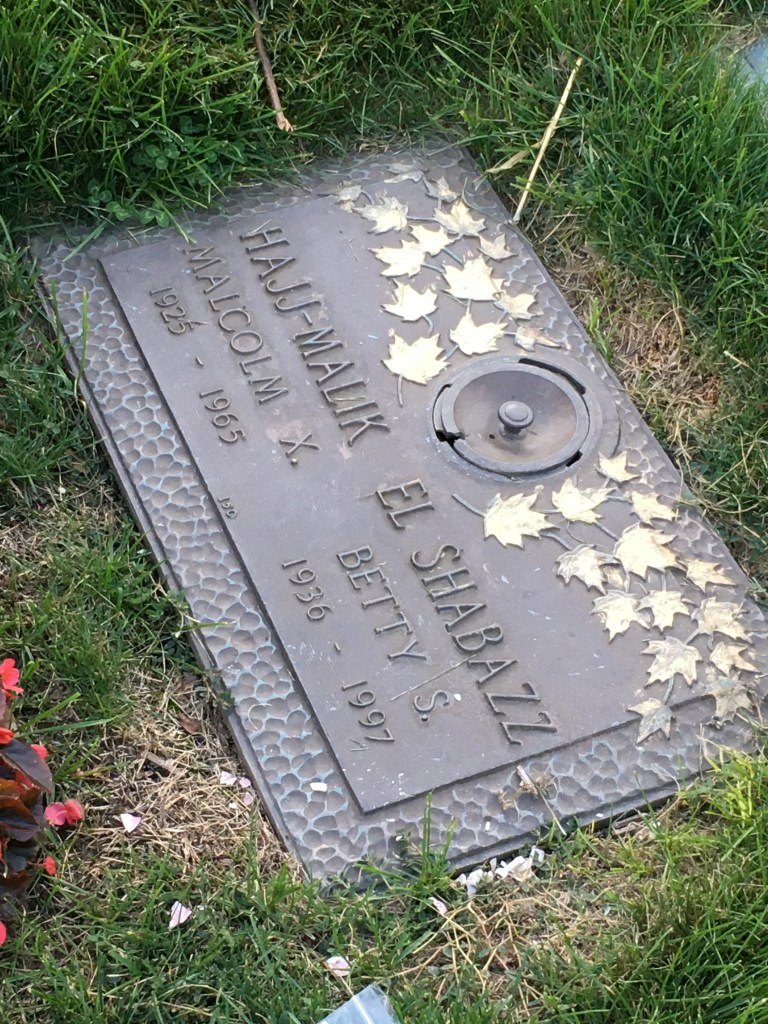
Sunday May 19, 2024 marked the 59th Ziyara (commemorative visitation) to the grave site of El Hajj Malik Shabazz (Malcolm X) and Dr. Betty Shabazz at Ferncliff Cemetary in Hartsdale, NY. As many know, the African American community cannot agree on many things but Malcolm is a rallying point for the forward-thinking trajectories within the community. This was evidenced by the peaceful coexistence of Sabian and Hanif traditions practiced by the intellectual, political, and spiritual offspring of Malik Shabazz at the annual Ziyara.

It was not always this way. In the aftermath of Malcolm’s murder it was a struggle to to keep his name alive let alone his ideas and his work. Only a few brave souls had the guts to open their doors and speak at his funeral. Joseph E. Hall and the Unity Funeral Home allowed the viewing of his body, the Faith Temple Church of God in Christ, allowed his wake, Shaykh Hesham Jaaber, who along with Shaykh Ahmad Hassoun washed and wrapped his body according to the Islamic tradition, Ahmad Osman, Ossie Davis who spoke, and the list of attendees like the late John Lewis, James Farmer, Andrew Young and many others… Their names will be forever etched in history. Similarly, Malcolm’s older sister and confidant Ella Collins sought to keep an accurate depiction of his character, philosophy, and direction by holding the annual Ziyara.

I will point out that these brave people were Hanifs. Despite the association of Hanif religions with conformity and reactionary politics the Black resistance to oppression required the strength and courage only inspired by true faith. That was the place of Malcolm, Betty Shabazz, Ella Collins, Martin Luther King, James Farmer, Mutulu Shakur, Sekou Odinga and countless other freedom fighters. Many of whom were practicing Muslims and Christians.

The Sabian dimension, like their ancient counterparts, has always contributed to the philosophical development of our people. A philosophy that pushes the boundaries of intellectual inquiry and imagination of how Africans can be in this world spiritually, mentally, and physically. Their contributions on the Black intellectual tradition should not be disregarded, as it was the likes of John Henrik Clarke and Dr. Ben Jochanan (both intellectual offspring of Malcolm), who forged a path for Black Studies in the universities to the chagrin of white intellectuals who controlled the narrative on African history. They were able to pry open the  grip that white Africanists had on the field prior to the 1960’s. Their contributions continue to reverberate with regards to the study of ancient Egypt (Kemet), which Africans on the continent and in the Diaspora rightfully claim a connection to despite the protests of some modern Egyptians.

This is not to say that they did not have lapses in knowledge, especially regarding the history of Islam. Their lack of contact with learned continental African Muslims and lack of acquaintance with the Islamic intellectual tradition in Africa and around the world has led to their over reliance on the sources of white Africanist and Orientalist scholars. Similarly, their logical fallacies that equate the Islamic experience with the Christian experience and inability to view things outside of the American paradigm has crippled their understanding of Hanif religions and led to an uncritical embrace of Sabian religion and spiritual thought. Their rejection of religion, while claiming a form of “spirituality,” has warranted them the label Sabian, whose etymological meaning refers to “one who has left religion.”

Beyond the ceremonious nature of the gathering, there was undoubtedly a political message. One that stood on the legacy of the Black Radical Tradition. This was orchestrated by Prof. James Small, a living progenitor of Malcolm. Not only was he the body guard of Malcolm’s older sister Ella Collins, but he was also imam of Muslim Mosque, Inc. and a leader within the Organization for Afro-American Unity (OAAU), the two organizations started by Malcolm before his death. Not only that, but he later acquired authorizations in the priesthoods of several African systems of spirituality and served as a point person for many Black revolutionary activists and freedom fighters since the 60’s. He is therefore an authority in African American Sabian, Hanif, and radical political traditions. As he emceed the event, he stressed the universality of these traditions and some of the speakers’ connection to Islam. He introduced the all-star round up of speakers consisting of scholars, revolutionaries, and leaders of the past and the future, like Dr. Leonard and Rosalind Jeffries, Sundiata Acoli, Pam Africa, Mfundishi Jhutyms, Jihad Abdul Mumit, Baba Zayid, Brother Reggie, Adéyínká “Muhammad” Mendes, and others. They shared prayers and spoke in brief about the legacy of Malcolm. Imam Talib Abdurrashid was noticeably absent from this gathering due to health issues, but members of the Mosque of Islamic Brotherhood (MIB) in Harlem as well as the Jamaat of Shehu Uthman Dan Fodio were delegated to represent him in his absence.

A final point was made about the link between the Pan African struggle and that of Palestine. Contrary to the sentiments of Pan African social media influencers and personalities, who claim that Palestine is not a “black issue,” the veterans and students of Malcolm say it is, because the Black radical tradition stands for justice everywhere. Additionally, we should not allow morally degenerate politicians and media executives to frame our issues for us. The issues of Palestine are not race, religion, terrorism, anti-Semitism, or even freedom of speech. Rather they are colonialism, the right to self-determination, and the right to self-defense. Likewise, these were the issues of the Black Power struggle in the U.S.; a struggle I would deem as successful in many ways. Although police brutality remains a salient issue for many Black communities, there are undoubtedly marked changes from the Jim Crow era to now that almost no elder will deny. But those improvements were not made from the kindness of the hearts of politicians and law enforcement, they were made from decades of political pressure applied by the likes of Martin Luther King and Malcolm X and those who upheld their intellectual, political and spiritual legacies.

Hamitic Arabs: A Revolutionary Approach to Race and Resistance

As we close out Black History Month 2024 with the trials facing Gaza, the West Bank, and throughout the Muslim world, Arab world, and Africa, I would like to highlight a movement that is often not acknowledged, but serves as one of the bridges between Pan-Arabism, African American Muslims, and social justice. Addeynu Allahe Universal Arabic Association is an American orthodox Muslim movement that has operated below the radar for almost a century and has an interesting take on identity that might raise eyebrows in Black and Arab communities alike. However, as we will see, some of its progeny have been at the forefront of Black and Third World liberation movements. In this post, I will examine a manuscript I obtained from Abdurrashid Ishaq, a member of Addeynu Allahe who attended my Arabic classes in Greensboro, NC in 2012. His memory was fading and he could not tell me much about the document before he returned to Allah in 2019, but I will do my best to analyze the anonymous text and speak on one aspect of Addeynu Allahe’s legacy.

“Who Am I?”: A Forgotten Treatise on Black American Identity

The document is a manuscript of perhaps a talk given in 1969. It is directed to Elizabeth, NJ Board of Education following student requests to teach “Black Heritage” in its public schools. It consists of 28 pages, typed with a typewriter, containing prose, footnotes, a chart, and appendices of quotes from various Orientalist authors that elucidate some aspect of Arab and Hamitic identity.

The document was published a little over 30 years since the founding of AA in 1938 and almost 10 years after the death of Professor Muhammad Ezzeldeen. It presents him as a son of “Hamitic Arab” parents and someone whose post-secondary education came from traveling to countries such as Morocco, Libya, Turkey, and Egypt. He is even said to have worked as an Egyptologist and obtained a doctorate from al-Azhar University.[1]

With regards to identity, the author seeks to deconstruct the aptness of the terms Negro and Black. Negro, he says, is equivalent to the Latin word for dead and Black is insufficient because it conceals the national heritage of our people. Rather, he sought to connect so-called African Americans to Ham, son of Noah, who represents ancient Egypt, Ethiopia, and the rest of Africa. On top of that, he recognized the connection between the ancient Egyptian language and Arabic.

The author also provides a linguistic analysis of the Arabic words in question. He pulls from Hans Wehr’s Arabic Dictionary to demonstrate the positive connotations to the root s-w-d (سود) from which the word black aswad (أسود) is derived. He does the same with the word Ham, assigning it to the root ḥ-m-y (حمي), which connotes protection, rather than ḥ-m-w (حمو), which connotes warmth. Nor does he connect it with the ancient Egyptian root Kham (black) as in Khemet.

Additionally, the author takes a brief historical approach to this identity. He discusses Moorish exploration to the Americas prior to Columbus and Muslims taken as slaves. He concludes by saying their origins were from parts of Africa, Arabia, Asia, and Europe that were ruled by Hamites and visually maps this genealogy in a chart.

Chart of Hamitic genealogy from “Who Am I?”

An Analysis of Language and Identity

This document is significant because it is a rare approach to identity; one that is controversial. Some debate the Hamitic Arab identity on grounds that it seeks kinship with a people who are not “Black” or may even be “anti-Black,” which is tantamount to cultural apostasy. Others my decry it as another form of cultural appropriation perpetrated by a lost and confused people. Others might take issue with its use of antiquated Biblical terms or the fact it conflates ethnic identity with religious identity.

Cultural Apostasy

With regards to the critique that the Hamitic Arab approach is cultural apostasy, the author makes it clear that that is not the case. Assuming that Black is an appropriate descriptor, the author sought to show that it has a negative connotation in English, but a positive connotation in Arabic. Similarly, he acknowledges that Bilād al-Sūdān was the name of the lands in Africa from which our ancestors came. This further solidifies the historical continuity between so-called African Americans and the Blacks of Africa.

Arabism

While the thought of African Americans calling themselves Arabs is an odd proposition, and is certainly not explained in depth in this piece, on face value can be considered cultural apostasy from an African American perspective and cultural appropriation from an Arab perspective. Yet the pretext for such an assertion comes from the Arabic saying that is often mistaken for a hadith: an Arab is whoever speaks the Arabic language (من تكلم بالعربية فهو عربي). To Arabs, this is a much more sound definition of Arab identity than one that favors biological lineage. Arabs are the descendants of people who were not biologically Arab, which would thus cause a paradox. So the criteria of Arabness or ʿUrūbah is proficiency in spoken Arabic. Perhaps the unintended result of such a definition is that it allows people from various backgrounds to acquire an Arab identity by acquiring the language. This is how many populations in the Levant and North Africa were able to acquire an Arab identity without intermarriage or conversion to Islam. This further debunks assertions that Islam is an Arab religion.

Terminology

The reliance on the Biblical term Hamitic can be considered antiquated and difficult to define. It is interesting that the author prefers to define Ham by an Arabic definition rather than a Hebrew or ancient Egyptian definition. His choice of etymology is also unconventional. Hans Wehr has an entry for Ham that is not at all informative, but he chose to relate it the word for protection. I am not convinced that the connection between the two is verified linguistically.

We generally understand that Ham from the Bible was the son of Noah who is considered the progenitor of the civilizations and people in which dark-skin dominates, Cush, Mizraim, Phut and Canaan. What the text does not address is the so-called “Curse of Ham,” which Noah actually pronounced on Canaan after Ham supposedly sodomized his father or witnessed his nakedness while he slept in a drunken stupor, according to the Biblical narrative. There is no such reference in the Arabic scripture and is categorically rejected by Islam, which upholds the piety of all the prophets of God. No doubt a Christian audience may have pause in embracing a Hamitic identity, not to mention an Arab one.

Ethnicity or Religion

Salahdeen Shakur (Photo credit: Stephen Shames)

Another criticism of the author’s approach is that it focuses primarily on ethnic identity rather than a religious identity or morality. The author does not explicitly connect this inherited identity to spirituality although it underlies his argument. Perhaps, it is because he was addressing the Board of Education, a government entity that cannot endorse religion, that he is silent on this aspect. Or perhaps, during the 60’s, when Islam was not known to most African Americans and its most popular expression was heterodox, it was preferable not to get into specifics. Whatever the reason, the author does not bridge that gap despite its religious undertones.

In total, the entire philosophy of Addeynu Allahe cannot be gleaned from this one piece. However, we get a keen look into the author’s thought process and the tools by which he arrives at his conclusions concerning the true identity of African Americans. While on the surface, his conclusions seem to endorse cultural apostasy, promote Arabism, make use of problematic terms, and conflate between ethnicity and religion, he is debating and drafting an ontology of racial discourse that runs counter to the unquestioned status quo discourse on race. Perhaps this does not sound revolutionary nowadays, the truth of their legacy is to the contrary.

A Revolutionary Legacy

I gained some clarity on the contents of this document from the American Muslim Centennial Banquet held in Edison, NJ February 17, 2024. Shaykh Muhammad Jaaber’s talk followed the same historical sequence as the document updated with newer information and more recent figures in the history of Islam in America. His presentation highlighted the presence of Addeynu Allahe and orthodox Muslims in the fabric of Black history.

Just a month before, I attended the funeral of Baba Sekou Odinga, which was held at Brooklyn’s Masjid At-Taqwa. It was attended by his immediate and extended family, the local Muslim and conscious community, and a cohort of the living luminaries of the Black liberation movement, like Baba James Small, Dhoruba Bin Wahad, Bilal Sunni Ali, Dr. Kokayi Patterson, and many more. Baba Sekou is remembered as one of the liberators of Assata Shakur and member of the celebrated Shakur family and Black Liberation Army (BLA). However, it might be easy to overlook his spiritual lineage, which goes back to Prof. Muhammad Ezzeldin.

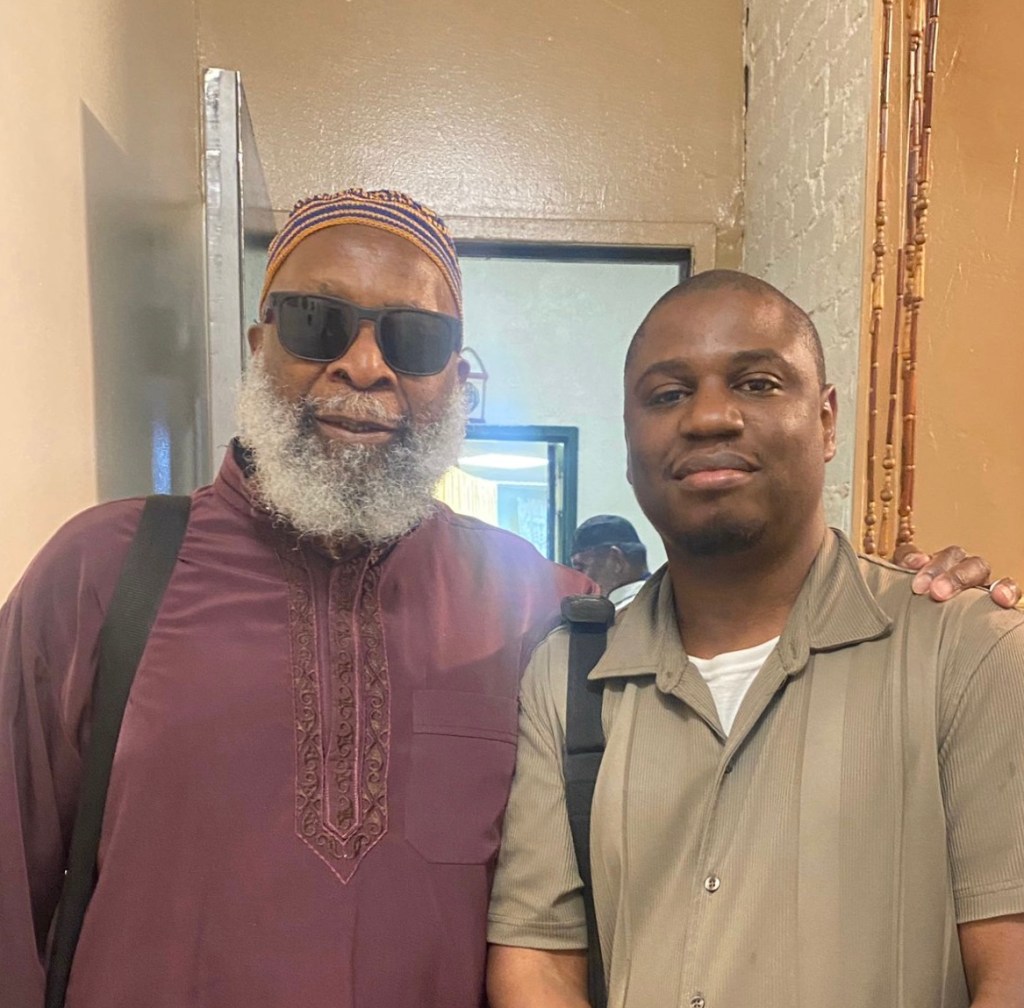
Baba Sekou and I at Masjid M.I.B. in Harlem (17 June, 2023)

El-Hajj Salahdeen “Aba” Shakur was a member of both Addeynu Allahe Arabic Association under Imam Hesham Jaaber and Malcolm X’s Organization of Afro-American Unity. He was the father of the revolutionaries, Zayd Malik Shakur and Lumumba Shakur. As members of their circle embraced Islam and political consciousness, they were absorbed into the Shakur family similar to the mawālāt system in early Islam in which Arab Muslim tribes would adopt non-Arab Muslim groups, eventually absorbing them into the tribe. Baba Sekou was from that circle and upheld his commitment to the political struggle as well as to his Islam until his death.[2]

The Shakur tribe of Hamitic Arabs have militantly stood against the oppression of Black people in the United States as well as oppressed people around the world. They serve as the bridge between the younger generations and the generation of Prof. Ezzeldeen, Malcolm, Shaykh Daoud Faisal, and our Maroon ancestors, merging social justice with the moral rectitude of Islam. Much of this story has yet to be told.

Notes

[1] It has yet to be determined the influence of the Young Muslim Men’s Association (Jamʿīyat Al-Shubbān al-Muslimūn) in Cairo, which sought to revive the Arab identity and culture in the early half of the 20th century. If he was involved with this organization during the 1930’s when he was there, he would have rubbed elbows with the likes of a young Maḥmūd Shākir and ʿIzz al-Dīn al-Qassām, two figures who would defend the Arab world in drastically different ways.

[2] Special thanks to Akil Fahd for compiling much of this information.

The Myth of “Arabized Islam” & Other Fallacies of Pseudo-Islam (Part 2)

The charge that “orthodox” Islam is Arabism or Arab Islam is based on ignorance and prejudice. It’s based on an ignorance of Islamic history and prejudice against people who identify as Arabs. On top of that, it is based on ad populum rhetoric, which is a type of logical fallacy that seeks to sway people to their opinion, not by engaging the merits of the ideas, but by stirring up prejudice against a people that they know their audience might dislike.

The facts, however, are against Kemetian. Some of the greatest scholars of Islam throughout history have not been Arab. Someone like Sībawayh, who wrote one of the most definitive works on Arabic grammar, was a Persian. Likewise, Abū Ḥāmid al-Ghazālī who wrote on numerous subjects such as philosophy, Islamic law, and Sufism was also Persian. Al-Buṣīrī the poet who wrote the Sufi Burdah poem in honor of the Prophet Muhammad was a real Moor from the Ṣanhājah Berber tribe.

Kemetian conflates a traditional understanding of Islam from its historical sources with Arabism. He does this to make you doubt  its veracity while promoting his non-historical personal understanding of religion. Traditional Islamic scholarship has a system of checks and balances to ensure no one makes up deviant doctrines according to their own preferences based on scriptural and textual evidence. The MST is in shambles precisely because they have no such mechanism. Yet, this is the nature of Sabianism. As the Christian heresiographer, Irenaeus, said of the early Christian Sabian groups:

…many offshoots of many heresies have come into existence because many-or indeed all -of them wish to be teachers and to leave the sect in which they were ; composing another doctrine from another opinion, and then another from another, they drive onwards to teach in a new way, describing themselves as the discoverers of whatever opinion they have concocted.

(Grant, R. 1978, p. 47)
AI generated image from Hotpot

As for Kemetian’s prejudice against Arabs, it is indicative of many in the so-called conscious community. They match a contemporary post-9/11 image of Arabs with their misreadings of history. The truth is that the Arab identity is much like the Latin identity, in which people of different races, ethnicities and geographies are connected through a common cultural-linguistic identity. Ignorant Blacks who only know the racial constructs of the United States often do not understand this fact and constantly try to force others into their own racial paradigm. Furthermore, these so called conscious folk have no sense of the religious, ethnic, and linguistic diversity in the Arab world, which consists of Nubians, Copts, Berbers, Kurds, Armenians, and Chaldeans to name a few. All Black Americans can see is black and white.

Additionally, there is nothing inherently wrong with being Arab no more than there is anything wrong with being African. Anyone who has ever lived in or visited regular people in the Arab world would know that the vast majority of them exhibit manners that the average American can only dream about. They are very hospitable, generous, and genuinely friendly. Perhaps the marketplace, in traffic, or politics are not the best places to witness these good manners, but they are there. They are not without their prejudices, but their prejudices are commonly directed at other Arabs, Jews, and SubSaharan Africans. Yet when Arabs are confronted about their prejudices, they usually back down.

Much of the Muslim world might hold Arabness in some esteem because of their love for the Prophet Muhammad and his family, who were Arabs. That aside, the Muslim world has not been dominated by Arabs since the Umayyad dynasty. it must be noted that only 20% of the Muslim world is Arab. The majority of the world’s Muslims are in Asia and their scholars have had a great influence on the Muslim world for centuries. Why aren’t the pseudo-Muslims decrying an Asian Islam?

The erroneous idea that Arabs run everything in Islam just like Europeans run Christianity is a false analogy and just plain wrong. For instance, black and white orientalists talk about an Arab slave trade, but never a European slave trade. They think that because Arabs were involved, they must have run it. Ignoring the fact that slave trading has always existed in the region and involved Arabs, Africans, Persians, Indians, Turks, and more. Moreover, the enslaved were not only black, but from these various races as well. This does not excuse any atrocities committed by Arabs or other people. It only serves to disrupt the narrative that so-called white Moors (i.e., Arabs) enslaved black Moors. Dark skin people are not the perennial victims of history.

The charge from Moors, NOI, Nuwaupians, Afrocentrics, and other so-called conscious groups that orthodox Muslims follow an “Arabized Islam” is baseless, which exposes their lack of knowledge and bigotry. It is simply a flimsy argument they use to keep from discussing Islam on its own terms. If anything, orthodox Islam reflects intergenerational, interethnic, intercivilizational, and international networks of knowledge that is not rivaled by any religious system today. In the next part of this series, I will address some of the specific fallacies Neo-Sabians fall into when approaching Islamic concepts, which cause them to completely misunderstand the religion.

The Myth of “Arabized Islam” & Other Fallacies of Pseudo-Islam (Part 1)

Whoever the Most High is a witness for Truth, he need not claim it. The claim is a sign of his veiling from Truth and Peace.

A quote from dhū al-nūn from al-Sha’rānī, ’Abd al-Wahhāb. Lawāqiḥ Al-Anwār al-Qudusīyya Fī Manāqib al-ʿUlamā Wa al-Ṣūfīyya. Maktabat al-Thaqāfa al-Dīnīyya, 2005, p. 129.

In recent years, the Moorish Science Temple (MST) has become one of the many groups on the conscious chit’lin circuit; some of them Hanifs, most of them Sabians. Unfortunately, the unscrupulous reader might mistake the Sabians among them for Muslims or, even worse, a factual representation of history. As a Muslim researcher with a specialization in the Arabic language and Islamic history, it is my responsibility to debunk the bogus claims propagated by such groups.

In one recent YouTube presentation on TITANS TV, a Moorish Science researcher and self-proclaimed Arabic teacher by the name of Kemetian Adept Hieruphant attempted to advocate for his Sabian-inspired MST doctrine using George G. M. James’ Stolen Legacy, orientalist mythology about the Egyptian Sufi, Dhū al-Nūn (more on this in another post), and a hodgepodge of information to confuse you. I beseech the reader not to confuse claims to knowledge for actual knowledge, as was the message of Dhū al-Nūn. In this post, I will focus on deconstructing Kemetian’s treatment of Stolen Legacy and the history of the Moors.  

While Kemetian uncritically accepts James’ thesis, he provides little to no detail to demonstrate the MST position. Kemetian throws a lot of images and texts at you, but his attempt to connect the so-called Moors to the ancient Egyptians is weak because it has no basis in the actual history of North Africa or the Islamic world. He, like many so-called conscious folk, suffers from debilitating confirmation bias; believing his point of view is the only way of seeing the information. Why does he perpetuate a bogus conspiracy theory about the death of James? (A past professor of mine researched and debunked this claim) Why does he think that by virtue of genetic lineage he has a rightful claim to the knowledge of ancient Kemet without actually studying it? And what is a mystery school today other than a university? Kemetian’s misinformation not only reduces his credibility but also the credibility of anyone who takes this topic seriously.

Kemetian Adept | Moors Custodians Of Kemet’s Wisdom Teachings

George GM James’ Misunderstood Stolen Legacy

Kemetian introduces his presentation with the passage from Stolen Legacy that opens Islam and the Ancient Mysteries Vol. 1. In my book, I put forth a better way to understand James’ thesis, which lies in answering three main questions:

  1. Who were the Moors discussed by James.
  2. What knowledge did the ancient Egyptians possess?
  3. How did the Moors acquire ancient Egyptian knowledge?

First, the Moors of history were not followers of Noble Drew Ali or members of an organization called the Moorish Science Temple. “Moor” was an epithet used by Europeans during the Middle Ages to refer to people with dark features and Muslims in general, and North African Muslims specifically. Whatever its original meaning, it was lost on European people by the Middle Ages. They were not calling North African Muslims “gods” or anything of that nature.

If we take the European usage of Moor at face value, it means someone who is dark (relative to the average European phenotype) and/or from North Africa and/or Muslim. This is a broad span of people, which can encompass SubSaharans, Berbers, Arabs, Persians, and Indians and often times it has referred to Jews, Christians, and Muslims living in Muslim-controlled lands.

Johannes Andreas Maurus, a Spanish convert from Islam to Christianity (original pen and ink drawing by Maurice Hines)

Secondly, we must have an understanding of what knowledge was attributed to the ancient Egyptians. While James touches on this, he is not completely clear as to what that knowledge was. On the one hand, James characterizes this ancient knowledge as a secret, exclusively for Egyptians, transmitted orally from teacher to student, and forbidden to be written down. On the other hand, he writes that this knowledge was kept in books at temples and libraries, which were eventually copied and plagiarized by the Greeks (particularly Aristotle), and then they became the domain of the Greeks, Freemasons, Theosophists, and occultists. How James deduces this can be challenged on the grounds that he retrofits the concepts of contemporary esoteric movements on to ancient Egyptian Mystery Schools. This is only James’ speculation, not concrete proof.

Additionally, James reconstructs the ancient Egyptian curriculum using a mixture of Christian and pre-Christian Greek sources, whose works he sees to be untrustworthy since the pre-Christian Greeks allegedly stole knowledge from the Egyptian Mysteries and the Christians attempted to annihilate them. Nevertheless, the curriculum according to James was made up of the seven liberal arts, secret languages and mathematical symbolism, as well as magic. This included memorizing the books of Hermes that teach the hieroglyphs, cosmography, geography, astronomy, typography, how to slaughter animals, law, theology, medicine, among other subjects.

Many of these subjects where known and practiced all over the ancient world including ancient Babylon and India, as James alludes to, as well as in Europe and the Americas. There simply is no concrete proof that this curriculum originated in Egypt, no matter how much we want to believe it. In one aspect, it was a secret that died with the last Egyptian priest. Any other empirical knowledge they developed could also be reconstructed by other people with similar aims. Not only that, but both the Islamic civilization and later the current European civilization surpassed the ancient Egyptians in the empirical sciences (no matter what our criticisms of those civilizations are). It is also much more logical and backed by evidence to think that the world’s knowledge was an intergenerational, multi-ethnic collective effort rather than the work of one people.

Finally, how did ancient knowledge transfer to the the hands of the so-called Moors and then to Western Europe? I demonstrate this process in Islam and the Ancient Mysteries Vol. 1. I firmly demonstrate that Muslim civilization under the Hanif creed absorbed the knowledge of ancient Near East, serving as a bridge between the ancient and modern world. The following is a summary of this history.

The True History of the Moors

What’s lost on Kemetian and the Moors are the key players in history that represented this passage of knowledge. If we were to question MST folk to name some of the Moors who conveyed knowledge from the ancient Mysteries, they would be hard pressed to name one. Yet, I have researched several of them for my book: the Ḥarrānian Thābit ibn Qurrah, the Persian family Āli Nawbakht, the Abbasid Translation Movement, and particular Muslim philosophers like Ibn Sina, al-Ghazali, and Ibn Rushd and their respective philosophical positions. There are countless more that historians have researched.

A synopsis of this history starts with the decline of the Mysteries, prior to Christianity. In the Greco-Persian wars, Alexander massacred Iran and sought to extinguish the Persian-Babylonian Mysteries and the knowledge they acquired. He brought their manuscripts to current-day Egypt and had them translated into Greek and Coptic and destroyed the Persian originals. The Greeks were therefore consolidating the knowledge of ancient Egypt and Babylon. As of the 4th and 3rd centuries BCE, this knowledge was most readily available in Greek and Coptic (an advanced form of the ancient Egyptian language).

Christianity was a Hanif system that challenged the Sabianism that proliferated among Judaism and the so-called Philosophers. The disciples spread the monotheistic message of Jesus, which eventually became mixed with the ideas of gnostics (i.e. Sabians), such as Simon Magus, Menander, and yes, Paul. The early scholars of Christianity were educated in the schools of the Greeks and were able to argue the Sabians in their own terms. Though the Christians opposed the Sabians, they ended up absorbing much of the ancient knowledge in the Eastern Church, which split from the Western Church relatively early in the history of Christiandom.

In the meanwhile, the Persians sought to reconstruct their mysteries by reviving the manuscripts found at the extremities of the Persian empire near India and China. They were open to various sects of Christianity such as the Nestorians. Many of those Christians preserved ancient knowledge they inherited from the Greeks in the Syriac language. By the time the Muslims conquered, these works began to be translated into Arabic. This proliferated during the Abbasid Caliphate that funded the Translation Movement; translating the works of the ancient mysteries primarily from Greek, Syriac, and Persian, because knowledge from the ancient world was largely consolidated in these languages.

While the likes of Thābit ibn Qurrah, the Nawbakht family, and Ibn Muqaffaʿ played key roles in this Translation Movement, the effort cannot be attributed to one tribe, ethnic group, race, or religion. Thābit’s ethnicity cannot be ascertained although he was a native Syriac speaker and also spoke Greek and Arabic. The Nawbakht family were from a lineage of Persian Magians who specialized in astrology. Likewise, Ibn Muqaffaʿ was a Persian litterateur responsible for translating numerous books from the Persian and Indian literary heritage. Muslim and Arabic-speaking scholars of other faiths engaged these works for nearly a millennium, including the questionable works on astrology and magic. Yet, the most controversial issues centered on the philosophical concepts of the creation of the universe, pantheism, and the like, which I covered in the post Is God the Universe?  

Social media scholars from the MST and other so-called conscious groups cannot accurately describe how or why this passed from Muslim lands to Western Europe. The Christian Crusades against Muslims began in the 11th century, at the height of the Translation Movement. One should also observe that during this time, many Europeans were “orientalists,” meaning that they admired Arabic language, culture, and knowledge; see (Burnett, 2008, p. 22). Many in Western Europe, who have long since been cut off from the ancient Greeks, rediscovered the knowledge compiled in Greek through Arabic. As political enmity grew between Western European Christiandom and Islamdom, the intellectual affinity grew. One might notice that some of the most erudite scholars from Andalus, migrated to Egypt during the Inquisitions such as al-Qurṭubī and Abū Ḥayyān al-Andalusī, etc. Khaled El-Rouayheb performed an excellent study on the influence of Maghribī scholars on theology and logic in Ottoman-controlled Egypt and prior. Many of whom were from the Ṣanhajah Berber ethnic group.

No narrative about the Moors’ passage of knowledge to Europe would be complete without mentioning the 12th century CE polymath Ibn Rushd (the grandson). In addition to being from a scholarly lineage based in Córdoba, he was a jurist, physician, and Aristotelian philosopher. In fact, he was known as the chief commentator on the works attributed to Aristotle. The untrained reader must remember that Aristotelian philosophy was at the core of Sabian doctrine, which was a proponent of the eternity of the universe. Ibn Rushd wrote a vehement defense of philosophy and Aristotelian concepts in his Faṣl al-Maqāl and Tahāfut al-Tahāfut against Abū Ḥāmid al-Ghazālī’s Tahāfut al-Filāsifah. Although Ibn Rushd’s positions were rejected by most Muslim scholars, many European orientalists were enamored with his works. This even prompted the Christian theologian, Thomas Aquinas to write a response opposing the eternity of the universe.

Conclusion

The perspectives propagated by the Sabian factions of the MST amounts to nothing short of pseudoscience and a creative re-telling of history. Only simpletons are impressed. History does not begin with the interpretations of pseudo-scholars, but the collective evidence established by a body of researchers. Unfortunately, the MST lacks members who have advanced through the degrees of scholarship: sufficient tertiary education, specializations, peer-reviewed publications, academic integrity and humility, etc. Furthermore, there is nothing novel about their teachings. Their teachings are simply Sabian-Noir doctrines; the same doctrines that have confused our people for generations. In another post, I will unravel some of their doctrines and their erroneous characterizations of Sufism.

The African American Muslim Summit 2023 – Reflections

Over the weekend of May 6-7, Masjid Muhammad of Atlantic City, New Jersey held their 5th annual African American Muslim Summit. I had the honor of attending the conference for the first time. It was also my first time attending a Muslim conference of this nature since my return to the U.S. In some ways, it had the vibe of a Muslim family reunion. In other ways, it was an intensive learning experience as speakers and attendees alike expressed their erudition on a broad range of topics dealing with not only the religious sciences of ʿaqīdah, fiqh, and taṣawwuf, but also on topics of finance, psychology, marriage, history, and politics. It could have used a panel about the revival of the Afrocentric Muslim, but that is the topic of another conversation. Beyond the speakers of the conference – many of whom the community benefits from year around in several online and localized venues – I would like to share a few take aways based on my conversations and reflections:

African American Islamic Summit

Photo credit: Islah Muhammad 2023

  1. The role of imam in an American Muslim community is a political role. The person in the position of imam should have as much political savvy as he does knowledge of Islamic sciences. Understanding the political terrain in the city, county, and state in which a masjid operates is key to the survival and growth of a community. New Jersey has a higher percentage of Muslims than any other state and these populations are used strategically by some local imams as well as politicians to achieve certain gains. This does not mean that communities located in places with less Muslims cannot play an effective political role in their locales. Politics is essentially about institutions working with other institutions. America is built on the mutual cooperation of these institutions. The sad truth is that those who are not affiliated with an institution are often ignored in American society.
  2. Every Muslim community should have a dār al-iftā run by qualified muftis/mujtahids, counselors, doctors, financial experts, lawyers, etc., who are sworn to the same ethical standards as therapists and social workers. Generally, American Muslims do not understand the purposes of the sacred law (Sharīʿah). This may be due to years of anti-Muslim propaganda or trauma related to dealing with secular law. However, we must understand that the Sharīʿah is not a Hammurabi’s Code of infractions and punishments. Rather it is about solving problems while keeping our dīn, hearts, and dignity intact. We know that international organizations like ICNA and some Mosques with qualified individuals have tried but more can be done. At any given moment, Muslims may deal with issues that require thoroughly researched responses. More often than not, they seek to resolve these issues by searching the web, social media, or Muslim gatherings where imams and knowledgeable people may be present. However, some issues require a personal touch and knowledge of disciplines beyond the traditional Islamic sciences. Imagine if such an institution was localized and widespread, solving everything from financial contracts to marital disputes.
  3. There is no benefit in intra-religeous polemical culture within Black Muslim communities. No matter how right one group is or how wrong another is, the harms outweigh the benefits and usually encourages people to double down on their positions. Black Muslims should understand how deeply these polemics divide our communities and destructive they can be. I find it just as disturbing coming out of the mouths of sufi madhhabis as I would from the mouths of salafis. I have listened and interacted with various elements of the African American Muslim community and found that most people just don’t understand each other and their doctrines completely. We should seek ways to cooperate with each other, even if we cannot convince each other of our ideas. The greater good of the community’s future is of more consequence. A simple exercise to keep ourselves in check is to imagine the impact you and your community will have on the history of Islam in America 100, 200, even 1,000 years from now. Ask yourself: how do you want to be remembered?

These are just a few of my thoughts that I hope we can realize sooner rather than later. Until then, I’m back to America and back to work.

The Mawlid: Between Sabians and Hanifs

Love for the Prophet Muhammad is an indisputable cornerstone of the Islamic faith, but the celebration of the Prophet’s birth has in modern times surfaced as a matter of contention. Despite its long-standing and widespread tradition, modern detractors have insisted that it is a blameworthy invention within the religion because it was not observed during the lifetime of the Prophet or his immediate predecessors. Others see it as an odd parallel to Christmas and a segue to the excesses of the Christians in their love for Jesus. While I will leave the legal debates to the experts, I seek to offer an additional perspective on the Mawlid. Given what we know of Sabian views on prophets and angels, there is more wisdom to celebrating the advent of the prophet than we may think.

Angels vs. Prophets

As mentioned in previous posts, one of the core disagreements between the Sabians and Hanifs according to Muhammad al-Shahrastani was the issue of prophecy and prophethood. The Sabians glorified the angels and deemed them superior to human prophets, because they are sinless and pure. To them, man is tainted both physically and spiritually because he is subject to carnal desires and temptations that distract his worship of God. The Hanifs, on the other hand, exalted the human prophets as God’s chosen guides to mankind. They believed that human beings who have overcome their desires and temptations through the grace of God, such as prophets, have more merit. They contend that angels have no choice but to worship God at all times and there is no merit in compulsion (Shahrastānī and Muhammad, 1993, 16-22).

By no means did these debates end in pre-Islamic times. Rather, they ensued well into Abbasid-era Islamic scholarly discourse and beyond. Ibn Rawandi, a Mu’tazilite scholar turned skeptic, was in conversation with a Sabian group called the Brahmins concerning the role of the intellect in religion. This group argued that the intellect was a sufficient alternative to revelation. They figured that even if the prophets brought teachings that were compatible with the intellect, the prophet would be superfluous because humans were already endowed with intellect. Likewise, they reasoned that sanctuaries in Mecca like the Kaʿba, Black Stone, Ṣafā, and Marwa, etc. were no different from other places in the world. So it made no sense to perform rituals at these sites to the exclusion of others and this was thus opposed to the intellect. Similarly, they deemed the prophets no different from other men even if they could predict future events. This is because they could determine the future by the stars and are thus in no need of prophets (Lawrence, 1976, 80).

The 15th century Egyptian scholar, Jalāl al-Dīn al-Suyūṭī wrote a book on Islamic angelology titled, Al-Ḥabā’ik fī Akhbār al-Malā’ik (The Arrangement Concerning the Traditions of the Angels), in which he collected the opinions of various Muslim scholars concerning the merits of angels versus human prophets. In a section, not featured in its English translation, he enumerates the various opinions of Muslim scholars on the preference of human prophets or angels. In summary, he states that there were three main positions:

1) the prophets are greater than the angels. This is the majority opinion for Sunnis and Shi’as.

2) the angels are greater than the prophets. This is the position of the Muʿtazilites, but there are some Sunni scholars who hold this opinion.

3) that there is no comparison; except that all are agreed that the Prophet Muhammad is the best of creation. (Suyūṭī, 1988, 203)

We find here, that the Muʿtazilites inherited the positions of the Sabian philosophers with regards to the angels and prophets. It is therefore the reemergence of Sabian thought within the Islamic umma that seeks to belittle the prophets to the level of ordinary men, rather than guides and examples who should be followed and celebrated. It is the core Hanif strain within Islam that opposes this diminution of the prophets and exalts their status and benefits for all of mankind.

References

Lawrence, Bruce B. Shahrastani on the Indian Religions. De Gruyter, 1976.

Shahrastānī, Muhammad ibn ʿAbd al-Karīm al-, and Ahmad Fahmi Muhammad. Al-Milal Wa al-Niḥal. 2nd ed., Dār al-Kutub al-ʿIlmīyyah, 1992.

Suyūṭī, Jalāl al-Dīn al-. Al-Ḥabā’ik Fī Akhbār al-Malā’ik. Dār al-Kutub al-ʿIlmīyyah, 1988.

The Epoch of Muhammad

In honor of the Mawlid al-Nabawī, the Maurchives present to you a seldom narrated story from the Prophetic Biography of Ibn Hishām, which indicates the mood in the world prior to the brith of the Prophet Muhammad. This and other narrations do not appear in the English translations and nor is it particularly “miraculous,” but it does set the stage for the coming of a new era…

Arenal Volcano in November 2006
Credit: Matthew.landry at English Wikipedia

The 6th century was a time of change. As documented in David Keys’ Catastrophe: A Investigation into the Origins of the Modern World, following the cataclysmic eruption of a volcano near Sumatra and Java in Southeast Asia, the world experienced a number of social, political, and religious shifts. Mesoamerican and Andes civilizations underwent geopolitical realignments, as did the Celts and Anglo-Saxons in Britain, and the Azars of Asia. Not the least of which was the plague and mounting political and religious vicissitudes that we know all too well in the Roman Empire at the time. It was precisely this era that the Prophet Muhammad was born.

Ibn Hishām narrates that shortly after his birth in the late 6th century, Muhammad was sent to the tribe of Banū Sa’d for nursing, to build his immunity (from the regional pandemic), and pick up their eloquent use of the Arabic language. After remaining with them during his formative years, his wet-nurse, Ḥalīma prepared to take him back to his mother in Mecca. The common narrative mentions two men in white accosting the young Muhammad and splitting his chest open. However, in this narrative, Ibn Hishām mentions a group of Abyssinian Naṣārā eyeing him as he traveled with Ḥalīma. The men questioned her about him, then declared that they would take him back to the king of Abyssinia for he has a great future ahead of him, which they knew better. Ḥalīma, obviously disturbed by this potential danger, was able to maneuver away from them and return Muhammad to his family in Mecca unharmed (Ibn Hishām, 219).

Again, while this story is not as miraculous as the common narrative, it shows that his prophethood was expected throughout the region, namely among the Naṣārā of Abyssinia. Their attempt to kidnap him in order to raise the Prophet under the protection of the African Negus is meaningful. Perhaps, this was among the reasons the early Muslims were able to find refuge in Abyssinia as they fled persecution from their people in Mecca. These men could have reported to the king and other influential people in their society that they saw a boy who had the signs of a prophet and when he reached out to him as the Prophet of God, they knew who he was.

References:

Ibn Hishām, Abū Muḥammad ʻAbd al-Malik ibn Hishām ibn Ayyūb al-Ḥimyarī. Al-Sīrah al-Nabawīyah. al-Juzʼ al-Awwal. Edited by Majdi Fathi Al-Sayyid. 1st ed. Cairo: Dār al-Sahāba lil-Turāth, 1995.

Keys, David. Catastrophe: A Investigation into the Origins of the Modern World. New York: Ballantine Books, 1999.

Bill Cooper vs. the Modern Mystery Schools

A few days after 9/11, I remember lying in my university dorm room in the middle of the night as bright lights from a helicopter illuminated my room and I heard the hoots and hollers of frat boys returning home after a night of partying. Before I came to my senses, I wondered if this was the Illuminati’s declaration of martial law? The year 2001 caught many off-guard. The conspiracy theory literature of the ’90’s had many of us thinking that as we approached the year 2000 something big was right around the corner. After Y2K passed without a hitch many people went back to sleep until Bush Jr. stole the 2000 election. People were shocked at first, but not mobilized since he was considered an idiot and comedic fodder. However, the events of 9/11 would change everything and confirm what many conspiracy theorists already assumed… That the US government would declare war on its people.

The cover of Behold a Pale Horse by Milton William “Bill” Cooper.

One book in particular stands out as the pivotal work for conspiracy theorists of various persuasions. That book is Behold a Pale Horse (1991) by Bill Cooper, who aimed to expose the plots of the perverted modern-day Mystery Schools. Cooper was killed two months after the 9/11 attacks in front of his Arizona home under a barrage of bullets from police officers, further validating his assertions. Not only did he predict that the US government would blame a terrorist attack on Bin Laden prior to 9/11, but his book properly identified how the president would expand his powers using executive orders, how computer technology would be used in social engineering, and the evils of the Federal Reserve. Cooper preceded Alex Jones as the go-to conspiracy theorist with his radio show “The Hour of the Time.” (Of course, Cooper was not a fan of shock jock Alex Jones.)

The 500-page monograph succinctly outlined the patriot’s worldview, which expounded on a number of primary source documents (also included in the book), such as intelligence memos, newspaper clippings, correspondences, and other documents the author thought worthy of public scrutiny. Therefore, the serious reader could claim that he/she has seen proof of the conspiracies with their own eyes. Back before the worldwide web was prevalent, such documents were not easily accessed, and thus his book represented a one-stop shop for self-study of the global conspiracy.

Fast forward over 20 years, when we live our entire lives online, a large web of conspiracy theories of all kinds has been weaved, which has distorted the approach of Cooper, popularly known as QAnon. Whether it’s the Illuminati or a reptilian cabal of pedophiles, QAnon beliefs have a genealogy that can be traced back to Cooper’s work, but does not remain loyal to it. Like QAnon, Cooper’s primary constituency were white Christian, often right-wing, constitutionalists, who were generally patriotic Americans and sometimes White Nationalists.

However, their anti-establishment disposition has not saved them from being duped by Trump. Trump spent years rubbing elbows with Hollywood stars and other elites, including the Clintons and known pedophile ring leader, Jeffrey Epstein. But somehow he has convinced his QAnon followers that he is fighting against those elites. Trump’s more than suspicious relationship with Putin has never been resolved and reeks of treason, but this does not seem to bother any of his supporters. Perhaps they did not read carefully enough when Cooper wrote:

“REMEMBER—NEVER WORSHIP A LEADER. IF YOU WORSHIP A LEADER, YOU THEN NO LONGER HAVE THE ABILITY TO RECOGNIZE WHEN YOU HAVE BEEN DECEIVED!” (p.91)

In a similar vein, Black-owned bookstores, hip-hop music, and lecturers like Steve Cokely were the means by which Cooper’s ideas were disseminated into Black communities. Of course the foundation was already laid by the Nation of Islam who canonized these conspiracy theories in the early part of the 20th century.

In their respective interviews with Fat Joe, rapper Busta Rhymes and producer Dallas Austin described a scene from the early 90’s in which the legendary funk musician, George Clinton hipped a generation of hip hop artists to Behold a Pale Horse. Their recording sessions were like a book club and the book would inform the doomsday themes that led to Busta Rhymes’ album titles. Goodie Mob would release “Cell Therapy.” The D.O.C.‘s long-awaited second LP had several Cooper-inspired tracks. Prodigy from Mobb Deep would mention concepts from the book in his verses. And the list of hip-hop’s connection to the book goes on…

Busta Rhymes discusses the influence of Behold a Pale Horse (52:55 – 56:47).
Dallas Austin discusses the influence of Behold a Pale Horse (1:04:06 – 1:04:32).

However, the so-called Black conscious movement is not without its contradictions either. In contrast to white patriots, many “conscious” Blacks are Muslims, Five Percenters, Nuwaubians, Hebrew Israelites, or ascribe to non-traditional Christian beliefs. Likewise, they often embraced Black Nationalism and leftist Black activism such as the Black Panther Party, something that Cooper probably would have disapproved of. However, Black people generally saw his theories as confirmation of the anti-Blackness and pure evil of the American political establishment.

As we watch red-cap and fatigue-laden protesters riot at the Capitol Building in Washington, D.C. and other capitol buildings around the US, we should know that their actions are motivated by beliefs with a genealogy that can be traced to Cooper, the Nazi Party, and even earlier in American history. The irony is that for much of American history both patriots and conscious Blacks alike thought that the fall of America would occur at the hands of Blacks and other minorities, but recent events are showing us otherwise.