The Myth of “Arabized Islam” & Other Fallacies of Pseudo-Islam (Part 1)

Whoever the Most High is a witness for Truth, he need not claim it. The claim is a sign of his veiling from Truth and Peace.

A quote from dhū al-nūn from al-Sha’rānī, ’Abd al-Wahhāb. Lawāqiḥ Al-Anwār al-Qudusīyya Fī Manāqib al-ʿUlamā Wa al-Ṣūfīyya. Maktabat al-Thaqāfa al-Dīnīyya, 2005, p. 129.

In recent years, the Moorish Science Temple (MST) has become one of the many groups on the conscious chit’lin circuit; some of them Hanifs, most of them Sabians. Unfortunately, the unscrupulous reader might mistake the Sabians among them for Muslims or, even worse, a factual representation of history. As a Muslim researcher with a specialization in the Arabic language and Islamic history, it is my responsibility to debunk the bogus claims propagated by such groups.

In one recent YouTube presentation on TITANS TV, a Moorish Science researcher and self-proclaimed Arabic teacher by the name of Kemetian Adept Hieruphant attempted to advocate for his Sabian-inspired MST doctrine using George G. M. James’ Stolen Legacy, orientalist mythology about the Egyptian Sufi, Dhū al-Nūn (more on this in another post), and a hodgepodge of information to confuse you. I beseech the reader not to confuse claims to knowledge for actual knowledge, as was the message of Dhū al-Nūn. In this post, I will focus on deconstructing Kemetian’s treatment of Stolen Legacy and the history of the Moors.  

While Kemetian uncritically accepts James’ thesis, he provides little to no detail to demonstrate the MST position. Kemetian throws a lot of images and texts at you, but his attempt to connect the so-called Moors to the ancient Egyptians is weak because it has no basis in the actual history of North Africa or the Islamic world. He, like many so-called conscious folk, suffers from debilitating confirmation bias; believing his point of view is the only way of seeing the information. Why does he perpetuate a bogus conspiracy theory about the death of James? (A past professor of mine researched and debunked this claim) Why does he think that by virtue of genetic lineage he has a rightful claim to the knowledge of ancient Kemet without actually studying it? And what is a mystery school today other than a university? Kemetian’s misinformation not only reduces his credibility but also the credibility of anyone who takes this topic seriously.

Kemetian Adept | Moors Custodians Of Kemet’s Wisdom Teachings

George GM James’ Misunderstood Stolen Legacy

Kemetian introduces his presentation with the passage from Stolen Legacy that opens Islam and the Ancient Mysteries Vol. 1. In my book, I put forth a better way to understand James’ thesis, which lies in answering three main questions:

  1. Who were the Moors discussed by James.
  2. What knowledge did the ancient Egyptians possess?
  3. How did the Moors acquire ancient Egyptian knowledge?

First, the Moors of history were not followers of Noble Drew Ali or members of an organization called the Moorish Science Temple. “Moor” was an epithet used by Europeans during the Middle Ages to refer to people with dark features and Muslims in general, and North African Muslims specifically. Whatever its original meaning, it was lost on European people by the Middle Ages. They were not calling North African Muslims “gods” or anything of that nature.

If we take the European usage of Moor at face value, it means someone who is dark (relative to the average European phenotype) and/or from North Africa and/or Muslim. This is a broad span of people, which can encompass SubSaharans, Berbers, Arabs, Persians, and Indians and often times it has referred to Jews, Christians, and Muslims living in Muslim-controlled lands.

Johannes Andreas Maurus, a Spanish convert from Islam to Christianity (original pen and ink drawing by Maurice Hines)

Secondly, we must have an understanding of what knowledge was attributed to the ancient Egyptians. While James touches on this, he is not completely clear as to what that knowledge was. On the one hand, James characterizes this ancient knowledge as a secret, exclusively for Egyptians, transmitted orally from teacher to student, and forbidden to be written down. On the other hand, he writes that this knowledge was kept in books at temples and libraries, which were eventually copied and plagiarized by the Greeks (particularly Aristotle), and then they became the domain of the Greeks, Freemasons, Theosophists, and occultists. How James deduces this can be challenged on the grounds that he retrofits the concepts of contemporary esoteric movements on to ancient Egyptian Mystery Schools. This is only James’ speculation, not concrete proof.

Additionally, James reconstructs the ancient Egyptian curriculum using a mixture of Christian and pre-Christian Greek sources, whose works he sees to be untrustworthy since the pre-Christian Greeks allegedly stole knowledge from the Egyptian Mysteries and the Christians attempted to annihilate them. Nevertheless, the curriculum according to James was made up of the seven liberal arts, secret languages and mathematical symbolism, as well as magic. This included memorizing the books of Hermes that teach the hieroglyphs, cosmography, geography, astronomy, typography, how to slaughter animals, law, theology, medicine, among other subjects.

Many of these subjects where known and practiced all over the ancient world including ancient Babylon and India, as James alludes to, as well as in Europe and the Americas. There simply is no concrete proof that this curriculum originated in Egypt, no matter how much we want to believe it. In one aspect, it was a secret that died with the last Egyptian priest. Any other empirical knowledge they developed could also be reconstructed by other people with similar aims. Not only that, but both the Islamic civilization and later the current European civilization surpassed the ancient Egyptians in the empirical sciences (no matter what our criticisms of those civilizations are). It is also much more logical and backed by evidence to think that the world’s knowledge was an intergenerational, multi-ethnic collective effort rather than the work of one people.

Finally, how did ancient knowledge transfer to the the hands of the so-called Moors and then to Western Europe? I demonstrate this process in Islam and the Ancient Mysteries Vol. 1. I firmly demonstrate that Muslim civilization under the Hanif creed absorbed the knowledge of ancient Near East, serving as a bridge between the ancient and modern world. The following is a summary of this history.

The True History of the Moors

What’s lost on Kemetian and the Moors are the key players in history that represented this passage of knowledge. If we were to question MST folk to name some of the Moors who conveyed knowledge from the ancient Mysteries, they would be hard pressed to name one. Yet, I have researched several of them for my book: the Ḥarrānian Thābit ibn Qurrah, the Persian family Āli Nawbakht, the Abbasid Translation Movement, and particular Muslim philosophers like Ibn Sina, al-Ghazali, and Ibn Rushd and their respective philosophical positions. There are countless more that historians have researched.

A synopsis of this history starts with the decline of the Mysteries, prior to Christianity. In the Greco-Persian wars, Alexander massacred Iran and sought to extinguish the Persian-Babylonian Mysteries and the knowledge they acquired. He brought their manuscripts to current-day Egypt and had them translated into Greek and Coptic and destroyed the Persian originals. The Greeks were therefore consolidating the knowledge of ancient Egypt and Babylon. As of the 4th and 3rd centuries BCE, this knowledge was most readily available in Greek and Coptic (an advanced form of the ancient Egyptian language).

Christianity was a Hanif system that challenged the Sabianism that proliferated among Judaism and the so-called Philosophers. The disciples spread the monotheistic message of Jesus, which eventually became mixed with the ideas of gnostics (i.e. Sabians), such as Simon Magus, Menander, and yes, Paul. The early scholars of Christianity were educated in the schools of the Greeks and were able to argue the Sabians in their own terms. Though the Christians opposed the Sabians, they ended up absorbing much of the ancient knowledge in the Eastern Church, which split from the Western Church relatively early in the history of Christiandom.

In the meanwhile, the Persians sought to reconstruct their mysteries by reviving the manuscripts found at the extremities of the Persian empire near India and China. They were open to various sects of Christianity such as the Nestorians. Many of those Christians preserved ancient knowledge they inherited from the Greeks in the Syriac language. By the time the Muslims conquered, these works began to be translated into Arabic. This proliferated during the Abbasid Caliphate that funded the Translation Movement; translating the works of the ancient mysteries primarily from Greek, Syriac, and Persian, because knowledge from the ancient world was largely consolidated in these languages.

While the likes of Thābit ibn Qurrah, the Nawbakht family, and Ibn Muqaffaʿ played key roles in this Translation Movement, the effort cannot be attributed to one tribe, ethnic group, race, or religion. Thābit’s ethnicity cannot be ascertained although he was a native Syriac speaker and also spoke Greek and Arabic. The Nawbakht family were from a lineage of Persian Magians who specialized in astrology. Likewise, Ibn Muqaffaʿ was a Persian litterateur responsible for translating numerous books from the Persian and Indian literary heritage. Muslim and Arabic-speaking scholars of other faiths engaged these works for nearly a millennium, including the questionable works on astrology and magic. Yet, the most controversial issues centered on the philosophical concepts of the creation of the universe, pantheism, and the like, which I covered in the post Is God the Universe?  

Social media scholars from the MST and other so-called conscious groups cannot accurately describe how or why this passed from Muslim lands to Western Europe. The Christian Crusades against Muslims began in the 11th century, at the height of the Translation Movement. One should also observe that during this time, many Europeans were “orientalists,” meaning that they admired Arabic language, culture, and knowledge; see (Burnett, 2008, p. 22). Many in Western Europe, who have long since been cut off from the ancient Greeks, rediscovered the knowledge compiled in Greek through Arabic. As political enmity grew between Western European Christiandom and Islamdom, the intellectual affinity grew. One might notice that some of the most erudite scholars from Andalus, migrated to Egypt during the Inquisitions such as al-Qurṭubī and Abū Ḥayyān al-Andalusī, etc. Khaled El-Rouayheb performed an excellent study on the influence of Maghribī scholars on theology and logic in Ottoman-controlled Egypt and prior. Many of whom were from the Ṣanhajah Berber ethnic group.

No narrative about the Moors’ passage of knowledge to Europe would be complete without mentioning the 12th century CE polymath Ibn Rushd (the grandson). In addition to being from a scholarly lineage based in Córdoba, he was a jurist, physician, and Aristotelian philosopher. In fact, he was known as the chief commentator on the works attributed to Aristotle. The untrained reader must remember that Aristotelian philosophy was at the core of Sabian doctrine, which was a proponent of the eternity of the universe. Ibn Rushd wrote a vehement defense of philosophy and Aristotelian concepts in his Faṣl al-Maqāl and Tahāfut al-Tahāfut against Abū Ḥāmid al-Ghazālī’s Tahāfut al-Filāsifah. Although Ibn Rushd’s positions were rejected by most Muslim scholars, many European orientalists were enamored with his works. This even prompted the Christian theologian, Thomas Aquinas to write a response opposing the eternity of the universe.

Conclusion

The perspectives propagated by the Sabian factions of the MST amounts to nothing short of pseudoscience and a creative re-telling of history. Only simpletons are impressed. History does not begin with the interpretations of pseudo-scholars, but the collective evidence established by a body of researchers. Unfortunately, the MST lacks members who have advanced through the degrees of scholarship: sufficient tertiary education, specializations, peer-reviewed publications, academic integrity and humility, etc. Furthermore, there is nothing novel about their teachings. Their teachings are simply Sabian-Noir doctrines; the same doctrines that have confused our people for generations. In another post, I will unravel some of their doctrines and their erroneous characterizations of Sufism.

Nationalism in the Nile: Egyptians, Afrocentrism, and Kevin Hart

A small faction of Egyptian neo-nationalists on social media has announced that the wholesome American comedian, Kevin Hart, is not welcome in Egypt leading up to his February 21, 2023 performance in the country. Behind this supposed “viral” campaign is a small cadre of under-educated Egyptians who have recently learned of something called Afrocentrism. In turn, they have erroneously made him the symbol of Afrocentrism due to some internet pictures of him dressed as an ancient Egyptian and some vague statements he made. A few people have brought this controversy to my attention and sought my opinion on it as someone who has bridged the gap between Afrocentricity and the Arab world in the past. As perhaps my final post from the city of Cairo, I will address this controversy and offer a voice of reason on the topic that I hope all interested parties can benefit from.

The Egyptian Neo-Nationalists Behind the Posts

The people behind the hashtags and the posts reflect a misplaced Egyptian nationalistic sentiment that only directs their energy at topics of no consequence for their country. They offer no solutions to class disparities, education, or discrimination within Egyptian society but they seem adamant that confronting Afrocentrism and banning African Americans will solve their problems. These neo-nationalists reject the fact that many of the ancient Egyptians were dark skinned; which can be considered a central tenant of Afrocentric thought. Furthermore, they might have encountered a hostile Hotep who might have spewed some rhetoric about taking back their ancestral homeland of Egypt in one of their vitriolic rants. But does this really warrant a protest movement? And what does it have to do with Kevin Hart?

Ahmad Youness

On December 13, he posted a video speaking out against the upcoming Kevin Hart show and Afrocentrism in general. He claims that the Egyptians of today are the Egyptians of the ancient past and he encouraged Egyptians to not tolerate the appropriation of their history by anyone, especially not “Africans.” Ahmad Youness is a 40-something year old radio personality who has been in the business since 2003. He is known for telling horror stories on the Radio 9090 station. According to his Wikipedia page, has a “license” (a low-level degree) in the English language but not much more of an educational background beyond that.

In one video, he states what could be translated as the following:

This is Ahmad Youness with you, an Egyptian media personality. Recently we heard about a show that will be held by the African actor, Kevin Hart. It should be a comedy show, but I don’t really see anything funny about it. The only funny thing about it is that there are people within Egypt who invited him and there is an Egyptian company that supports and organizes it…

This guy called Kevin Hart is one of the supporters of Afrocentrism. Afrocentrism, if you don’t know, is a movement that says that the ancient Egyptian civilization is not ours but it belongs to Africans and that we stole it. It has since then been falsely attributed to us and that they will take it back one way or another. They have a lot of supporters within and outside their ranks as well. There are also those who secretly support them. You might think that the idea is not widespread but it is very popular. The topic of Afrocentrism is one that has been discussed at length and there are big names that support it.

He shouldn’t come here to Egypt and we shouldn’t welcome him. He is not here. He is not welcome here. And he will not enter Egypt!

Of course, there are many things wrong with his diatribe. Kevin Hart is not an African actor but an American actor who happens to be African American. Racist Arabs often drop the American aspect of an African American’s identity to demean them. This was done to Barack Obama often in the Arab media throughout his presidency. While Kevin Hart might believe how most African Americans (and probably most non-Black Americans) believe, that the ancient Egyptians were Black Africans or dark skinned people, but he is not the poster boy for Afrocentrism by any means. In the US, Kevin Hart has a reputation as a wholesome comedian who is funny but not as edgy or raunchy as other well-known comedians such as Dave Chappelle or Chris Rock. His opposition to Kevin Hart amounts to nothing but a safe target of his campaign. Ahmad Youness is a labeling Kevin Hart with a term that he never claimed in the first place. And he is accusing him of something so minute that Hart probably has no clear recollection of.

Egyptian History Defenders

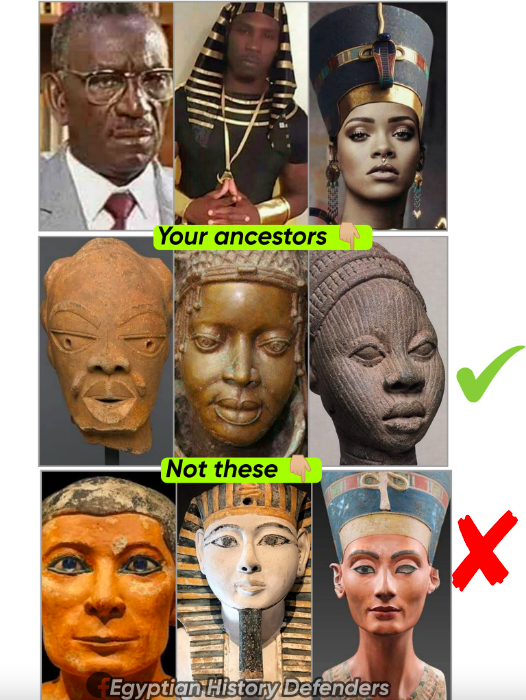
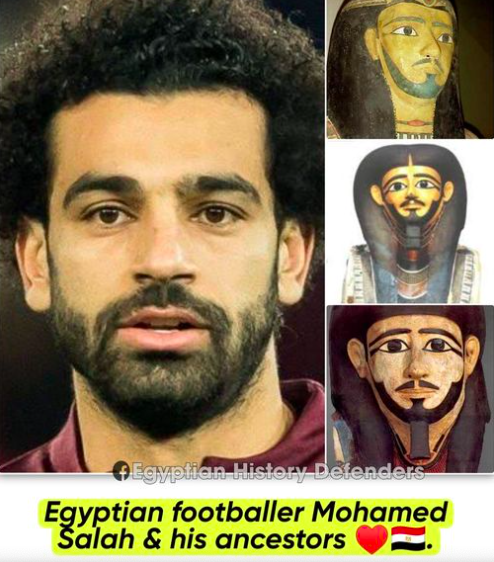
Another front in the campaign against Kevin Hart is the social media handle Egyptian History Defenders. Their social media accounts are full of anti-African American memes concerning their so-called appropriation of Egyptian history. These memes are directed at Afrocentric claims that Black people are at the root of Egyptian civilization. However, it is clear that they cannot differentiate between an Afrocentrist and an African American. Indeed, probably most African Americans believe that the ancient Egyptians were Black, but that does not make them Afrocentrists. This group probably only heard of the term Afrocentrism without researching it, then began to label everything that resembles it by that term. In truth, Afrocentrism is a scholarly approach stemming from the Black Studies movement that began to take shape in the mid-20th century. At its core, it intends to center the perspectives and experiences of Africans on the continent (Egyptians included) and throughout the diaspora in various fields of study starting with history. Molefi Asante, perhaps the most vocal proponent of the term who has since disavowed the concept, rejected the use of Afrocentrism as a response to Eurocentrism. Rather, he used the term Afrocentricity to denote a proactive cultural movement among Africans that shapes the adherent’s paradigm on various areas of human interest. The neo-nationalists have instead reduced Afrocentrism to a mere musing on the ancestors.

Interestingly enough, these Egyptian neo-nationalists in their anti-intellectualism have slipped into the same methodological fallacy as some Afrocentrists. Just as Afrocentrists juxtapose paintings and sculptures from ancient civilizations to pictures of contemporary African Americans to show that these ancient people would be classified as Black by present American standards, they too have taken to juxtaposing pictures of ancient Egyptians to show that they would be classified as Egyptians by today’s standards. While interesting to look at, this is not proof of descent, not for African Americans and not for current-day Egyptians.

On both sides, we should acknowledge that many changes have taken place on earth since the ancient days. While it is obvious that the original Egyptians were Black as we know it today that does not exclude any other people from greatness. Many of those dark skinned people continue to live in the region where you find most of the ancient Egyptian monuments in Luxor and Aswan along with many other Ṣaʿāyada (people of Upper Egypt), who all Egyptians identify as sumr (dark skinned). Why neo-nationalist Egyptians ignore them is indicative of their racism and colonial mindset. They are blinded by the metropolitan north which is dominated by descendants of Central Asians, Greeks, Anatolians, Circassians, and other people of European descent including the French and Germans, that they don’t even realize the dark skinned people that dominate the south of the country where the markers of ancient Egyptian civilization are found. But most Egyptians care nothing about ancient Egypt until foreigners show an interest in it.

No Protests Against European Egyptologists

Why don’t Egyptian neo-nationalists oppose European Egyptologists? They have done more damage than Afrocentrists ever have. In fact, Afrocentrists pose no threat to Egyptian society despite their fiery rhetoric. Yet, white Americans and Europeans are the only groups who have a proven track record of attacking Egypt and distorting its historical narrative under the guise of research. Not only did the French and British colonize Egypt, and the U.S. continues to influence its politics, but they stole artifacts, introduced the question of the ancient Egyptians’ race, and interfered in Egyptian politics, society, and media. Not only that, but it was the West who took the civilization away from Egypt and labeled it “world heritage,” effectively handing their history and artifacts over to the “world,” which just happens to be located in Western countries.

The debate over the race of the ancient Egyptians was started by European orientalists, who founded the field of Egyptology with the intention of barring indigenous scholarship and participation in it. But there are no hashtags and strong words from media personalities for them. The “red line” they draw supposedly at the tampering with Egyptian history is only for the imaginary threat of Black Americans and not the real threat of White Westerners. The neo-nationalist Egyptians should thank Africans and African Americans trained in the West like Carter G. Woodson, Cheikh Anta Diop, George G.M. James, Ivan van Sertima, and John Henrik Clarke among others, who loosened the grip of White colonialists on the narrative of ancient Egypt. In addition, it was the movie Black Panther that sparked the recent sentiment of returning antiquities to their countries of origin. This is an Afrocentric sentiment that Egyptians are tangibly benefiting from. If ancient Egypt is indeed world heritage, then scholars of all backgrounds with the interest and necessary qualifications should be able to contribute to the scholarship of that heritage.

Concluding Thoughts

One of the major accomplishments of the Afrocentric movement was that they dispelled the myth of colonizing European Egyptologists who spread the lie that the ancient Egyptians were “white” like them. I don’t know a single African American or other ethnicity from America for that fact who does not believe that the ancient Egyptians were dark skinned African people. Does Ahmad Youness and his cadre seek to disinvite all foreigners who hold these views regardless of race? Or is this ban exclusively for African Americans? I have lived in Egypt six years and met Egyptians who believe that the ancient Egyptians were Black Africans as well. Do they also think those Egyptians should be expelled? If so, when does the madness end?

Plus, who gave these people the authority to say who is and is not welcome in Egypt? They are not government officials or even intellectuals. They do not speak for the majority of Egyptians who have no idea what Afrocentrism is and more than likely do not care. Kevin Hart’s coming to Egypt would stimulate a depressed economy, which is suffering greatly now. It will also bring joy to a depressed people. Who are these protesters who care nothing about the poor condition of their country and their people? Tourists of all types, including African Americans, stimulate the Egyptian economy every year by taking tours throughout the country. What these protesters want to do effectively is deprive their country of this essential income for their economy. What did not make the headlines was the cancellation of the annual Afrocentric conference that takes place in Luxor. We can presume that it was at the behest of the same neo-nationalists. Baba James Small alerted me to this earlier in the year and I thought it was a bit uncharacteristic of the Egyptian tourist industry, which jumps at just about any and every opportunity to make a dollar. It is clear that Afrocentrism has benefited Egyptians financially and intellectually, more than it has harmed them. If only its detractors would research the matter more seriously.

What I see as vital to resolving the issues between my Afrocentric and Egyptian brethren is opening the lines of communication and the venues for dialogue. From my readings of contemporary Egyptian scholars like Okasha El Daly and Nadim al-Sayyar, as well as classical Arabic scholarship on ancient Egypt, I feel like the two sides have more in common than they might think. Currently, the exchange is almost all hostile and emotionally charged based on their own cultural sensitivities. But if a few level heads came together to discuss things on an intellectual level I am sure we will learn a lot from each other. If there is anyone out there interested in such an exchange please let me know. Until then, enjoy the Kevin Hart show.

Islam and the Ancient Mystery Schools (Part 4)

I had to take a brief hiatus from writing the Islam and Ancient Mystery Schools series in absence of some information and in light of new information. In this post, I want to share some of my findings on the practices and identity of the Hanifs.

Since I published Islam and Ancient Mystery Schools (Part 3), I hoped to find a comprehensive work specifically about the Hanifs, but I have not located such a work in English or Arabic as of yet. Perhaps the paucity of sources about the Hanifs is due to the fact that they were not written about in depth in early sources. However, there are some tertiary sources and secondary sources that touch on the topic tangentially.

The most extensive of which was W. Montgomery Watt’s treatment of Ibn Ishaq’s Sira (in English) and al-Mafassal fi Tarikh al-‘Arab Qabl al-Islam by Jawwad Ali (in Arabic). While the general consensus is that the Hanifs are a mysterious group, if they can be called that, I will summarize a few points of interest for this study.

  • There is a consensus that the Hanifs were monotheistic Arabs. No particular tribe or region had a particularly high number of hanifs in their midst. Ali compares them to reformists of our day (Ali vol. 6, 457). They observed their society and religious landscape and hoped for something better. They found solace in reclaiming the religion of Abraham.
  • In terms of their practices, they were known to make hajj and practice circumcision. They also avoided the worship of celestial bodies and idols and refused to eat meat sacrificed to pagan gods. There were those among the Hanifs who would meditate on the Universe, practice spiritual seclusion by living in caves, and abstain from alcohol and foul language. They, however, had no shari’ah i.e. systemized worship, beliefs, or scripture (Ali vol. 6, 456 and 455).
  • From what is known about them, they were not a monolith. Most classical Muslim scholars considered them to be monotheists who did not follow any of the known religions of the time. Others have named among the Hanifs Arab converts to Christianity such as Waraqa ibn Nawfal. Qays ibn Sa’ida al-Ayadi, and ‘Uthman ibn al-Huwayrith. Similarly, not all Hanifs converted to Islam upon learning about it like Abu Amir the Monk and Kinana ibn ‘Abd Yalayl al-Thaqafi (Ali vol. 6, 457-461).
  • Orientalist scholars have found that some Syrian Christian groups used to refer to monotheistic Arabs as Hanifs, especially those from Yemen. They were said to have been influenced by the surrounding Jews and Christians. They were also knowledgeable of other languages such as Syriac and Hebrew. Ali states unequivocally that all Hanifs were often well-to-do and able to read and write. They spent their surplus income purchasing books, which were expensive in those times. He also speculated that they might have been familiar with Greek books of philosophy in addition to religious scriptures (Ali vol. 6, 453 and 456).

Conclusion

Is it possible that the Hanifs were the inheritors of the defunct Ancient Mystery Schools? According to George G.M. James, the Roman emperor Justinian had closed the Mystery Schools in Egypt as well as the teaching of Greek philosophy in the 6th century (p. 31). Thus the only religions tolerated were Trinitarian Christianity and Judaism to a lesser extent. All other doctrines, whether monotheistic or not were outlawed. Therefore it is possible that non-Jewish and non-Christian monotheists from the Mystery Schools roamed the peripheries of the Roman Empire in search of a purer and more ancient religion. It is also possible that they were subsumed into non-Hellenized interpretations of Christianity to which some Hanifs converted.

As we know, the Mystery Schools was highly structured and primarily oral. It would have been difficult to maintain the teachings of the full curriculum across lands, languages, and potential harm, so only visages of their beliefs and practices would survive. Still the fact that they were literate in other languages and spent their time and money educating themselves using the available written material of the time is a sign that they were seeking to reclaim knowledge that was lost.

While the true nature of the Hanifs may never be known, we can safely assume that they were influenced by the religious milieu of their time. The abolition of the Mystery Schools in the 6th century left a spiritual void on the Earth that would not be fulfilled until the spread of Islam in the coming centuries. As soon as Justinian attempted to extinguish the light of the Mystery Schools, a new light was sparked in the Arabian desert among the Hanifs…

Sahih International: They want to extinguish the light of Allah with their mouths, but Allah refuses except to perfect His light, although the disbelievers dislike it. (Qur’an 9:32)

Islam and the Ancient Mysteries (Part 1)

Is there a relationship between Islam and the mystery schools of the ancient world? This sounds like a strange comparison for someone who is only familiar with Freemasonry or for someone only familiar with the teachings of Islam. Yet, a close, open-minded reading of Freemasonic texts combined with a strong background in Islamic teachings and history will reveal a number of similarities between what is called the “Ancient Mysteries” and Islam as we know it.

I became aware of this relationship in my high school years when I read a book entitled, Stolen Legacy: Greek Philosophy is Stolen Egyptian Philosophy, by George G. M. James, originally published in 1954. It stands as one of the pivotal works of African-centered studies of history. The author does not use the word Islam at all throughout the whole book, but he alludes to it in a section entitled, “How the African Continent gave its culture to the Western World,” where he states:

During the Persian, Greek and Roman invasions, large numbers of Egyptians fled not only to the desert and mountain regions, but also to adjacent lands in Africa, Arabia and Asia Minor, where they lived, and secretly developed the teachings which belonged to their mystery system. In the 8th century A.D. the Moors, i.e., natives of Mauritania in North Africa, invaded Spain and took with them, the Egyptian culture which they had preserved. Knowledge in the ancient days was centralized i.e., it belonged to a common parent and system, i.e., the Wisdom Teaching or Mysteries of Egypt, which the Greeks used to call Sophia. (p. 32)

This passage prompted me to study Islam more seriously and to look at it from this historical perspective. Over the years, I would make mental notes of information I came across in the Islamic canon alluding to the idea of the Ancient Mysteries. However, before I can discuss the Islamic sources and my interpretation of them, I must clarify exactly what the Ancient Mysteries are…

What were the Ancient Mysteries?

Also known as the Ancient Mystery Schools, this name is used by Freemasons, esotericists, and privy Afrocentrics to describe the catholic (i.e. universal) religion of the ancient world. More specifically, it refers to the initiatic organization that taught and preserved religious teachings, the physical sciences, legislation, and the liberal arts among other things. James gives a concise description of the Ancient Mystery Schools:

The ancient Egyptians had developed a very complex religious system, called the Mysteries, which was also the first system of salvation. As such, it regarded the human body as a prison house of the soul, which could be liberated from its bodily impediments, through the disciplines of the Arts and Sciences, and advanced from the level of a mortal to that of a God. This was the notion of the summum bonum or greatest good, to which all men must aspire, and it also became the basis of all ethical concepts. The Egyptian Mystery System was also a Secret Order, and membership was gained by initiation and a pledge to secrecy. The teaching was graded and delivered orally to the Neophyte; and under these circumstances of secrecy, the Egyptians developed secret systems of writing and teaching, and forbade their Initiates from writing what they had learnt. (p. 7)

Given my description and James’ statement above you might ask…

How can a universal religion be secret?

First, it should be remembered that these schools were called “mysteries” because the primordial religion of mankind had no name by which it was referred. True adherents to the religion recognized it in others by their moral rectitude, erudition in the arts and sciences, as well as their keen knowledge of the narratives and symbols that were shared between all the religious orders of that time.

Secondly, the notion of mystery and secrecy was used strategically. According to Albert Pike in his book, Morals and Dogma, secrecy was used to excite curiosity and to stir the emotions of those who might witness the passion plays of initiation. Likewise, they saw the spirit of mystery as coming from God Himself, Who reveals Himself to the human heart in a manner that is unspoken (p. 255).

Furthermore, the true interpretations of the symbols, myths, and allegories were maintained by a scholarly/priest class who were not at liberty to share them with people who were not prepared to receive them. This took spiritual purity, which was only gained through the long and painful process of initiation. Only through this process, could other scholars and priests know that an initiate was prepared, strong, and trustworthy enough to uphold the doctrine, teach it accurately, and shield it and himself from corruption.

Exclusivity in the scholarly/priest class maintained the chains of authorities within these schools and thus maintained the purity and accuracy of its doctrines and practices. As James alludes to later in his book, it was the Greeks who learned from the Egyptians who broke this oath and consequently posited incomplete knowledge, which led to inaccuracies and misunderstandings of the original doctrines and practices.

***

In future posts, I will demonstrate how Islam is tied to the Ancient Mysteries, historically and doctrinally. I will discuss some of the characteristics of the Mysteries, their decline in the ancient world, and their remnants in Arabia prior to Islam. Then I will take a brief look at early Islamic history to ask some important questions that might link the burgeoning Islamic civilization to the Ancient Mysteries as hinted to by James.