The Death of Black Consciousness: “Sinners” and the Rise of Hedonistic Afro-Fetishism

If you can control a man’s thinking you do not have to worry about his action. When you determine what a man shall think you do not have to concern yourself about what he will do. If you make a man feel that he is inferior, you do not have to compel him to accept an inferior status, for he will seek it himself. If you make a man think that he is justly an outcast, you do not have to order him to the back door. He will go without being told; and if there is no back door, his very nature will demand one.(Woodson, 1933, pp. 84-85)

Ryan Coogler’s Sinners attempts to bite the neck of black consciousness and drive a stake through the heart of whatever is left of it. In a day and age when “wokeness” has been weaponized against the people it was designed to inform, it is surprising to see my people blinded by yet another co-opting of and profiteering from our intellectual heritage. What’s worse is the uncritical nature in which large segments of our community have embraced this co-opting and appropriation. This is undoubtedly due to our continued miseducation and psychological entrapment that somehow we have grown to love.

The greater issue at hand is that the so-called conscious ones among us are some of the most miseducated. They have “suspended their disbelief” in American popular culture and media, the true religion of America, and have drunk the proverbial kool aid and are now sacrificing their moral integrity at the alter of the cinemas. Over the years, I have witnessed our people take events and symbols in movies as educational tools. While there is no doubt that Netflix, movie theaters, podcasts, and YouTube have replaced our once literate culture, they still do not realize how much facts and symbols can be distorted to fit someone else’s agenda. Despite the outdated themes addressed in Sinners, which has allowed it to be heralded as a beacon of wokeness, its themes appear carefully curated for domesticated Blacks. In this post, I will criticize the film for its promotion of three concepts that are leading to the death of black consciousness: 1) Black Hedonism, 2) Afro-Fetishism, and 3) Domestication.

Black Hedonism

A major aspect of the American racism project is to portray people of African descent as immoral and governed by their passions. Margaret Mitchell, author of Gone With the Wind, writes in the 1930s of African Americans who took part of the Great Migration:

…the former field hands found themselves suddenly elevated to the seats of the mighty. There they conducted themselves as creatures of small intelligence might naturally be expected to do. Like monkeys or small children turned loose among treasured objects whose value is beyond their comprehension, they ran wild–either from perverse pleasure in destruction or simply because of their ignorance. (Mitchell, 1936, p. 1249)

Sinners reinforces this stereotype. It portrays the Smoke-Stack twins as protagonists and heroes despite their link with the criminal underbelly of 1920s- 30s Chicago. According to the film’s backstory, they survived a brutal and treacherous life in the city to return to their hometown in Mississippi, home of the blues, and start a business, a juke joint, the early 20th century equivalent to a club. Much of the film’s rising action centers on their preparation and advertising for this club. In one scene, one of the twins shoots his friend in the buttocks unknowingly for rummaging through his truck. He then coldly shoots the man’s young accomplice in the legs. What is the point of this? Is black consciousness now promoting wanton black on black violence?

A common pretext of lynchings historically has been the ease with which official channels (law enforcement, media, etc.) can shape public opinion to believe that any black person who is accused of committing a crime must be guilty because black people are somehow predisposed to illegal and immoral behavior. Instead of opposing this construct by showing how European dominance is illegal and immoral in a universal sense, the writers of Sinners have embraced the hedonistic image of black people. This image makes crime, addiction, lack of sexual discipline, and violence a natural part of black culture. Not only have they accepted this image for their own generation, but have projected this image on generations past. This is not to say that there was no black underworld or social ills, but it is not representative of all black culture but for some reason it is repeatedly highlighted in American media.

Sinners also promotes loose sexual behavior that is not even justified by secular culture. The fact that both Mary and Pearline are married to other men but are entertaining Stack and Sammie respectively as love interests promotes adulterous behavior that has historically destroyed our communities. The animosity and broken homes that result from adultery is debilitating to any type of black unity or solidarity. Even princes of Pan-Afrikanism, conscious kings, and champions of Black women like Dr. Umar Johnson and Brother Polight lose all credibility due to their lack of sexual discipline. Yet the same people blame religion for the problems of the Black community, when in actuality the average church, mosque, and temple only warns us of the dangers of self-destructive behavior. In actuality, people don’t have a problem with religion. They have a problem with self-control. They have a problem with accountability. They have a problem with systematic learning. And most of all they have a problem with discipline.

Additionally, the rhetoric of some pro-Black spiritualists that “religion” was forced on black people needs to stop. They have not yet received the memo that: “We is free now” and black people have been choosing their religion freely in the U.S. for over a century. When they say “religion” they usually mean Christianity, but extend this to mean Islam as well. Their logic is that Christianity was forced on enslaved Africans in the Americas. Enslaved Africans in America are Africans and Christianity is a religion. Therefore, all religions were forced on all Africans. The analogy is so weak that even a child can see the gaping hole in it. Just because Europeans forced Christianity on some Africans in the past does not mean that Christianity and other religions that Africans happen to follow was forced on them and will be perpetually in the future. Also, now that African Americans are no longer enslaved, whatever religion they choose to practice is of their own free will, be it Christianity, Islam, or Yoruba.

Our treatment of Christianity with regards to African populations must be studied in context, whether in Africa or in the Americas. Christianity in the context of colonial Nigeria was liberating in some regards. Conversion to Christianity gave rural Nigerians access to skills and resources that they could use to gain upward mobility and compete with more urbanized Nigerians. However, in the Americas conversion to Christianity did not accompany such perks. In Catholic controlled colonies, conversion was mandatory. And although Africans were baptized en masse, they received little to no religious instruction. So there is no wonder why the African expressions of Catholicism are folk and syncretic in nature.

In Protestant controlled colonies, African conversion to Christianity was treated with caution. On the one hand, the initial justification for the slavery of Africans was the fact that they were not Christians. Once they embraced Christianity their servitude should have been void but it was not. For this clear hypocrisy, Protestants feared the conversion of enslaved Africans and they tried unsuccessfully to emphasize verses encouraging submission to their human masters rather than the powerful narrative of Moses leading his people out of bondage (Curry, 1997, pp. 24-26). This fact is corroborated by Carter G. Woodson in his Education of the Negro. In the early 19th century, religious education for enslaved Africans was equivalent to training them for insurrection.

The push against organized religion in popular American culture is more of an emotional response to perceptions of religious institutions than an intellectual one. Most have never bothered to read widely and deeply on the histories of religions and it shows. Religious institutions have historically been one of our strongest institutions because they have brought people of like minds together, served as a base for exchanging ideas, and offered charitable services. Institutions, religious, political, financial, educational, or social, are means to power, influence, and freedom. Instead of strengthening our religious institutions, which we still retain some control over, black hedonists have worked to weaken these institutions in favor of fragmented and individualistic Afro-fetishism.

Afro-Fetishism

Afro-fetishism has risen in prominence since the inception of Afrocentrism. It is the tendency of African Americans to romanticize things they consider to be authentic African culture. In Sinners it manifests itself with the romanticism of southern root doctors, conjuring spirits, and the conflation of entertainment (music and dance) with spirituality. In reality, there is no one thing called “African spirituality.” Simply put, “spirituality” is a European concept developed primarily by Theosophists and occultists, which seeks to separate spirituality from religion. It represents one of the modern iterations of the so-called European Enlightenment, which promotes a Eurocentric view of religion and religious history; a history not experienced by most of the people of Africa.

Every religious system has a spiritual aim. “Religion” – as Afro-fetishists might call it – is the exoteric outer core that houses the esoteric inner core or “spirituality.” The doctrines, rules, rites, and rituals of religion must be upheld for people to achieve their spiritual goals. The morality, meanings, and heart-felt connection is cultivated through religious discipline. Both are necessary, otherwise, confusion and delusion prevails.

We witness this in Sinners and in real life. For instance, Smoke rightfully questions Annie’s Hoodoo practices, which she believes protected Smoke and Stack as they led a life of crime in Chicago. Yet, these same practices were not sufficient to thwart the death of Smoke and Annie’s baby daughter. Although, her herbs and concoctions helped her defend the non-dead at the juke box against the dead, we should remember that vampires are fantasy. Not only that, but potions and fetishes often tied to “African spirituality” are powerless against the spells of “niggerdom” and white supremacy.

The fact that their daughter passed away also poses an interesting question to those who venerate the ancestors. Is their daughter an ancestor because she passed away before her parents or is she still their “descendant?” Moreover, many of the people who talk about conjuring the spirits of the ancestors also speak about inter-generational curses and barely get along with their living family members. Why are they calling on the same people who caused the curse? Why do they want to build/continue relationships with the dead rather than the living? Are they not inviting vampires in their home?

Furthermore, every individual has an exponential number of ancestors, represented by the following equation: x=2n. This means that after three generations, a person has eight grandparents; after four generations, a person has sixteen grandparents, and so on. Once a person goes back ten generations, for instance, they have over a thousand grandparents. That is a lot of ancestors to make shrines to. Hardly anyone can remember the names of all of them let alone find pictures or memorabilia for them.

When people claim communion with the ancestors, how do they determine which ones to commune with? And if the ancestors speak to them, how do they know the person speaking from beyond the grave is not an imposter? The truth is that while it is essential to honor one’s ancestors by not speaking ill of them, speaking their names for as long as possible, and fulfilling any of their good endeavors, they are in more need of us than we are of them. Their lives are over and their affair is with their Creator. It is on us to live our lives, honor, and speak to our loved ones while they are still alive instead of seeking out mystical ways of communicating with them after they are gone.

While I understand the need of our people to connect with their roots, which were severed from us during our oppression in the western hemisphere, African Americans have the tendency to perform these so-called connections in a very superficial way that is more indicative of their Americanness than any real connection with actual Africans. Furthermore, much Afro-fetishism is based on marketing and consumerism. Things like red black and green flags, ankh jewelry, and incense are mainstays of an Afrocentric esthetic but are not items indigenous to Africa or are staples of any contemporary African culture. Yet, someone has convinced us through strategic marketing to pay top dollar for these things. From tours of ancient Egyptian temples to pathways towards citizenship for African Americans, even people from the continent have thought of ways to market to the emotional sentiments of African Americans because at the end of the day we are just consumers with US dollars.

Annie prepares potions of protection and healing through her knowledge of Hoodoo.

Domestication

Finally, Sinners speaks to the domestication of black consciousness. Domesticated black consciousness can only be militant about safe topics related to racial bigotry, cultural autonomy, and other corny topics that get black people riled up but will never spark a revolutionary consciousness or affect real change. The film is set in the 1930s and features a lot of details and covert commentary on that era but misses several opportunities to draw parallels and commentary to current events. However, as the famous Mozart quote goes: “The music is not in the notes, but in the silence between.”

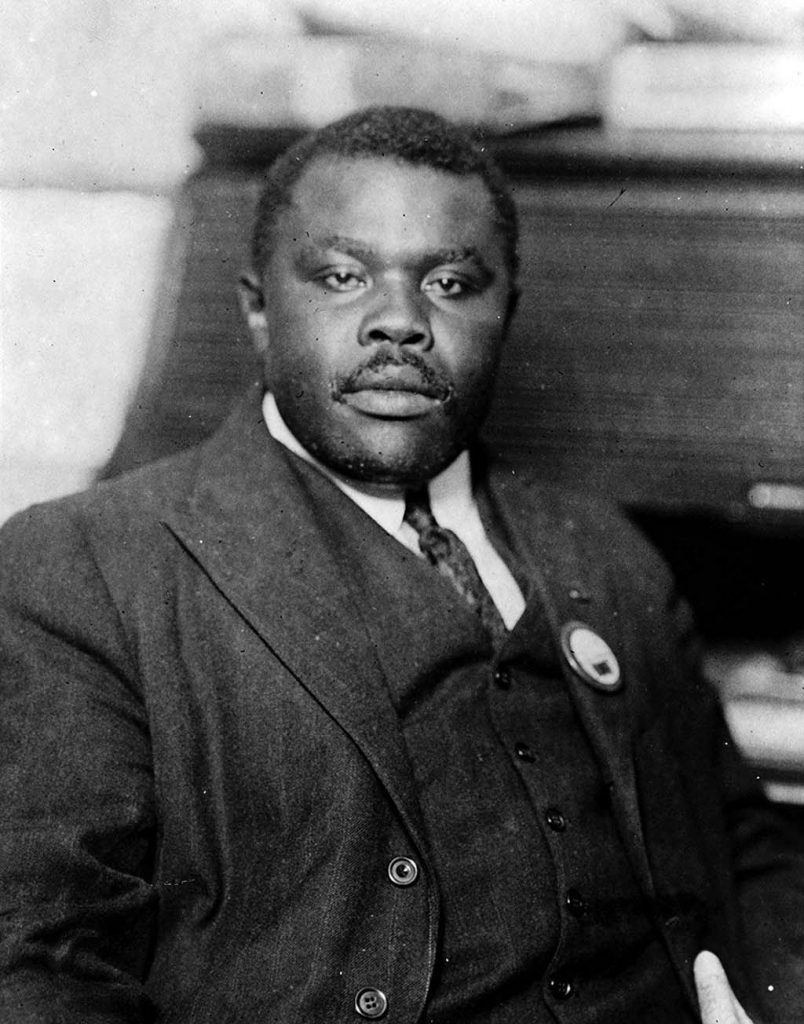
While the film attempts to highlight complex racial dynamics from the 1930s such as colorism, European ethnic dynamics, Asian immigration, labor inequality, etc., it is completely silent on actual movements of Black people from that era to improve their political and social conditions. No attention is given to the influence of Marcus Garvey from the 1920s and the Communist movement of the 1930s. Garvey instilled pride in blackness and self-determining industriousness that had nothing to do with organized crime. Still intelligence agencies identified Garvey as an existential threat to the American order who would lead a Bolshevik-style revolution among African Americans. As perhaps the first target of J. Edgar Hoover’s terror campaign, Garvey became a victim of a government set up, which led to his imprisonment and deportation. In an odd, yet correct move, President Biden pardoned Garvey fully and unconditionally as one of his last acts as president. Nevertheless, a movie supposedly made for Black people of conscious did not even hint at the power the Garvey movement had on African American communities as well as its parallels to the current political climate.

Another footnote of history that Sinners neglected is the fact that Communism had spread across Black America. Inspired by the 1917 Soviet revolution but not controlled by it, many African Americans were attracted to Communism and Socialism during the period the film is set in. The likes of Shirley Graham Du Bois, W.E.B. Du Bois, Benjamin Davis Jr., and Paul Robeson had adopted the ideals of the revolutionary left. This was because of the all-too-familiar trap of the two-party system: the Democrats, who were then the preferred party of the Ku Klux Klan and segregationists, and the Republicans, the party to whom most African Americans were loyal because it was the party of president Abraham Lincoln, who supposedly “freed the slaves.” At that historical moment, with the onset of economic depression, the white Republicans’ growing disinterest in the black community, and the Democrats’ deconstruction of the Reconstruction in the form of Jim Crow segregation laws left very few viable political alternatives for African Americans. There is a lesson there for people who reflect on our current situation as America teeters on yet another great depression, the Democrats’ obsession with only symbolic progress for blacks, and the Trump-led Republicans reversal of some our domestic victories in the form of Civil Rights.

While the Communist Party may not be the most viable direction now, where are the black conscious thinkers, artists, and filmmakers to groom the next generations of Martin Luther Kings, Malcolm X’s, and Shirley Chisholms? Who are the people who will use their platforms to organize around the African Union Symposium of 2025 in which reparations for the African diaspora will be a key issue? Who will educate the masses about conflicts in the Congo and Sudan? Who will meet with forward-thinking African leaders like Ibrahim Traore, Assimi Goïta, and Julius Malema on our behalf? Sinners has looked deeply into the “safe” aspects of African American history like the Great Migration, the Blues, and even lives of ethnic groups like the Chinese, Irish, and Native Americans in rural Mississippi, but cannot find the bandwidth to dig into the aspects of black history that will make us reflect on and correct our current conditions.
Conclusion

Carter G. Woodson is probably rolling in his grave to find that his book the Miseducation of the Negro still applies almost word for word to 21st century Negroes. Coogler and the cast of Sinners has effectively carved out a back door for African Americans to re-enter into American society. This is a door in which we only seek validation from a pat on the head for our musical and athletic prowess. This is a door in which we can only move forward in society if we wait until someone lets us by. This is a door in which we literally stay in our places and have no global scope for our economic future. We are only content with ratchet and hustle culture.

As black social media applauds the symbolism in the film Sinners and the many social issues it raises, corporate America has yet again blindsided them by ignoring, if not suppressing, many latent histories and current events. However, as the last visages of black consciousness, we must reject hedonism and embrace discipline in all aspects of our lives. We must reject Afro-fetishism and the shallow consumerist mindset that is meant to derail us from our true purpose. And we must reject the domestication of our purpose, which will keep us from thinking globally and connecting our ideas from the past to benefit our future. As the sun rises in the west, I hope the vampires of black consciousness are laid to rest and we can resurrect our consciousness for the generations to come.

Suggested Readings:

Curry, Mary Cuthrell. Making the Gods in New York: The Yoruba Religion in the African American Community. Studies in African American History and Culture. New York: Garland Pub., 1997.

Horne, Gerald. Black Liberation/Red Scare: Ben Davis and the Communist Party. Toronto: Associated University Presses, 1994.

———. Race Woman: The Lives of Shirley Graham Du Bois. New York: New York University Press, 2000.

Mitchell, Margaret. Gone With the Wind. New York: MacMillan Company, 1936.

OnGenealogy. “Do the Math – How Many Ancestors Do I Have?,” 2025. https://www.ongenealogy.com/do-the-math-how-many-ancestors-do-i-have/.

Woodson, Carter G. The Education Of The Negro Prior To 1861 A History Of The Education Of The Colored People Of The United States From The Beginning Of Slavery To The Civil War. Project Gutenberg, 1919.

Woodson, Carter Godwin. The Mis-Education of the Negro. Khalifah’s Booksellers & Associates, 1933.

Imposter Syndrome: Unraveling Jewish Identity Through Qur’anic Terminology

Is it true that Ashkenazis are fake Jews or “converts” at best? Are the claims of a stolen Israelite legacy made by Black Hebrew Israelites substantiated? Are the claims of some anti-Zionist Jews that Judaism is primarily a religious designation rather than an ethnic one substantiated? And what clarifications can a close reading of the Qur’anic revelation offer us on this topic?

The Qur’an offers some interesting insights into the dubious identity of a segment of the population that identifies as Jews. The key to gaining these insights is through a close reading of the Qur’anic terms for Jews. Throughout the Qur’an we find four references to this population. The first is the overarching term ahl al-kitāb, commonly translated as “People of the Book.” The second is Banū Isrā’īl, the Children of Israel. The third is Yahūd (plural Hūd) and the fourth is alladhīna hādū, both of which are usually  translated as “Jews” but I will discuss the difference momentarily.

Ahl al-Kitāb

Ahl al-Kitāb can refer to “people” who followed revealed scriptures, primarily the Torah and the Gospels, or religions that follow a revealed law. This designation conveys a privileged status according to Islamic law and governance. Socially, this means that Muslims can eat their slaughtered meat, Muslim men can marry their women, and they can freely express their religion. Under an Islamic government, then Ahl al-Kitāb must pay a special tax, called jizyah, they can bear arms to defend themselves against external enemies as well as receive protection from a Muslim army, and they can govern themselves according to their own sacred law. Alternatively, the word ahl can refer to the “qualified” people of those religions i.e. the religious scholars and priests.

Muhammad al-Shahrastānī divides Ahl al-Kitāb into two groups. One that retains the name Ahl al-Kitāb and the other is called Ummī. Ummī can mean those who are illiterate or had no written scripture. To use the terms of the Jews and Christians they would be considered Goyim or Gentiles.

As for the Ahl al-Kitāb, they were the Jews and Christians that lived in Medina. They followed the religious methodology of the twelve sons of Israel (i.e. the Prophet Jacob or Yaʿqūb), who followed the apparent meaning of scripture and upheld the sacred law. Their direction of prayer was the Holy Sanctuary of Jerusalem and they opposed the blatant blasphemy of the likes of Pharaoh.

As for the Ummī, their capital was Mecca. Although they also claimed to follow the religious methodology of the Children of Israel, their direction of prayer was the Holy Sanctuary of Mecca (i.e. the Kaʿbah). They believed that they preserved the inner meanings of the sacred law and their enemies were the idolators and those who worshiped the heavenly bodies. (Shahrastānī and Muhammad, 1992, vol. 2, pp. 227-228). Shahrastānī’s description of the Ummī can be understood as the Ḥanīfs of Arabia.

Children of Israel

The term Children of Israel is often mentioned in a positive light throughout the Qur’an. From the lineage of Abraham, Israel refers to the prophet Jacob or Yaʿqūb the son of Isaac or Isḥāq, who had twelve sons:

  1. Reuben (Hebrew רְאוּבֵן‎ Rəʼūḇēn)
  2. Simeon (שִׁמְעוֹן‎ Šīməʻōn)
  3. Levi (לֵוִי‎ Lēwī)
  4. Judah (יְהוּדָה‎ Yəhūdā)
  5. Issachar (יִשָּׂשכָר‎ Yīssāḵār)
  6. Zebulun (זְבוּלֻן‎ Zəḇūlun)
  7. Dan (דָּן‎ Dān)
  8. Naphtali (נַפְתָּלִי‎ Nap̄tālī)
  9. Gad (גָּד‎ Gāḏ)
  10. Asher (אָשֵׁר‎ ’Āšēr)
  11. Benjamin (בִּנְיָמִן‎ Bīnyāmīn)
  12. Joseph (יוֹסֵף‎ Yōsēp̄)

It is said that their origin was from Canaan (current-day Palestine), but migrated to Miṣr (Miṣrīm) according to both the Biblical and Qur’anic narrative of the prophet Joseph or Yūsuf. I doubt that the Miṣr mentioned in the Bible and the Qur’an is present-day Egypt, as most of us commonly believe. There is substantial evidence to doubt the common belief but not enough evidence to establish its location definitively. However, Miṣr is suspected to be somewhere on the Arabian Peninsula. (For more on this topic see the works of Kamal Salibi and those who built on his theory).

Nevertheless, the Children of Israel were considered the correct believers in God and recipients of the succession of Biblical prophets until Jesus or ʿĪsā. God in the Qur’an speaks of a covenant He made with the Children of Israel. They were given blessings and merit over all people if they upheld certain commandments like only worshiping God, being good to their parents, family, orphans, and the poor. They were commanded to be good to people and to establish prayer and give charity as expressed in al-Baqarah: 83 for instance:

وَإِذْ أَخَذْنَا مِيثَاقَ بَنِي إِسْرَائِيلَ لَا تَعْبُدُونَ إِلَّا اللَّهَ وَبِالْوَالِدَيْنِ إِحْسَانًا وَذِي الْقُرْبَىٰ وَالْيَتَامَىٰ وَالْمَسَاكِينِ وَقُولُوا لِلنَّاسِ حُسْنًا وَأَقِيمُوا الصَّلَاةَ وَآتُوا الزَّكَاةَ ثُمَّ تَوَلَّيْتُمْ إِلَّا قَلِيلًا مِّنكُمْ وَأَنتُم مُّعْرِضُونَ

Remember when We took a covenant from the Children of Israel, [saying]: Do not worship but God and be good to parents, family, orphans, and the poor; and speak good to people, establish regular prayer, and give charity. Then you turned away except a few of you, and you are resistant.

As the Qur’an indicates, not all of the Children of Israel maintain their covenant with God. Some even committed the egregious sin of worshiping a golden calf during the time of Moses (Mūsā) and Aaron (Hārūn). While Biblical accounts attribute the creation of this idol to Aaron as his brother Moses received the Ten Commandments from God, the Qur’an absolves Aaron of such a deed and instead attributes to a man only known as al-Ṣāmirī.

The mandate for the Children of Israel was to maintain the apparent form of the sacred law. Shahrastānī states that the “divine light” of revelation was split between two camps: 1) the Children of Israel and 2) the Children of Ishmael. Israel represented its outer with its succession of prophets. Ishmael represented its inner dimensions by preserving its rituals and symbols, and concealing the state of the prophets (Shahrastānī and Muhammad, 1992, vol. 2, page 228).

The Killing of Prophets and the Disobedience of the Israelites from Blogging Theology

Yahūd

As noted above, one of the sons of Jacob was named Judah, whose Arabized name was Yahūd. In the 11th century BCE, this tribe conquered Canaan and established the Kingdom of Judah in the southern Levant next to the sister Kingdom of Israel. The Jewish religion is named for the tribe of Judah. The kingdom would eventually succumb to the Babylonians under the king Nebuchadnezzar II in 586 BCE. Solomon’s temple was destroyed and the Jews were exiled to Babylon. It was during this exile that a number of Jews begin to embrace aspects of the ancient Babylonian religion. The religion of Babylon, if we remember, is the Chaldean religion of the people of Abraham, which he refuted. They were also known as Sabians and Magians.

Alladhīna Hādū

In addition to Yahūd, the Qur’an uses a peculiar phrase to reference this group: alladhīna hādū, which either means “those who claim to be Jews” or “those who became Jews.” The word hādū is a past tense verb conjugated in the third-person plural form as opposed to Yahūd, which is a noun.

It is my opinion that “those who claimed to be Jews” and “those who became Jews” were a faction of the Sabians who adopted Jewish customs and rituals but secretly maintained their belief in Sabian doctrines such as the eternity of the universe, a belief in a demiurge, the worship of intermediary spirits, the use of occult sciences, killing the prophets, etc. The likes of the Persian polymath Abū Rayyān al-Bīrūnī claims that the true Sabians were the Jews of Babylon, who mixed the rites of Judaism with Magianism (Bīrūnī and Sachau, 1879, p. 188).

It is important to note that the Mandaeans of Iraq, a group Muslim sources have always identified as Sabians, claim to have once been of the Jews. However, they split from the body of Jews over the issue of Mary’s (Miryam) immaculate conception of Jesus. The Mandaeans as “those who claimed to be Jews” slandered Mary and opposed Jesus. Although the Mandaeans saw Mary as one of them, they claimed that she became pregnant by witchcraft and that Jesus was a demon and false prophet (Buckley, 2002, p. 4). This is alluded to in al-Nisā‘: 155-157:

فَبِمَا نَقْضِهِم مِّيثَـٰقَهُمْ وَكُفْرِهِم بِـَٔايَـٰتِ ٱللَّهِ وَقَتْلِهِمُ ٱلْأَنۢبِيَآءَ بِغَيْرِ حَقٍّۢ وَقَوْلِهِمْ قُلُوبُنَا غُلْفٌۢ ۚ بَلْ طَبَعَ ٱللَّهُ عَلَيْهَا بِكُفْرِهِمْ فَلَا يُؤْمِنُونَ إِلَّا قَلِيلًۭا ١٥٥

وَبِكُفْرِهِمْ وَقَوْلِهِمْ عَلَىٰ مَرْيَمَ بُهْتَـٰنًا عَظِيمًۭا ١٥٦

وَقَوْلِهِمْ إِنَّا قَتَلْنَا ٱلْمَسِيحَ عِيسَى ٱبْنَ مَرْيَمَ رَسُولَ ٱللَّهِ وَمَا قَتَلُوهُ وَمَا صَلَبُوهُ وَلَـٰكِن شُبِّهَ لَهُمْ ۚ وَإِنَّ ٱلَّذِينَ ٱخْتَلَفُوا۟ فِيهِ لَفِى شَكٍّۢ مِّنْهُ ۚ مَا لَهُم بِهِۦ مِنْ عِلْمٍ إِلَّا ٱتِّبَاعَ ٱلظَّنِّ ۚ وَمَا قَتَلُوهُ يَقِينًۢا ١٥٧

[The Children of Israel were condemned] for breaking their covenant, rejecting the signs of God, killing the prophets unjustly, and for saying, “Our hearts are locked!” Rather, it is God Who has sealed their hearts due to their disbelief. For none of them truly believe except for a few.

As well as for their slander against Mary.

And their claim, “We killed the Messiah, Jesus, son of Mary, the messenger of Allah.”

The Mandaean Sabians served as the wedge between the Yahūd and Naṣārā (Jews and Christians). Had the Sabians not slandered and caused confusion about Mary and Jesus then the Jews would have accepted them and the Christians would have continued to the practice the laws of the Children of Israel.

Concluding Thoughts

If understood properly, the Qur’an has accurately described the population associated with Judaism. The Qur’an often addresses them with linguistic nuance that can be understood through the lens of history. However, because these concepts are not commonly known there is still much research that must be done on them. Not the least of which is the ethnic and racial component. For instance, many Islamic historians who speak of Jews in Arabia do not make an ethnic distinction between pagans, Jews, and Christians on the peninsula. In fact, historians speak of them of having a common origin from Abraham, who simply differed in location, political affiliation (Rome or Persia), and religious law. Plainly speaking, the original Hebrews were not ethnically or racially distinct from the Arab peoples. Their differences were in religious methodology.

As Shahrastānī suggests, the Hebrew mandate was the preservation of the outer form of the divine law. This is the understanding of their “choseness,” which was conditional upon their adherence to the law set by the prophets and not changing scripture. However, they broke this covenant by constantly breaking the laws, killing the prophets, and corrupting the scripture.

Another insight from Shahrastānī that is often not addressed by historians is that of the numbers of the Children of Israel. Shahrastānī mentions that their ummah (religious community) was greater than that of the Christians (Shahrastānī and Muhammad, vol. 2, 1992, p. 229). If we think about it, the religion of the Children of Israel existed longer and existed among many tribes. As mentioned above, they were twelve tribes, only one of whom carried the name Yahūd (Jew). In much Islamic historical literature, the Jews or Children of Israel are represented in Arabia more than the Christians in early Islam.

There are currently about 15 million Jews in the world and almost 2.5 billion Christians. If the Children of Israel and their religion – not just the Jews and Judaism – endured until now, then where and what is their religion? Of course, the Black Hebrew Israelites in their various expressions attempt to address this question by proposing that the European Jews are imposters and do not represent the totality of the House of Israel and by theorizing that the tribes of Israel ended up in the Americas. However, their movement could benefit from a Qur’anic perspective and more rigorous and realistic look at history.

It is clear to me that the religion of the House of Israel was lost and distorted throughout time. If it was not, then there would have never been a need for a succession of prophets. Judaism represents a reconstruction of this religion by their scholars and rabbis without a divine chain to the prophets Jesus and Muhammad. As for the remaining tribes, then it would be realistic to look into the genealogies of the people of Arabia and greater Near East to understand their diffusion throughout the earth.

References

Buckley, Jorunn Jacobsen. The Mandaeans: Ancient Texts and Modern People. Oxford University Press, 2002.

Shahrastānī, Muhammad ibn ʿAbd al-Karīm al-, and Ahmad Fahmi Muhammad. Al-Milal Wa al-Niḥal. 2nd ed., Dār al-Kutub al-ʿIlmīyyah, 1992.

Hamitic Arabs: A Revolutionary Approach to Race and Resistance

As we close out Black History Month 2024 with the trials facing Gaza, the West Bank, and throughout the Muslim world, Arab world, and Africa, I would like to highlight a movement that is often not acknowledged, but serves as one of the bridges between Pan-Arabism, African American Muslims, and social justice. Addeynu Allahe Universal Arabic Association is an American orthodox Muslim movement that has operated below the radar for almost a century and has an interesting take on identity that might raise eyebrows in Black and Arab communities alike. However, as we will see, some of its progeny have been at the forefront of Black and Third World liberation movements. In this post, I will examine a manuscript I obtained from Abdurrashid Ishaq, a member of Addeynu Allahe who attended my Arabic classes in Greensboro, NC in 2012. His memory was fading and he could not tell me much about the document before he returned to Allah in 2019, but I will do my best to analyze the anonymous text and speak on one aspect of Addeynu Allahe’s legacy.

“Who Am I?”: A Forgotten Treatise on Black American Identity

The document is a manuscript of perhaps a talk given in 1969. It is directed to Elizabeth, NJ Board of Education following student requests to teach “Black Heritage” in its public schools. It consists of 28 pages, typed with a typewriter, containing prose, footnotes, a chart, and appendices of quotes from various Orientalist authors that elucidate some aspect of Arab and Hamitic identity.

The document was published a little over 30 years since the founding of AA in 1938 and almost 10 years after the death of Professor Muhammad Ezzeldeen. It presents him as a son of “Hamitic Arab” parents and someone whose post-secondary education came from traveling to countries such as Morocco, Libya, Turkey, and Egypt. He is even said to have worked as an Egyptologist and obtained a doctorate from al-Azhar University.[1]

With regards to identity, the author seeks to deconstruct the aptness of the terms Negro and Black. Negro, he says, is equivalent to the Latin word for dead and Black is insufficient because it conceals the national heritage of our people. Rather, he sought to connect so-called African Americans to Ham, son of Noah, who represents ancient Egypt, Ethiopia, and the rest of Africa. On top of that, he recognized the connection between the ancient Egyptian language and Arabic.

The author also provides a linguistic analysis of the Arabic words in question. He pulls from Hans Wehr’s Arabic Dictionary to demonstrate the positive connotations to the root s-w-d (سود) from which the word black aswad (أسود) is derived. He does the same with the word Ham, assigning it to the root ḥ-m-y (حمي), which connotes protection, rather than ḥ-m-w (حمو), which connotes warmth. Nor does he connect it with the ancient Egyptian root Kham (black) as in Khemet.

Additionally, the author takes a brief historical approach to this identity. He discusses Moorish exploration to the Americas prior to Columbus and Muslims taken as slaves. He concludes by saying their origins were from parts of Africa, Arabia, Asia, and Europe that were ruled by Hamites and visually maps this genealogy in a chart.

Chart of Hamitic genealogy from “Who Am I?”

An Analysis of Language and Identity

This document is significant because it is a rare approach to identity; one that is controversial. Some debate the Hamitic Arab identity on grounds that it seeks kinship with a people who are not “Black” or may even be “anti-Black,” which is tantamount to cultural apostasy. Others my decry it as another form of cultural appropriation perpetrated by a lost and confused people. Others might take issue with its use of antiquated Biblical terms or the fact it conflates ethnic identity with religious identity.

Cultural Apostasy

With regards to the critique that the Hamitic Arab approach is cultural apostasy, the author makes it clear that that is not the case. Assuming that Black is an appropriate descriptor, the author sought to show that it has a negative connotation in English, but a positive connotation in Arabic. Similarly, he acknowledges that Bilād al-Sūdān was the name of the lands in Africa from which our ancestors came. This further solidifies the historical continuity between so-called African Americans and the Blacks of Africa.

Arabism

While the thought of African Americans calling themselves Arabs is an odd proposition, and is certainly not explained in depth in this piece, on face value can be considered cultural apostasy from an African American perspective and cultural appropriation from an Arab perspective. Yet the pretext for such an assertion comes from the Arabic saying that is often mistaken for a hadith: an Arab is whoever speaks the Arabic language (من تكلم بالعربية فهو عربي). To Arabs, this is a much more sound definition of Arab identity than one that favors biological lineage. Arabs are the descendants of people who were not biologically Arab, which would thus cause a paradox. So the criteria of Arabness or ʿUrūbah is proficiency in spoken Arabic. Perhaps the unintended result of such a definition is that it allows people from various backgrounds to acquire an Arab identity by acquiring the language. This is how many populations in the Levant and North Africa were able to acquire an Arab identity without intermarriage or conversion to Islam. This further debunks assertions that Islam is an Arab religion.

Terminology

The reliance on the Biblical term Hamitic can be considered antiquated and difficult to define. It is interesting that the author prefers to define Ham by an Arabic definition rather than a Hebrew or ancient Egyptian definition. His choice of etymology is also unconventional. Hans Wehr has an entry for Ham that is not at all informative, but he chose to relate it the word for protection. I am not convinced that the connection between the two is verified linguistically.

We generally understand that Ham from the Bible was the son of Noah who is considered the progenitor of the civilizations and people in which dark-skin dominates, Cush, Mizraim, Phut and Canaan. What the text does not address is the so-called “Curse of Ham,” which Noah actually pronounced on Canaan after Ham supposedly sodomized his father or witnessed his nakedness while he slept in a drunken stupor, according to the Biblical narrative. There is no such reference in the Arabic scripture and is categorically rejected by Islam, which upholds the piety of all the prophets of God. No doubt a Christian audience may have pause in embracing a Hamitic identity, not to mention an Arab one.

Ethnicity or Religion

Salahdeen Shakur (Photo credit: Stephen Shames)

Another criticism of the author’s approach is that it focuses primarily on ethnic identity rather than a religious identity or morality. The author does not explicitly connect this inherited identity to spirituality although it underlies his argument. Perhaps, it is because he was addressing the Board of Education, a government entity that cannot endorse religion, that he is silent on this aspect. Or perhaps, during the 60’s, when Islam was not known to most African Americans and its most popular expression was heterodox, it was preferable not to get into specifics. Whatever the reason, the author does not bridge that gap despite its religious undertones.

In total, the entire philosophy of Addeynu Allahe cannot be gleaned from this one piece. However, we get a keen look into the author’s thought process and the tools by which he arrives at his conclusions concerning the true identity of African Americans. While on the surface, his conclusions seem to endorse cultural apostasy, promote Arabism, make use of problematic terms, and conflate between ethnicity and religion, he is debating and drafting an ontology of racial discourse that runs counter to the unquestioned status quo discourse on race. Perhaps this does not sound revolutionary nowadays, the truth of their legacy is to the contrary.

A Revolutionary Legacy

I gained some clarity on the contents of this document from the American Muslim Centennial Banquet held in Edison, NJ February 17, 2024. Shaykh Muhammad Jaaber’s talk followed the same historical sequence as the document updated with newer information and more recent figures in the history of Islam in America. His presentation highlighted the presence of Addeynu Allahe and orthodox Muslims in the fabric of Black history.

Just a month before, I attended the funeral of Baba Sekou Odinga, which was held at Brooklyn’s Masjid At-Taqwa. It was attended by his immediate and extended family, the local Muslim and conscious community, and a cohort of the living luminaries of the Black liberation movement, like Baba James Small, Dhoruba Bin Wahad, Bilal Sunni Ali, Dr. Kokayi Patterson, and many more. Baba Sekou is remembered as one of the liberators of Assata Shakur and member of the celebrated Shakur family and Black Liberation Army (BLA). However, it might be easy to overlook his spiritual lineage, which goes back to Prof. Muhammad Ezzeldin.

Baba Sekou and I at Masjid M.I.B. in Harlem (17 June, 2023)

El-Hajj Salahdeen “Aba” Shakur was a member of both Addeynu Allahe Arabic Association under Imam Hesham Jaaber and Malcolm X’s Organization of Afro-American Unity. He was the father of the revolutionaries, Zayd Malik Shakur and Lumumba Shakur. As members of their circle embraced Islam and political consciousness, they were absorbed into the Shakur family similar to the mawālāt system in early Islam in which Arab Muslim tribes would adopt non-Arab Muslim groups, eventually absorbing them into the tribe. Baba Sekou was from that circle and upheld his commitment to the political struggle as well as to his Islam until his death.[2]

The Shakur tribe of Hamitic Arabs have militantly stood against the oppression of Black people in the United States as well as oppressed people around the world. They serve as the bridge between the younger generations and the generation of Prof. Ezzeldeen, Malcolm, Shaykh Daoud Faisal, and our Maroon ancestors, merging social justice with the moral rectitude of Islam. Much of this story has yet to be told.

Notes

[1] It has yet to be determined the influence of the Young Muslim Men’s Association (Jamʿīyat Al-Shubbān al-Muslimūn) in Cairo, which sought to revive the Arab identity and culture in the early half of the 20th century. If he was involved with this organization during the 1930’s when he was there, he would have rubbed elbows with the likes of a young Maḥmūd Shākir and ʿIzz al-Dīn al-Qassām, two figures who would defend the Arab world in drastically different ways.

[2] Special thanks to Akil Fahd for compiling much of this information.

Is God the Universe?

It has become popular to refer to God as the Universe in recent years but few know that this practice is rooted in ancient philosophical debates over ḥulūl (pantheism) and the eternity of the universe. Sabians generally argued that the universe was eternal and thus equal to God. Because of this, they accepted the concept of pantheism, i.e. that God can be found within His creation as celestial bodies, inanimate objects, living things, a man or mankind in general, etc. On the other hand, Hanifs argued that eternity was an attribute of God alone and thus the universe was not eternal but a creation of God. As a consequence of this thinking, God was an entirely different genus from His creation and this, among other qualities, made Him worthy of worship.

While these debates are not prominent in popular contemporary discourse , they nonetheless influence much of our thinking, knowingly or unknowingly. Therefore, every time we hear someone praising the universe, we are hearing the residuals of Sabian thought echoing in the current day. While some might see these debates as benign or akin to splitting hairs, they most definitely have metaphysical, if not physical consequences on the masses past, present, and future. In this post, I will present the ancient debate and identify strains of Sabian thought in the modern day.

Al-Ghazālī vs. the Muslim Sabians

In the 11th century, Abū Ḥāmid al-Ghazālī penned his landmark work, Tahāfut al-Falāsifa (often translated as The Incoherence of the Philosophers). While the work is pivotal to Islamic theological debates as well as the intellectual history of philosophy from the ancient world to modern times, it is also relevant to the study of Sabian thought. Moreover, it allows us to understand the fallacies of Sabian thought from a Muslim perspective as well as how to recognize them and refute them in our times. He noticed a trend among the Muslim intellectuals of his day who, upon studying the works of the ancient Greeks, would adopt their philosophies uncritically. This meant that they embraced the belief of the eternity of the universe, which led to other blasphemous ideas such as the weakness of God, the possibility of two deities, and the purposelessness of existence.

In addition to this mistake having detrimental effects on the personal faith of these Muslim philosophers, they would also submerge Muslim civilization in the same theological turmoil that the Naṣārā (Christians) suffered. If we recall from Islam and the Mystery Schools Part 10, the Naṣārā of the Roman Empire, Persia, and beyond were plunged into the philosophical debates of the Mystery Schools i.e. Sabians. Although they won debates about the supremacy of the prophet of their time (i.e. Jesus Christ/ʿĪsā), they compromised on the topic of ḥulūl or pantheism, with the caveat that only Christ occupies the position of God to the exclusion of others in His Creation. In the Muslim Ummah, the likes of al-Farābī and Ibn Sīnā would spearhead this dangerous slip into Sabian philosophy. To others, it was Ibn ʿArabī’s concept of waḥdat al-wujūd (the unity of existence). Wherever the concept was raised it was refuted.

We should understand that al-Ghazālī did not categorically refute the knowledge of the Sabian philosophers. Rather he enumerated 20 points in which the philosophers went wrong and jeopardized their metaphysical futures. While seemingly benign, al-Ghazālī is serious about the magnitude of these mistakes. As I read his words, I cannot help but see some similitude to our current situation. Here, I will turn to al-Ghazālī’s criticisms that are related to the nature of the universe.

Ancient Sabian philosophers argued that it was impossible that a temporal creation emanate from an intemporal creator, i.e., that a finite universe proceed from an eternal God. Instead, they argued that the universe always existed or always had the potential to exist. So, if the universe came into existence at a particular point in time, then why? In their line of questioning, they asked: Was God incapable of bringing the world into existence before this point, thus changing from weakness to power or impossibility to possibility or futility to purpose? They contended that if God was All-Powerful and All-Knowing, then all the conditions were met to bring the universe into existence prior to its existence. So, there must have been some catalyst or cause to bring it into existence.

Al-Ghazālī responds to this conundrum by stating that the creation of the universe at the point that it came into existence was part of God’s eternal will and essentially that God sees the big picture and man does not and cannot. Man might ascribe perceived changes in God’s will to some sort of flaw based on man’s experience and dispositions but these experiences and dispositions do not apply to God. Therefore, the burden of proof is on the philosopher to demonstrate that the creation of the universe was not God’s will. (Ghazālī, 1963, 14-19) Indeed the entire debate is God’s will. We only need to choose the side on which we stand.

Malachi Z. York (leader of the Nuwaubians)

Sabians in the Modern Day

If we turn our attention to the current American metaphysical landscape, we find that our communities are infested with Sabian “manifestations” (or perhaps man-infestations). The New Age movements, Black conscious community, and woke culture represent Sabian thought in our day. Movements such as the Nation of Islam and the Five Percenters have adopted the concept of hulūl, when they deem the Black man as God. The Nuwaubians, with their multifarious deifications of Malachi York have done the same. Some Afrocentric Egyptophiles are also guilty of this in their claims that the Black woman is God, while also postulating their pseudo-intellectual arguments for the existence of multiple gods in the form of ancestors.

Even though modern-day Sabians often pose their questions as intellectual speculation, their intent is mostly mockery of God and His prophets with the aim of leading people to confusion and disbelief in God. Their speculation into the nature of God and the universe is not aimed at a higher Truth but confusion. You will barely find one who can understand the ancient arguments of the Sabians, let alone debate an intelligent Hanif. Their solution is to embrace a multitude of beliefs because in reality they do not believe in anything.

Though modern-day Sabians go by many names, they all have similar traits, like the veneration of the creation over the Creator. Equating the universe to God is tantamount to denying God because it omits the initial Cause and opens up the gates of pantheism, which allows creation to be regarded as God or part of God. These ideas were accepted by the ancient Sabians but opposed by the Hanifs, whose strongest proponents were the Muslims. Yet, within the ranks of the Muslim world these ideas would need to be refuted when they gained traction in its societies. But few among the Muslims are debating these ideas in our times. Even among the droves of Muslim students of knowledge, who study ʿaqīda, kalām, the works of al-Ghazālī, and Muslim philosophers, we have not raised conscious minds who understand the Sabian-Hanif dichotomy and can construct strong rebuttals of the modern Sabians. Rene Guenon (Abd al-Wahid Yahya) was perhaps one of the last to champion Traditional (Hanif) religion over the aberrations of the Spiritualists (Sabians) of his time. I call on my Hanif brethren among the Muslims and the People of the Book to stand up to the Sabian confusion of the current day with knowledge and grace by which we can restore the order of the universe to its proper place.

Reference

Ghazālī, Abu Hamid. Al-Ghazali’s Tahāfut al-Falāsifah: Incoherence of the Philosophers. Translated by Sabih Ahmad Kamali, Pakistan Philosophical Congress, 1963. lib.aucegypt.edu Library Catalog, https://www.ghazali.org/books/tf/index.htm.

Islam and the Ancient Mystery Schools (Part 7)

 إِنَّ الَّذِينَ آمَنُوا وَالَّذِينَ هَادُوا وَالصَّابِئُونَ وَالنَّصَارَىٰ مَنْ آمَنَ بِاللَّهِ وَالْيَوْمِ الْآخِرِ وَعَمِلَ صَالِحًا فَلَا خَوْفٌ عَلَيْهِمْ وَلَا هُمْ يَحْزَنُونَ

Indeed, those who believed and those who were Jews or Christians or Sabeans [before Prophet Muḥammad (ﷺ)] – those [among them] who believed in Allah and the Last Day and did righteousness – will have their reward with their Lord, and no fear will there be concerning them, nor will they grieve. (Qur’an: 2:62)
— Saheeh International

If you are like me, you might have glossed over the mention of the Sabians the first few hundred times you read this verse and those like it. Mysteriously sandwiched between two groups of people we feel we know about, the Jews and the Christians, we know less about the Sabians in our times. Not only that, but many Muslim scholars appear to have been perplexed as to their true identity and disagreed about who they are, what they believe, and their status vis-a-vis the Muslim community. Many contemporary scholars have tried, but few have arrived at a viable conclusion. It, thus, remains a mystery… perhaps, a mystery school.

My hunch is that the Mysteries of the Greeks – and later the Freemasons and other New Age groups – are what classical Islamic sources refer to as Ṣābi’ah (Sabianism), a complex and multifarious religious tradition that merged different fields of knowledge into its spiritual worldview. Like the Ancient Mysteries described in esoteric sources of modern times, it was thought to be the primordial religion of mankind going back to Adam. It is most often associated with Hermes (Tehuti/Thoth in Egypt, Enoch, in the Bible and Idrīs in the Qur’an). Over time it suffered from corruption and experienced internal reform and slowly dissipated from public attention. Sabianism was overshadowed by other religious movements in the Near East, occasionally taking on different names and descriptions depending on the language, reformer, or public sentiments of the time.

Tehuti aka Hermes aka Enoch aka Idris.
Original source: Budge, E. A. Wallace. “The Nile: Notes for Travellers in Egypt.” (Harrison and Sons, London: 1902). p. 188.

Christopher Buck, in his article, The Identity of the Sabi’un: An Historical Quest, examines the evidences for the various accounts of early Muslim encounters with so-called Sabians according to the listing of Jacques Waardenburg:

  1. Mazdaeans of Mesopotamia, Iran and Transoxania
  2. Christians of various denominations
    1. Nestorians of Mesopotamia and Iran
    2. Monophysites of greater Syria, Egypt, and Armenia
    3. Orthodox Melkites of greater Syria
    4. Orthodox Latins of North Africa
    5. Arians of Spain
  3. Jews of Mesopotamia and Iran, greater Syria, and Egypt
  4. Samaritans of Palestine
  5. Mandaeans of south Mesopotamia
  6. Harranians of north Mesopotamia
  7. Manichaeans of Mesopotamia and Egypt
  8. Buddhists and Hindus of the Sind
  9. Indigenous religions of east Africa (172-173)

Were the early Muslims so oblivious that they went all over the world calling every unfamiliar religious denomination Sabians or did their understanding differ from ours? In future posts, I will attempt to unravel this mystery, step-by-step until we see that classical Muslim writers referred to the Ancient Mystery Schools as Sabianism.

Buck, Christopher. “The Identity of the Sabi’un: An Historical Quest.” The Muslim World 74, no. 3–4 (1984): 172–86. https://www.bahai-library.com/buck_identity_sabiuns.

Afrocentric Madness: Anti-Religiosity in Afrocentric Thought

Afrocentricism is a valid methodology of looking at history. With the idea that all history is subjective (HIStory, as they like to say), it is worth looking at history from the perspectives of Africans. However, the popularization of Afrocentricism in African American communities throughout the 20th century, and now into the 21st century, has taken a highly anti-religious tone, which has resulted in the dismissal of anyone associated with the three main Abrahamic religious paths. In this post, I will address some aspects of the methodology of those who have usurped Afrocentricism and highlight some of their fallacies using a video lecture from the 2000’s by Dr. Phil Valentine.

Classic Fallacies of Afrocentricism

In an attempt to avoid the pitfalls of religious communities, Dr. Phil Valentine, like others of his ilk, falls into a classic fallacy by regurgitating anti-religious rhetoric. His first course of action is to attack the history of the Christian Church in Europe and how it was used to colonize and enslave Africans. Then he looks at the Black Christian today, often attacking his character and psychology. Finally, he turns to other religious expressions adopted by African Americans, like Islam and the Hebrew Israelites.

Most Afrocentric thinkers make this false-equivalence, refusing to recognize: 1) the complex history of Christianity, 2) the complex history of Islam and other religions, 3) their own blind-spot regarding racial identity, and 4) their biases and prejudices.

Dr. Phil Valentine speaks on religion.

1) Failure to recognize the complex history of Christianity

  • Afrocentric thinkers do not always recognize that Christianity had “Western” versions and “Eastern” versions that diverged pretty early in its history. These doctrinal differences drew a wedge between them philosophically and geographically, resulting in completely different historical experiences.
  • Acknowledgment of these various forms of Christianity are almost always along racial lines rather than doctrinal lines. However, doctrinal differences under the Roman Empire at the advent of Christianity often trumped racial differences.

2) Failure to recognize the complex history of Islam and other religions

  • Islam has its own complex history that is starkly different from that of European Christianity.
  • Direct experience with God was never discouraged.
  • Power of interpretation was regional and lied with whoever possessed the knowledge, not upon charisma, descent, race, class, etc. (although debates existed)
  • There was no wide-scale dark age and rejection of science, systematic disenfranchisement of women and minorities, or even slavery based solely on race.
  • Not all societies see religion as a means for political and social control as it is imagined in the West.

3) Afrocentric blind-spot concerning race

  • Almost all Afrocentrics operate on a construct of race invented in the United States.
  • This is the duality of Blackness and Whiteness.
  • That Blackness is equivalent to African and Whiteness is equivalent to European.
  • Any noticeable amount of African descent counts as Black, except for Arabs.
  • Black Arabs must choose to identify either with their “Black African mothers” or with their “White Arab fathers.”
  • There is no room in this construct for a “Black” person to see oneself as possessing multiple identities or to reject them altogether. Any lack of conformity to this construct evokes ridicule.

4) Biases and Prejudices

  • Most Afrocentrics are Egyptophiles and have an unquestioning reverence for Kemet (ancient Egypt). This causes them to ignore information about it that might seem distasteful to them like homosexuality, violent conquest, honor killings, etc.
  • They are theoretically in favor of Blacks and Africans in all they do until their thinking and actions do not fit the mold that they have constructed. Therefore, African Christians and Muslims are all brainwashed; Africans that marry outside of their race are all self-hating; etc.
  • They are prejudiced against:
    • Europeans for slavery and oppression in America.
    • Arabs primarily for corner stores in Black neighborhoods, secondly due to post-9/11 propaganda, and tangentially for their history of slavery in East Africa.
  • They are prejudice against all Muslims for the actions of Arabs and Black Christians for the actions of Europeans.

Kemetan Exceptionalism

At one point in Dr. Valentine’s lecture, the crowd turns its attention directly to Islam and Muslims. One can observe that he does not know much about Islam and he would rather avoid the topic, but since audience members ask, he is compelled to say something. At around the (1:04:15) mark in the video, he makes the comment:

“Islam is an off shoot of the same triumvirate. Judaism, Christianity, and Islam all have the same prophets. If they share the same prophets, they share the same bullsh*t.”

After being prodded with specifics, Dr. Valentine states that the Muslims took the act of women covering from the ancient Africans. He said that it was done for protection from the sun and to guard against male pheromones that would cause them to ovulate. Then he said that it degenerated into something to keep a woman down. When addressing men praying in front and women in the back, he said that was also taken from Kemet. In his interpretation, women behind men meant that they were the support. He goes on to say that when the Arabs came and saw the hieroglyphs, they interpreted it to mean subservience based on their cultural values.

While Dr. Valentine appears to confirm the “correctness” of these Islamic practices in as much as they are conform to his brand of scientism and Kemetanism, he denies Muslims the intellectual capacity for having a similar reasoning. He assumes that the Muslim woman’s veil and her praying behind men are necessarily oppressive when coming from Muslims and cannot be interpreted in any other way. One person in the crowd states that he heard from a Muslim that women praying in front of or along side men could be a distraction, but he does not address this comment.

The conversation devolves into a rant against Christianity. In the process, he mentions a hallmark that distinguishes cultural nationalists from revolutionaries. He believes that at some point in the future when all Black people recognize their true selves, only then will we live happily ever after. This grand approach is not all dissimilar from some religious dogma that posit that everyone should believe the same in order for us to live happily ever after. It can also be argued that such a unity of thought and belief is pure fantasy and has never been achieved along racial or religious lines in history.

Revolutionaries, however, tend to take a different approach. They meet people where they are at and do not obligate them to buy into a particular paradigm before attempting to make a positive impact on people’s lives. Conflicts and controversy have always existed, and religious movements have historically helped people wade these waters. In waiting for an imaginative collective consciousness, Afrocentrics and other cultural nationalists fix a permanent chip on their shoulders and ensure that they will always have a reason to not take action.

Trajectories of Western Islam Part I: Traditionalism

Generally speaking, two trajectories of Islam have influenced the masses of Western Muslims in the last century: Traditionalism and Spiritualism. By Western Muslim, I mean those whose backgrounds are not immediately from the Muslim world. For those of us who learned about Islam in the 20th century we know how deeply one or both of these currents have shaped our view of Islam, even if it has not been articulated in the way that I will discuss in the next few posts.

Islam & Traditionalism

While we commonly think of Islam’s contentious relationship with the West, Islamic influence has been penetrating Europe since the Middle Ages. Muslim dominance in Andalusia and the spread of Islam in Eastern European lands such as Turkey, Greece, and the Balkans are examples of this penetration going back several centuries. Though it is well documented that Muslim influence is what brought Europe physically out of its Dark Ages, less is known about Islam’s spiritual influences. [1]

We can say that overt displays of Islamic influence was taboo in Europe following the Spanish Inquisition and during the Crusades. However, Islamic spiritual influence began to emerge as Europeans conquered Muslim lands. The first handful of known European converts to Islam appeared in the 16th and 17th centuries. However, it was not until the early 20th century that we saw an actual movement of European conversions to Islam under the banner of Traditionalism. This was due to the direct and indirect influence of Rene Guenon.

Traditionalism, in Guenon’s conception, required an initiation into an established religious tradition with an unbroken chain to the source. For those Europeans who were influenced by his writings and had direct meetings or correspondences with him like Frithjof Schuon, Jean Reyor (Marcel Clavelle), Titus Burckhardt, Martin Lings, etc. he encouraged to embrace Islam and join a Sufi order. While many followed through with this conversion, they often considered their practice as a means to sophia perennis (perennial wisdom).

Though Guenon was credited with the founding of Traditionalism, it was really Schuon on those that followed him that took the concept in the direction of what we now know as Perennialism. Schuon and the early Traditionalists embraced Islam and joined the order of the Algerian shaykh, Ahmad al-‘Alawi, primarily because he was based in France and spoke French. After the shaykh’s death, Schuon quickly rose through the ranks and became the shaykh of the order. As explained by Mark Sedgwick, this was because of his visions and an ambiguous ijaza he received from al-‘Alawi’s immediate successor.[2]

As shaykh, Schuon began to take on unorthodox beliefs and practices. Some particularly alarming examples of these were:

  • his enduring infatuation for his former girlfriend named Madeleine, which he brought into the beliefs of the order saying, “Whoever does not love Madeleine is not of the order!”[3]
  • his attachment to religious artifacts like a Sanskrit copy of the Baghavad Gita and a statuette of the Virgin Mary.[4]
  • his tendency to make major decisions based on his own interpretations of visions he had, such as a trance that overtook him the day of Shaykh al-‘Alawi’s death, his waking up with certainty that he had become the shaykh, and his vision of the (naked) Virgin Mary, which caused him to change the name of the order to the Maryamiyya.[5]
  • his habit of walking around naked and painting pictures of the Virgin Mary in the nude.[6]
  • his “verticle marriage” to a woman already married to one of his followers.[7]

Needless to say, the Islam in his sufi order did not last and he and many of his followers ended up taking other spiritual paths. However, what became of Traditionalism under Schuon would foreshadow or parallel much of what we hear about “goofy sufis” in the U.S.

The Faults of Traditionalism

The faults of Traditionalism in the European context was due to two main factors: 1) secrecy and 2) lack of knowledge:

Secrecy

Mark Sedgwick gives a few reasons for the Traditionalists’ use of secrecy: 1) “Secrecy is a part of the Western or occultist conception of initiation,” 2) to avoid the hostilities of “unsuspected… powers,” 3) Islam was a temporary step towards a greater goal, 4) people feared scorn from the society and losing their livelihoods if they lived openly as Muslims, and 5) there was no Islamic infrastructure (mosques, schools, etc.) in most European societies in those times.[8]

The first three reasons, secrecy and insulation, is what allowed for abuses and distortions. First, their understanding of initiation, or lack thereof, implied secrecy, whereas a careful reading of Guenon’s writings would reveal that initiation implied a serious commitment to a religious tradition that entailed taking spiritual instruction by a learned person in that tradition.

Secondly, Guenon’s attack on Theosophists and occultists, as well as his soured relationship with the Catholic Church, was perhaps necessary or inevitable, but it stirred much animosity in European circles of religious thought. The solution was to create the insulated communities thought sought to preserve and protect their beliefs from people that could challenge or potentially obstruct their movements.

Finally, because their initiation into Islam was seen as temporary, there was no need to be consistent with their beliefs or practices. It was open to change depending on the time and circumstances.

Lack of Knowledge

The temporary nature of the Islamic initiation also reflected their lack of knowledge of the tradition. The shaykh (or master of any other tradition for that matter) spent his whole life learning, practicing, and mastering the tradition in order to remain steadfast on it and teach it to others. The notion that one can ascend to that level by simply having visions should be cause for alarm. Furthermore, moving on to another path would place them at square one of another tradition, which would take another lifetime to master, remain steadfast upon, and teach others.

As for the fact that they would have received scorn and lost their livelihoods is a serious concern, which turned out to not be true. Von Meyenburg, a follower of Schuon, was discovered to be a Muslim by his Swiss employers and they did nothing.[9] Such a revelation could have been grounds for making their presence known in the society and gaining acceptance if that was a concern. Likewise, they could have built the infrastructure they wanted had that been a concern.

Perhaps, one justification was that they were not soundly educated in the tradition of Islam. It should be remembered that resources by which one could become educated on non-European religions was quite scarce in those times. Even if there were resources about such religions they often did not give much insight into how one might use them for devotional purposes. The problem of translating an ancient tradition into modern European languages is one that exists to this day. The only solutions were to travel to the East, learn the language(s) and learn the traditions from spiritual masters in those lands or attach oneself to a master or a student of a master in one’s homeland and learn directly from him. Such a theme will re-emerge later when I discuss contemporary Traditionalism in the U.S.

In the next post, I will discuss the second trajectory of Western Islam, Spiritualism, particularly among 20th century groups in the U.S.

References

[1] See W. Montgomery Watt, The Influence of Islam on Medieval Europe, Islamic Surveys 9 (Edinburgh: Edinburgh University Press, 2001).

[2] Mark J. Sedgwick, Against the Modern World: Traditionalism and the Secret Intellectual History of the Twentieth Century (Oxford ; New York: Oxford University Press, 2004), 88-93.

[3] Ibid., 91.

[4] Ibid., 92-3.

[5] Ibid., 88, 92, 149, and 151.

[6] Ibid., 150-1.

[7] Ibid., 152.

[8] Ibid., 91-2.

[9] Ibid., 92.

Islam and the Ancient Mysteries (Part 3)


If research and reflection be pushed far enough it becomes clear that the universality and uniformity referred to are due to the fact that at one time, long back in the world’s past, there existed or was implanted in the minds of the whole human family… a Proto-Evangelium or Root-Doctrine in regard to the nature and destiny of the soul of man and its relation to the Deity. (p.203). 

W.L. Wilmshurst, The Meaning of Masonry

Islam is in agreement with Freemasonry that humanity was initially guided by a sophisticated, single religion from which people deviated, and of which all known religions in the world derived and retain visages thereof. This is contrary to the evolutionary view on the origin of religion, which maintains that religions started off primitive and employed the use of myth and superstition to explain natural phenomena then later religious beliefs and rituals became more advanced and sophisticated over time. As many perennialists, anthropologists, and scholars of comparative religion will point out, there are many parallels between religious beliefs and practices across the world’s religions. Recurring themes such as the primal golden age of man, the fall of man, and the redemption of man appear in various religious traditions, using the literary tropes familiar to their local cultures. Thus, local expressions of the primordial religion differed based on locality and time. Below, I will discuss this original religion of mankind using the tools of the Qur’an and the Arabic language.

The Natural Religion

Wilmshurst notes that the etymology of the word religion in the English language comes from the Latin re-ligare, meaning “to bind back” (p.206) or “to rebind” or “tie back to.” This implies that the ancient concept of religion was one that connected people back to an original state. Muslims would call this original state the fitrah, the natural inclinations that God has implanted into every human being.

There is a scene from the Qur’an that describes God’s creation of Adam (عليه السلام) and the souls of all people to come. At the moment of our creation we took a pledge in which we acknowledged the existence of God and His right to be worshipped.

And [mention] when your Lord took from the children of Adam – from their loins – their descendants and made them testify of themselves, [saying to them], “Am I not your Lord?” They said, “Yes, we have testified.” [This] – lest you should say on the day of Resurrection, “Indeed, we were of this unaware.” (Qur’an 7:172)

~Sahih International

Therefore, the Prophet Muhammad (صلى الله عليه وسلم) declared that: “Every child is born on the fitrah. It is his parents that makes him a Jew, Christian, or Zoroastrian. Similarly, an animal gives birth to offspring intact. Have you ever seen one born in pieces?” In this statement, we find that the spiritual tendencies are inborn, but the religious identity or expression of those tendencies are determined by the parents and by extension the environment. Moreover, the Prophet’s metaphor insinuates that the various religious identities are but fragments of a parent religion. Were the child to remain in this state, he would be adhering to the religion of his nature.

Islamic Terms for Religion

In Arabic, there are four main terms that can refer to religion. Each word has its unique etymology and particular usage in the Qur’an. Likewise, they have their particular interpretations based on the way they were understood throughout history.

Din

Din (pronounced deen) is the most common Arabic word that is used for the concept of religion. It carries connotations of lowering, subduing, and exercising power. Some scholars of Islam and the Arabic language have defined it in the following ways:

  • Whatever a person adheres to.
  • A divine word deterring the lower self; resisting and preventing it from persisting on what was instilled in it.
  • Dominion and power.
  • To lower or subdue something. (Nuzha, p. 295-296)

In the famous hadith known as the Hadith of Jibril (عليه السلام) in which the Angel Gabriel or Jibril approached the Prophet Muhammad () and asked him questions about the religion he was teaching. At the conclusion, he states that din is essentially three things:

Islam is explained as the shahada (testament of faith), establishing regular prayer, paying charity, fasting during the month of Ramadan, and making pilgrimage to the Ancient House in Mecca if one has the ability to do so.

Iman is explained as belief in the oneness of God, belief in His angels, His scriptures, following His messengers, belief in the Last Day, and God’s measure and decree (predestination).

Ihsan is explained as worshipping God as if you see Him, or if that cannot be achieved, then worshipping God with the knowledge that He sees you.

To Muslims, these are the three elements of a complete religion:

  1. islam, the outward religious laws and practices, which makes your environment peaceful, sound, or whole
  2. iman, which makes your thinking and beliefs certain and free from defects and contradictions
  3. ihsan, which refines your morals, to beautifies your character, and makes your soul pure again.

Ummah

The Qur’anic term, ummah, is a word with a wide range of meanings. According to Lane’s Lexicon, it is derived from a word meaning to direct one’s aims toward among other things (p. 88). Other words in Arabic that share its origin are umm (mother), amaam (in front of), and  imam (leader). It is commonly used to refer to the global Muslim community and occasionally to Jewish and Christian communities. Abu’l Faraj Ibn Jawzi (Nuzha p. 142-143) gathered the following meanings for the word:

  • a class of individuals or groups
  • A time period
  • A spiritual leader
  • A religion
  • A physical stature

The following verse from the Qur’an uses the word ummah to mean religion within a particular time period. Here it refers to the primordial religion:

Mankind was [of] one religion [before their deviation]; then Allah sent the prophets as bringers of good tidings and warners and sent down with them the Scripture in truth to judge between the people concerning that in which they differed. And none differed over the Scripture except those who were given it – after the clear proofs came to them – out of jealous animosity among themselves. And Allah guided those who believed to the truth concerning that over which they had differed, by His permission. And Allah guides whom He wills to a straight path. (Qur’an 2:213)

~Sahih International

Millah

The word millah is another Qur’anic term used for religion. It is exclusively used to mean religious path or spiritual law. The word is mentioned several times in the Qur’an most often referring to religions of the past, particularly that of Abraham (عليه السلام), which is called hanif.

Hanif

Hanif is a word most often used in the Qur’an to refer to the religion of Abraham. Its root meaning is to incline or decline. The word hanaf describes the condition of talipes or club foot, in which the two feet of an individual curve upward so that they end up walking on the sides of their feet. Historically, the people of Arabia who inclined to monotheism, performed ritual circumcision, meditated in caves, and made pilgrimage to the Ka’ba in Mecca were known as Hanifs. It was said that these were the only rites they had retained from the religion of Abraham. Though there were Jews, Christians, and other monotheistic faiths present in the Arabian peninsula at the time the Hanifs were not members of those communities. Therefore the Hanifs did not adhere to any religious law or study of scripture.

The community and practices of the Hanifs was that of the Prophet Muhammad (صلى الله عليه وسلم) prior to his prophetic mission. From a historical point of view, we know much about the Prophet Muhammad (صلى الله عليه وسلم), the Arab society prior to Islam, and the early Muslim community, but relatively little about the Hanifs. As it seems, the Hanifs held remnants of an ancient religion that pre-dated Judaism and Christianity, which is proclaimed to be their parent religion, as Abraham (عليه السلام) was both a genealogical and ideological ascendent of the practitioners of those faiths. Were we to establish a link between Islam and the Ancient Mysteries it would be through knowing who were the Hanifs.

Yet several questions remain about this faith group that adhered to none of the known faiths at that time:

What was the religion that Abraham taught? How did these teachings arrive to remote regions of the Arabian peninsula such as Becca and Yathrib? Can anything more be gleaned from their practices that sound similar to the practices of the Ancient Mysteries?

So direct your face toward the religion, inclining to truth. [Adhere to] the fitrah of Allah upon which He has created [all] people. No change should there be in the creation of Allah. That is the correct religion, but most of the people do not know. (Qur’an 30:30)

~Sahih International

Islam and the Ancient Mysteries (Part 2)

Based on George G. M. James’ theory, I wish to examine the historical connections and pedagogical parallels between Islam and the Ancient Mysteries. Here, I will to put forth my hypothesis for the historical transformation of the Ancient Mysteries into Islamic scholarship:

  • What Afrocentric, Masonic, and occult sources call the Ancient Mystery Schools represent the primordial religion of mankind from which all religions, major and traditional, are derived.
  • The Mystery Schools were the institutions that resulted from the knowledge brought by prophets (or enlightened individuals) in each epoch. They consisted of a class of people dedicated to preserving and building upon that knowledge.
  • The Mystery Schools had a particular set of objectives, curriculum, and ways of preserving their teachings that made their students and teachers recognizable to one another in various regions across the ancient world.
  • The Mystery Schools had faced decline due to the changes instituted by the Greeks, internal confusion and corruption, the rise of Hellenized Christianity, and later the linking of the Church to the political entity of the Roman Empire, as well as its hostile position to other interpretations (which were expressions of the Mysteries) all served to replace their dominance in the world.
  • Political conflicts, the destruction of the Mystery Schools, and the interruption of knowledge transmission led to religious confusion, forced migration, and factionalism.
  • Some of these migrants and religious factions ended up on the Arabian Peninsula, where they were free to maintain their religious practices and beliefs away from the persecution and conflicts of one of the prevailing empires of the time. Among these religious factions were those known in Islamic sources as the Hanifs, who upheld the teachings of the Ancient Mystery Schools.
  • The pluralism of the Arabian society along with the presence of the Hanifs made it fertile ground for the coming of the Prophet Muhammad to usher in a new age, confirm the truth in people’s practice and beliefs and correct the falsehoods therein, and re-establish the chain of transmission of prophetic knowledge in the world.
  • The disciples of the Prophet Muhammad “opened” many of the areas through conquest that were once hubs of the Ancient Mystery Schools, which allowed for the re-establishment of the schools under the prophetic transmission of Muhammad.
  • Many of the objectives, curricula, and teaching and learning methods coincided with those of the Ancient Mystery Schools.
  • As the Islamic schools developed in different regions, scholars sought out the written works of ancient civilizations and a movement to translate them into Arabic quickly spread. Islamic scholars read, used, and critiqued the works of the ancients and passed their knowledge on to the contemporary world.


Islam and the Ancient Mysteries (Part 1)

Is there a relationship between Islam and the mystery schools of the ancient world? This sounds like a strange comparison for someone who is only familiar with Freemasonry or for someone only familiar with the teachings of Islam. Yet, a close, open-minded reading of Freemasonic texts combined with a strong background in Islamic teachings and history will reveal a number of similarities between what is called the “Ancient Mysteries” and Islam as we know it.

I became aware of this relationship in my high school years when I read a book entitled, Stolen Legacy: Greek Philosophy is Stolen Egyptian Philosophy, by George G. M. James, originally published in 1954. It stands as one of the pivotal works of African-centered studies of history. The author does not use the word Islam at all throughout the whole book, but he alludes to it in a section entitled, “How the African Continent gave its culture to the Western World,” where he states:

During the Persian, Greek and Roman invasions, large numbers of Egyptians fled not only to the desert and mountain regions, but also to adjacent lands in Africa, Arabia and Asia Minor, where they lived, and secretly developed the teachings which belonged to their mystery system. In the 8th century A.D. the Moors, i.e., natives of Mauritania in North Africa, invaded Spain and took with them, the Egyptian culture which they had preserved. Knowledge in the ancient days was centralized i.e., it belonged to a common parent and system, i.e., the Wisdom Teaching or Mysteries of Egypt, which the Greeks used to call Sophia. (p. 32)

This passage prompted me to study Islam more seriously and to look at it from this historical perspective. Over the years, I would make mental notes of information I came across in the Islamic canon alluding to the idea of the Ancient Mysteries. However, before I can discuss the Islamic sources and my interpretation of them, I must clarify exactly what the Ancient Mysteries are…

What were the Ancient Mysteries?

Also known as the Ancient Mystery Schools, this name is used by Freemasons, esotericists, and privy Afrocentrics to describe the catholic (i.e. universal) religion of the ancient world. More specifically, it refers to the initiatic organization that taught and preserved religious teachings, the physical sciences, legislation, and the liberal arts among other things. James gives a concise description of the Ancient Mystery Schools:

The ancient Egyptians had developed a very complex religious system, called the Mysteries, which was also the first system of salvation. As such, it regarded the human body as a prison house of the soul, which could be liberated from its bodily impediments, through the disciplines of the Arts and Sciences, and advanced from the level of a mortal to that of a God. This was the notion of the summum bonum or greatest good, to which all men must aspire, and it also became the basis of all ethical concepts. The Egyptian Mystery System was also a Secret Order, and membership was gained by initiation and a pledge to secrecy. The teaching was graded and delivered orally to the Neophyte; and under these circumstances of secrecy, the Egyptians developed secret systems of writing and teaching, and forbade their Initiates from writing what they had learnt. (p. 7)

Given my description and James’ statement above you might ask…

How can a universal religion be secret?

First, it should be remembered that these schools were called “mysteries” because the primordial religion of mankind had no name by which it was referred. True adherents to the religion recognized it in others by their moral rectitude, erudition in the arts and sciences, as well as their keen knowledge of the narratives and symbols that were shared between all the religious orders of that time.

Secondly, the notion of mystery and secrecy was used strategically. According to Albert Pike in his book, Morals and Dogma, secrecy was used to excite curiosity and to stir the emotions of those who might witness the passion plays of initiation. Likewise, they saw the spirit of mystery as coming from God Himself, Who reveals Himself to the human heart in a manner that is unspoken (p. 255).

Furthermore, the true interpretations of the symbols, myths, and allegories were maintained by a scholarly/priest class who were not at liberty to share them with people who were not prepared to receive them. This took spiritual purity, which was only gained through the long and painful process of initiation. Only through this process, could other scholars and priests know that an initiate was prepared, strong, and trustworthy enough to uphold the doctrine, teach it accurately, and shield it and himself from corruption.

Exclusivity in the scholarly/priest class maintained the chains of authorities within these schools and thus maintained the purity and accuracy of its doctrines and practices. As James alludes to later in his book, it was the Greeks who learned from the Egyptians who broke this oath and consequently posited incomplete knowledge, which led to inaccuracies and misunderstandings of the original doctrines and practices.

***

In future posts, I will demonstrate how Islam is tied to the Ancient Mysteries, historically and doctrinally. I will discuss some of the characteristics of the Mysteries, their decline in the ancient world, and their remnants in Arabia prior to Islam. Then I will take a brief look at early Islamic history to ask some important questions that might link the burgeoning Islamic civilization to the Ancient Mysteries as hinted to by James.