The Myth of “Arabized Islam” & Other Fallacies of Pseudo-Islam (Part 2)

The charge that “orthodox” Islam is Arabism or Arab Islam is based on ignorance and prejudice. It’s based on an ignorance of Islamic history and prejudice against people who identify as Arabs. On top of that, it is based on ad populum rhetoric, which is a type of logical fallacy that seeks to sway people to their opinion, not by engaging the merits of the ideas, but by stirring up prejudice against a people that they know their audience might dislike.

The facts, however, are against Kemetian. Some of the greatest scholars of Islam throughout history have not been Arab. Someone like Sībawayh, who wrote one of the most definitive works on Arabic grammar, was a Persian. Likewise, Abū Ḥāmid al-Ghazālī who wrote on numerous subjects such as philosophy, Islamic law, and Sufism was also Persian. Al-Buṣīrī the poet who wrote the Sufi Burdah poem in honor of the Prophet Muhammad was a real Moor from the Ṣanhājah Berber tribe.

Kemetian conflates a traditional understanding of Islam from its historical sources with Arabism. He does this to make you doubt  its veracity while promoting his non-historical personal understanding of religion. Traditional Islamic scholarship has a system of checks and balances to ensure no one makes up deviant doctrines according to their own preferences based on scriptural and textual evidence. The MST is in shambles precisely because they have no such mechanism. Yet, this is the nature of Sabianism. As the Christian heresiographer, Irenaeus, said of the early Christian Sabian groups:

…many offshoots of many heresies have come into existence because many-or indeed all -of them wish to be teachers and to leave the sect in which they were ; composing another doctrine from another opinion, and then another from another, they drive onwards to teach in a new way, describing themselves as the discoverers of whatever opinion they have concocted.

(Grant, R. 1978, p. 47)
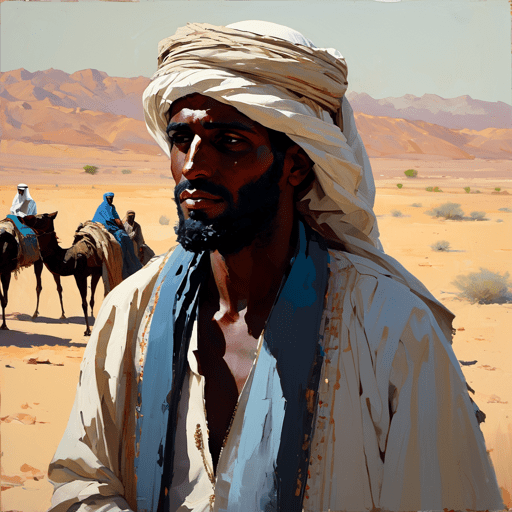
AI generated image from Hotpot

As for Kemetian’s prejudice against Arabs, it is indicative of many in the so-called conscious community. They match a contemporary post-9/11 image of Arabs with their misreadings of history. The truth is that the Arab identity is much like the Latin identity, in which people of different races, ethnicities and geographies are connected through a common cultural-linguistic identity. Ignorant Blacks who only know the racial constructs of the United States often do not understand this fact and constantly try to force others into their own racial paradigm. Furthermore, these so called conscious folk have no sense of the religious, ethnic, and linguistic diversity in the Arab world, which consists of Nubians, Copts, Berbers, Kurds, Armenians, and Chaldeans to name a few. All Black Americans can see is black and white.

Additionally, there is nothing inherently wrong with being Arab no more than there is anything wrong with being African. Anyone who has ever lived in or visited regular people in the Arab world would know that the vast majority of them exhibit manners that the average American can only dream about. They are very hospitable, generous, and genuinely friendly. Perhaps the marketplace, in traffic, or politics are not the best places to witness these good manners, but they are there. They are not without their prejudices, but their prejudices are commonly directed at other Arabs, Jews, and SubSaharan Africans. Yet when Arabs are confronted about their prejudices, they usually back down.

Much of the Muslim world might hold Arabness in some esteem because of their love for the Prophet Muhammad and his family, who were Arabs. That aside, the Muslim world has not been dominated by Arabs since the Umayyad dynasty. it must be noted that only 20% of the Muslim world is Arab. The majority of the world’s Muslims are in Asia and their scholars have had a great influence on the Muslim world for centuries. Why aren’t the pseudo-Muslims decrying an Asian Islam?

The erroneous idea that Arabs run everything in Islam just like Europeans run Christianity is a false analogy and just plain wrong. For instance, black and white orientalists talk about an Arab slave trade, but never a European slave trade. They think that because Arabs were involved, they must have run it. Ignoring the fact that slave trading has always existed in the region and involved Arabs, Africans, Persians, Indians, Turks, and more. Moreover, the enslaved were not only black, but from these various races as well. This does not excuse any atrocities committed by Arabs or other people. It only serves to disrupt the narrative that so-called white Moors (i.e., Arabs) enslaved black Moors. Dark skin people are not the perennial victims of history.

The charge from Moors, NOI, Nuwaupians, Afrocentrics, and other so-called conscious groups that orthodox Muslims follow an “Arabized Islam” is baseless, which exposes their lack of knowledge and bigotry. It is simply a flimsy argument they use to keep from discussing Islam on its own terms. If anything, orthodox Islam reflects intergenerational, interethnic, intercivilizational, and international networks of knowledge that is not rivaled by any religious system today. In the next part of this series, I will address some of the specific fallacies Neo-Sabians fall into when approaching Islamic concepts, which cause them to completely misunderstand the religion.

Islam and the Ancient Mystery Schools Part 12

I would like to return to my original thesis that was sparked by George G.M. James’ Stolen Legacy several years ago (see Islam and the Ancient Mysteries Part 1and Part 2). Although this thesis has undergone modifications since I began my research, the premise has remained the same. In the midst of this series I have found that the word Ṣābi’a is the general term in Arabic for the Ancient Mystery Schools, while theorizing that other terms such as Naṣārā and Chaldean refer to the leaders of temporal and geographic Mystery Schools. In the following post, I will summarize my theory and trace the genealogy of Sabian/Mystery School thought to this day.

Islam and the Revival of the Ancient Mysteries

The Sabians mentioned throughout classical Arabic literature are what the Greeks called the Mysteries. Like the Jews and Christians before them, the Muslims wrestled with the perceived harms and benefits of Sabian thought. On the one hand, the scriptures of the Abrahamic traditions were deeply critical of the theological distortions in Sabian doctrine. Abrahamic doctrines and rituals were in response to the beliefs and practices of the Sabians, which opened up the gates of polytheism among the unlearned laymen. On the other hand, the Sabians had benefited the world by their advances in other areas of human knowledge. The Abbasid Caliphate, like Eastern Christianity, came to terms with the knowledge produced by the Sabians. However, the Muslims strived not to take the road of the Christians, whose doctrine ultimately succumbed to the philosophical influences of the Sabians.

What we witness from the 9th to 11th century in the Islamic world with the codification of both traditional religious knowledge as well as the translation of ancient empirical and occult texts, is a race to retain knowledge of the Prophet Muhammad, while also reviving the knowledge of the Sabians (i.e. the Mystery Schools). The Islamic empire and its scholars sought to uphold the Abrahamic doctrine in the face of Sabian doctrine by calling people to Islam and granting protection (i.e. dhimmi status) to the People of the Book, i.e. Jews and Christians. At the same time, they were vehemently opposed to the polytheistic elements of Sabian thought.

As such, the Muslims had revived the Mystery Schools under the Abrahamic creed of Islam. This, however, was not without its conflicts. As certain groups of Muslims had the tendency to slip back into the beliefs of the Sabians, such as:

  • The Khawārij, who embraced the Stoic (Mystery School) concept of perfection and sinlessness as a sign of righteousness.
  • The Muʿtazilites would later stress the primacy of reason over revelation, which placed the philosopher sage on level with and sometimes over the prophets and rekindle the notion that human beings attain prophethood through their own efforts and merits rather than the grace and ordinance of God.
  • Al-Ghazālī’s criticism of the Muslim philosophers (primarily Ibn Sīnā) in his Incoherence of the Philosophers, identifies certain ancient beliefs held by these philosophers, which he believes led them to apostasy. This, while maintaining the utility of ancient Sabian empirical knowledge.
  • Ibn Rushd (Averroes) would later take issue with al-Ghazālī’s conclusions, claiming that the “craft of ḥikma” (wisdom/ancient knowledge) needed to be passed down like any other craft.

Ibn Rushd’s defense of Sabian philosophy would be rejected or ignored by the greater Muslim world, but the means by which Sabian knowledge would gain interest and popularity in Western Europe.

Modern Day Mysteries

In the last few centuries, Western civilization has become the battleground between Abrahamic and Sabian thought since the so-called European Renaissance. As such, Renè Guenon considered the beginning of the West’s decline to be Renè Descartes’ hyper-skepticism. Even as the West was philosophizing itself out of the Abrahamic tradition, it was making a dash for Eastern empirical and esoteric knowledge, which they harbored in their secret societies. This would lead to the separation of religion from science, politics, sociology, and the many other sciences needed for human civilization.

In the 20th century, Western philosophy and esotericism trickled down to the populace by way of clandestine organizations, theosophy, and counterculture movements. In no place were these ideas more prevalent than in the United States. As a result, we witness Sabian thought proliferate in the society everyday. More specifically, Sabian thought has entered African American communities through such groups as the Moorish Science Temple, the Nation of Islam, the Five Percenters, Nuwaubians, and Afrocentrists. All of these groups have explicitly or implicitly embraced the erroneous notion that they can reconstruct the Mystery Schools. I understand that this is a bold claim, but I will show the parallels between their theosophies and ancient Sabian thought. I will argue that they based their movements on incomplete knowledge of the ancient Mysteries because they did not received their knowledge through an unbroken chain of living teachers. This knowledge of the Mysteries/Sabians has been filtered by the Abrahamic faiths, primarily Islam in the current day, and cannot be accessed except through these traditional channels.

Trajectories of Western Islam Part I: Traditionalism

Generally speaking, two trajectories of Islam have influenced the masses of Western Muslims in the last century: Traditionalism and Spiritualism. By Western Muslim, I mean those whose backgrounds are not immediately from the Muslim world. For those of us who learned about Islam in the 20th century we know how deeply one or both of these currents have shaped our view of Islam, even if it has not been articulated in the way that I will discuss in the next few posts.

Islam & Traditionalism

While we commonly think of Islam’s contentious relationship with the West, Islamic influence has been penetrating Europe since the Middle Ages. Muslim dominance in Andalusia and the spread of Islam in Eastern European lands such as Turkey, Greece, and the Balkans are examples of this penetration going back several centuries. Though it is well documented that Muslim influence is what brought Europe physically out of its Dark Ages, less is known about Islam’s spiritual influences. [1]

We can say that overt displays of Islamic influence was taboo in Europe following the Spanish Inquisition and during the Crusades. However, Islamic spiritual influence began to emerge as Europeans conquered Muslim lands. The first handful of known European converts to Islam appeared in the 16th and 17th centuries. However, it was not until the early 20th century that we saw an actual movement of European conversions to Islam under the banner of Traditionalism. This was due to the direct and indirect influence of Rene Guenon.

Traditionalism, in Guenon’s conception, required an initiation into an established religious tradition with an unbroken chain to the source. For those Europeans who were influenced by his writings and had direct meetings or correspondences with him like Frithjof Schuon, Jean Reyor (Marcel Clavelle), Titus Burckhardt, Martin Lings, etc. he encouraged to embrace Islam and join a Sufi order. While many followed through with this conversion, they often considered their practice as a means to sophia perennis (perennial wisdom).

Though Guenon was credited with the founding of Traditionalism, it was really Schuon on those that followed him that took the concept in the direction of what we now know as Perennialism. Schuon and the early Traditionalists embraced Islam and joined the order of the Algerian shaykh, Ahmad al-‘Alawi, primarily because he was based in France and spoke French. After the shaykh’s death, Schuon quickly rose through the ranks and became the shaykh of the order. As explained by Mark Sedgwick, this was because of his visions and an ambiguous ijaza he received from al-‘Alawi’s immediate successor.[2]

As shaykh, Schuon began to take on unorthodox beliefs and practices. Some particularly alarming examples of these were:

  • his enduring infatuation for his former girlfriend named Madeleine, which he brought into the beliefs of the order saying, “Whoever does not love Madeleine is not of the order!”[3]
  • his attachment to religious artifacts like a Sanskrit copy of the Baghavad Gita and a statuette of the Virgin Mary.[4]
  • his tendency to make major decisions based on his own interpretations of visions he had, such as a trance that overtook him the day of Shaykh al-‘Alawi’s death, his waking up with certainty that he had become the shaykh, and his vision of the (naked) Virgin Mary, which caused him to change the name of the order to the Maryamiyya.[5]
  • his habit of walking around naked and painting pictures of the Virgin Mary in the nude.[6]
  • his “verticle marriage” to a woman already married to one of his followers.[7]

Needless to say, the Islam in his sufi order did not last and he and many of his followers ended up taking other spiritual paths. However, what became of Traditionalism under Schuon would foreshadow or parallel much of what we hear about “goofy sufis” in the U.S.

The Faults of Traditionalism

The faults of Traditionalism in the European context was due to two main factors: 1) secrecy and 2) lack of knowledge:

Secrecy

Mark Sedgwick gives a few reasons for the Traditionalists’ use of secrecy: 1) “Secrecy is a part of the Western or occultist conception of initiation,” 2) to avoid the hostilities of “unsuspected… powers,” 3) Islam was a temporary step towards a greater goal, 4) people feared scorn from the society and losing their livelihoods if they lived openly as Muslims, and 5) there was no Islamic infrastructure (mosques, schools, etc.) in most European societies in those times.[8]

The first three reasons, secrecy and insulation, is what allowed for abuses and distortions. First, their understanding of initiation, or lack thereof, implied secrecy, whereas a careful reading of Guenon’s writings would reveal that initiation implied a serious commitment to a religious tradition that entailed taking spiritual instruction by a learned person in that tradition.

Secondly, Guenon’s attack on Theosophists and occultists, as well as his soured relationship with the Catholic Church, was perhaps necessary or inevitable, but it stirred much animosity in European circles of religious thought. The solution was to create the insulated communities thought sought to preserve and protect their beliefs from people that could challenge or potentially obstruct their movements.

Finally, because their initiation into Islam was seen as temporary, there was no need to be consistent with their beliefs or practices. It was open to change depending on the time and circumstances.

Lack of Knowledge

The temporary nature of the Islamic initiation also reflected their lack of knowledge of the tradition. The shaykh (or master of any other tradition for that matter) spent his whole life learning, practicing, and mastering the tradition in order to remain steadfast on it and teach it to others. The notion that one can ascend to that level by simply having visions should be cause for alarm. Furthermore, moving on to another path would place them at square one of another tradition, which would take another lifetime to master, remain steadfast upon, and teach others.

As for the fact that they would have received scorn and lost their livelihoods is a serious concern, which turned out to not be true. Von Meyenburg, a follower of Schuon, was discovered to be a Muslim by his Swiss employers and they did nothing.[9] Such a revelation could have been grounds for making their presence known in the society and gaining acceptance if that was a concern. Likewise, they could have built the infrastructure they wanted had that been a concern.

Perhaps, one justification was that they were not soundly educated in the tradition of Islam. It should be remembered that resources by which one could become educated on non-European religions was quite scarce in those times. Even if there were resources about such religions they often did not give much insight into how one might use them for devotional purposes. The problem of translating an ancient tradition into modern European languages is one that exists to this day. The only solutions were to travel to the East, learn the language(s) and learn the traditions from spiritual masters in those lands or attach oneself to a master or a student of a master in one’s homeland and learn directly from him. Such a theme will re-emerge later when I discuss contemporary Traditionalism in the U.S.

In the next post, I will discuss the second trajectory of Western Islam, Spiritualism, particularly among 20th century groups in the U.S.

References

[1] See W. Montgomery Watt, The Influence of Islam on Medieval Europe, Islamic Surveys 9 (Edinburgh: Edinburgh University Press, 2001).

[2] Mark J. Sedgwick, Against the Modern World: Traditionalism and the Secret Intellectual History of the Twentieth Century (Oxford ; New York: Oxford University Press, 2004), 88-93.

[3] Ibid., 91.

[4] Ibid., 92-3.

[5] Ibid., 88, 92, 149, and 151.

[6] Ibid., 150-1.

[7] Ibid., 152.

[8] Ibid., 91-2.

[9] Ibid., 92.

Rene Guenon vs. the Modern Mystery Schools

I am convinced that no discussion of the Ancient Mystery Schools is complete without discussing the works of the French philosopher and purported founder of the Traditionalist school, Rene Guenon, also known as Abdul Wahid Yahya.

Rene Guenon

He grew up as a Catholic and later became immersed in the growing European occultist scene, joining the Freemasons, and what became known as the Theosophical Society. He was one of the major French commentators on metaphysics and the occult even though he did not complete his academic studies. He would later study a variety of Eastern religions like Taoism, Hinduism, folklore and other mystic traditions, writing extensively on them for European audiences.

Guenon came to oppose the European trends towards occultism, masonry, and theosophy, dismissing them as pseudo-religions and symptoms of a crisis in the modern European world. In doing so, he touches on a key point worthy of discussion. How was it that the ancient mysteries became associated with such trends?

It was exactly these modern European groups that co-opted the notion of “the Ancient Mysteries,” misconstrued the ideas of the Eastern spiritual paths, and attempted to separate spirituality from religion. Guenon rightfully opposed these trends from the perspective of a European who had once been intimately intertwined with such groups and had come to study Eastern religions from their sources in the East. He was also privy to the intellectual fallacies and personal flaws of those in this movement, whose leaders were often charlatans.

The Modern Mysteries

The Ancient Mystery Schools are not the same as the Modern Mystery Schools. The Ancient Mysteries, as we have elucidated before, was how humans maintained the revelations of the early prophets. In the Qur’an it is simply referred to as islam or the path of the Hanifs. Yet, Modern Mystery Schools tend to be hodgepodges of different religions or progenitors of supposedly new doctrines. Some of them lean towards mystical elements while others focus only on a material reality.

The difference between true systems of spiritual knowledge and counterfeit systems is their ability to achieve a balance between the inner and the outer dimensions of human experience. Societies worldwide were based on the true systems, because their origins were from the Creator of human beings, its teachings maintained by the most knowledgeable and sincere in society. As such, they were wholistic enough for people to base their entire lives around them

In contrast, the counterfeit systems of modern times are responsible for the corruption of true systems of spiritual knowledge and the degeneration of societies, as they tend to promote the will of the individual over all things, devalue religious meritocracy by casting doubt on traditional institutions, and foster confusion and dissent among unsuspecting believers.

Contribution of Rene Guenon

Though the Modern Mysteries had been gaining traction for a number of centuries prior, Rene Guenon was able to spot its influence at a critical junction in human history. In his book, Theosophy: History of a Pseudo-Religion, he tells of Helen Blavatsky’s establishment of the Theosophical Society in the United States and her consequent introduction of a new international wave of occultism to the Western Hemisphere.

In this critical biography of the life and works of Madame Blavatsky, he establishes the archetype of the Modern Mystery leader. They often have a checkered history of crime and deception. Many American cult leaders followed in her footsteps, not the least of which have found their way into African American communities, as noted by Wudjau Iry-Maat.

Rene Guenon did a huge service by giving us a formula to unravel such cults:

  • Scrutinizing their biographies and exposing lies, inconsistencies, and destructive behavior. This allows us to limit the cult leader’s sphere of influence among decent people.
  • Understanding the ideological lineages and using clear logical language to deconstruct and challenge their philosophies. This allows for the long-term resistance to these organizations and their ilk.

Rene Guenon spent the last twenty years of his life in Cairo, Egypt, where he embraced Islam and joined the Shadhili sufi tariqa. According to various sources, he spent his time in spiritual reflection and publishing works that expounded on his ideas and combated the growing influence of the Modern Mystery Schools.